
You're probably here because you picked up a jar of jam, a loaf of bread, or a bag of crackers labeled “artisan” and had the same reaction most of us have.
What does that mean?
Sometimes the word points to food made with real care. Sometimes it's just packaging doing a lot of work. That's why this question matters. When you search what is artisan food, you usually aren't looking for a dictionary definition. You're trying to figure out whether the food in front of you is better than the mass-produced version beside it.
That's the useful question. Not “Is this label fancy enough?” but “Will this taste better, use better ingredients, and come from someone who stands behind it?”
Table of Contents
- The 'Artisan' Question You Are Really Asking
- What Does the Term Artisan Food Actually Mean
- What changes when a real person makes the food
- A side by side look
The 'Artisan' Question You Are Really Asking
The word “artisan” gets used because it sounds warm, handmade, and a little more special than the usual shelf-stable stuff. But the label itself isn't the prize. The prize is finding food that feels more honest when you eat it.
That usually means a few things. Better flavor. A shorter, easier-to-understand ingredient list. More care in how the product is made. A stronger sense that a real person made decisions about this food, instead of a committee trying to make it as cheap and uniform as possible.
That's also where people get confused. They assume “artisan” automatically means healthier, local, or made by hand from start to finish. Sometimes that's true. Sometimes it isn't. A product can look rustic and still be mostly marketing.
The label can start your search, but it shouldn't finish it.
I prefer food from local makers and independent brands because the difference is often obvious once you start paying attention. Bread has more character. Sauces taste like someone adjusted the recipe until it was right. Snacks don't all flatten into the same sweet-salty blur. You also get context. You can learn who made it, what they care about, and why the product tastes the way it does.
So if you came here asking what is artisan food, the most useful answer is this. It's food people associate with craft, smaller-scale production, and more direct connection to the maker. But if you want the best version of that idea, think less about the buzzword and more about food from independent makers. That's where a genuine quality upgrade usually lives.
What Does the Term Artisan Food Actually Mean
You see a loaf wrapped in plain paper at a weekend market and another in a glossy plastic bag at the supermarket. Both promise quality. Only one gives you a real sense of how it was made, what went into it, and who decided it was ready to sell.
That gap is the heart of the term "artisan food."
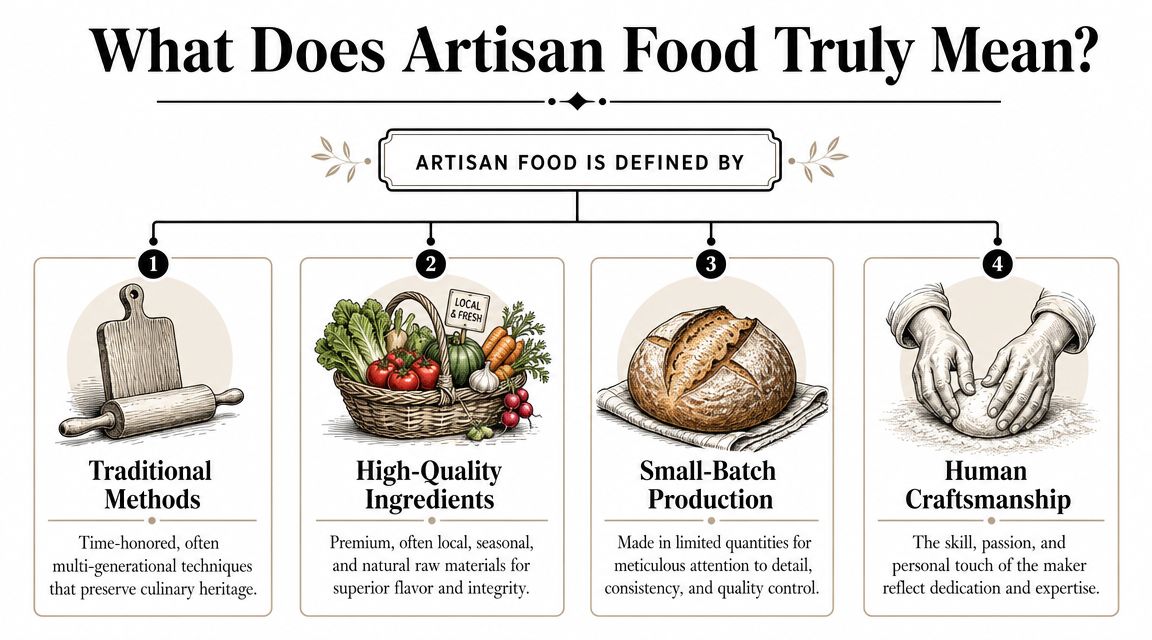
The tricky part is that "artisan" is not a tightly protected everyday label in the way people often assume. It works more like shorthand. People use it to signal food made with human judgment, smaller production runs, stronger ingredient standards, and a visible maker behind the product.
A simple way to read it is to ask four practical questions.
Was skill involved?
Someone made choices that affect the final taste, texture, or finish. A baker adjusts fermentation by feel. A jam maker stops the batch when the fruit still tastes like itself. That kind of judgment is hard to fake.
Was it made on a scale where quality can still be noticed?
Smaller production does not guarantee greatness, but it gives the maker a better chance to catch problems and refine the result. It works like cooking for eight people instead of eight thousand. You can pay attention to details that would disappear on an industrial line.
Do the ingredients sound chosen, not merely sourced?
The label either starts to mean something or falls apart in this regard. Better food usually gives you specifics. What flour? What fat? What sweetener? What nuts, fruit, herbs, or spices? Vague language often hides average ingredients behind rustic branding.
Can you trace it back to actual people?
If you can learn who made it, why they chose a method, or how they want the food to taste, you are much closer to what shoppers usually mean by artisan. That direct line matters because it replaces buzzwords with accountability.
If you ever need a gift for someone who lights up over this kind of food, guides like creative presents for foodies can help you think beyond generic gift baskets and toward products with a real point of view.
A commonly cited working definition narrows the idea further. This overview of artisanal food summarizes an artisan food producer as one making less than $500,000 annually and selling more than 50% direct to consumers within the same state and within a 400-mile radius. That standard is not the final word, but it helps explain why people often connect the term with both craft and proximity.
That said, readers are usually asking a more practical question. Will this food be better?
Often, yes, if the word points you toward independent makers who care about ingredients and flavor enough to make distinct choices. A product such as Pistachio Shortbread Cookie Mix, Almond Flour & Pistachios, Sugar-Free Keto Low Carb, 2g Net Carbs, 16 Cookies, 11 oz Bag | ROSETTE'S by Loyaltie at $12.50 gives you something more useful than the word artisan ever could. It tells you what is in the bag, almond flour and pistachios, and what kind of eating experience it is built for.
That is the better frame for this whole topic. "Artisan" can be a starting clue, but food from independent makers is the primary objective. The term matters less than whether the product shows its work.
Practical rule: If a product uses the word “artisan” but tells you nothing about ingredients, process, or the people behind it, treat the claim as incomplete.
Independent Makers vs Mass Production
You don't need a lecture to spot the difference once you know what to compare. The best test is simple. Look at what each kind of product is designed to do.
Food from independent makers is usually built around taste, character, and a clear point of view. Mass-produced food is usually built around consistency, scale, long shelf life, and broad appeal. That doesn't make every big-brand product bad. It just means the priorities are different.
What changes when a real person makes the food
A maker can decide the peach jam should taste more tart this season because the fruit came in especially sweet. A large production system usually wants the jar to taste exactly like last quarter's jar.
A maker might tell you where the olive oil came from, why they chose a certain flour, or why they kept a recipe simple. A mass brand often gives you a polished brand story without much detail underneath it.
If you want a concrete product category to study, it helps to explore fine artisan olive oil and notice how people talk about harvest, flavor, and origin when quality is the main point.
A side by side look
| Attribute | Food from Independent Makers | Mass-Produced Food |
|---|---|---|
| Ingredient choices | Often more specific and easier to understand | Often optimized for scale, cost control, and shelf life |
| Production style | Smaller runs with hands-on oversight | High-volume systems built for uniform output |
| Flavor | More distinct, sometimes seasonal or batch-specific | Standardized to taste the same every time |
| Transparency | You can often learn who made it and how | The maker is usually hidden behind a large brand identity |
| Texture and appearance | Natural variation is common | Visual uniformity is usually the goal |
| Shopping experience | More direct connection, often no middleman | Multiple retail layers between you and the producer |
That table explains why buying directly can feel so different. You aren't just switching brands. You're switching priorities.
When food keeps a little personality, that's often a sign that someone chose quality over strict uniformity.
There's also an emotional difference. Food from independent makers feels more memorable. You remember the hot sauce with real depth, the cracker with actual grain flavor, the caramels that tasted like browned butter instead of just sugar. Mass products can be fine. But “fine” isn't the same as satisfying.
The Real Benefits of Buying Directly from Makers
The biggest benefit is simple. Your food can get more interesting.
When you buy directly from makers, you often get products with stronger flavor, better texture, and a clearer ingredient story. You're closer to the source, so there's less mystery and less generic branding between you and what you're eating.
Why your everyday food can feel better
This matters most with the foods you buy all the time. Bread, snacks, sauces, coffee, sweets, pantry basics. When those products come from people who care about the actual eating experience, the upgrade shows up in small daily moments.
You may notice:
- More flavor: Products don't have to appeal to the broadest possible audience, so they can taste bolder and more distinctive.
- Better transparency: You can often see the ingredient logic and understand why the product was made that way.
- Less sameness: Independent brands tend to make food that reflects a recipe, region, or personal style instead of chasing the safest average.
- More trust: When you know who made something, it's easier to decide whether it fits your standards.
A lot of shoppers also like the direct model because it cuts out extra layers. If you want a plain-English look at that buying model, this explanation of direct-to-consumer is useful.
Why more shoppers started caring
This shift has been building for a while. In 2018, specialty food sales in the United States hit over USD 140 billion, growing 9.8% in two years, and over 80% of Millennials were purchasing artisan food, according to an industry source summarized by Ignite2X. That tells you the appetite for more authentic, quality-driven food didn't stay on the fringe.
People didn't move in that direction because they wanted a trend badge. They moved because a lot of big retail food became too predictable. Once you've had a cracker made with intention or a sauce with actual depth, it's hard to get excited about the flattened version.
How to Find and Verify Great Food
You are standing in front of two jars of pasta sauce. Both use earthy colors. Both mention tradition. Both look like they belong in a farmhouse pantry. One tastes flat and sugary. The other tastes like tomatoes, olive oil, and someone cared enough to stop before adding junk. That is the core shopping problem people are trying to solve.
The word "artisan" does not solve it for you. Evidence does.
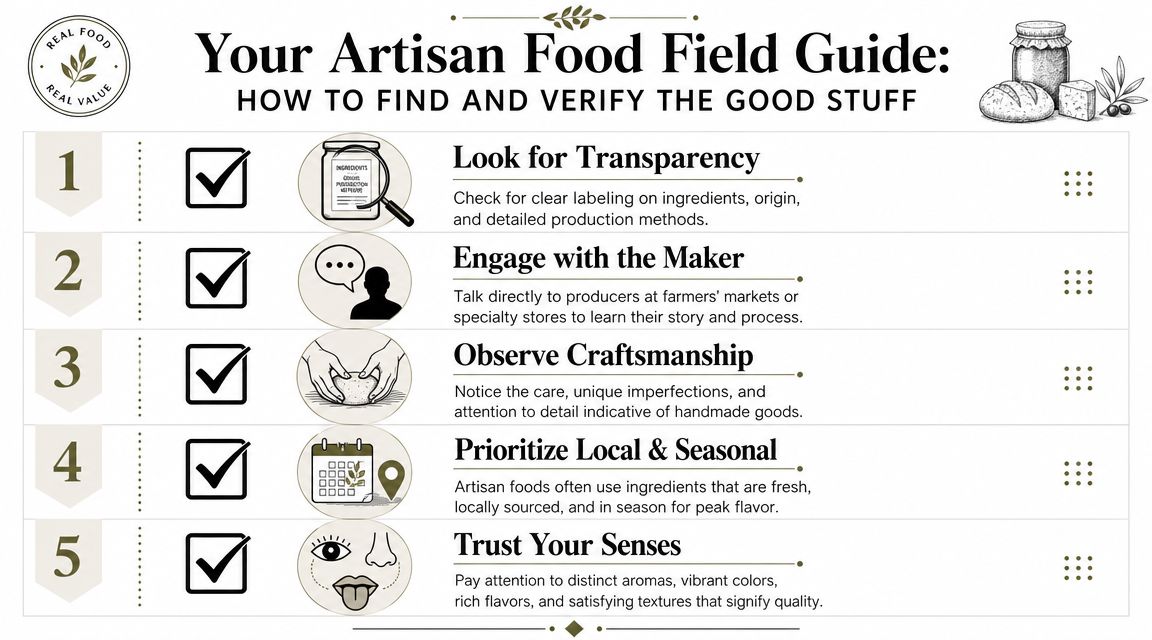
A simple field guide
Start with the package as your first clue, not your final answer. A good label works like the ingredient list on a recipe card. It should help you understand what the maker used, what they did, and why the product will taste the way it does.
Here are the signs worth checking:
- Ingredient clarity: Can you recognize the ingredients without translating vague filler terms?
- Process detail: Does the maker explain how it is made, such as fermented, stone-ground, slow-cooked, or baked in small runs?
- Maker visibility: Can you identify the person, team, or business behind it?
- Specificity: Details about origin, season, variety, or sourcing usually tell you more than rustic design cues.
- Practical fit: If you are buying online, does the seller explain freshness, storage, and delivery clearly?
If you bake at home, product education can sharpen your judgment fast. A focused guide on tools like DBakerAid™ proofing baskets shows how process changes texture, structure, and final flavor in bread. That same kind of specificity is what you want food makers to show you.
Don't ask, “Does this sound handcrafted?” Ask, “What proof did the maker give me?”
It also helps to watch food with a critical eye. This short video is a good prompt for thinking about process and quality while you shop.
What to question before you buy
One common mistake is treating "artisan" like a guarantee. It is not a guarantee of health, local sourcing, or environmental standards. The Food Literacy Center's note on artisanal food makes that clear. You still need to check what is in the product and whether the maker explains their claims.
That is good news for shoppers, because it puts your attention on the part that matters. Better food usually leaves a trail of specifics.
Ask a few simple questions:
- Who made this? A real maker should be easy to identify.
- What ingredients do the work? Good food usually sounds like food, not a chemistry set.
- What method shaped the result? Specific processes often explain taste and texture better than branding ever will.
- Which claims need support? Words like “natural,” “local,” and “sustainable” mean more when the maker explains them.
- How will it ship and store? Great food can still arrive in bad condition. This guide on how to ship perishable food is a useful reference for what careful fulfillment looks like.
The goal is simple. Stop buying the label alone. Start buying food from independent makers who show their work.
A Quick Guide for Independent Food Makers
A shopper picks up your jar, loaf, or sauce and asks a simple question. Why should this earn a spot in my kitchen instead of the cheaper version beside it?
That is the decision your packaging, product page, and photos need to answer.
People are not hunting for the word "artisan" by itself. They are looking for signs of a better bite, better ingredients, and a maker they can trust. If you sell independently, that is your advantage. You can show your work in ways a large brand usually cannot.
What buyers want to see from you
Start with the details that remove doubt and make quality feel concrete.
- Name ingredients in plain language: Specific ingredients signal care. "Single-origin cocoa" says more than "premium chocolate flavor."
- Describe your process without drama: Fermented for three days, stone-milled, small-batch baked, hand-cut. Clear methods help buyers understand texture and taste.
- Put a real person or team in view: A face, a name, and a location make your food feel accountable.
- Explain why your choices matter: Tell buyers what changes because you use this flour, this fruit variety, this aging time, or this farm relationship.
- Make the next purchase easy: Great food loses momentum if reordering feels confusing or slow.
A good maker page works like a farmers market conversation. The buyer should come away knowing what the product is, why it tastes the way it does, and who stands behind it.
Trust grows from that kind of specificity. If you want a practical framework, this guide on how to build customer trust explains the habits that help buyers feel comfortable ordering again.
Demand for crafted food categories is strong when the product delivers and the explanation feels honest. That does not mean every independent maker should wrap themselves in romantic language. It means clear proof beats buzzwords. Show the ingredients. Show the method. Show the person. The quality story gets easier to believe when buyers can see where it comes from.
If you want to skip the guesswork and discover food from real makers more directly, Loyaltie is a practical place to start. It is built for shoppers who want better everyday products from independent brands in the US, with direct ordering and clear brand information on each purchase.