You're standing in the meat aisle with three packages in front of you. One says “grass-fed,” another says “pasture-raised,” and a third carries an organic seal. They all look reassuring, but the labels don't tell you the same story. If you're searching for where to buy grass fed beef, the key question isn't only which store has it. It's which seller can prove how the cattle were raised.
The most reliable route is to buy from an independent local brand, farm, butcher, or verified online producer that can answer direct questions about feed, finishing, certification, and handling. You'll get a clearer product story, better traceability, and often a more useful relationship than you will from a package that relies on broad marketing language.
Table of Contents
Why Finding Real Grass-Fed Beef Is Harder Than It Looks
A shopper can pick up a steak labeled “grass-fed” and reasonably assume the animal ate grass throughout its life. That assumption may be wrong. Some products use the phrase without making it clear whether the cattle were grass-finished, whether grain was introduced later, or whether an independent organization reviewed the claim.
The confusion starts with the structure of the market. In the United States, grass-fed beef has been estimated at about 4% of total beef retail and food-service sales, worth roughly $4 billion, according to the USDA Agricultural Marketing Service market analysis. Around $3 billion of that estimate represents unlabeled grass-fed product moving through the conventional beef supply chain, while only about 1% of the total beef market, or roughly $1 billion, is labeled, handled, and marketed explicitly as grass-fed in that analysis.
That split explains why shopping can feel inconsistent. You may find one producer at a farmers market, another through a regional butcher, and a third through an online meat seller. There isn't one standardized grass-fed aisle with identical sourcing rules.
Why independent sellers often offer better answers
A local producer who sells directly can usually explain the raising protocol in plain language. You can ask whether cattle were ever grain-finished, how the producer documents the feed program, and which processor handles the beef. A direct relationship doesn't automatically guarantee quality, but it gives you a practical way to test the claim.
That's the quality upgrade independent brands and local makers offer. You're not buying from them because they need charity. You're buying because real people are closer to the product, and they're more likely to show you how it was made.
Practical rule: If the seller can't explain the feed protocol without changing the subject, keep looking.
This also applies to national online sellers. A producer doesn't have to be located nearby to be trustworthy. The important distinction is whether the company publishes specific raising standards, identifies certification or documentation, and separates its claimed product from conventional supply.
Decoding Grass-Fed Labels and Certifications
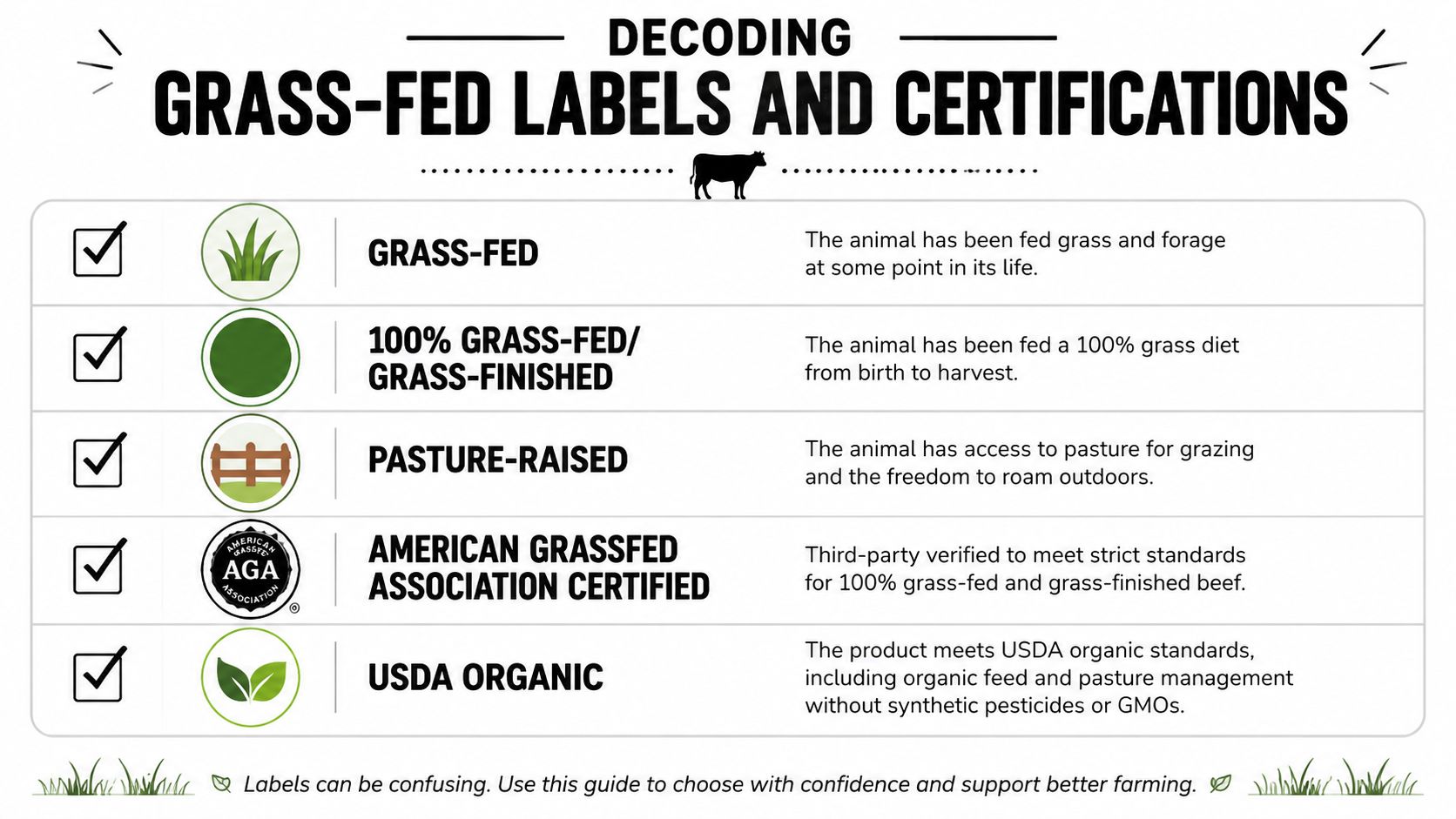
The label matters, but the wording matters more than the pastoral photograph or green packaging. Start by separating a basic diet claim from a claim that describes the animal's entire finishing program.
“100% grass-fed” or “grass-fed and finished” is the clearest signal for shoppers who want cattle raised without grain. USDA-aligned guidance says the animal must consume only forage from after weaning through harvest, with no grain or grain byproducts, and must have continuous pasture access during the growing season. The University of California Agriculture and Natural Resources label guidance recommends looking for a documented claim or certification rather than trusting the phrase by itself.
The wording that deserves caution
A plain “grass-fed” claim can be less informative. It may describe forage consumption without making the finishing period clear. “Pasture-raised” describes access or management language, but it doesn't necessarily tell you whether the animal ate grain. “Grass-finished” is useful when the producer defines it precisely, yet consumer guidance warns that terms such as “pastured” and “grass-finished” can be used inconsistently and may not always exclude grain.
Organic is separate. USDA Organic addresses the organic production system, not automatically a forage-only diet. Organic cattle may receive organic grain, so an organic seal alone doesn't answer the grass-fed question.
USDA marketing rules for grass-fed beef were rescinded in 2016, which means the term is no longer governed by one federal marketing standard. Producers can use private standards, making exact language and third-party verification especially important, as explained by the National Sustainable Agriculture Coalition.
The three questions every seller should answer
Ask these questions before ordering:
- What did the cattle eat from weaning to harvest? Look for a clear answer that excludes grain and grain byproducts if that's your requirement.
- Were any animals grain-finished? A direct “yes” or “no” is more useful than a general statement about pasture access.
- Who verifies the claim, and what documentation exists? Ask for the certification body, raising protocol, or audit information.
Third-party standards commonly involve written protocols, segregation records, and certification files. The Niche Meat Processor Assistance Network's labeling guide explains why that paperwork acts as a quality-control filter. If the seller can't answer the three questions clearly, treat the claim as weaker than a verified 100% grass-fed product.
For a related use of the ingredient, Tallow Body Serum, Grass-Fed Beef Tallow & Organic Oils, Deep Hydration for Dry Skin, Lavender Rosemary Vanilla Lemongrass | Ojas Glow by Loyaltie is described as a tallow-based body serum made with grass-fed beef tallow and organic mango butter.
Comparing Where to Buy Grass Fed Beef
The best channel depends on what you need most. If traceability comes first, start with a direct farm or a butcher who knows the producer. If convenience matters more, choose an online seller that publishes its feed protocol and documentation instead of treating a polished website as proof.
| Channel | Traceability | Cut Selection | Price Range | Convenience |
|---|---|---|---|---|
| Local farms | Often strongest, especially when you can speak with the producer | Bulk shares may offer broad variety, but individual cuts can be limited | Varies by farm and order size | Lower at first, especially with pickup schedules |
| Farmers markets | Strong when the rancher is present and answers questions | Usually a rotating selection of available cuts | Varies by cut and producer | Convenient for nearby shoppers, but inventory changes |
| Independent butcher shops | Good if the shop identifies its suppliers and standards | Usually the best choice for custom cuts and cooking advice | Varies by sourcing and cut | High, with the advantage of in-person guidance |
| Grocery retailers | Mixed, depending on certification and documentation | Familiar cuts are usually easy to find | Varies by brand and package | Highest for routine shopping |
| Verified online marketplaces | Strong when producer information and raising protocols are published | Often broad, including specialty cuts and prepared products | Varies by seller, shipping, and cut | High, with delivery and easy reordering |
Local farms and farmers markets
Direct farm buying gives you the clearest path to the source. You can ask about grazing, finishing, processing, pickup, and bulk-share options in one conversation. The tradeoff is planning. Farms may sell by the whole, half, or quarter animal, and their harvest dates can determine when your beef is ready.
Farmers markets are better for starting small. You can try ground beef or one familiar steak, talk to the producer, and judge whether the answers feel specific. Don't assume every market vendor uses the same standard. Ask the same feed and finishing questions you'd ask online.
Butchers and grocery retailers
An independent butcher is useful when you care about cut selection, portioning, and preparation. Ask where the beef comes from and whether the shop can show the product's certification or producer documentation. A butcher who knows the farm can give you more practical information than a retail package can.
Grocery stores win on convenience, but they require more label discipline. Look for “100% grass-fed” or “grass-fed and finished,” then check for third-party certification or supporting information. Retail can work well, but only when the label survives scrutiny.
You may also encounter prepared beef products and charcuterie through online sellers, such as herbed Wagyu bresaola from Foris Meats. That's a different buying decision from sourcing fresh steaks, so check the product description and handling details separately.
How to Find Local Grass-Fed Beef Producers Near You
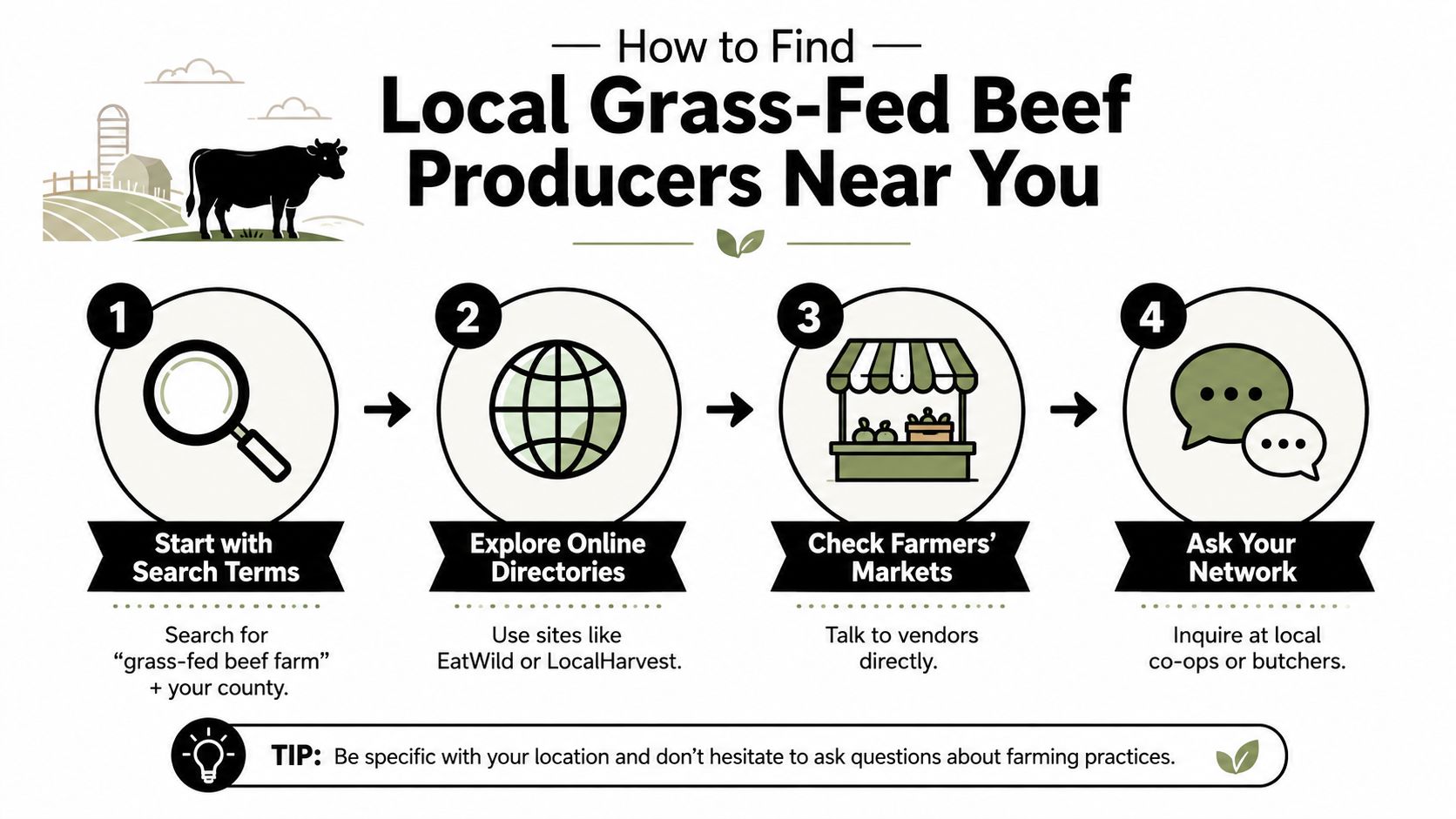
Start with search terms that combine the product, geography, and production method. Try “100% grass-fed beef farm” plus your county, “grass-finished beef near me”, “direct farm beef pickup”, or “bulk grass-fed beef” plus your state. Adding the county often surfaces producers who don't rank for broad city searches.
Use directories, then verify independently
Directories can help you build a shortlist. Search EatWild, LocalHarvest, regional food hubs, and state agriculture directories. The USDA Agricultural Marketing Service also tracks local and regional food channels using information from farmers markets, auctions, food hubs, direct-to-consumer sales, retail advertisements, and farm-to-school programs. Its local and regional food market resources can help you identify how independent producers sell in your area.
A directory listing is a lead, not a certification. Visit the producer's website or social pages and look for:
- Specific feed language: Does the farm say 100% grass-fed, grass-finished, or only grass-fed?
- Processing information: Does it identify the processor, packaging method, or pickup process?
- Direct contact: Can you email or call someone who can answer questions?
- Order clarity: Are cuts, shares, availability, and collection instructions explained plainly?
If you're also looking for simple ways to cook what you buy, this guide to home cooking near me with Just Cook can help connect local food shopping with practical meal preparation.
Ask people who handle food locally
A natural foods co-op, independent butcher, farmers market manager, or local chef may know producers who don't spend much on online advertising. Ask who supplies their beef and whether the farm sells directly. Local recommendations are valuable because they often reveal pickup arrangements and seasonal availability that search results miss.
You can also browse local independent food makers through Korean Samgyetang Ginseng Chicken Soup from Nourish Meal Delivery, especially if you're comparing direct-sourced meat with ready-to-eat local food options. Keep the verification standard consistent. Ask what the product contains, where it comes from, and how it was handled.
The best producers won't hide behind vague language. They'll tell you what they feed, how they finish, and where the beef is processed.
Smart Buying and Storage Strategies
Buying better beef doesn't require filling a freezer immediately. Start with an amount you can use comfortably, especially if you're testing a producer or learning which cuts your household cooks. A mixed order can be useful because it lets you compare ground beef, roasts, steaks, and stew cuts without committing to a large share.
Buy according to meals, not enthusiasm
Before placing a bulk order, review your normal cooking pattern. If you make burgers often, ask for more ground beef. If you cook slowly on weekends, roasts and stew meat may provide more value than a freezer full of steaks. Request cut customization when the farm offers it.
Compare sellers using the same basis. Check whether the quoted price includes processing, packaging, delivery, or pickup. A lower price per pound may not represent a better deal if it leaves you with cuts you won't use or adds unexpected handling costs.
Freeze with discipline
Vacuum sealing helps protect individual portions from air exposure and freezer burn. If the seller doesn't vacuum-seal, divide the meat into meal-sized portions, wrap it tightly, and place it in a clearly labeled freezer bag. Label every package with the cut and date so older portions get used first.
A chest freezer makes bulk buying more practical, but it only helps if you maintain an organized inventory. Keep a simple list on the freezer door or in your phone. Mark down steaks, ground beef, roasts, and specialty cuts as they go in and out.
Freezer habit: Package for the meal you'll cook, not the package size the seller happens to provide.
Thaw beef in the refrigerator rather than on the counter. Move the next meal's package from freezer to refrigerator early enough for it to thaw gradually, then cook it according to the cut. If you receive frozen beef by delivery, inspect the packaging promptly and follow the seller's handling instructions.
Bulk buying can reduce waste when it matches your routines. It can also waste money when you order more than your freezer, schedule, or cooking habits can handle.
Common Grass-Fed Beef Myths That Cost You Money
Myth one, “grass-fed” always means grass-finished. It doesn't. The American Grassfed Association consumer guide notes that shoppers seeking grain-free beef should look for “100% grass fed.” Some products marketed with grass-related language may still involve grain, especially when the label doesn't define the finishing program.
Myth two, organic automatically means grass-fed. Organic and grass-fed answer different questions. Organic describes the production system and approved inputs. It doesn't, by itself, prove that cattle ate forage exclusively.
Myth three, buying local always means better. Local can improve your access to the producer, but geography isn't verification. A nearby seller with vague labeling is a weaker choice than a distant producer with clear protocols, certification, and traceable handling.
Myth four, the most expensive package must be the most authentic. Price can reflect cut, shipping, packaging, processing, brand position, or scarcity. It doesn't replace documentation. Pay for a clear raising standard and cuts you'll cook, not for pastoral imagery.
Myth five, grass-fed beef has one universal taste and texture. Flavor depends on breed, age, fat level, cut, cooking method, and the producer's finishing practices. Choose a forgiving cut first, cook it appropriately, and assess the actual beef instead of relying on a blanket promise.
The same principle applies to related tallow products. For example, Whipped Grass-Fed Tallow Balm from BalmandBee is a separate skincare product, so its ingredient and use information should be evaluated independently from claims about fresh beef.
Your Action Plan for Buying Better Beef
You don't need to become a cattle expert. You need a repeatable filter that prevents vague labels from making the decision for you.
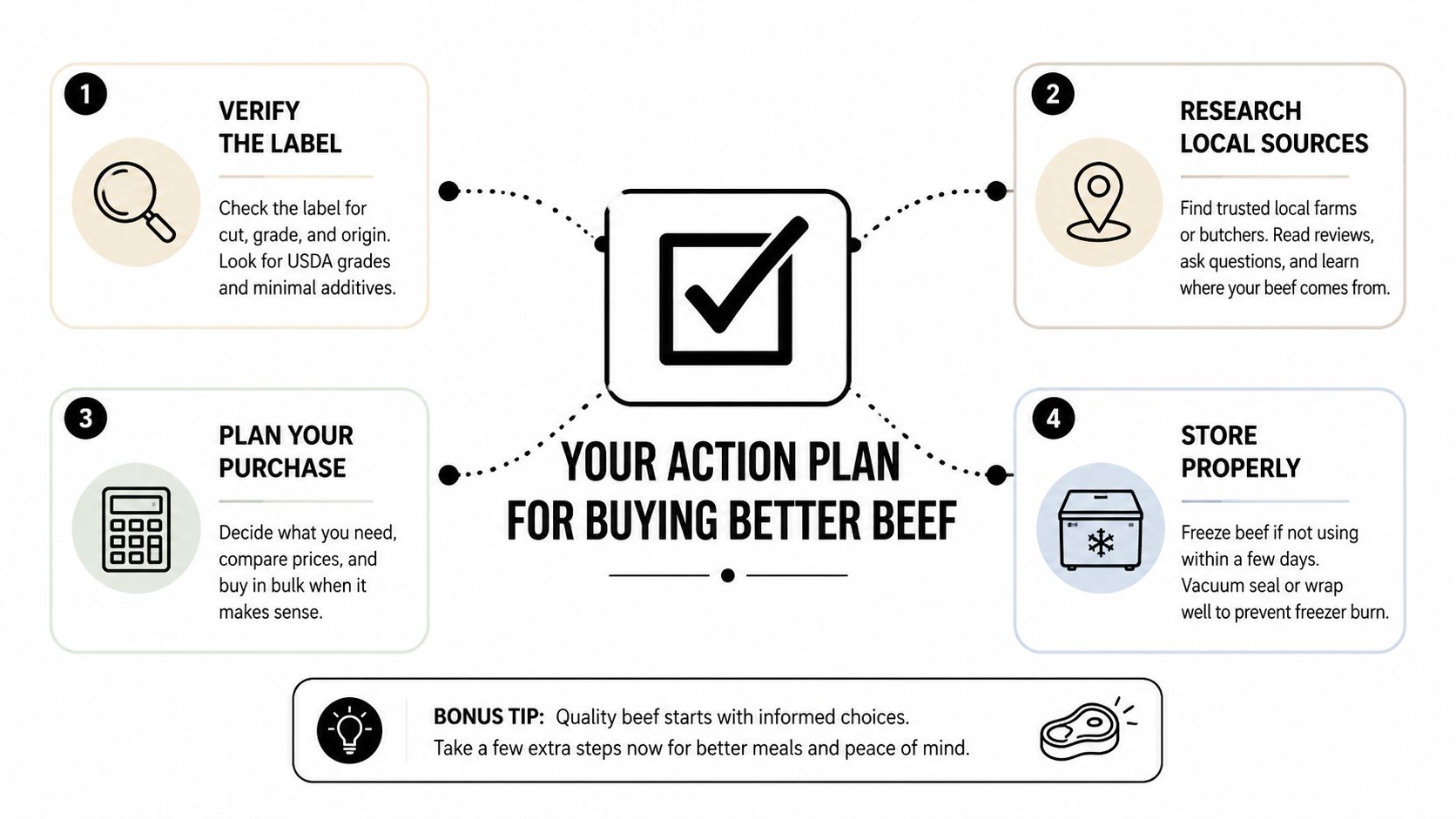
Start with the label
Look for 100% grass-fed or grass-fed and finished if you want cattle that remained on forage. Treat “grass-fed,” “pasture-raised,” and “organic” as incomplete answers until the seller defines them.
Build a local shortlist
Search by county and state, then check EatWild, LocalHarvest, farmers markets, food hubs, co-ops, and independent butcher shops. Contact several producers. The seller who answers clearly about feed, finishing, and documentation earns your attention.
Test before scaling up
Buy a manageable order first. Compare the cuts, packaging, freshness, cooking results, and communication. Once a producer proves reliable, consider bulk purchasing or a regular reorder that fits your freezer and meals.
Store what you buy properly
Divide meat into useful portions, seal it tightly, label the cut and date, and thaw it in the refrigerator. Good sourcing loses its value if poor storage leaves you with freezer-burned packages or cuts you forget to use.
Your decision rule: Choose the seller who gives you the clearest evidence, not the most attractive label.
The answer to where to buy grass fed beef is usually a channel decision followed by a verification decision. Local farms and markets offer personal access, but online producers and independent brands can work just as well when they disclose their standards. Start with one trustworthy source, ask direct questions, and let the quality of the answers determine whether you buy again.
Loyaltie is a marketplace where people discover and buy directly from independent brands across the US, including local food, wellness, skincare, and other everyday products. Visit Loyaltie to find makers and producers with clearer product information, then choose the direct-to-maker options that fit your standards and routine.