
Black cod fillets usually sell for about $24.99 to $29.95 per pound in major U.S. seafood markets, and some listings go higher depending on the cut and seller. If that price makes you pause, you're not overreacting. Black cod often causes sticker shock at the fish counter.
A lot of people see the label, compare it to regular cod in their head, and assume they're looking at an overpriced white fish. That's where the confusion starts. Black cod is one of those foods where the number on the tag only makes sense once you understand what you're buying.
If you're trying to figure out the price of black cod, what affects it, and whether it's worth bringing home, it helps to stop thinking in one flat price. This fish gets priced differently depending on whether you're buying whole fish, fillets, portions, frozen packs, or a bulk box. The place you buy it matters too.
What you're really paying for is a combination of texture, cut, labor, yield, and timing. Once you know how those pieces fit together, it gets much easier to tell when black cod is a smart buy and when you're better off passing.
Table of Contents
- Why Black Cod Can Seem So Expensive
- Why it doesn't compare neatly to regular cod
- Why chefs and home cooks keep coming back to it
- Is black cod always sold fresh
- How should you store it
- What's the easiest way to cook it well
- How do you know if a black cod price is fair
- Is buying directly worth it
Why Black Cod Can Seem So Expensive
You walk up to the seafood case, spot black cod, and do a quick double take. The fillets look beautiful, but the tag says $24.99, $28.50, or $29.95 per pound in the kinds of retail examples collected from major U.S. seafood markets, which puts it firmly in a higher-priced fish category (retail black cod pricing examples).
That reaction is normal because buyers don't buy fish by species alone. They buy by expectation. If the name says "cod," many shoppers expect something closer to everyday cod pricing, and black cod doesn't behave that way.
The fish also shows up in a lot of different formats. A neat center-cut fillet, a skin-on portion, a frozen pack, and a whole J-cut fish can all come from the same species and still look like completely different values. That's one reason the simple question "what's the price of black cod?" usually leads to a messy answer.
Black cod isn't priced like a basic weeknight fish. It's priced more like a fish people actively seek out for a specific texture and eating experience.
There's also a story behind that number. You're looking at a wild fish, caught, handled, processed, packed, shipped, and trimmed into a form that's easy to cook at home. Every one of those steps changes the final price.
So yes, the sticker can feel steep. But the useful question isn't just why it's expensive. It's what part of the price comes from the fish itself, and what part comes from the form you're buying.
What Exactly Is Black Cod
Black cod is commonly called sablefish, and knowing that helps clear up a big source of confusion right away. It isn't the same eating experience as the cod many people already know.

What people love about black cod is its texture. It's rich, soft, and almost silky when cooked well. Instead of turning dry or flaky in a lean way, it stays moist and forgiving. That's a big reason cooks who are nervous about seafood often end up liking it once they try it.
Why it doesn't compare neatly to regular cod
If you're expecting a mild, firm, everyday white fish, black cod can surprise you. It has a fuller mouthfeel and a much more luxurious texture. That's why direct price comparisons with ordinary cod often miss the point. You're not shopping for the same result on the plate.
A good comparison is the difference between buying a basic ingredient and buying one for a specific craving. Sometimes you just want fish for tacos or a quick pan fry. Other times you want a piece of fish that can carry a simple dinner almost by itself, with little more than salt, heat, and a squeeze of citrus.
Simple buying rule: If you're choosing black cod, you're usually paying for texture first and species second.
That same idea shows up in other categories too. A product like Moonlit Radiance – African Black Soap Face Wash | Midnight Oasis Essentials by Loyaltie isn't just "soap." The point is the specific experience. In the product snapshot, it combines African Black Soap with aloe vera and turmeric to help clear buildup and avoid that tight, stripped feeling. Black cod works similarly as a food purchase. The label alone doesn't tell you why people choose it. The experience does.
Why chefs and home cooks keep coming back to it
Black cod rewards simple cooking. It takes well to roasting, broiling, glazing, and gentle pan cooking because the flesh stays tender. If you've ever overcooked lean fish by a minute or two and regretted it, black cod is much more forgiving.
That doesn't mean it's for every meal. It means the value starts to make more sense when you stop comparing it to bargain white fish and start asking whether this is the result you want tonight.
Decoding the Price Tag Factors
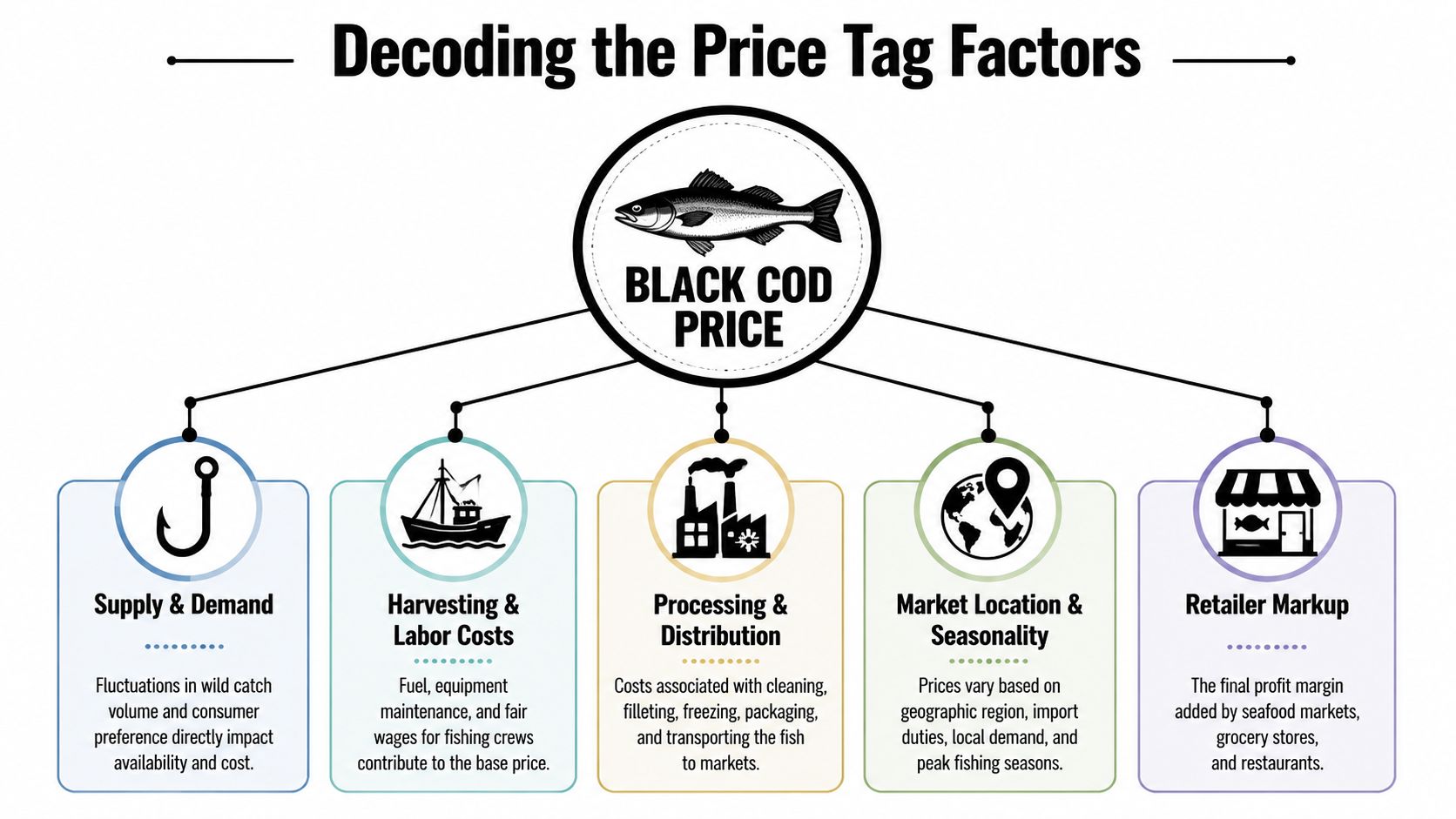
The price of black cod isn't random. It reflects a chain of decisions and constraints long before the fish lands in a retail case.
Supply can move the market fast
One of the clearest drivers is supply. A 2024 industry update said the total allowable catch for black cod was about 60 million pounds, a slight decrease from 2023 but still more than double the level of a decade earlier. The same update noted the fishing pace in mid-March was almost halved from the year before, while broader 2024 commentary described prices falling to record low levels after the market had been saturated for the previous two years (2024 sablefish market update).
That matters because the fish can still be highly desired and still get cheaper if too much hits the market at once. The reverse can happen too. Slower catch pace or tighter availability can support firmer pricing later.
For a home cook, the practical lesson is simple:
- Season and timing matter: The same fish can feel expensive or surprisingly fair depending on when supply is flowing.
- Low prices aren't always a warning sign: Sometimes they're the result of market conditions, not lower quality.
- High prices don't always mean better fish: Sometimes you're paying for timing, format, or retail handling.
If you like planning meals carefully, it helps to think about fish the same way you think about produce or meat specials. Tools for budgeting for your recipes can help you compare whether a black cod dinner makes sense for a weeknight or fits better as a once-in-a-while meal.
Size and processing change the math
Size matters long before the fish gets filleted. In the Mentera sablefish report, ex-vessel prices in 2018 ranged from about $1.28 per pound for fish under 2 pounds to $7.75 per pound for fish over 7 pounds. The same report found an inflation-adjusted first wholesale price for eastern-cut H&G sablefish from the Gulf of Alaska averaging $8.39 per pound across size categories in 2016 to 2018, equal to a round-weight equivalent of $5.29 per pound using a 0.63 yield factor (Mentera sablefish research report).
If those numbers seem abstract, here's the plain-English version. Bigger fish can be worth more. Then processing changes the math again. Once a fish is headed, gutted, trimmed, skinned, boned, and portioned, you aren't paying just for pounds of fish. You're paying for the pounds that remain after waste and labor.
A tidy fillet is part fish and part processing.
That's why a retailer can sell black cod in very different formats at very different prices without anyone being dishonest. The cut itself changes the economics.
When you're planning how to cook it, the same logic applies to everything around the fish. A straightforward seasoning can help you keep the preparation simple, whether that's salt and citrus or something fuller like a smoky paprika garlic pepper dry rub if you're roasting or grilling a richer cut.
Where You Buy Matters A Comparison
The place you buy black cod can change the price almost as much as the fish itself. Market-to-market spread is real. Recent listings have shown black cod fillets at $17.99 per pound in one U.S. market, £19.80 in the UK, and bulk boxes such as 8 pounds for $199.95. Those gaps reflect format, channel, packaging, and shipping, not just retailer mood swings (black cod market listings across channels).
That means the best place to buy depends on what you care about most. Convenience, cut consistency, shipping, and connection to the source all shape the final value.
Black Cod Buying Options at a Glance
| Source | Typical Price | Quality & Freshness | Selection | Connection to Source |
|---|---|---|---|---|
| Supermarket seafood counter | Often easier to access, but price varies by store and cut | Can be good, but handling details may be less clear | Usually limited to a few formats | Usually low |
| Local fishmonger | Often reflects more curation and staff knowledge | Often stronger guidance on freshness and cooking | Better chance of specific cuts | Moderate |
| Direct from a fishery or independent seller online | May include fillets, portions, or bulk boxes in very different price formats | Can be strong if shipping and packing are handled well | Often the broadest mix of pack sizes and formats | Usually highest |
How each option feels in real life
A supermarket works well when you want speed. You can see the fish, buy one piece, and move on with dinner. The tradeoff is that you may get less context about where it came from, how recently it was packed, or why one cut costs more than another.
A local fishmonger is useful when you want guidance. If you're not sure whether to broil skin-on fillets or buy a larger piece to portion at home, a good counter person can steer you. That advice can be worth money if it keeps you from buying the wrong cut.
Buying direct can be the most interesting option if you care about control. You may be able to choose a larger box, compare cuts more carefully, or buy closer to the people handling the fish. That doesn't automatically make it cheaper, but it often makes the pricing easier to understand because you're seeing the product in its original sales format instead of only in a trimmed retail presentation.
If a black cod price looks unusually low or unusually high, check the cut, weight format, and whether shipping is folded into the number.
For readers who already prefer to buy directly from the maker in other categories, seafood follows a familiar pattern. The more clearly you can see the product form and who prepared it, the easier it is to judge value.
How to Find the Best Value Black Cod
You are standing at the fish case, looking at two pieces of black cod. One costs much less per pound. The other is trimmed, portioned, and ready to cook tonight. The better value depends on what you are buying. Fish, labor, convenience, or less waste on your cutting board.
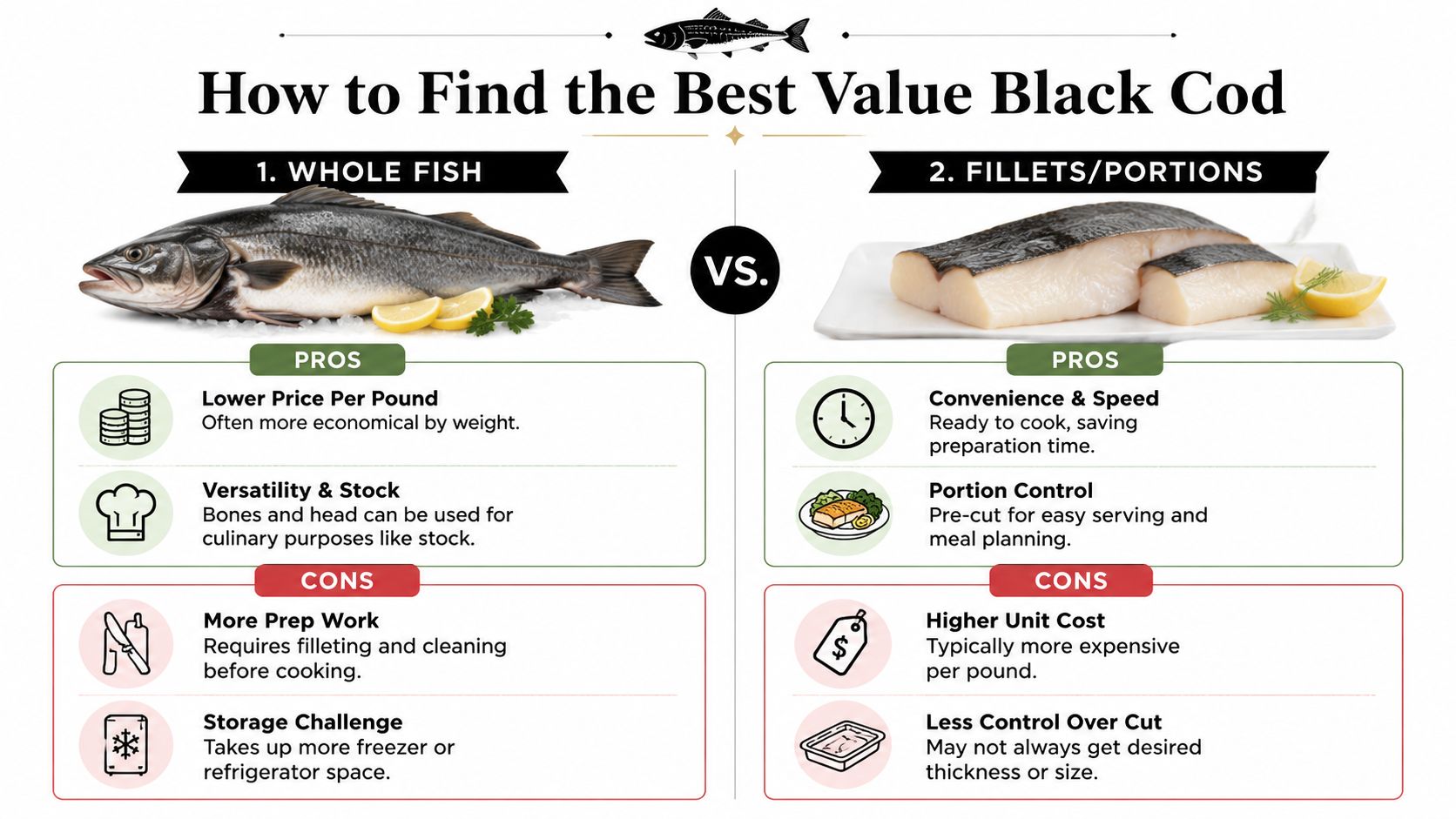
A good way to judge black cod is to stop at the sticker price and ask a second question. How much of this fish will end up in the pan and on the plate? A whole fish can look cheaper at first glance, while fillets often cost more because someone else already did the trimming, portioning, and cleanup. That price gap reflects labor and usable yield, as shown in this whole black cod versus fillet pricing comparison.
Focus on usable fish
Black cod value works a lot like buying fruit. A whole pineapple may cost less by weight than pre-cut pieces, but the math changes once you remove the parts you will not eat. Fish works the same way.
If you are comfortable breaking down fish at home, a larger piece can save money. If you want dinner to be simple and low-stress, ready-to-cook portions may be the smarter buy even at a higher per-pound price.
A few questions make the choice clearer:
- How soon are you cooking it? A same-night meal favors portions you can season and cook right away.
- Will you use the extra fish well? A bulk buy only pays off if you freeze it carefully or plan more than one meal.
- Do you want even portions? Pre-cut pieces make timing and serving easier.
- Are you willing to trim bones or skin? If not, paying for prep may save both waste and frustration.
Simple rule: The lowest listed price is only a value if the format matches your kitchen skills and your meal plan.
Small finishing touches matter more with black cod than with many cheaper fish because its texture is the main event. A light hand with seasoning lets you taste what you paid for. Something like fleur de sel finishing sea salt makes sense here because it adds crunch and salinity without covering the fish's rich, silky character.
Look for clarity, not just a lower number
The best black cod sellers make the product easy to understand. You should be able to tell what cut you are buying, whether the fish is skin-on or skinless, how it is packed, and how much work has already been done for you.
That is why buying closer to the source can help. You are often getting a clearer view of the actual product instead of a vague retail label. A marketplace focused on direct-from-maker sales can be useful for that reason, including Loyaltie, where the format and seller details may be easier to compare than on a generic shelf.
Good value comes from matching the fish to the meal. If you want a special dinner with very little prep, pay for the clean portion. If you are confident with a knife and cooking for several people, a larger cut may stretch your dollars better.
So Is Black Cod Worth the Price
Sometimes yes. Sometimes no. The answer depends on what you're asking the fish to do.
A recent comparison showed a 5 to 7 ounce portion of Wild Alaska Black Cod at $19.99 versus $13.25 for the same-sized portion of Wild Atlantic Cod (black cod versus Atlantic cod portion pricing). That gap is real, and it won't make sense if all you want is a mild fish to bread, fry, or tuck into a heavily sauced dish.
When the higher price makes sense
Black cod earns its keep when texture is the point. If you want a fish that feels rich, soft, and almost self-saucing when roasted, it's in a different lane from Atlantic cod. That's what you're paying for.
It also makes sense when you want a forgiving fish. For people who overcook lean fillets or worry about dry seafood, black cod is friendlier. That can turn a higher purchase price into better dinner value because you're less likely to ruin it.
On the other hand, not every meal needs black cod. If you're making fish tacos, chowder, or a strongly seasoned baked dish, a less expensive fish may do the job just fine. Paying more only makes sense when the special qualities of black cod will still show up on the plate.
A bright condiment can help you keep that balance. Something like pineapple mango habanero hot sauce works best if used lightly, so it lifts the richness instead of covering it up.
So yes, black cod can be worth the price. Just not for every dinner, and not in every format.
Your Questions About Black Cod Answered
Is black cod always sold fresh
No. You may see it fresh, previously frozen, frozen in portions, or packed in larger boxes. None of those formats is automatically worse. The useful question is whether the format fits how you cook and store fish at home.
How should you store it
If you're cooking it soon, keep it very cold and use it promptly. If you're buying more than you need, portioning and freezing can protect both quality and your budget. The less often you thaw and refreeze any fish, the better.
What's the easiest way to cook it well
Keep it simple. Roast, broil, or gently pan-cook it, and don't overload it with heavy seasoning. Black cod's appeal is its texture, so the goal is to support that, not bury it.
How do you know if a black cod price is fair
Check the form first. Whole fish, fillets, single portions, and shipped packs all price differently. A fair price depends on whether you're buying convenience, yield, and labor along with the fish.
Is buying directly worth it
Often, yes, if you like clearer product information and want to compare cuts or pack sizes more carefully. That can be especially helpful when you're trying to understand the value of what you're buying, not just the number on the label.
If you like buying food, pantry goods, and everyday essentials with more context and less middleman, Loyaltie is a marketplace where you can discover and buy directly from independent brands across the US. It's a practical way to find products made by real people, compare quality more clearly, and shop with a better sense of what you're getting.