
You're probably doing this right now. Standing in the snack aisle, holding two boxes that both sound good. One says “all natural.” The other leans hard on “whole grains.” Both look like they belong in your cart. Neither is telling you the full story.
That's why knowing how to read nutrition labels feels so useful once you get the hang of it. It turns shopping from guessing into choosing. You stop buying based on whatever the front of the package shouts at you, and start buying based on what's in the food.
That shift matters even more when you're buying from independent brands and local makers. The good ones usually don't need flashy language to distract you. They're proud of what's inside, and the label often shows it. If you want the same kind of plain-English breakdown for pills and powders, Peak Performance's supplement guide is a helpful companion read.
Table of Contents
- Your Secret Map to Better Food
- Start with the numbers that control everything else
- A quick store-aisle reality check
Your Secret Map to Better Food
The Nutrition Facts panel looks dry until you use it in a real shopping decision. Then it becomes useful fast. It's the part of the package that doesn't flirt, flatter, or overpromise.
Say you're comparing two crackers. The front of one talks about seeds. The other talks about being baked. Nice, but that's marketing language. Turn both boxes around and you get the actual comparison: portion, calories, fat, carbs, protein, and the ingredient list that explains how the food got there.
The front of the package sells an idea. The back tells you what you're actually buying.
That's the secret map. Once you learn to read it, you start spotting foods that are worth bringing home. Not just foods that wear a healthy costume, but foods that look balanced on the label and straightforward in the ingredients.
This is also where independent brands often stand out. When people make food they're proud of, the label tends to reflect that. You're more likely to find a product that makes sense from top to bottom, instead of one that wins on packaging and gets muddy on the details.
A good label doesn't force you to decode a bunch of front-of-box claims. It lets you make a calm decision. That's what you want, especially when you're trying to find better pantry staples, smarter snacks, or breakfast options you'll feel good about eating again.
First Stop Serving Size and Calories
Start with the numbers that control everything else
Before you read anything else, look at serving size and servings per container. That's the anchor. The FDA says this is the starting point because every calorie and nutrient amount on the label applies to that specific serving, not automatically to the whole package, and serving sizes are standardized so people can compare similar foods. The FDA also notes that serving size is not a recommendation for how much to eat, and if you eat 2 servings, you consume double the calories and nutrients listed for 1 serving. The same FDA guidance explains that the Percent Daily Value is based on a 2,000-calorie diet. FDA guidance on using the Nutrition Facts label
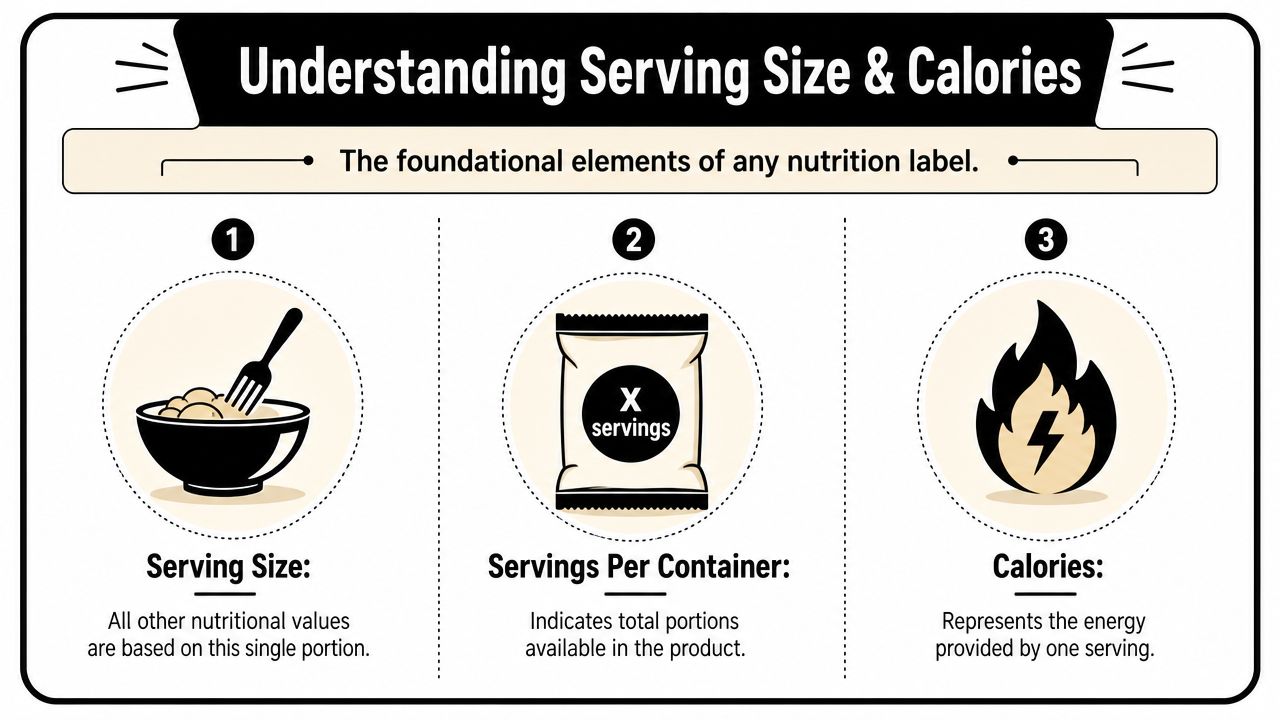
Harvard notes that serving size and calories are bolded and shown in larger type on the modern label, which makes those two numbers easier to spot quickly. That's a helpful design change, because these are the numbers that shape everything else you're about to read.
A quick store-aisle reality check
Consumers often find this confusing. A bottle, pouch, or snack bag can look like one personal portion, but the label may describe more than one serving. If you eat the whole thing, the label has to be scaled to match what you consumed.
Here's the easy rule:
Check the serving size first
Don't assume the package equals one serving.Check the number of servings in the container
A package can be small and still contain more than one serving.Multiply if needed
If you eat more than one serving, multiply calories and nutrients accordingly.
Practical rule: Never judge a food until you know whether you're reading one serving or the whole package.
This gets especially useful when you're comparing foods you'll eat often. If you buy breakfast foods, for example, a prep-ahead option like overnight oats mix with freeze-dried mango and seeds is easier to judge when you look at the actual serving framework first instead of trusting the front label.
If you're planning meals around a daily target, it can also help to see how one product fits into a broader eating pattern. That's where something like these 1900 calorie meal prep tips can be useful for context.
And if you're packing snacks for kids, labels matter just as much. Kids Fruit Snack Bars, Organic Dates & Fruit, Nut-Free School Snack, 20-Pack Variety (Apple Pie, Blueberry, Raspberry, Pea | Skout Organic by Loyaltie are described as school-safe snack bars made with organic dates and real fruit, with no gluten, dairy, or soy, and nut-free for lunchboxes. That's the kind of product where checking both the label and the ingredient list gives you the clearest picture fast.
Navigating Fats Carbs and Protein
Read the middle of the label with a purpose
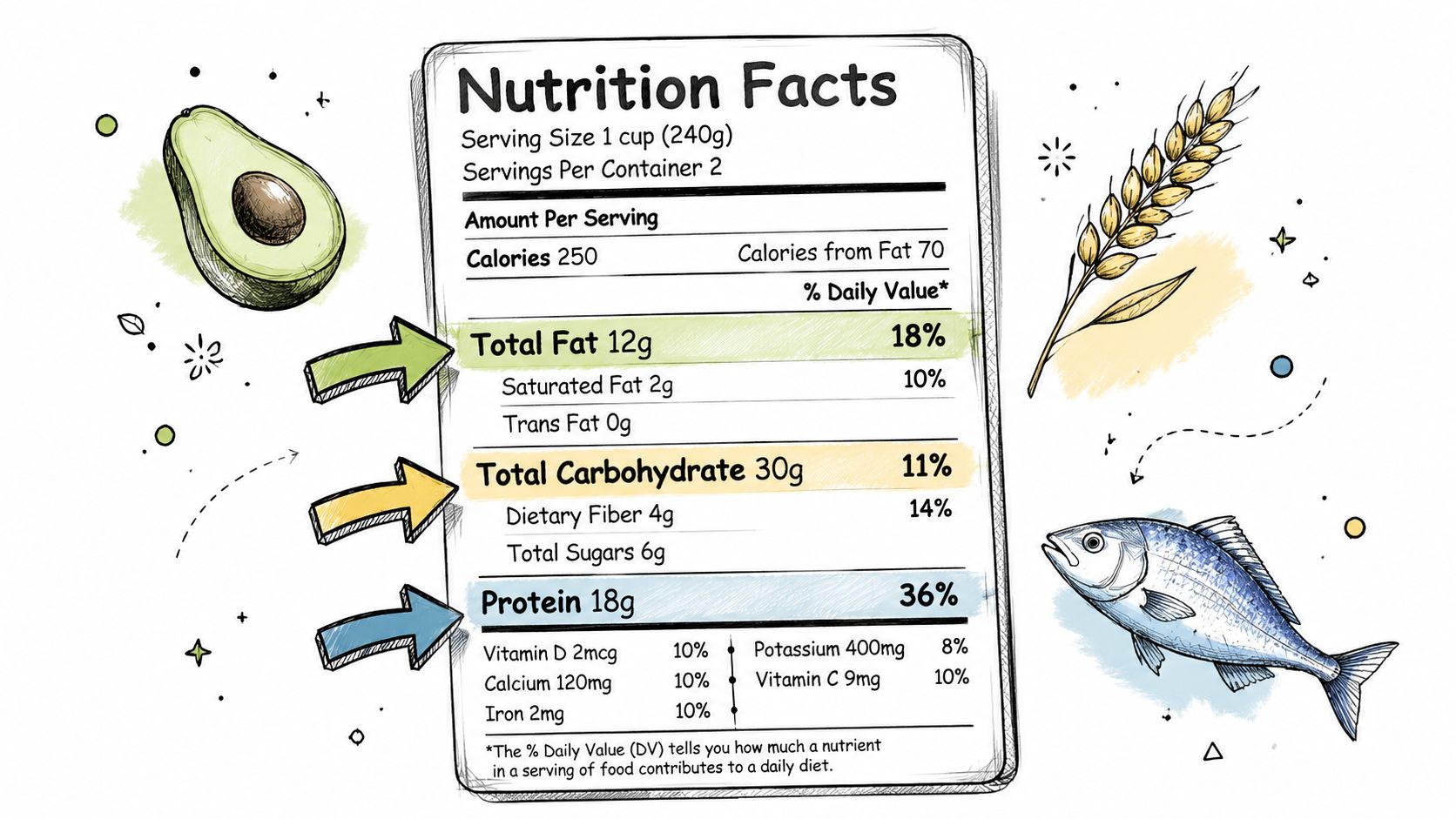
Once you've got the portion straight, your eyes usually land in the middle of the panel. That's where the food's energy makeup shows up: fat, carbohydrates, and protein.
Don't read this section like a scorecard where every low number wins. Read it like a clue about what kind of food this is. Some foods are naturally richer in fat. Some are built around carbs. Some are useful because they bring protein to a meal or snack. The question isn't “Is every number tiny?” The question is “Does this match what I want this food to do?”
For a quick example, if you're looking at a protein product, you'd expect protein to be one of the reasons to buy it. A straightforward option like organic chocho lupin protein powder invites exactly that kind of label check. You're looking to see whether the panel and ingredients support the product's main purpose.
What each section is trying to tell you
Under Total Fat, pay attention to the breakdown below it. Saturated fat and trans fat are the lines many shoppers want to keep an eye on. You don't need to panic at the sight of fat, but you do want to notice what type is showing up and how prominent it is in the serving you consume.
Under Total Carbohydrate, look beyond the headline number. The useful detail is often lower down.
- Dietary fiber matters because it helps you judge whether the carbohydrate comes with something beneficial.
- Total sugars tells you sugar is present, but it doesn't tell the whole story by itself.
- Added sugars is especially helpful because it shows sugar that was put in during processing.
Protein is simpler. If you want a food that holds you longer or rounds out a meal, this line helps you decide whether the product delivers.
The American Diabetes Association suggests a practical shortcut when you're scanning labels: aim for less than 10% DV for nutrients to limit and 10% DV or higher for nutrients to favor. It also notes a common pitfall. People often underestimate intake when a package looks like a single serving but isn't. American Diabetes Association guidance on reading food labels
A fast mental filter looks like this:
| What you're checking | What you want to notice |
|---|---|
| Fat | What kinds of fat are doing most of the work |
| Carbs | Whether fiber is present and whether added sugars stand out |
| Protein | Whether the food gives your meal or snack real staying power |
If you want a visual walk-through of where these numbers live on the panel, this short video is a useful refresher before your next grocery run.
Using Percent Daily Value as Your Guide
How to use the right-hand column fast
The % Daily Value, or %DV, is the part many people skip, which is a mistake because it gives the rest of the label context. A gram amount by itself can feel abstract. The %DV helps you judge whether that nutrient is a relatively small or more meaningful share of a day's intake.
Think of this column as your comparison tool. When two products look similar, the %DV can help you sort them quickly. It's especially handy when you're comparing foods in the same category and the serving sizes match.
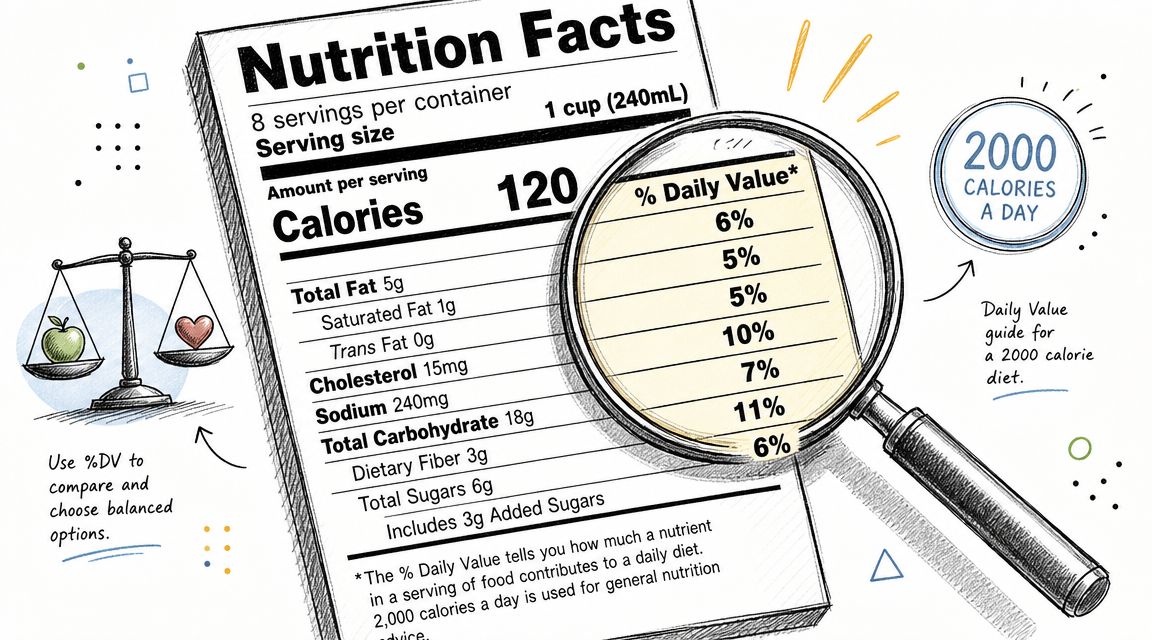
Here's a simple way to use it in the aisle:
For nutrients you want less of
Look for a lower %DV.For nutrients you want more of
Look for a higher %DV.When comparing products
Make sure the serving sizes are similar first, or you're not making a fair comparison.
A label gets easier to read when you stop staring at every gram and start using the %DV as a shortcut.
Use percent daily value and vitamins together
The vitamin and mineral lines near the bottom are easy to ignore, but they tell you whether a food contributes something beyond energy. Here, the label shifts from “What does this cost me?” to “What does this add?”
A product can fit your calorie needs and still offer very little else. Another product can land in a similar calorie range and bring along fiber or listed vitamins and minerals that make it a stronger everyday choice. That doesn't mean every food has to be nutritionally heroic. It just means the label helps you spot the foods that pull more of their weight.
When you use %DV together with the lower section of the panel, you get a fuller read on the product. You're not only screening out foods that lean too hard on the stuff you want to limit. You're also spotting foods that contribute something useful.
That's a much better way to shop than trusting a wellness-sounding phrase on the front.
The Real Story Is in the Ingredients
Why the ingredient list feels more honest
If the Nutrition Facts panel tells you what is in the food, the ingredient list tells you how the food was made. For a lot of shoppers, this is the most revealing part of the package.
Ingredients are listed in order by weight, so the first few ingredients matter most. That's why the beginning of the list tells you a lot about the product's true identity. If the first ingredients sound like food you recognize, that's usually easier to work with than a list dominated by fillers, flavors, and additives you didn't expect.
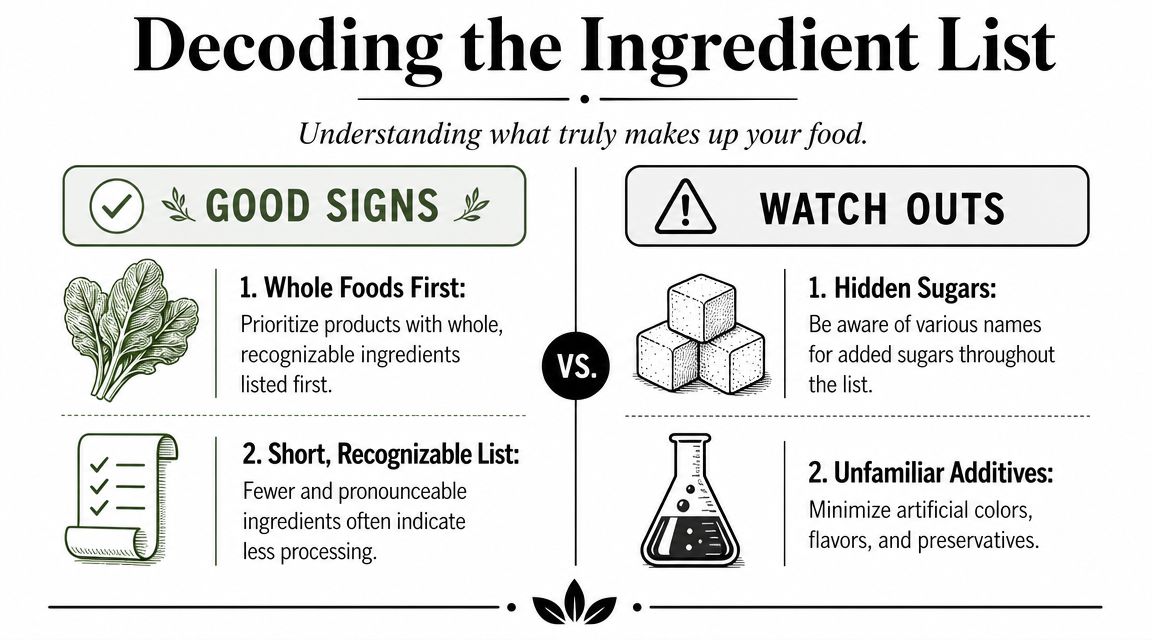
This doesn't mean every long ingredient list is automatically bad, or every short one is automatically good. It means the list gives you a cleaner read on what the maker prioritized. You can often tell whether the product started with real food and stayed close to it, or started as a formulation exercise.
Shopping clue: The ingredient list is where brands stop storytelling and start disclosing.
That's one reason independent makers can be such a good find. Many of them build products around ingredients they're comfortable naming clearly. You can feel the difference when a food sounds like something someone intended to make, not something a marketing team meant to position.
If you're curious about adjacent label language, Yuve's explanation of non-GMO options is a useful read for understanding one of the claims shoppers often see around ingredient quality.
What thoughtful food labels often have in common
When you're scanning an ingredient list, watch for a few simple patterns:
Whole ingredients near the top
If the first ingredients are recognizable foods, that's usually a strong sign.A list that makes sense for the product
Crackers need ingredients. Granola needs ingredients. But the list should still feel connected to what the food is.Clear allergen information
Thoughtful labeling helps you make fast decisions, especially for households managing sensitivities.Less camouflage
If sugar appears in several forms across the list, or the ingredient deck feels padded with additives, that's worth noticing.
A useful compare-and-contrast habit is to hold two similar products side by side and read only the ingredients first. Don't even look at the front. One list often sounds direct and grounded. The other sounds engineered. That difference is easy to miss if you only shop by claims.
The fun of finding better food returns. Once you know how to read nutrition labels and ingredient lists together, you can find products from local makers and independent brands that are clear about what they're offering. No middleman language. No fog. Just food that makes sense.
Quick Tips and A Note for Makers
Smart habits for your next shopping trip
A few habits make label reading much easier in real life.
Ignore the front first
Start on the back of the package. That's where the useful information lives.Compare like with like
If two products have different serving sizes, slow down before deciding one is “better.”Look for the overall pattern
One snack or one breakfast item won't decide your whole diet. What matters is what you buy again and again.
If you like buying directly from the maker instead of sorting through mass retail shelves, Loyaltie's marketplace for independent brands across the US is one place where shoppers can discover and buy directly from makers with clear product information and everyday essentials in one place.
A quick note for food makers
If you make food, your label does more than satisfy a requirement. It signals whether you respect the customer's attention. A clean panel, a readable serving setup, and an ingredient list that sounds like real food all help people trust what they're holding.
Shoppers notice that. Especially the ones who read labels more than once.
The brands that win repeat orders often make the decision easy. They don't hide behind front-of-pack buzzwords. They let the product speak plainly.
If you want an easier way to discover foods, wellness products, and everyday goods with that kind of clarity, Loyaltie is a marketplace where people discover and buy directly from the best independent brands in the US. It's a practical way to find products made by real people, compare them with less marketing noise, and choose with more confidence.