


You're probably doing what most of us do when we shop for health and wellness products online. You open a big retailer, search for something simple like magnesium, herbal tea, toothpaste, or a calming body oil, and then you get buried. Page after page. Dozens of labels that all sound alike. “Natural.” “Clean.” “Better for you.” “Made with care.” None of that tells you much.
After a while, the problem isn't finding options. It's figuring out which ones are worth bringing into your home.
I've learned that the easiest way out of that loop is to stop shopping like a bargain hunter and start shopping like a person building a better daily routine. That usually means looking past mass retail and getting closer to the people who make the products. When you buy directly from the maker, you can often understand what you're buying, why it was made, and who stands behind it.
That shift matters because wellness isn't some side category anymore. The global health and wellness market reached an estimated value of $7.19 trillion in 2026, and 84% of U.S. consumers now explicitly prioritize wellness in their daily lives, according to Ringly's summary of 2026 health and wellness ecommerce trends. More demand means more products, more noise, and a bigger need for a smarter way to choose.
Table of Contents
- Better products usually come from shorter paths
- People are already paying for the upgrade
- The part most shoppers miss
- Start with places that are already curated
- Use social platforms like a scout, not a shopper
- Learn to spot local-sounding marketing
- Start with the product page
- Check whether the claims match the evidence
- Use one real product page as practice
Tired of the Endless Scroll for Wellness
The usual online shopping experience makes wellness feel strangely impersonal. You're trying to choose something that touches your body, your sleep, your energy, your skin, or your kitchen, and yet the shopping process feels disconnected from real life.
A lot of product pages are built to win a click, not answer a question. You see polished packaging, vague benefit claims, and ingredient lists that sound more like a wall of text than useful information. Even when the product might be fine, you're left guessing.
I hit this wall most often with everyday items. Tea blends. Supplements. Skincare. Toothpaste. Pet care. Coffee. The categories differ, but the frustration is the same. You want something better than mass-produced sameness, but you don't want to spend your evening decoding labels.
Buy fewer mystery products. Buy more products that tell you who made them, what's in them, and why those choices matter.
That's why independent brands are worth your attention. They often give you a cleaner line of sight between the product and the person behind it. Instead of trying to sort through endless lookalikes, you can focus on products made with a point of view.
What usually confuses shoppers
- Too many similar claims. “Clean” and “natural” can sound reassuring, but they don't automatically explain sourcing, testing, or product fit.
- No sense of origin. You can't tell whether a brand is a real maker, a reseller, or a private-label product with a nice story wrapped around it.
- Weak product education. You still don't know how to use the item, who it's for, or what would make it a good match for your routine.
When you start buying from local makers and independent brands, the experience changes. The goal stops being “find the cheapest acceptable thing.” It becomes “find the product I'll feel good using again.”
That's a much better way to shop for wellness.
Why Buying Direct Is a Quality Upgrade
Buying direct gets framed as a feel-good choice. I think that misses the point. The main appeal is that you often get a better product experience.
When there's no middleman, the maker has more control over how the product is described, packaged, updated, and supported. You can see that in categories where freshness, formulation, and handling matter, like herbal blends, skincare, supplements, and food.
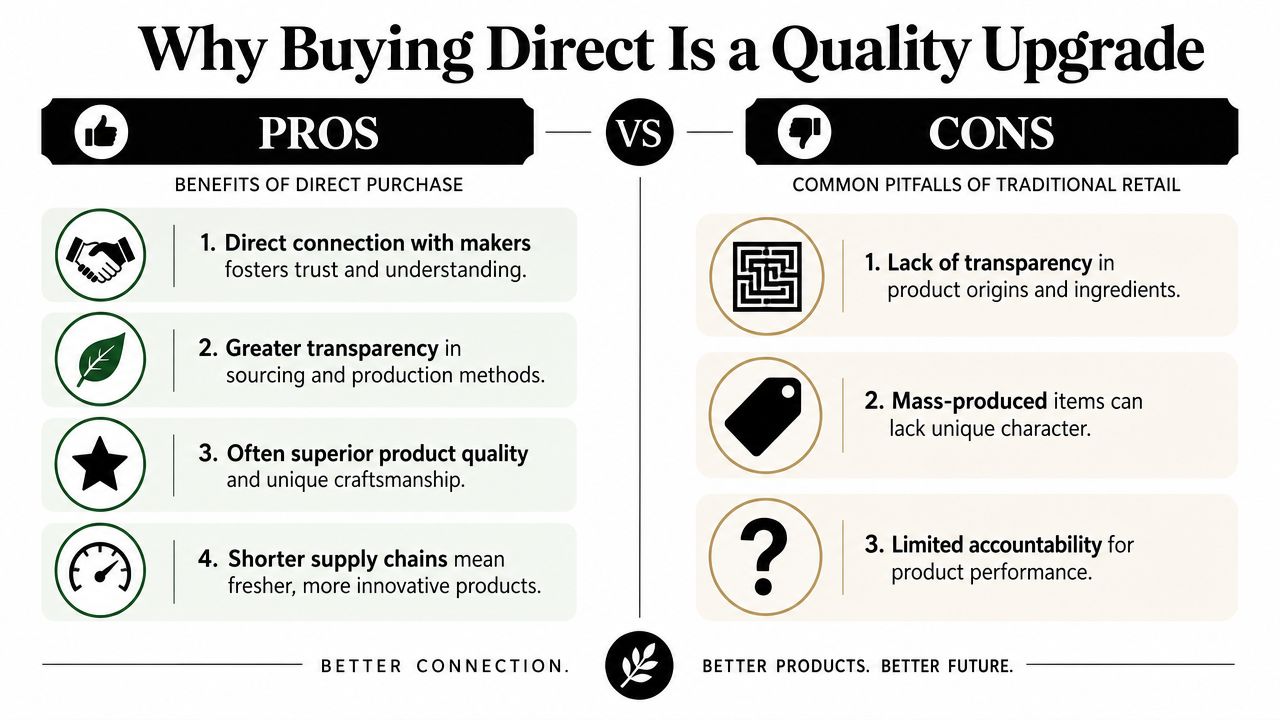
Better products usually come from shorter paths
A shorter path between maker and buyer solves several common problems at once.
| Direct from maker | Traditional retail pattern |
|---|---|
| Clearer product story | Generic marketing language |
| More transparent sourcing | Harder to trace origin |
| Easier to ask questions | Limited accountability |
| Faster updates to listings | Product details can stay vague |
That doesn't mean every independent brand is automatically better. It means the setup gives you a better chance of finding quality because the person making the product is closer to the buying experience.
In practice, that can look like:
- More useful ingredient context. A maker can explain why an herb, oil, or active ingredient is included, not just list it.
- Stronger accountability. If a customer has a question, the answer usually comes from someone who knows the formula or the sourcing.
- More distinctive products. You're less likely to end up with the same generic item sold under five different labels.
People are already paying for the upgrade
Shoppers understand this at a gut level. Consumers across the US say they're willing to spend an additional $150 monthly to support neighborhood stores, and $68 out of every $100 spent with independent retailers stays in the local community, according to Forbes on shopping at neighborhood stores.
What I take from that isn't charity. It's that people are willing to pay more when they believe the product quality, experience, and trust are better.
Practical rule: If a product costs a little more but gives you a clearer ingredient list, a real maker story, and better answers before you buy, that's often a smarter purchase than the cheaper mystery option.
The part most shoppers miss
Direct buying also changes your mindset. You stop treating wellness products like random commodities and start treating them like parts of your daily environment. That matters. The tea you drink every night, the toothpaste you use every morning, the supplement you reorder, the body product you apply to your skin. Those choices add up.
Independent brands tend to work well for people who care about the little things. Texture. Taste. Packaging that makes sense. Instructions that don't feel evasive. A product page that sounds like it was written by a real person.
That's the quality upgrade. Not status. Not marketing. Just a better product relationship.
Discovering Independent Brands You Will Love
Once you stop relying on giant marketplaces, discovery gets easier than generally expected. You just need a better search pattern.
More people are already moving this way. Seventy-five percent of consumers plan to shop more locally over the next year, and 56% already patronize neighborhood stores or buy locally sourced products, according to the U.S. Chamber of Commerce on post-pandemic demand for smaller brands. That tells me you're not searching against the tide. You're shopping in a direction many people now prefer.
Start with places that are already curated
My first move is simple. Don't start with a blank search bar if you can avoid it.
A curated marketplace narrows the field before you ever click. That's useful when you want to buy directly from the maker without spending hours figuring out who's real. One example is Pressed With Purpose Teas on Loyaltie, which sits inside a marketplace where people discover and buy directly from the best independent brands in the US.
That kind of setup helps because it reduces one big source of friction. You're not trying to verify every brand from scratch.
Use social platforms like a scout, not a shopper
Instagram and Pinterest can be great for discovery if you use them with intention.
Try this process:
- Search by product type first, not by trend term. “Herbal tea blend,” “tallow balm,” “sea moss gummies,” “dog calming treats,” or “small-batch coffee.”
- Look for signs of a real maker presence. Behind-the-scenes clips, production shots, ingredient talk, founder explanations, packaging updates.
- Save a few brands, then leave the platform and review their actual website before buying.
A social post can introduce a brand. It shouldn't be the only reason you trust one.
If a brand looks local on social media but the website never explains where products are made or how they're sourced, slow down.
Learn to spot local-sounding marketing
Many individuals find themselves misled. Some brands use words that suggest nearness, care, or maker identity without giving you any proof.
Look for specifics such as:
- Location details that go beyond a vague “USA made” line
- Real product education instead of decorative storytelling
- Consistent category focus so the store doesn't feel like a random assortment
- Maker visibility through photos, about pages, or direct contact options
The sweet spot is a brand that feels personal and clear at the same time. You don't need a dramatic origin story. You need enough detail to know who made the thing and why it deserves a spot in your routine.
A Practical Checklist for Vetting Products
This is the habit that will save you the most money and the most disappointment. Before you buy, pause and vet the product page like a careful friend would.
Consumers increasingly want science-backed claims and trusted sourcing, but they often struggle to verify whether a product is local or just marketed that way, as noted in McKinsey's wellness trends coverage. That gap is exactly where a checklist helps.
A good product page should lower confusion, not create more of it.

Start with the product page
When I land on a product listing, I look for clarity in this order:
- Ingredient list first. Can you easily see what's in it? Are common allergens, flavoring details, or active ingredients stated plainly?
- Usage guidance next. Does the brand explain how to use it, when to use it, or who it may suit?
- Specific claims. Are the benefits described carefully, or does the page lean on broad promises that could apply to anything?
If you're buying food or snacks, label reading matters just as much. A practical guide to making healthier snack choices can sharpen your eye for serving details, ingredient order, and what a nutrition label does and doesn't tell you.
Here's a simple gut check. If you have to reread the page three times to understand what the product is, move on.
Check whether the claims match the evidence
Some phrases sound meaningful but aren't enough on their own.
“Natural,” “clean,” and “better for” can point you toward a product category, but they don't replace proof. For wellness items, look for things like testing information, sourcing notes, manufacturing details, or a plain explanation of what the brand can and cannot claim.
This matters even more in products built around personal outcomes. Women's health, mood support, hormonal balance, digestive support, and mental wellness often get marketed with broad language. BCG notes that women's health needs are highly individual, and many shoppers still struggle to assess personalized wellness products when clinical validation is unclear, in BCG's analysis of women's consumer health needs.
The more personal the promise, the more careful you should be with the product page.
A trustworthy listing usually sounds measured. It helps you decide. It doesn't pressure you into believing.
Use one real product page as practice
A concrete example helps. If you look at Daily Supplement System Bundle + Electrolytes, Digestive Support, Bloat Relief 3 Pack, 25, 30, 30 Servings, the useful move isn't to ask whether the product sounds exciting. It's to ask whether the page gives you enough information to judge fit.
Try these questions:
- Does the product title clearly tell you what's included?
- Can you tell whether the intended use is daily support, occasional use, or targeted use?
- Are the ingredients and serving details easy to find?
- Do the claims stay grounded in what the product contains?
- Can you understand the routine without needing to contact support?
A solid listing should answer most of those on its own.
Here's another helpful test. Read the page once, then explain the product out loud in one sentence. If you can't do that, the listing probably needs work.
A short video can also help you think through product evaluation with a more careful lens:
Identifying Trustworthy Online Shops and Makers
A good product can still sit on a weak website. That's why I separate product trust from store trust. You need both.
When I'm checking a new shop, I'm not looking for perfection. I'm looking for signs that a real business expects real customers to ask real questions.

Trust starts before checkout
A trustworthy shop usually gets the basics right in visible ways.
| What to check | Why it matters |
|---|---|
| HTTPS and secure checkout | Your payment and account details need a protected connection |
| Clear contact options | Real businesses make it possible to reach them |
| Shipping and return policies | You should know what happens if something goes wrong |
| Detailed product descriptions | Specificity signals care and accountability |
You can often tell within a minute whether a store respects your attention. If policies are hidden, product descriptions are thin, and contact info is missing, that's useful information.
A product listing like Activated Bamboo Charcoal Toothpaste, Aloe Vera & Turmeric, Teeth Whitening & Fresh Breath, SLS-Free Vegan, 4 oz | Life Gardening Tools by Loyaltie is a good example of the kind of snapshot that helps a shopper orient quickly. The listing states that it's meant to give a cleaner-feeling mouth and a brighter-looking smile with activated bamboo charcoal powered by aloe vera and turmeric, and that the formula is vegan and SLS-free for a fresh, naturally polished finish. That kind of factual description is much easier to evaluate than vague copy.
Reviews should sound human
Reviews help, but only when you read them with some skepticism.
Look for a mix of details, not just a wall of praise. Real reviews usually mention routine, texture, taste, packaging, timing, or product fit. Fake-looking reviews often sound generic, repeat the same phrases, or read like ad copy.
A trustworthy shop doesn't need every review to sound glowing. It needs the overall pattern to feel believable.
Also check whether the shop has a living presence outside the product page. That might be a social account with actual customer interaction, an About page with substance, or support information that feels current.
Trust online is rarely one big signal. It's a stack of small ones that agree with each other.
A Guide for Makers Listing Products on Loyaltie
If you make wellness products, the trust signals shoppers want are not mysterious. They're visible, repeatable, and very teachable.
The fastest way to improve your listing is to stop writing like a marketer and start writing like a clear shop owner who knows customers have questions. People buying health and wellness products online want less sparkle and more certainty.

Show the product before you sell the story
Lead with what the item is, what's in it, and how someone uses it. Your story matters, but it should support the product, not hide it.
A strong listing tends to include:
- A title that does real work. Name the product clearly. Include the form, key ingredients, and size when useful.
- Photos that reduce uncertainty. Show packaging, texture, serving format, and scale.
- An ingredient list that's easy to scan. Don't make people hunt for basics.
- Use instructions that sound practical, not mystical.
If you're listing something like black seed oil drops, don't assume the customer already knows the routine, the taste profile, or the reason your version is different. Explain it clearly.
Write like a clear teacher
The best maker pages answer the next question before the customer asks it.
That usually means covering these points in plain language:
- What is this product for in everyday terms?
- What ingredients or materials matter most?
- How should someone use it?
- Who might like it, and who should read more carefully?
- What can the product reasonably do, and what are you not claiming?
That last point matters. Honest boundaries build trust. If you can't clinically prove something, don't imply that you can.
For makers who want a practical starting point, seller resources on Loyaltie can help with the nuts and bolts of presenting products online. The bigger lesson is simpler: when your listing removes confusion, you make it easier for a customer to reorder, buy on a plan, and recommend you to someone else.
Your Next Step Toward Better Wellness Buys
The internet makes it easy to buy almost anything. It does not make it easy to buy thoughtfully.
That's why this approach matters. When you shop for health and wellness products online with a little more care, you get better odds of finding products that fit your life, explain themselves clearly, and come from real people who stand behind what they make.
You don't need to overhaul your whole routine this week. Start with one category you already buy often. Tea. Toothpaste. Supplements. Skincare. Coffee. Pet products. Pick the one where you're most tired of generic choices.
Then do three things:
- Find one independent brand that looks promising.
- Read the product page slowly and use the vetting checklist.
- Buy one product you'd want to reorder if it works for you.
That's enough to change how you shop.
Once you've done that a few times, the endless scroll loses its grip. You get faster at spotting weak listings, better at recognizing trustworthy makers, and more confident buying directly from the maker with no middleman in the way. Your daily products start feeling less random and more intentional.
If you want one place to start, browse Loyaltie, a marketplace where people discover and buy directly from the best independent brands in the US. It's a practical way to find local makers, compare products with more context, and shop with added confidence.