
If farm raised fish were merely "worse," the label would be enough and you could stop reading. It isn't. A pond catfish and a net-pen salmon can wear the same words and still differ in fat, flavor, feed, and footprint. The useful question isn't farmed or wild. It's which species, what it ate, and who will tell you.
You already shop this way for coffee and pantry staples. You read the origin before you trust the bag. Fish deserves that same habit, especially when you can buy directly from the maker and skip the guesswork a big seafood case leaves on the sticker.
Table of Contents
What Farm Raised Fish Really Means
Farm raised fish are fish grown from hatchery to harvest in a setting people control. Someone chooses the water, the feed, and how many fish share the space.
A cattle rancher and a deer hunter can both put meat on the table. Only the rancher decided what the animal ate and where it lived. The hunter took what the woods already grew. Farming is the ranch side of that story. Wild catch is the hunt.
Four common systems
Earthen ponds are the everyday freshwater setup for channel catfish, tilapia, and carp. Picture a managed field that holds water. Farmers stock young fish, feed pellets, and harvest on a schedule.
Flow-through raceways and tanks are the usual home for rainbow trout. Spring or river water runs through long channels, so the fish get cold, clean flow instead of sitting in one still pool.
Recirculating aquaculture systems (RAS) are indoor tanks that filter and reuse their water. Producers use them for salmon and tilapia nearer cities, where a pond isn't realistic and every gallon has to be cleaned like a closed kitchen sink.
Net pens sit in lakes, bays, and the open ocean. Most Atlantic salmon are raised this way. The fish stay in the cage. The surrounding water does the flushing.
Shellfish are the quiet cousin. Mussels and oysters often grow on ropes or rafts and filter what's already in the water instead of eating a pellet.
This is ordinary food production, not a curiosity. In 2023, U.S. aquaculture farms recorded $819.6 million in food-fish sales, according to the U.S. Department of Agriculture's National Agricultural Statistics Service.
The word "farm" tells you a person managed the animal. It doesn't tell you which animal, or what that animal ate.
Species and system shape the fillet more than the farmed label does. A pond catfish and a net-pen salmon both qualify. They don't cook, taste, or cost the same, so the next step is learning the names on the ice.
Common Farmed Species and What Sets Them Apart
Start with the fish you're likely to see, not with a verdict about farming in general.
| Species | Main Farming Method | Typical Feed | Where Most Supply Comes From | What to Check |
|---|---|---|---|---|
| Channel catfish | Earthen ponds | Plant-based pellets | Southern US pond farms | Ask for US-raised; mild, lean flesh |
| Rainbow trout | Raceways and tanks | Fish-meal and fish-oil pellets | Idaho and other US freshwater farms | Richer, firm flesh; a strong local option |
| Atlantic salmon | Net pens; some indoor RAS | Fish-meal and fish-oil pellets | Mostly imported; limited US farms in Maine and Washington | Fattier; check origin and feed |
| Tilapia | Ponds and indoor tanks | Plant-heavy pellets | Mostly imported; some US RAS farms | Mild, lean; check origin |
| Pangasius (basa, swai) | Ponds | Plant-heavy pellets | Mainly imported from Vietnam | Budget white fish; check origin on the label |
| Farmed shrimp | Ponds and tanks | Pellets | Mostly imported | Check origin and treatment records |
| Silver and bighead carp | Ponds, often mixed-species | Plant-based, plankton-driven | Mostly sold in Asian markets | Check the species name and origin |
Freshwater at home, marine mostly elsewhere
About 70% of U.S. aquaculture is freshwater farming, concentrated mainly in catfish and trout, and NOAA also reports that aquaculture supplies about 5% of the U.S. seafood supply overall, while U.S. marine aquaculture contributes less than 1.5%. NOAA identifies only a handful of U.S. farms raising marine finfish such as salmon in Maine and Washington and yellowtail and Pacific threadfin in Hawaii.
That's why a locally raised catfish or trout is the more realistic domestic fish. A salmon fillet in the case is usually an import, even when the shop feels local.
Flavor follows the species
Catfish and tilapia stay mild and lean, so they take spice, cornmeal, and a hot pan without fighting you. Trout and salmon are richer and fattier, which is why they taste buttery even with just salt. Pangasius, sold as basa or swai, is the budget white fish. It's fine in a curry. It's a letdown if you wanted trout.
You already sort groceries by origin. A bag of Costa Rica Single Origin Coffee, Air-Roasted, Balanced & Sweet Aroma, 1 lb Bag, Whole Bean or Ground | Pops Coffee Company by Loyaltie is a smooth, balanced cup with a naturally sweet aroma, roasted on hot air for a cleaner finish and sent out fresh in small batches, whole bean or ground. Fish deserves that same "where did this come from" glance.
For weeknights, catfish, trout, and tilapia are the easy cooks. Salmon and shrimp are worth the extra questions on origin, feed, and any treatment record before they go in the cart.
Nutrition and Taste Compared With Wild Fish
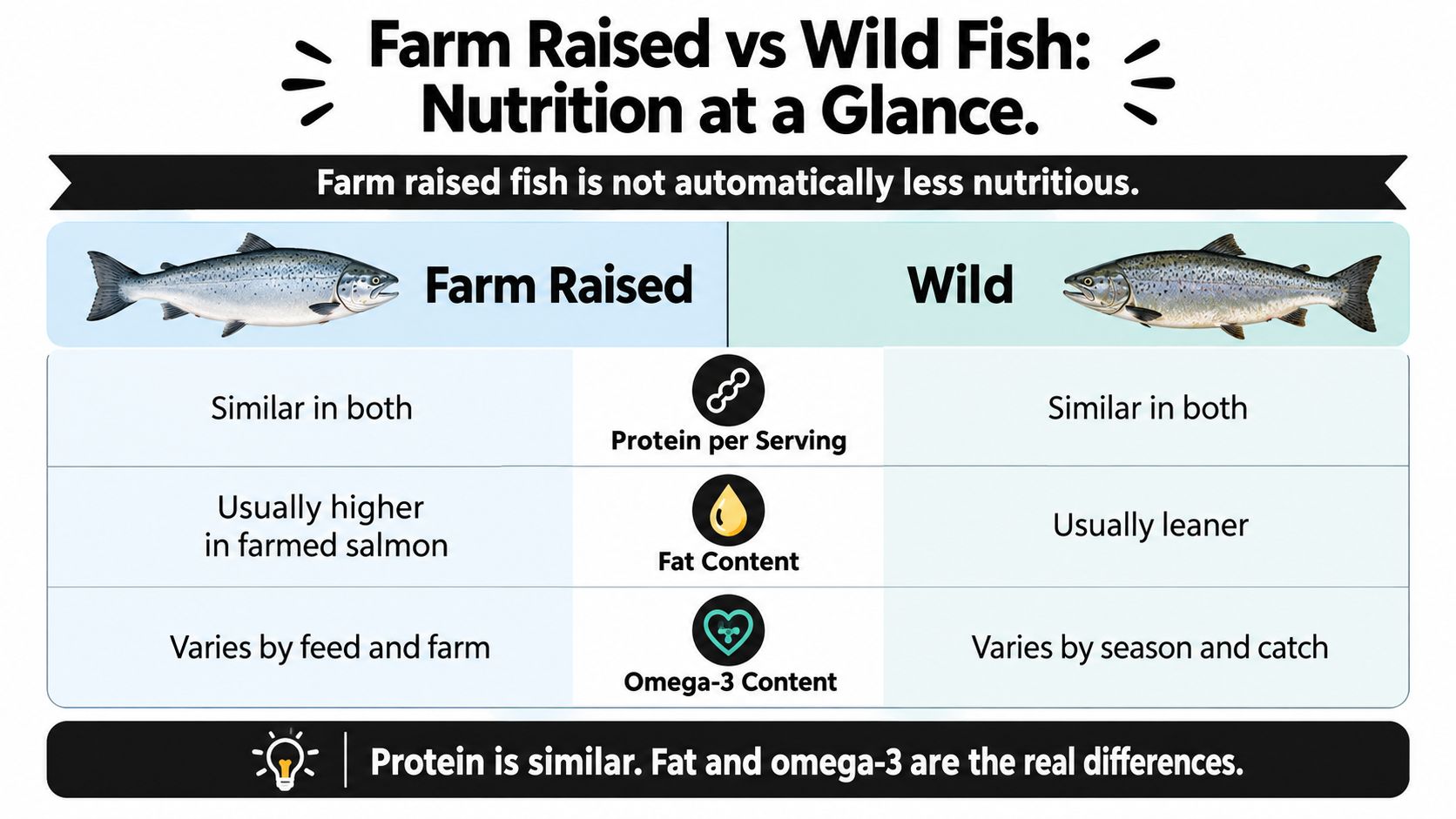
Farm raised fish isn't automatically less nutritious. Protein per serving is similar for farmed and wild fish of the same type. Fat, and the omega-3s that ride in that fat, are where the plates diverge.
Fat is the feed story
Farmed salmon usually carries more total fat than wild salmon. More fat means more calories, and it also means more of the omega-3s, EPA and DHA, that sit in fat. Wild salmon is typically leaner, so the portion looks lighter on the plate and in the pan.
The fish is what it eats, the same way grass-fed and grain-fed beef don't taste identical. When plant oils replace fish oil in the pellet, a farmed fillet's omega-3 level can drop even if the species name stays the same. Feed is the hidden ingredient. A salmon raised on a fish-oil-rich pellet and a salmon raised on a mostly plant pellet can share a species and still hand you different fats.
If heart health is why you're buying fish, portion and species still matter more than a farmed-or-wild slogan. A Bedford health shop's omega 3 guide is a plain walk-through of how EPA and DHA fit a normal week of meals, which is more useful than treating one fillet as a supplement.
How they taste, and how to cook them
Farmed fish often tastes milder and more buttery because the diet is steady and the fat is higher. Wild fish shifts with the season, tastes stronger, and usually has firmer flesh. Neither is a moral win. It's a cooking choice.
Buy one farmed fillet and one wild fillet of the same species. Sear both skin-side down in a hot pan and taste them plain. You'll learn more in ten minutes than from another argument online.
Fattier farmed fillets forgive high heat and an extra minute. Lean wild fillets want gentler heat and a shorter cook so they don't dry out. If you want to see the difference in a kitchen rather than on a chart, this short clip shows the side-by-side cook.
Salt both, skip the heavy sauce on the first try, and let the fat tell you which one belongs in tacos and which one belongs under a squeeze of lemon.
How Farming Affects the Environment
Farm-raised fish can put less pressure on some resources than certain wild fisheries, but the result depends on the species, feed, and farming system. The feed is an easy-to-miss part of that calculation: it can shift environmental pressure from the farm to the fisheries and crops that supply its ingredients.
A Food and Agriculture Organization assessment compared farmed silver and bighead carp, salmon, trout, and other finfish and crustacean groups. Silver and bighead carp had the lowest greenhouse-gas, nitrogen, and phosphorus emissions among the groups studied, while using the most water. Farmed salmon and trout used the least land and water in that comparison. Better feed-conversion ratios can reduce environmental pressures across fed aquatic animals, and higher fish yields can lower land and water use.
Feed conversion, in grocery terms
Feed-conversion ratio (FCR) measures how many kilograms of feed are needed to grow one kilogram of fish. A lower FCR means less feed is used for the same amount of fish, which can reduce waste and demand for the ingredients in the pellet, such as fish oil or grains.
Feed matters especially for carnivorous species. Salmon pellets often contain fish meal and fish oil from other fisheries, while plant-eating carp do not rely on those same marine ingredients. So the environmental picture depends in part on what the fish eats, not just whether it was farmed.
What leaves the pen
Uneaten feed and fish waste can add nutrients to nearby water. FAO feed guidance estimates that, when nutrient capture is poor, producing 1,000 kg of fish can release approximately 180 kg of solids, 13 kg of phosphorus, and 105.4 kg of nitrogen. The location and farming system affect whether that load enters a bay or is captured by a filter.
Wild fishing has environmental costs too. Boats burn fuel, and nets can catch species that fishers did not intend to land. Comparing farmed and wild fish means weighing different pressures rather than assuming either method is always better.
Producers seeking a lower FCR can adjust pellet size and feeding rate, as well as choose ingredients fish digest well. This guide to ways to improve feed conversion in fish farming explores practical approaches. For a clearer picture of a particular fish, ask the seller which species it is, what it was fed, and how much feed was used per kilogram of fish.
Contaminants and Safe Serving Guidance
For lower-mercury choices, the guidance is two to three servings a week; fish above the higher cutoff are choices to avoid. The species and its feed help explain why farmed fish can differ, while the fish's measured mercury level is what the serving guidance follows.
The FDA and EPA guidance places salmon, pollock, catfish, shrimp, and canned light tuna among commonly eaten lower-mercury choices. It recommends avoiding shark, swordfish, king mackerel, and tilefish because of higher methylmercury. Fish at or below 0.15 micrograms per gram fit the two-to-three-servings-a-week category, and fish above 0.46 micrograms per gram are choices to avoid. The EPA fish-tissue criterion is 0.3 mg/kg methylmercury, while FDA's action level for interstate seafood is 1 ppm.
| Mercury Tier | Methylmercury Level | Serving Guidance | Common Examples |
|---|---|---|---|
| Lower-mercury choices | At or below 0.15 µg/g | 2-3 servings a week | Salmon, pollock, catfish, shrimp, canned light tuna |
| Middle range | 0.15 to 0.46 µg/g | Not in the 2-3 weekly group | Species that test between those cutoffs |
| Choices to avoid | Above 0.46 µg/g | Avoid, per FDA guidance | Shark, swordfish, king mackerel, tilefish |
Species is the dose
Species sets the strength of the dose, and serving frequency sets how often you get it. Lower-tier fish can be a regular plate for most adults, at two or three servings a week. A middle-tier fish is not automatically off the menu; it is a reason to eat it less often and check the species before planning the week.
Who should be pickier
If you're pregnant, breastfeeding, or feeding young children, choose lower-mercury species and keep portions smaller. “Farm-raised” alone does not tell you a fish's contaminant profile. Species, farm or region, harvest date or lot, and testing paperwork can help clarify what is known about a particular fish.
Check the species first, then the serving, then the lot. A seller who can point to a test for that batch offers more useful information than a generic “safe seafood” sign.
Reading Farm Raised Fish Labels and Certifications
The label that matters first is the one U.S. rules already require. Under Country of Origin Labeling, covered fresh and frozen fish, including fillets, steaks, nuggets, and other fish flesh, must show both country of origin and production method, and the USDA's consumer guidance lists "farm-raised," "farmed," "wild caught," and "wild" as acceptable method words. USDA defines farm-raised fish as fish harvested in controlled environments, and that definition also includes ocean-ranched or penned fish. The declaration has to be conspicuous, and sellers have to pass origin and method information to the retailer.
So farm raised describes the method. It isn't a quality grade.
| Label or Claim | What It Tells You | What It Does Not Tell You | Where to Find It |
|---|---|---|---|
| Farm-raised or farmed | Fish was raised in a controlled environment | Species, feed or treatments | Required on covered fresh and frozen fish labels |
| Wild caught or wild | Fish was harvested from natural waters | Stock health or the gear used | Required on covered fresh and frozen fish labels |
| Country of origin | Where the fish was raised or caught | Farm practices within that country | Required on covered fresh and frozen fish labels |
| ASC certified | Third-party audit of farm environmental and social standards | Feed used on the specific lot you bought | Package logo; check the certificate code |
| BAP certified | Third-party standards covering farms, hatcheries and processing plants | Lot-level testing results | Package logo; look up the certificate number |
| Harvest date or lot code | Traceability to a specific batch | Farm practices | Package print or the seller's records |
What the logo leaves out
ASC and BAP are third-party checks on how a farm, hatchery, or plant is run. They're useful. They still may not tell you what that exact lot ate on the week it was harvested, or what a lab found in that batch. A certificate code you can look up beats a leaf icon with no number behind it.
Words like natural, sustainable, or fresh don't carry a standard unless a named program sits next to them. If the package won't say species, origin, and method, the adjective is decoration.
Run a five-second check before you pay.
- Method. Farm-raised or wild, in the words the rule allows.
- Origin. The country, not just a brand name.
- Species. Catfish, trout, salmon, not "white fish."
- One certification, only if you care, and only if you can see a code.
- A lot or harvest date, so a problem can be traced to a batch.
If any of those are missing on a covered fresh or frozen fillet, ask. A quiet label is a choice, not an accident.
Transparency Practices for Small Fish Producers
Buying directly from the person who raised the fish is a quality upgrade. There's no middleman between the pond or tank and your kitchen, so you can ask what a warehouse label never prints. The appeal is a better fillet from a real producer, not a favor you're doing them.
What to put where buyers can see it
Publish the specifics a careful shopper uses to choose.
- Species name: Channel catfish or rainbow trout, not "fresh fish."
- Farm location: Town and state, so "local" means a place.
- Harvest date or lot: One code per batch.
- Stocking density: How many fish shared the water.
- Feed type: Plant pellets, fish-meal pellets, or a named mix.
- Feed conversion ratio: Kilograms of feed per kilogram of fish.
- Treatments: What was used, plus the withdrawal period before harvest.
- Chill time: How fast the fish hit ice, and how cold storage was held.
Make the feed number real
Feed to demand when the fish will take it, instead of dumping a guessed ration. Weigh what you put in. Log it every week. An FCR you calculated from those weights is a number. An FCR you remember from last season is a story.
Say what you test and what you don't. If you have mercury or residue results for a lot, keep them with that lot. If you aren't certified to a named program, say so and say why. Honesty about the gap beats a vague "responsibly raised" line.
A marketplace like Loyaltie, where people discover and buy directly from independent brands in the US, is one place to put that record in front of nearby buyers. Pair it with your own page, a farmers-market sign, or a note in the box. The format matters less than the facts. Species, place, feed, lot, and chill. That's the upgrade people can taste and trace.
Choosing Your Next Fillet With Confidence
What makes a fillet worth bringing home? Start with the species, then look at its origin, feed, handling, and price. Those details give you a clearer answer than the farm-raised or wild label alone, because species and feed shape what reaches your plate.
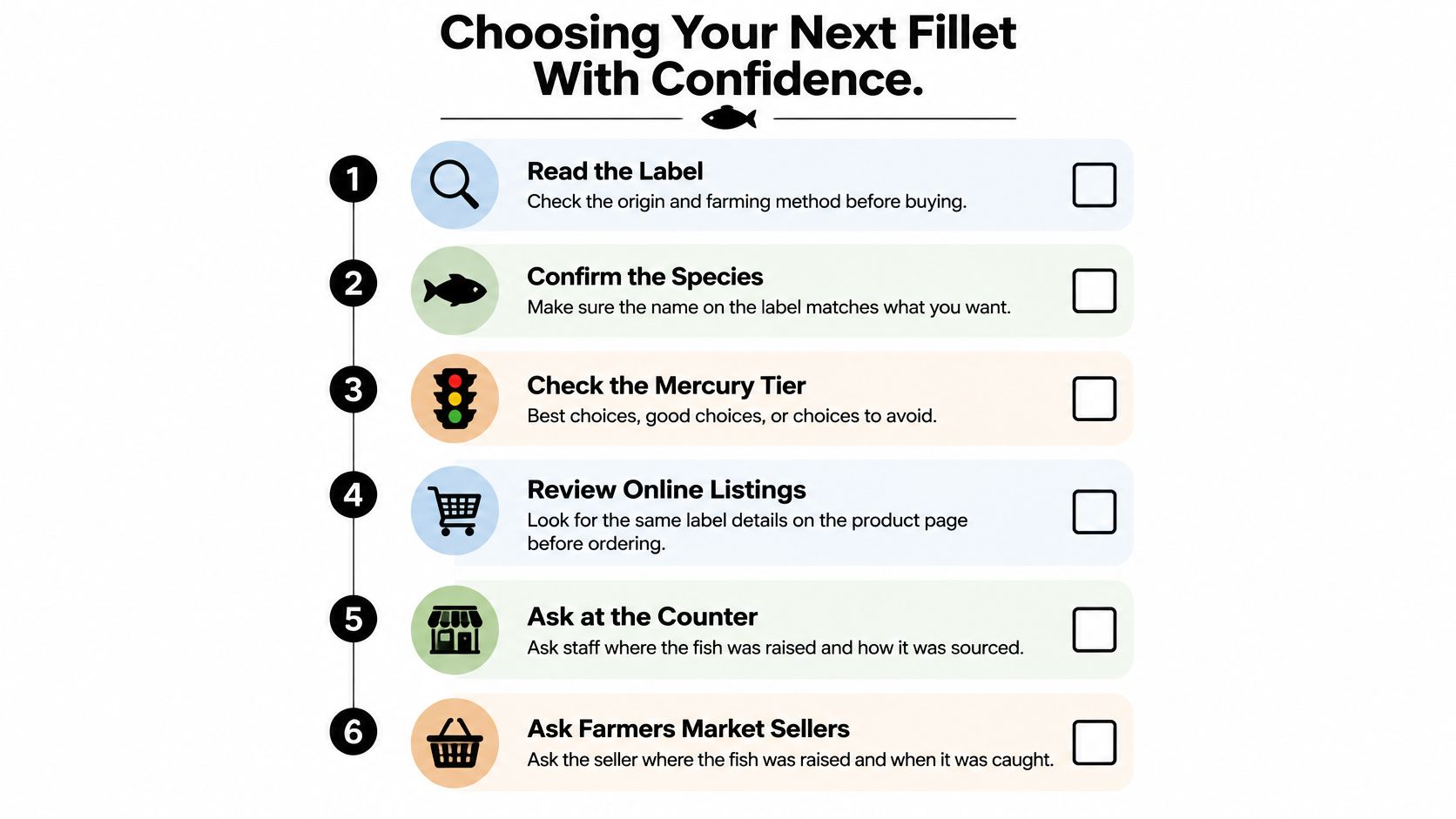
- Check the species. Look for catfish, trout, or salmon by name. A specific name gives you something concrete to compare.
- Match the mercury tier to your household. Consider how often you serve that species, and take extra care if you're pregnant, breastfeeding, or feeding children.
- Read the method and origin. Look for farm-raised or wild and the country of origin. A certification code can add useful context if you want to check it.
- Look for a harvest date or lot code. That detail makes it easier to trace a fish back to its batch.
- Check signs of handling. The fish should have been chilled or frozen promptly. Skip fillets with a sour smell, dried edges, or a thick ice glaze that obscures the fish.
- Compare the cost of a serving. A fattier farmed fillet may stretch into more meals than a leaner one that cooks down.
Then ask, and buy closer to the source
Ask what the fish was fed, where it was raised, and when it was harvested. Feed is the hidden ingredient: two fish with the same species name can differ depending on what the farm feeds them. A specific answer about feed and origin helps you judge the fillet, while a vague label leaves those details unclear.
Chefs also check origin before choosing a cut. A chef's guide to choosing Wagyu offers a useful parallel: knowing where a product comes from helps you make a more informed choice.
When shopping online, compare the details each producer shares, especially species, location, feed, and lot. For a fillet with good flavor, a little all-purpose seafood seasoning can complement the fish without needing to cover it up.
Try one lower-mercury farmed fish and one option with a certification code you can look up. Cook each plainly, notice what you prefer, and choose the producer who gives a clear answer about the feed.