
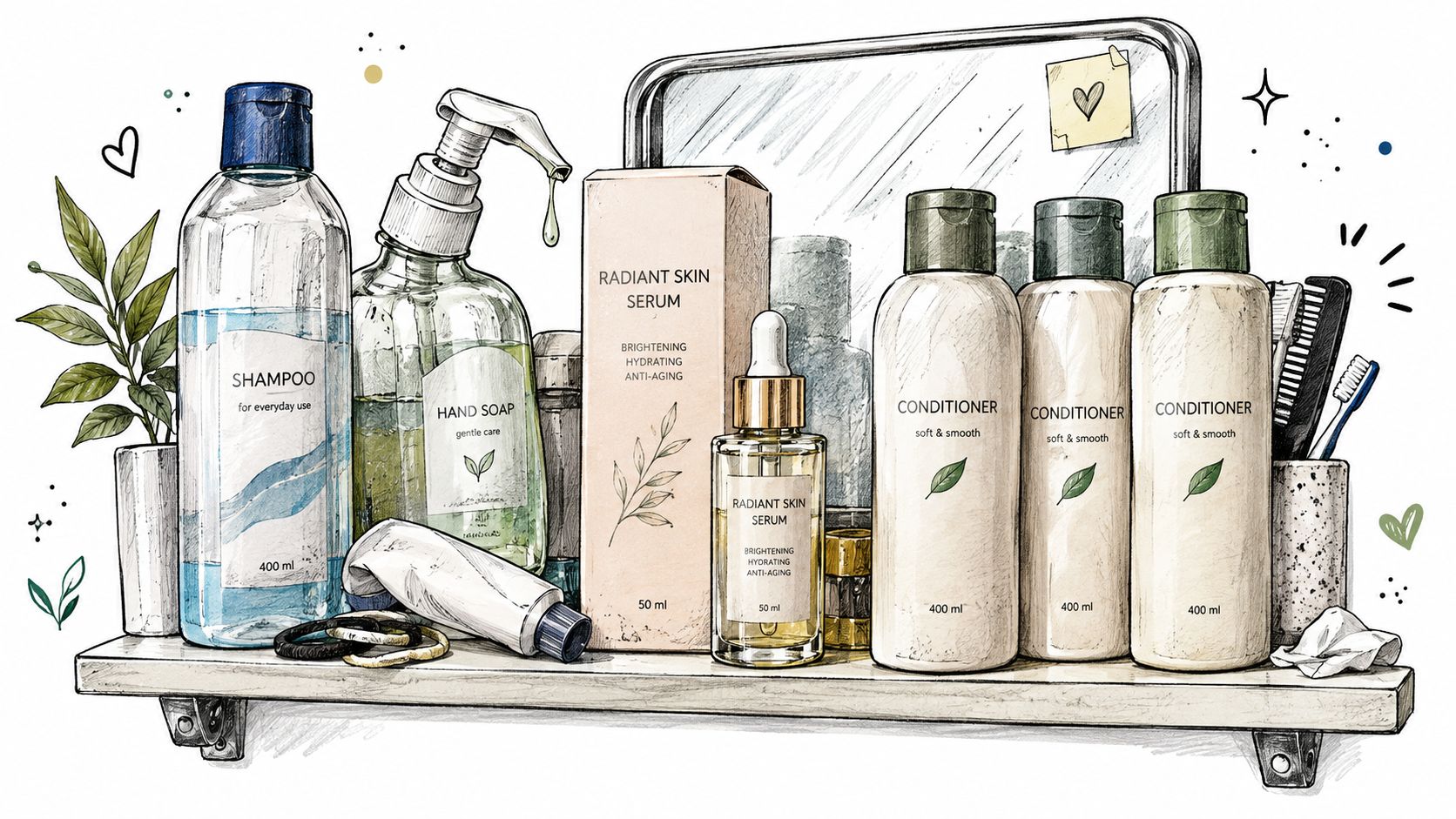
You're standing in front of a bathroom shelf that looks less like a routine and more like a packaging graveyard. Half-used plastic bottles lean against one another, a pump has stopped working while plenty of lotion remains, and a serum arrived in a box large enough to hold a pair of shoes. There are three conditioners that seem almost identical, plus a razor that can't go in the recycling bin.
That quiet annoyance is a useful starting point. Zero waste beauty products aren't about achieving a perfectly empty bathroom overnight. They're about removing the waste that contributes nothing, choosing formats that work in real life, and buying better products from people who can explain exactly how they're made.
The practical path matters because beauty creates a huge materials problem. The industry generates more than 120 billion packaging units globally every year, while industry summaries estimate that about 95% of cosmetic packaging is thrown away and packaging represents roughly 70% of the sector's total waste (packaging waste facts). You don't need to replace everything today. You need a sensible order of attack, honest label reading, and makers who treat packaging as part of the product.
Table of Contents
The Bathroom Shelf That Started You Down This Path
Start by taking everything out of the cabinet. Not to shame yourself, but to see the pattern. A facial oil in a tiny glass bottle may have arrived with a cardboard insert, a printed sleeve, and a shipping box. Your cleanser may use a plastic bottle, a plastic pump, and a cap made from a different material. Even products you use responsibly can create unnecessary waste when the packaging system was designed for disposal.
The worst offenders usually aren't dramatic. They're the products you repurchase without thinking: shampoo, conditioner, body wash, deodorant, cotton rounds, and makeup remover. The packaging adds up because these products move through your routine repeatedly.
Start with the waste you can actually remove
Don't begin by throwing away usable products. Finish what works, then replace one category at a time. A naked shampoo bar, a refillable cleanser, or reusable makeup rounds can remove a recurring packaging stream without forcing you to rebuild your whole routine.
Your choices should also account for performance. A bar that leaves your scalp irritated isn't a successful swap, and a refill system you never use properly isn't automatically low waste. The best change is the one you'll keep using.
This guide covers what zero waste beauty products mean, which packaging formats deserve your money, why refill and recycling claims often fail, and how to switch without creating a new pile of abandoned products. It also covers how independent makers can formulate, package, label, and sell low-waste beauty products through a local marketplace. You'll get concrete swaps, not a demand for perfection.
What Zero Waste Beauty Products Actually Mean
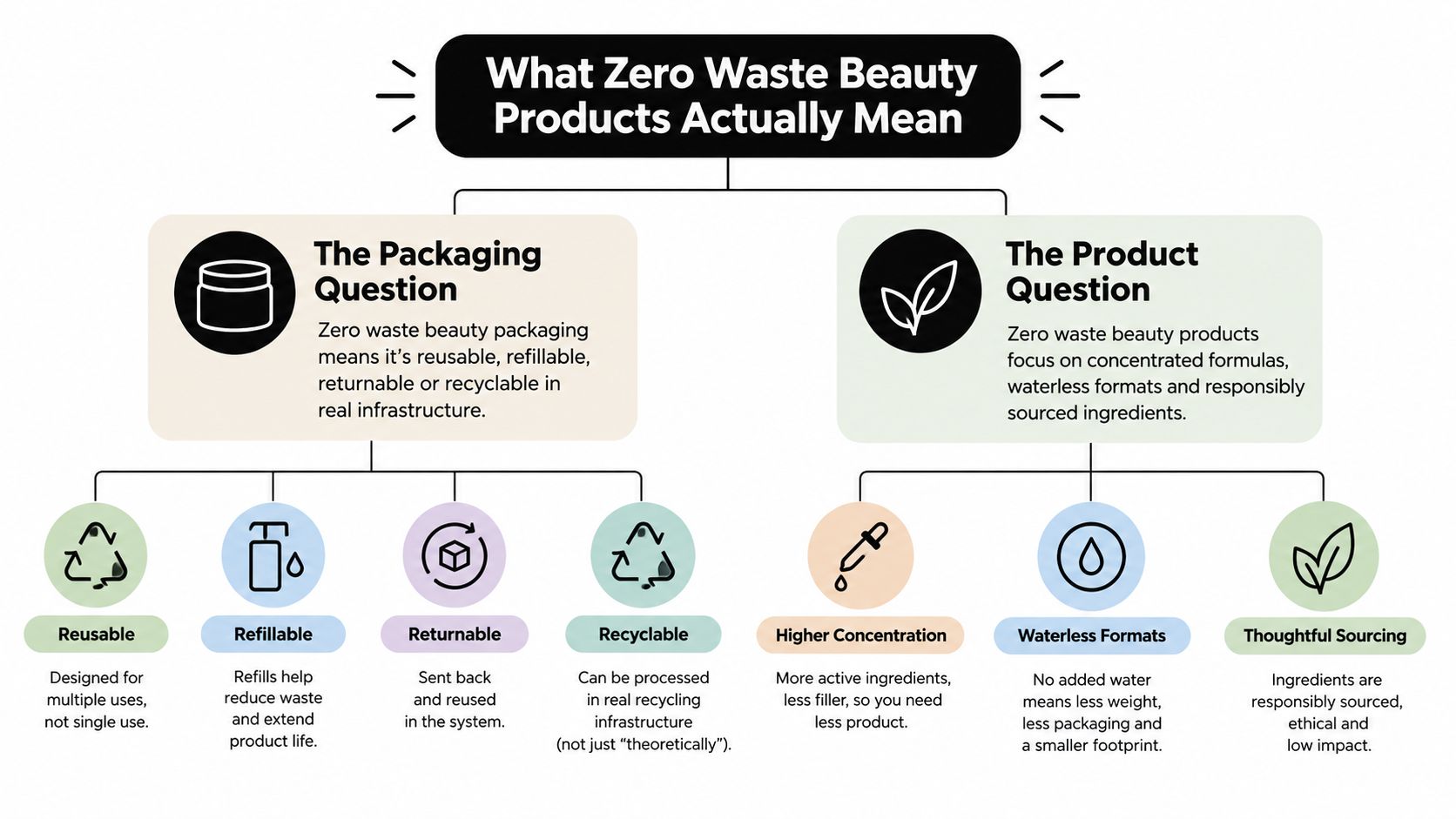
The phrase sounds simple, but it hides two separate decisions. The first concerns the package. The second concerns the formula inside it.
The packaging question
Ask whether the container is naked, reusable, refillable, returnable, or recyclable through infrastructure you can access. “Recyclable” on a label doesn't tell you whether your local program accepts the format, whether the material is clean enough, or whether sorting equipment can capture it.
A naked bar removes the container entirely, but it still needs protection from moisture during storage and shipping. A liquid lotion in returnable glass may use more transport weight than a solid lotion bar, yet the return system can make the container useful over and over. A refill pouch can reduce packaging material, but only if its end-of-life route and return behavior make sense.
The product question
Formula design matters too. Concentrated products, solids, powders, and waterless formats can reduce the need to ship water and may require less packaging. Ingredients should also be considered for biodegradability, sourcing, processing, and what happens when the product enters wastewater.
That doesn't mean every synthetic ingredient makes a product unacceptable. A refillable lotion with a synthetic preservative can still be a strong zero waste beauty product if the refill loop works and the formula stays safe. Conversely, a shampoo bar wrapped in plastic doesn't become low waste just because it's solid.
Practical rule: Judge the whole system, not the most appealing word on the front label.
For a plain-language introduction to lower-waste routines, this green self-care guide by ArtNaturals is a useful companion. If you're considering a solid cleanser for the hair, compare the format and care instructions with this nettle and honey shampoo bar.
“Zero waste” usually means waste reduction, not literal elimination. Your goal is to choose the option with the clearest path to repeated use, recovery, or reduced material demand.
Packaging Formats Worth Choosing and Ones to Skip
No packaging format wins every category. A solid shampoo and a facial serum have different stability, hygiene, and transport needs. Match the package to the product instead of treating one material as morally superior.
Packaging Formats Compared
| Format | Strengths | Watch Out For | Best For |
|---|---|---|---|
| Naked bar | Eliminates a primary container and works well for concentrated formulas | Needs a dry storage dish and protection during transit | Shampoo, conditioner, soap, cleansing bars |
| Refill pouch | Uses less material than a rigid bottle and can keep a durable container in use | Many pouches aren't accepted in curbside recycling and may add shipping or cleaning demands | Products with a clear take-back or verified material route |
| Glass jar with deposit return | Durable, reusable, and easy to understand | Heavy to transport, breakable, and dependent on a functioning return loop | Local lotions, balms, masks, and facial products |
| Aluminum tin | Lightweight, durable, and useful for solids | Coatings, lids, and residue can complicate recovery | Balms, salves, solid moisturizers, and deodorant |
| Paper-wrapped stick | Cuts down on plastic and suits firm products | Paper can absorb moisture, and mixed lining may undermine recovery | Deodorant, soap, and solid skincare |
| Traditional plastic pump | Familiar, protective, and convenient | Pumps often combine materials that local sorting systems can't separate | Only when refill, return, or a verified recovery route exists |
The format I'd choose first is a naked bar, provided the formula suits your hair or skin. It removes packaging at the source and avoids the uncertainty around small containers. Store it on a draining dish, not in standing water, or you'll use up the product faster than necessary.
Glass makes more sense for local buying than for long-distance shipping. A maker who sells a facial balm in a deposit-return jar can collect containers directly, clean them, and keep the loop visible. For an example of a reusable glass format, look at this Hinoki body spray in a reusable glass bottle.
Skip first:
- Oversized shipping boxes: They add material without improving the formula.
- Mixed-material pumps: They're difficult to disassemble and often escape recovery.
- Unclear compostable films: A compostable claim means little without a collection route.
- Miniature containers: Small formats are physically harder for sorting systems to capture.
Why Most Refill and Recyclable Claims Quietly Underperform
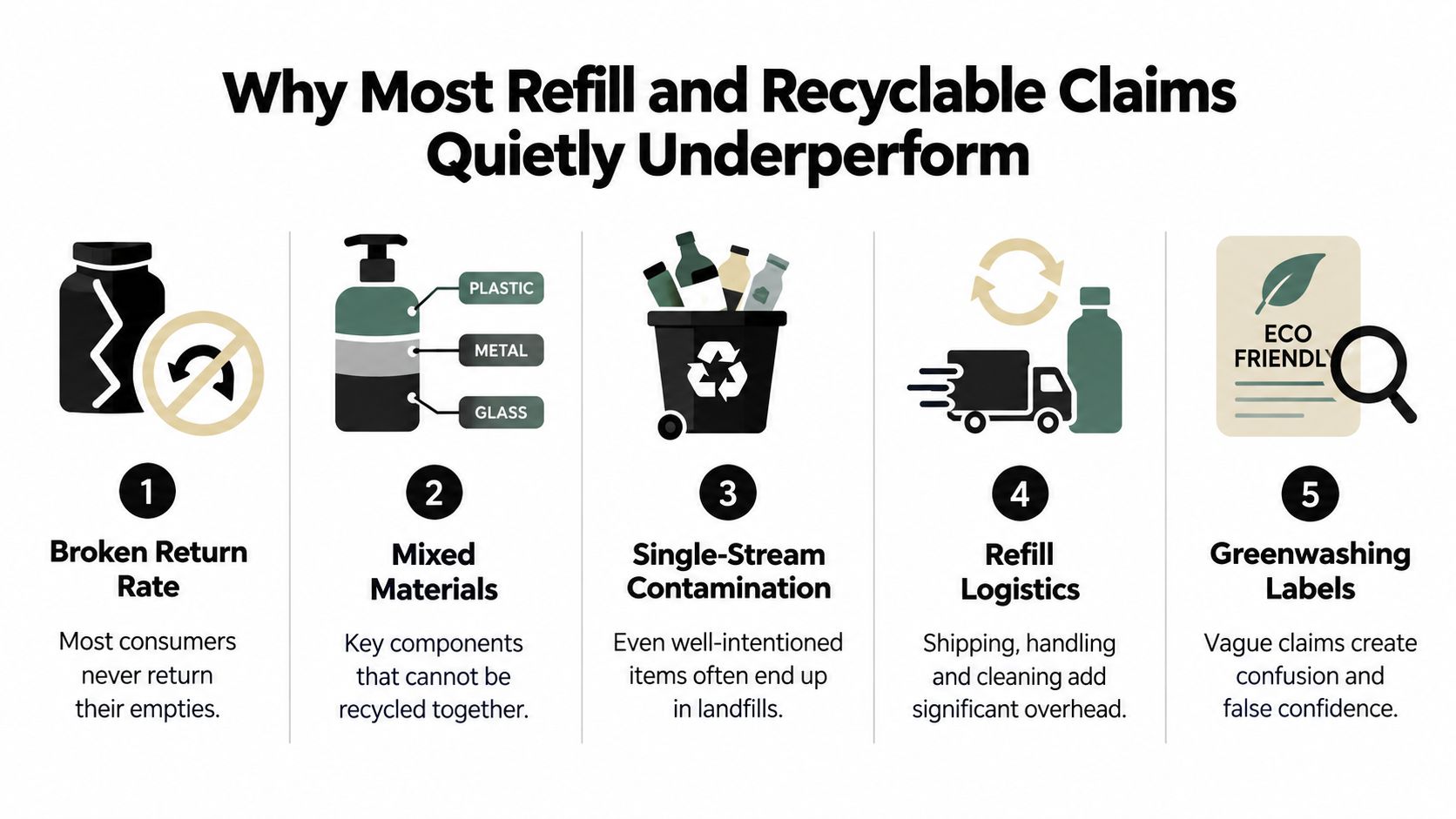
A refill label is a promise about behavior and infrastructure, not proof of lower waste. An independent 2023 study covering 14 skincare and makeup refill programs found that only 3 achieved net plastic reduction after transport, secondary packaging, and real consumer return rates were included. The average return rate was just 12% (refill program analysis).
That changes how you should evaluate refills. A lightweight pouch may use less material than a rigid bottle, but if you order it through a long delivery route, throw it away afterward, and never return the container, the system may not deliver the result you expected. Reuse depends on completed cycles, not the existence of a refill product.
Recycling has a similar weakness. Small containers, pumps, mascara wands, lipstick tubes, compacts, deodorant sticks, and travel-size packaging are often not accepted in curbside programs. By contrast, large HDPE number two shampoo, conditioner, and body-wash bottles are generally accepted, although local rules still control (cosmetics recycling guidance).
Run these questions before you buy:
- What return rate does this system need? If the answer isn't clear, assume the return loop is unproven.
- What local infrastructure exists? Check your municipal guidance and the maker's take-back instructions.
- What happens if you skip the return trip? Choose the option with the least damaging fallback.
For a deeper visual explanation of the failure points, watch the video below.
The strongest claim is the one that still looks reasonable in the worst-case scenario. If the container ends up in the trash, the product should have minimized material from the start.
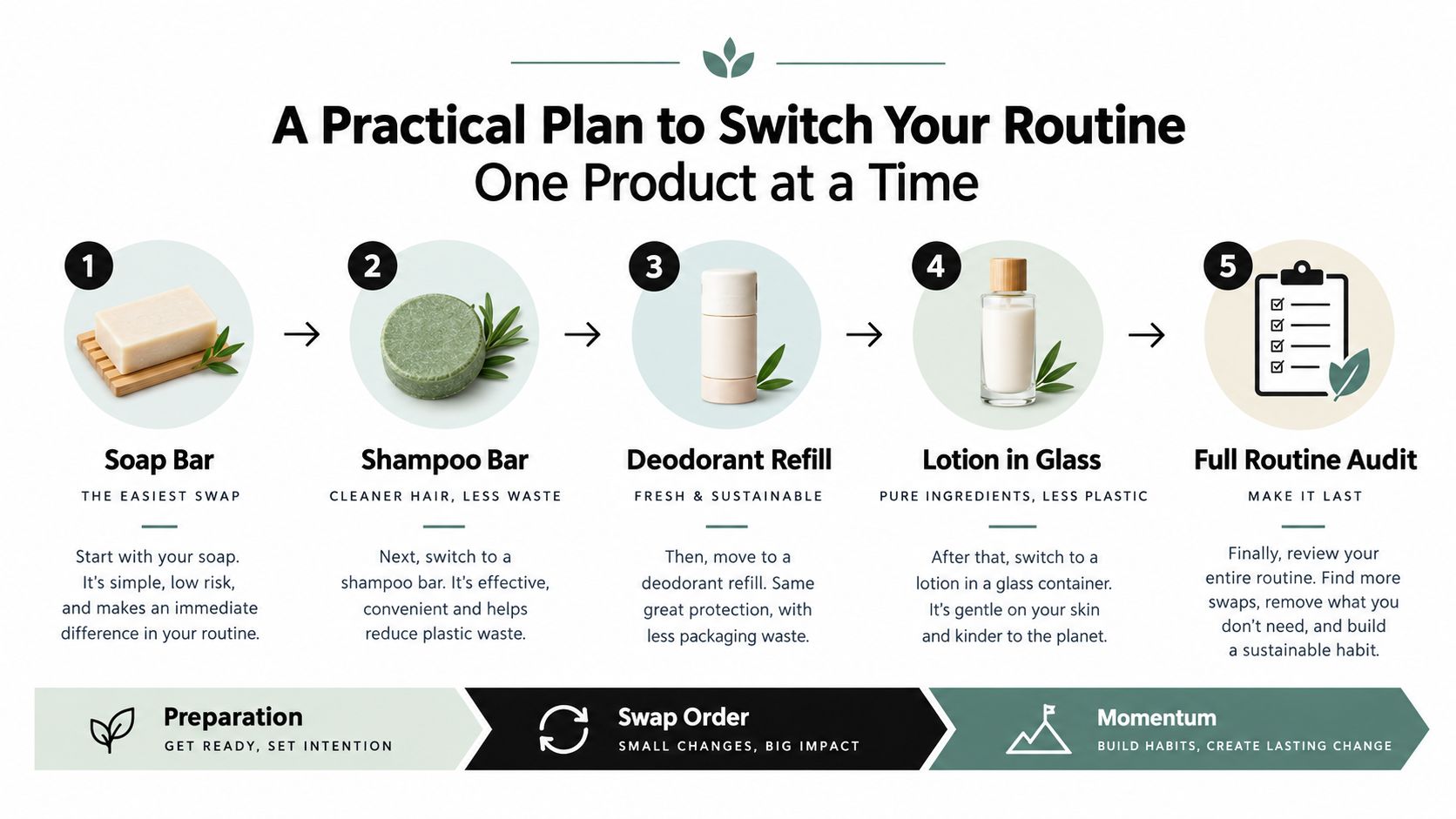
A Practical Plan to Switch Your Routine One Product at a Time
Don't replace your whole bathroom in one weekend. That creates waste, costs more, and leaves you with products you haven't tested. Use the routine you already have as the testing ground.
Begin with the easiest win
Start with soap, then shampoo or conditioner. Solid formats are easy to understand, and you can compare performance without changing every product at once. For a sensitive scalp, look for an SLS-free formula and give the bar enough time to dry between uses.
Next, test a bar conditioner or a refillable cleanser. A skin bar should be pH-balanced, while reactive skin usually does better with a fragrance-free option. Don't buy a product with a new-to-you formulation without patch-testing it first.
Build the routine carefully
A sensible order looks like this:
- Soap bar: Choose a formula that doesn't leave your skin tight or squeaky.
- Shampoo or conditioner bar: Store it dry and assess scalp comfort, buildup, and manageability.
- Naked deodorant: Check application texture and avoid a first purchase that feels difficult to control.
- Refillable cleanser: Confirm how you'll return, clean, or recycle the refill before ordering.
- Makeup removal: Try reusable cotton rounds with an oil cleanser, then wash and dry the rounds properly.
Skip anything with no ingredient list, a suspiciously low price, or a brand-new formulation you haven't patch-tested. Low cost doesn't prove poor quality, but missing information makes a product impossible to assess responsibly.
Keep your conventional backup until you've finished the swap and tested the replacement for two weeks. That rule prevents one disappointing bar from sending you straight back to disposable packaging.
Use a notes file or photo log. Record how the product feels, how long it lasts, whether the packaging was easy to handle, and what you did with the empty. Honest tracking beats abandoning the entire idea after one bad hair day.
Reading Labels and Certifications With Confidence
Labels answer different questions, so don't treat every logo as proof of the same thing. FSC relates to paper packaging, while USDA Organic and COSMOS Organic concern formulation standards. Leaping Bunny and Cruelty Free International address animal-testing policies. EWG Verified focuses on ingredient screening, and B Corp evaluates company-wide practices.
Certifications and Claims Compared
| Certification or Claim | What It Verifies | Third-Party Verified |
|---|---|---|
| B Corp | Company-wide social and environmental practices | Yes, through the certification process |
| EWG Verified | Ingredient screening and product disclosure criteria | Yes |
| USDA Organic | Organic production and handling standards for qualifying products | Yes |
| COSMOS Organic | Organic and natural cosmetic standards | Yes |
| Leaping Bunny | Animal-testing policy compliance | Yes |
| Cruelty Free International | Animal-testing policy compliance | Yes |
| FSC | Responsible sourcing of paper and wood-based materials | Yes |
| “Natural” | No single universal definition | No, unless paired with a separate standard |
| “Eco-friendly” | Broad environmental positioning | No |
| “Clean beauty” | Brand-defined ingredient or formulation philosophy | Usually no |
A certification doesn't automatically tell you whether the package is reusable or locally recyclable. It answers a narrower question, which is why you need to read the actual format too.
For ingredients, pay attention to undisclosed fragrance, parabens, phthalates, PEGs, and synthetic musks if you're avoiding potential endocrine disruptors. The word “fragrance” can legally cover many undisclosed chemicals, so ask the maker what it contains if the label doesn't clarify.
Use a 30-second scan:
- Certification: Identify what the logo verifies.
- Ingredient order: Check the first ingredients and look for the full INCI list.
- Packaging format: Decide what happens to the container after use.
That order keeps attractive packaging from distracting you from an unsuitable formula or vague disclosure.
Finding Independent Makers Who Get Zero Waste Right
Independent brands and local makers often give you something mass-produced products rarely provide: a direct explanation of the formula, the packaging, and the production process. That isn't charity. It's a quality upgrade when the maker uses transparent ingredients, practical formats, and a supply chain you can understand.
Use the listing as evidence
Look for four details before buying:
- Packaging: Does the maker name the actual container material and explain disposal or return?
- Refills: Are refills genuinely available, or is the product only sold once in a new container?
- Ingredients: Is there a complete INCI list, along with useful sourcing notes?
- Proof: Are certifications documented, or does the listing rely on self-declared terms such as “green” or “clean”?
A maker who lists a physical location and answers questions plainly earns more trust than a polished product page full of sweeping environmental language. You should be able to ask how the refill is handled, whether a tin can be returned, and what happens to damaged stock.
Waste occurs before products reach your bathroom too. Industry reporting has estimated that more than 10% of beauty and personal care products are wasted in the supply chain, with about $4.8 billion in lost value each year, including waste linked to overproduction and damage or spoilage (supply-chain waste reporting). A maker who produces carefully and sells directly can explain that inventory better than a distant, opaque distribution chain.
A quality-filtered local marketplace can shorten the search. Use this reusable bamboo makeup remover pad set as the kind of listing to assess closely. Look beyond the product name and check the material, care instructions, seller location, and end-of-life guidance.
How Local Makers Can Build and Sell Zero Waste Beauty Products
Makers should begin with the formula, not the label design. Waterless products such as balms, oil serums, and bars can avoid some preservation demands because they don't contain added water. Powder-to-foam formats can also reduce water in the product itself, but they still need clear instructions and packaging that protects the powder from moisture.
Anhydrous doesn't mean risk-free. Makers need appropriate stability, safety, sanitation, and shelf-life practices. Any claim about benefits, sourcing, biodegradability, or environmental performance needs evidence that supports the wording.
Choose packaging that matches the product
For local production, aluminum tins, glass jars with metal lids, and paper-wrapped bars are practical starting points. Refill pouches can work when the film is truly mono-material and accepted through a known recovery route, but a maker shouldn't call a pouch recyclable just because one component is recyclable.
| Packaging Format | Best For | Pros | Cons |
|---|---|---|---|
| Aluminum tin | Balms, salves, solid moisturizers | Light, durable, and useful for waterless products | May need cleaning and clear disposal guidance |
| Glass jar with metal lid | Creams, masks, and oils | Reusable and familiar to buyers | Heavy and breakable in shipping |
| Paper-wrapped bar | Soap, shampoo, and conditioner | Minimal material and easy storage | Needs moisture protection |
| Mono-material refill pouch | Liquids and concentrated refills | Can reduce rigid packaging | Only works when the recovery route is real |
| Returnable container | Local lotions and cleansers | Keeps packaging in a direct loop | Requires collection, cleaning, and customer participation |
Labels should include the full INCI list, net weight, batch or lot identifier, allergen disclosures, shelf life or period-after-opening guidance, and any required warnings. Keep claims specific. “Made with organic jojoba oil” is more useful than “eco-friendly beauty,” provided the maker can substantiate it.
Price the product transparently. Add ingredients, packaging, labels, labor, and platform fees before setting the retail price. Then make the buying system easy: create a Loyaltie shop, offer localized pickup where practical, group refills into clear bundles, and use accurate zero-waste badges only when the product meets the stated criteria.
Loyaltie is a marketplace where people discover and buy directly from independent brands in the US, including local makers offering lower-waste beauty and personal care. Visit Loyaltie to compare products, review maker details, and find a routine that replaces disposable packaging without asking you to compromise on quality.