If you're buying local honey because someone told you it prevents hay fever, pause before you spend more. The American Academy of Allergy, Asthma & Immunology says the pollen that usually triggers seasonal allergies comes from wind-borne trees, grasses, and weeds, while honey mostly contains pollen from flowers pollinated by insects. It also says there are no high-quality studies proving that local honey treats allergic rhinitis, and the relevant pollen amount in honey is unknown and almost certainly too low to create a therapeutic immune response. (American Academy of Allergy, Asthma & Immunology)
That doesn't make local honey pointless. It means the better reasons to buy it are more grounded in what you can taste, inspect, and trace: regional flavor, freshness, a shorter supply chain, and a clearer relationship with the person who produced it. Honey is also a global commodity, and concerns about adulteration make provenance more meaningful than a vague “natural” label.
Table of Contents
- Can children eat raw local honey?
- How long does local honey stay fresh?
- Is cloudy or crystallized honey spoiled?
- Is local honey worth the higher price?
The Real Reasons Local Honey Is Worth Buying
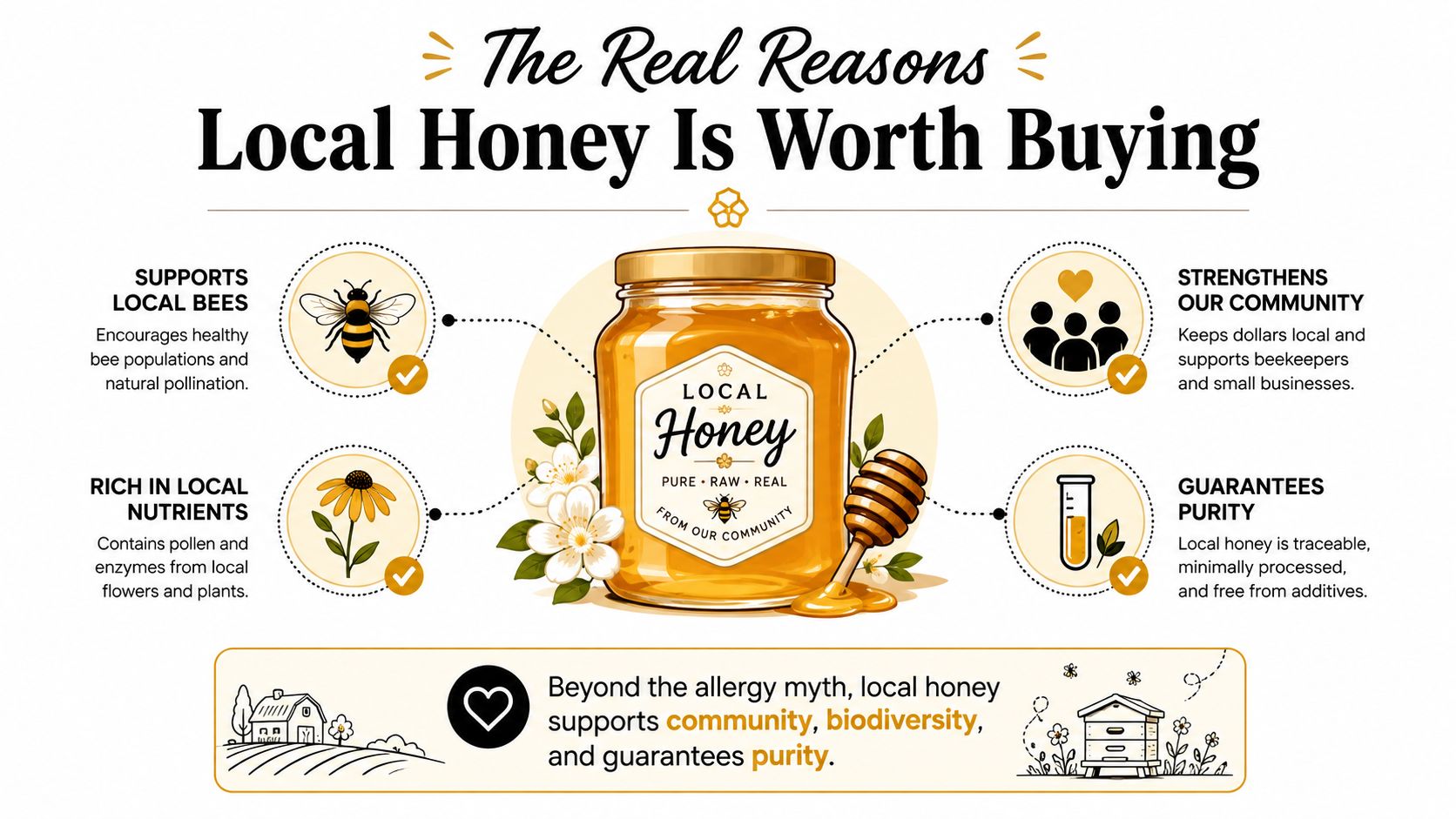
The strongest answer to why buy local honey starts with flavor, not folklore. Bees collect nectar from the plants blooming around their hives, so a jar from a particular region can reflect clover, wildflowers, citrus blossoms, buckwheat, or another local forage pattern. The result isn't always dramatic or easy to name, but genuine honey can have floral, herbal, fruity, earthy, or lightly toasted notes that disappear when every batch is blended into a uniform product.
Processing matters, too. Many independent makers extract honey gently, strain out wax and debris, and bottle it without aggressive heat treatment. That approach can preserve more of the honey's natural aroma and create a texture that changes with the season. “Raw” doesn't automatically mean local or better, but a local raw jar gives you a clearer chance to experience the character of that harvest.
What changes in your kitchen
A short route from hive to jar can make the product easier to understand. You may be able to learn which county the bees foraged in, when the honey was harvested, how it was strained, and whether the producer warms it during bottling. That kind of information is much more useful than a front label promising “pure” or “natural” without explaining origin.
Traceability also changes how you shop. If you want to compare batches, ask about forage, or report a problem, you have a named maker to contact rather than an anonymous chain of processors and importers. You can start with a clearly identified product such as raw wildflower honey from AR's Hot Honey, then apply the same questions to a local market find.
The environmental case needs careful wording. Buying from a nearby beekeeper can keep your purchase connected to regional pollination and local ecosystems, but honey alone doesn't guarantee responsible beekeeping. Look for producers who can explain how they manage hives, protect forage, and work with the local environment rather than treating “local” as an automatic sustainability certificate.
How Local Honey Actually Differs from Store Brands
A supermarket jar and a beekeeper's jar may both say honey, yet they can represent very different journeys. Commercial honey is often blended from multiple sources to create a consistent color, texture, and taste. That consistency helps retailers stock a predictable product, but it can blur the identity of the individual harvest.
Some commercial processors also filter honey very finely to remove pollen and other particles, improve clarity, and slow visible crystallization. High-heat processing can further change aroma and reduce heat-sensitive compounds, including enzymes such as diastase and invertase. The exact process varies by brand, so don't assume every supermarket honey receives the same treatment. Read the label and ask the manufacturer when the information matters to you.
A neighborhood beekeeper usually works with a smaller number of identifiable apiaries. The honey may be extracted, strained, and bottled with less intervention, leaving more variation from one harvest to the next. That variation is useful information, not a defect. It tells you the jar reflects a season and a place rather than a formula designed to taste identical year-round.
A side-by-side look
Think of the difference like fresh-pressed apple juice compared with a shelf-stable juice box. The second product can be convenient and safe, but the first usually gives you a stronger sense of the fruit and the pressing. Honey isn't juice, of course, but the comparison makes processing easier to understand.
| Attribute | Local / Independent | Commercial / Supermarket |
|---|---|---|
| Origin | Often tied to a named beekeeper, apiary, town, or region | May combine honey from multiple regions or countries |
| Flavor | Can shift with local flowers, season, and harvest | Usually designed for a consistent taste |
| Processing | Often gently extracted and strained, depending on the producer | May be finely filtered and heat-treated, depending on the brand |
| Appearance | Color and clarity can vary between batches | Often selected for uniform clarity and appearance |
| Crystallization | May crystallize at a natural, uneven pace | Processing and blending may delay or reduce visible crystallization |
| Questions | You may speak directly with the producer | You may need to contact a processor or brand owner |
What you'll notice first
Taste is usually the easiest test. Local honey may smell more floral when you open the lid, feel thicker or more grainy as it crystallizes, and finish with something beyond simple sweetness. A jar can also be pale, amber, or dark without any one color proving quality. The important difference is whether the sensory experience has character and whether the maker can explain why that batch tastes the way it does.
What About Allergies and Other Health Claims
The popular allergy story sounds plausible: bees visit local flowers, local plants release pollen, and eating local honey supposedly trains your immune system. The problem is that the pollen in honey usually isn't the same pollen that drives seasonal allergic rhinitis. Clinical summaries report that local honey typically contains mostly insect-pollinated floral pollen, while the relevant tree, grass, and weed pollen travels through the air.
Controlled trials haven't shown local honey to provide a significant symptom benefit compared with placebo, and medical guidance doesn't support it as a treatment for hay fever, allergic rhinitis, or asthma. (GoodRx's clinical summary) The broader evidence review also concludes that there aren't high-quality studies demonstrating that local honey works for allergic rhinitis. (Independent medical review)
Medical reality: Local honey can be a pleasant food, but it isn't a reliable form of allergy desensitization.
That correction shouldn't leave you feeling tricked. Genuine honey has properties that explain why people find it soothing in food and drinks. Honey's low pH and hydrogen peroxide production contribute to antimicrobial activity, while darker varieties can contain more antioxidant compounds and honey can provide trace minerals. Those characteristics belong to honey itself, especially genuine raw honey, not exclusively to jars produced near your home.
Choose the right reason
If you're trying to understand your symptoms, identify triggers, or decide whether testing makes sense, browse allergy testing with Repose Healthcare rather than relying on a farmers' market claim. Honey shouldn't replace medical advice or an appropriate allergy treatment plan.
You can still choose local honey for its taste, freshness, traceability, and clearer origin. You might also enjoy products that contain bee-derived ingredients, such as digestive and liver support capsules with bee pollen, royal jelly, and propolis, but don't confuse the presence of bee products with proof of allergy treatment. The useful distinction is simple: folklore explains a buying habit, while biochemistry and clinical evidence tell you what the product can realistically do.
Why Provenance and Fraud Matter More Than You Think
A honey jar can look simple while hiding a long chain of custody. Global production rose from 1.25 million tons in 2000 to 1.83 million tons in 2022, a 45.8% increase, according to FAO production data via AGRIS. The same source reports that Asia supplied 44% of global production, Europe 24%, the Americas 19%, Africa 11%, and Oceania 2%.
Those figures do not make imported honey fraudulent. They show why a jar may pass through exporters, processors, blenders, and retailers before reaching your kitchen. With every handoff, a basic question becomes harder to answer: where did this honey come from?
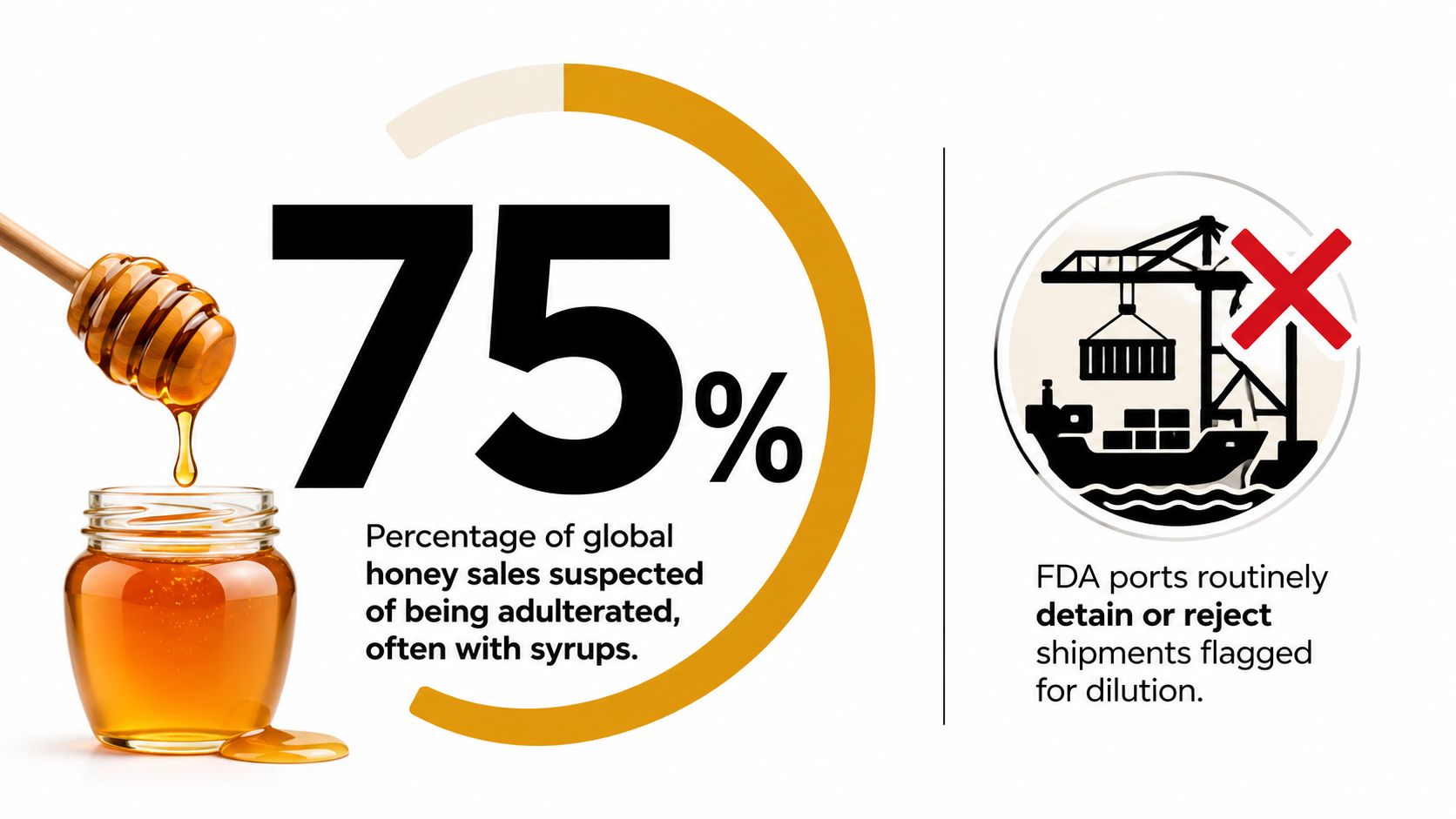
FDA sampling gives the concern a concrete shape. In 2025, the agency tested 102 honey samples and found about 4% of domestic products violative, including 2 of 54 samples, and about 4% of imported products, including 2 of 48. An earlier 2021–2022 assignment found 10% of 144 imported samples violative, while the 2022–2023 assignment found 3% of 107 imported samples violative. These are sampling results, not proof that every imported jar is suspect. (FDA honey sampling results)
What adulteration means for you
Honey fraud can involve inexpensive cane, corn, rice, or sugar-beet syrups. The Congressional Research Service overview notes that FDA guidance treats pure honey as free of added sugar or syrup. If sweeteners are added, the product should be labeled as a blend.
Local sourcing is not a purity certificate. It can shorten the route between beekeeper and buyer, though. You can ask who harvested the honey, where the hives stood, and what went into the jar. For a concrete example, compare the details offered for raw wildflower honey from Shenandoah Valley, Virginia. That kind of traceability cannot guarantee authenticity, but it gives honest producers a clearer way to stand apart from anonymous blends.
Buying Directly from Independent Local Producers
An independent local producer is usually easy to recognize once you know what to look for. The label may name the beekeeper, identify a town or county, list an apiary region, and provide a way to get in touch. The producer might harvest and bottle the honey personally or work with a nearby facility while still knowing exactly which hives supplied the batch.
That direct connection is the quality upgrade. Instead of choosing a jar because its packaging looks rustic, you can ask practical questions and judge the answers. A beekeeper who knows the forage area can tell you whether the honey came mostly from clover, orange blossom, buckwheat, or mixed wildflowers. They can also explain how they removed wax, whether they used heat, and how they stored the finished jars.
Why single-origin flavor is useful
Single-origin doesn't mean every bee visited only one flower. Bees forage where conditions lead them, and a producer may use a botanical label to describe the dominant nectar source or a recognized floral profile. Still, a clearly identified harvest gives you a better chance of tasting a distinct variety rather than a neutral blend.
Supermarket honey can travel through processors, co-packers, exporters, and distributors before it reaches a shelf. Direct buying removes some of that distance and gives the maker a visible role in the product. You're not purchasing out of pity or treating a jar as a donation. You're paying for a food with a known maker, a narrower chain of custody, and a flavor that may be specific to its region.
If you're exploring independent producers beyond honey, browse French producer listings for another example of how direct discovery can connect shoppers with named makers and local products. The same habit works at a farmers' market: read the label, ask a question, and buy the product whose story is supported by specific answers.
A useful question: “Which hives supplied this batch, and what did you do to it after extraction?”
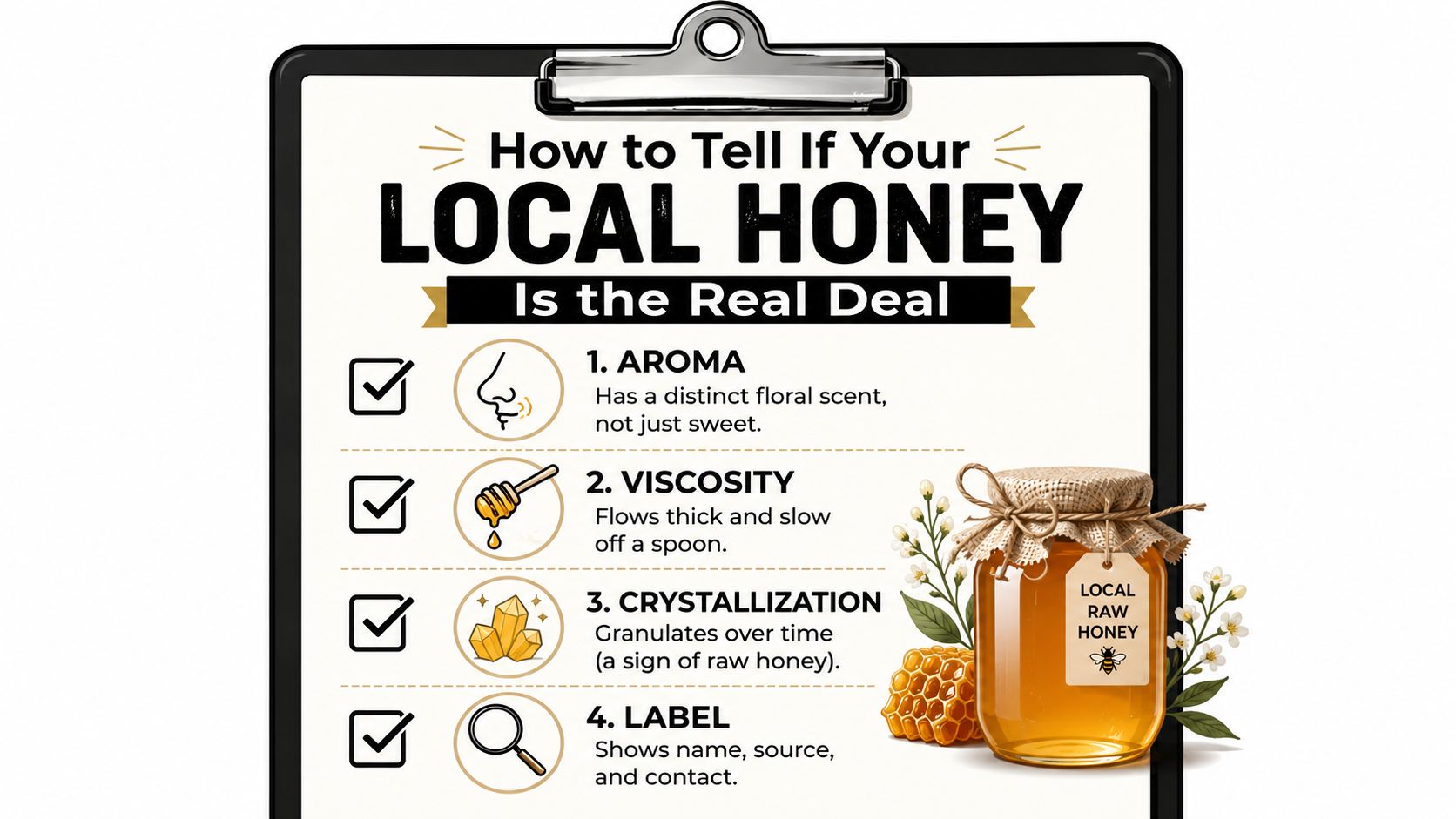
How to Tell If Your Local Honey Is the Real Deal
A farmers' market stall gives you an advantage because you can inspect the jar and speak with the person selling it. Online listings can work, too, but you'll need to look for the same details in photographs and product descriptions. Authenticity is rarely proven by one home trick. It comes from several consistent signals.
Start with the jar
Open the lid if the seller allows it, or ask about the aroma. A distinct floral or herbal scent suggests more character than a jar that smells only sweet, although smell alone can't prove origin. Watch how the honey moves, too. Genuine honey is viscous, but temperature and variety affect how quickly it flows, so treat thickness as a clue rather than a laboratory test.
Crystallization is normal. Raw honey can granulate over time, sometimes into fine crystals and sometimes into a coarse, uneven texture. Cloudiness can also come from pollen, tiny wax particles, or crystals. None of those appearances proves purity by itself, and perfectly clear honey isn't automatically more authentic.
Read every part of the label
Use this quick checklist:
- Named producer: Look for a beekeeper or company name, not only a broad brand identity.
- Source location: A town, county, state, apiary, or harvest region gives you something concrete to verify.
- Batch information: A harvest date or batch code improves traceability.
- Ingredient line: For a pure product, look for 100% honey with no added syrup or sugar.
- Origin wording: Be cautious with vague language such as “blend of honeys from multiple countries” if you want a local, single-source jar.
- Contact details: A website, email, or market presence makes follow-up possible.
Home tests often create more confidence than they deserve. Water dissolvability, the thumb test, and a flame test don't reliably establish honey authenticity because results change with moisture, temperature, container shape, and other variables. Vinegar tests are also not dependable. If crystallized honey needs loosening, warm the sealed jar gently in a water bath rather than microwaving it, which can create hot spots and damage the flavor.
Pollen analysis, called melissopalynology, is a traditional way to investigate botanical and geographic origin. Modern reviews caution that pollen levels vary with plants, seasons, regions, and bee behavior, so low or absent pollen doesn't prove fraud; strong verification combines pollen evidence with compositional, chromatographic, or isotopic testing. (Review of honey authentication methods)
Ask the beekeeper where the bees foraged, how the honey was extracted, whether it was heated, and how it was stored. Specific answers won't replace formal testing, but evasive answers should lower your confidence.
Bringing It All Together and Quick Answers
The practical answer to why buy local honey is a combination of benefits rather than one miracle claim. Choose a jar with a named producer, a clear harvest location, a simple ingredient line, and enough information to contact the maker. Prefer raw, single-origin honey when you want the fullest expression of a local harvest, then use the sensory and label checklist when the product leaves you uncertain.
Can children eat raw local honey?
Children under one year old shouldn't eat honey because of the risk of infant botulism. For older children, ask a pediatrician if a child has a specific medical condition or dietary concern. Local sourcing doesn't change that basic safety rule.
How long does local honey stay fresh?
Properly sealed honey can remain usable for a long time because its low moisture environment discourages many microbes. Store it in a clean, closed container away from excessive heat and moisture, and follow the producer's storage guidance for the best flavor.
Is cloudy or crystallized honey spoiled?
Usually not. Crystallization is a natural change, and cloudiness can reflect pollen, wax particles, or crystals. Look for off odors, fermentation-like bubbling, or other unusual changes, and contact the maker if you're unsure.
Is local honey worth the higher price?
It can be, if you value a distinct regional flavor, a shorter supply chain, and the ability to ask who produced your food. You're deciding whether those qualities matter more to you than the uniformity and lower price of a blended commercial jar.
Visit a farmers' market, farm shop, or apiary and compare two honeys side by side. Taste, inspect, and ask questions. That experience will tell you more about the value of local honey than the allergy myth ever could.
Loyaltie is a marketplace where you can discover and buy directly from independent brands in the US, including local food makers whose products come with clearer provenance. Visit Loyaltie to find honey and other everyday products from identifiable producers, then choose the jar you can understand and enjoy.