


Most advice about wholesalers of designer clothing starts in the wrong place. It tells you to get a business license, open a formal brand account, and prepare for huge minimums before you even know what your customers will buy. That was closer to the old playbook. It isn't the only one now.
If you run an independent boutique, the opportunity is learning which channels are open, which ones are risky, and how to buy in a way that protects your cash. The apparel market is already massive, valued at USD 1.84 trillion in 2025 and projected to reach USD 2.56 trillion by 2035, with a 3.4% CAGR according to GM Insights apparel market data. Big market doesn't automatically mean easy access, but it does mean there are more layers, more inventory pathways, and more room for smart buyers than the gatekeeper narrative admits.
The boutiques that source well usually aren't the ones chasing prestige first. They're the ones checking paperwork, ordering samples, negotiating terms line by line, and staying disciplined when a supplier pushes them into a bigger buy than they need.
Table of Contents
- Forget the Gatekeepers Your Guide to Designer Wholesale
- Direct brand and distributor relationships
- Wholesale marketplaces and trade events
- Authorized resale and liquidation channels
- Emerging designers and micro-wholesale
- Check the seller before you check the product
- Inspect samples like a buyer, not a fan
- Use payment methods that leave a trail
- Know your numbers before you reply
- Terms that deserve real attention
- A simple first outreach that works
Forget the Gatekeepers Your Guide to Designer Wholesale
The biggest myth in this business is that designer inventory sits behind a velvet rope. In practice, access depends less on status and more on channel selection, documentation, and patience.
Some suppliers still want formal accounts, resale paperwork, and a buying history. That's real. But plenty of genuine inventory reaches boutiques through secondary wholesale paths, overstock networks, closeout partners, and emerging designer programs that don't look anything like the classic luxury account model.
That shift matters because it changes how you enter the market. Instead of asking, "Who will approve me?" ask, "Which channel matches my size, cash flow, and customer?"
Practical rule: If a supplier's main pitch is exclusivity, but they won't answer basic questions about provenance, packaging, or returns, walk away.
Good sourcing also overlaps with a broader shift in retail. Buyers are getting more comfortable with direct relationships, local makers, and curated alternatives to mass-produced inventory. That's part of why platforms that help brands sell directly have become useful infrastructure. If you're a maker building your own channel as well as buying inventory, Sell on Loyaltie is one example of a marketplace where people discover and buy directly from the best independent brands in the US.
The useful mindset is simple. Designer wholesale isn't closed. It's layered. Once you stop chasing the fantasy of a perfect direct account and start working the actual channels, the field looks a lot more practical.
Your Sourcing Map Four Paths to Designer Inventory
There isn't one best source for all boutiques. There are four. The right one depends on whether you care most about exclusivity, flexibility, lower opening risk, or fast experimentation.
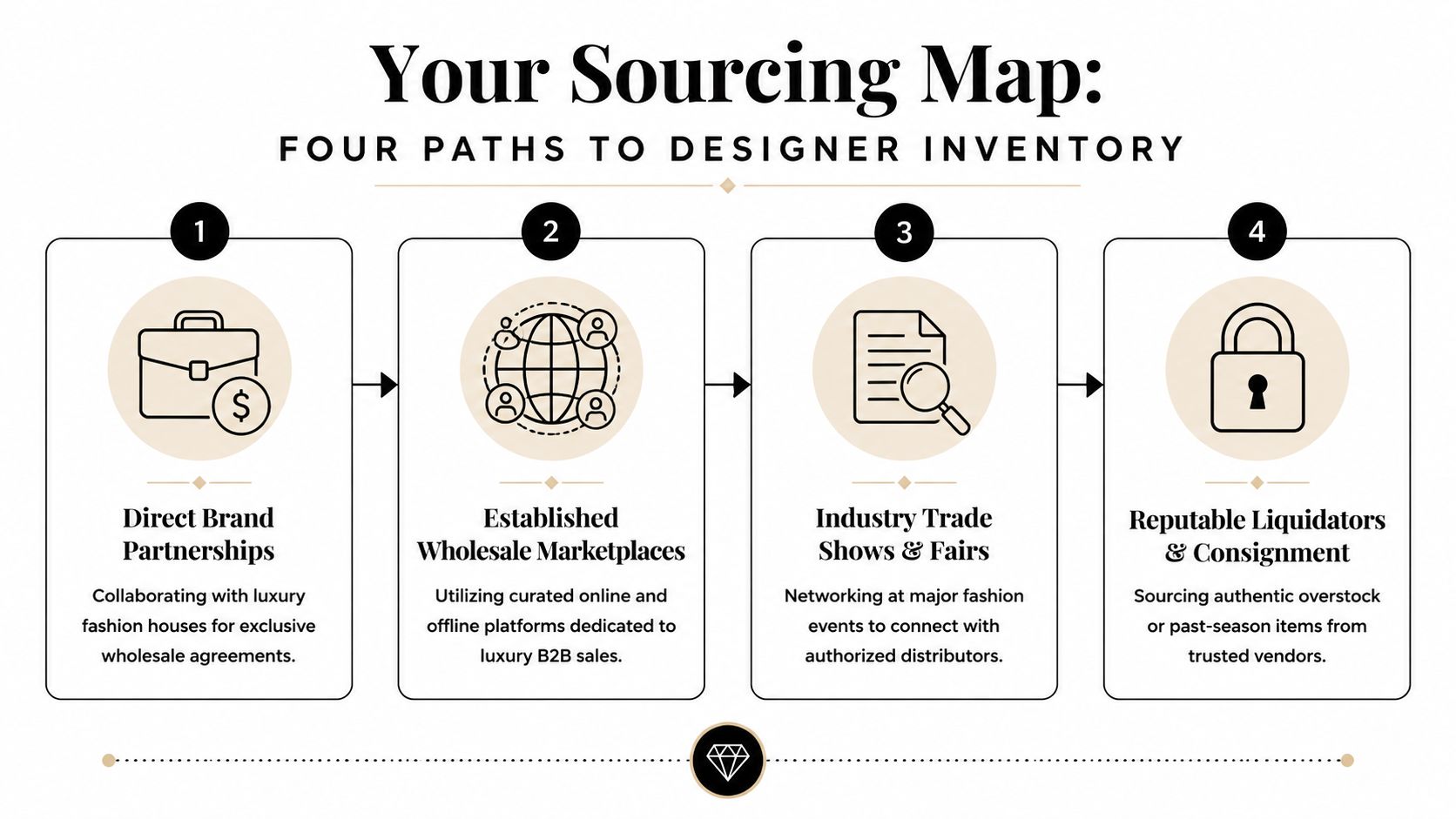
Recent reporting says 68% of genuine designer wholesale now flows through authorized resale and liquidation channels open to non-licensed small businesses, which is why boutiques that only chase direct brand accounts often miss the easiest entry point, as noted in BrandsGateway's discussion of designer wholesale access.
Direct brand and distributor relationships
This is often the first route imagined. You contact the brand or its appointed distributor, present your store, explain your customer, and ask for account terms.
This path works best when your boutique already has a clear point of view. Brands want to know where their product will sit, how you'll merchandise it, and whether your shop fits their image. A vague "we sell fashion" pitch rarely gets traction.
The upside is control. You usually get cleaner product flow, current season access, and clearer authorization. The downside is friction. These accounts can move slowly, ask for more business information, and sometimes expect a deeper opening buy than a newer retailer wants.
Wholesale marketplaces and trade events
Many owners gain their initial stability through these channels. Curated marketplaces and trade events let you compare suppliers faster, ask direct questions, and notice patterns in pricing and presentation.
Use them to build a shortlist, not to buy blindly. A polished booth or polished site doesn't prove authenticity. It only proves the seller knows how to present.
If you're trying to sharpen your eye for assortment, this guide on find unique products for Shopify B2B is useful because it focuses on how retailers sort through saturated inventory and look for items that feel distinct.
You can also keep a running sourcing file with vendor notes, sample outcomes, and follow-up dates. A practical home base for operating documents and seller education can be as simple as the Loyaltie seller resources page, especially if you also work with independent brands and local makers in other categories.
Authorized resale and liquidation channels
This is the channel most beginners get warned away from, and often for the wrong reasons. Legitimate closeout and liquidation inventory can be a legal, workable source of genuine goods if the seller can document where the stock came from.
This route is useful for boutiques that want recognized labels without opening a formal house account. It's also one of the better ways to test whether your customer responds to a designer line before you commit to a deeper relationship.
What doesn't work is treating liquidation like a treasure hunt with no controls. You need invoices, lot details, condition clarity, return terms, and a sample or small opening order whenever possible. If the seller gets slippery on any of that, move on.
Buy from a paper trail, not from a promise.
Emerging designers and micro-wholesale
This is the overlooked path. Smaller labels and niche designers often care less about rigid account structures and more about fit. If your store tells a clear story, they're often easier to work with than established labels.
This route also helps boutiques that like to mix designer apparel with adjacent accessories and giftable pieces. For example, a compact accessory like Faux Leather Phone Purse Crossbody, Flip-Top Phone Wallet w/ Card Slots, Adjustable Strap, Compact 7.5 x 4.9 in | My Beautiful Fluff by Loyaltie fits the kind of add-on category many stores pair with fashion. The available product snapshot describes it this way: carry your phone and cards without the bulk, with two flip-top compartments, hidden card slots, and a long adjustable strap for comfort.
This path is especially good when you want to buy directly from the maker, avoid bloated opening orders, and build a store that doesn't look copied from every other rack in town.
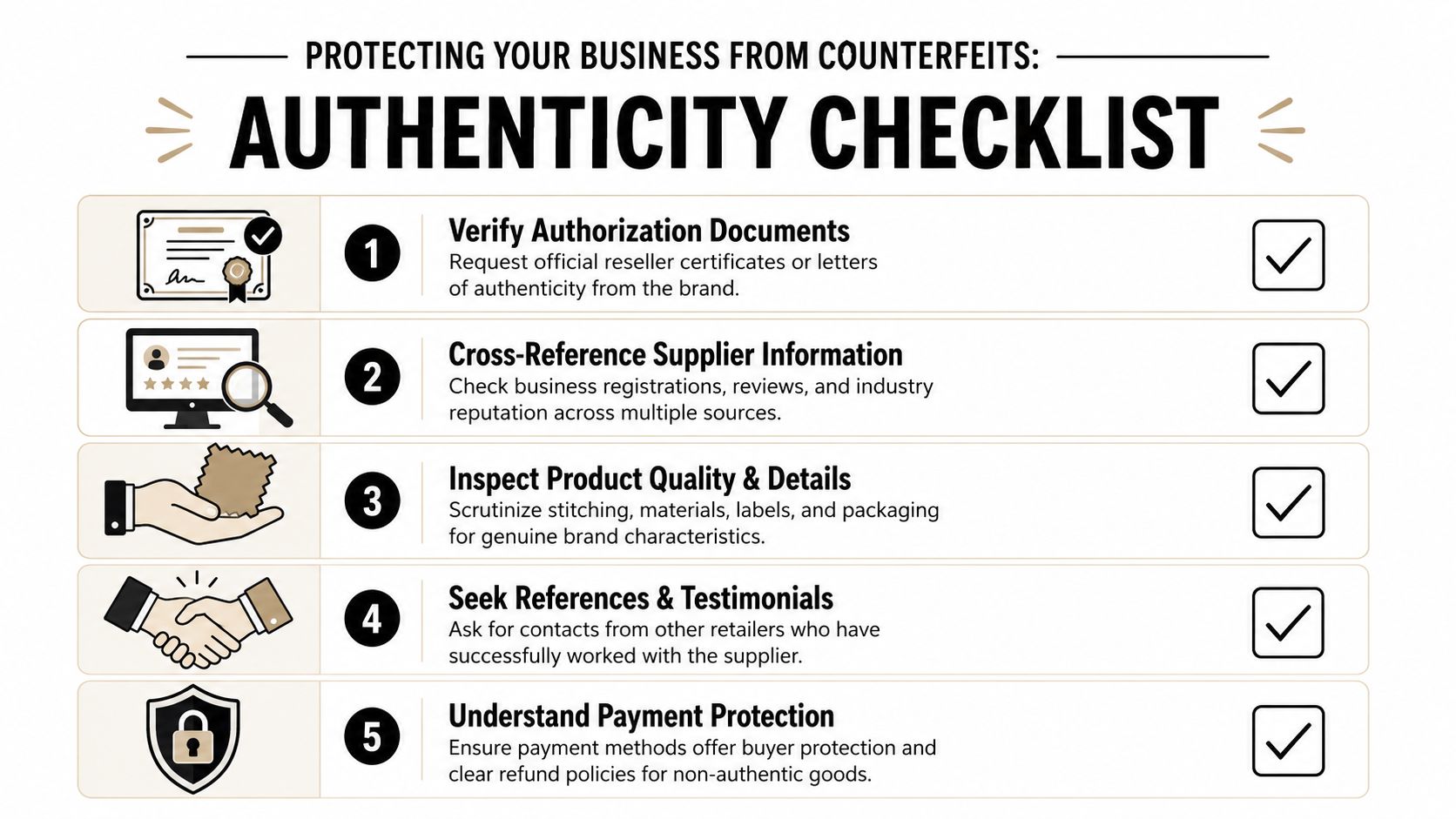
Protecting Your Business from Counterfeits
One bad buy can damage your margin and your reputation at the same time. In designer apparel, that's why verification has to be a routine, not a vibe.
Start with the seller. Then move to the goods. Then lock down payment protection.
Check the seller before you check the product
A counterfeit problem often shows up in the seller's behavior before it shows up in the stitching. Watch for evasive answers, inconsistent company names, missing contact details, or a refusal to share invoices or authorization documents.
My baseline checklist looks like this:
- Business identity: Match the company name on invoices, email signatures, payment instructions, and shipping paperwork.
- Inventory origin: Ask where the stock came from, whether it's current season, overstock, liquidation, consignment, or return inventory.
- Reference quality: Ask for retailer references, not generic testimonials pasted into a PDF.
- Policy clarity: Read the return and dispute policy before you send money.
- Image consistency: Compare listing photos across marketplaces. Reused luxury imagery with vague descriptions is a warning sign.
If a seller acts insulted when you ask basic provenance questions, that's useful information.
Inspect samples like a buyer, not a fan
When the sample arrives, slow down. Counterfeits often look convincing in photos and fall apart in hand.
Check the product in layers:
| Area | What to look for |
|---|---|
| Labels and tags | Consistency in spelling, placement, material quality, and attachment |
| Stitching | Clean construction, even seams, and no rushed finishing |
| Hardware | Weight, finish, engravings, zipper action, and attachment quality |
| Fabric and lining | Hand feel, drape, consistency, and whether materials match the seller's description |
| Packaging | Dust bags, hang tags, boxes, and paperwork that make sense for that brand and channel |
A sample isn't only for authenticity. It's also for sellability. A genuine piece that feels off for your customer is still a bad buy.
A quick visual walkthrough helps if you're training staff or building your own inspection routine:
Use payment methods that leave a trail
The safest buying habit is boring on purpose. Pay in ways that create records, confirm the seller identity, and preserve dispute options when goods arrive misrepresented.
Avoid pressure tactics around rushed transfers. If the seller says the deal only works if you pay immediately through a method with weak recourse, assume the risk is being shifted onto you.
Documentation beats confidence. Keep invoices, screenshots, product descriptions, tracking details, and all written promises in one folder for every order.
Smart Negotiations and Secure Payment Terms
Most new buyers spend too much energy trying to get a lower unit price and not enough energy negotiating the terms that protect their business.
A good deal isn't just a cheap buy. It's a buy you can price correctly, receive on time, inspect, and challenge if something arrives wrong.

Know your numbers before you reply
Wholesale math has to work before you start negotiating tone. According to AIMS360's apparel pricing guide, designer clothing wholesalers need a 2.0 to 2.5x landed cost markup to reach a 50 to 60% wholesale margin, while retail should align at 2.2 to 2.5x wholesale to avoid channel conflict. Their example flow is $20 cost → $40 wholesale → $88 retail.
That matters because some suppliers quote a unit cost that sounds reasonable until freight, duties, handling, damaged units, and payment fees land on top. Negotiate from landed cost, not factory price.
A short pre-buy table keeps the conversation grounded:
| Cost layer | Question to ask |
|---|---|
| Unit cost | Is this the final invoice cost or only the opening quote? |
| Freight | Who pays, and when does responsibility transfer? |
| Damage allowance | What happens if units arrive flawed? |
| Returns | Is there any protection for misrepresented goods? |
| Restock timing | Can the supplier support reorders if the style moves? |
Terms that deserve real attention
Good suppliers expect questions. Weak suppliers hope you won't ask.
Push on these terms before sending payment:
- Order accuracy: Get SKU, size run, color breakdown, and condition in writing.
- Damage process: Ask how quickly you must report issues and what proof they require.
- Returns for authenticity disputes: This should be addressed clearly, even if the answer is limited.
- Shipping terms: Clarify ship date, carrier, tracking, and liability point.
- Exclusivity claims: If a supplier promises territory protection, get the exact scope in writing.
For a broader legal checklist, this guide on managing B2B agreement risks is worth reading because it helps you think about contract language before a disagreement starts.
A simple first outreach that works
You don't need a dramatic brand story in the first email. You need clarity.
Use something close to this:
Hello [Name],
I run a boutique focused on designer and limited-run apparel with a clear emphasis on [customer/style]. I'm interested in learning more about your available inventory, opening order expectations, documentation for product origin, and current payment terms. If samples or a small opening order are possible, I'd like to start there before discussing a larger buy.
Thank you,
[Your Name]
That email works because it signals seriousness without pretending you're ready for a giant commitment.
Buying Smart Managing MOQs and Your First Order
A high MOQ can make a new buyer feel legitimate. It can also put you in a hole before the first item hits the rack.
The mistake isn't buying inventory. The mistake is treating volume as proof that you've found the right supplier.
Why large opening orders go bad fast
Big opening orders lock cash into somebody else's assumptions. Their assumptions about what sells, what sizes move, what colors feel current, and what your customer wants.
That pressure is even worse in designer categories because product value can make mediocre inventory look smarter than it is. New buyers talk themselves into overbuying because the label feels safe. Then the slow sizes sit, markdowns creep in, and the next reorder gets harder.
A better habit is to treat the first order as a test of three things at once:
- Customer response: Do people pick it up, try it on, and buy it?
- Operational quality: Did the supplier ship accurately, on time, and with clean documentation?
- Margin reality: Does the product still work after all costs land?
The first order is not a victory lap. It's an audition.
How the test order should look
The strongest first orders are small and intentional. A documented wholesale approach recommends a test, learn, repeat model with 10 to 30 units before a larger commitment, and related case studies report brands reaching profitability within 6 to 8 months, according to Fashion Solutions NYC's wholesale strategy article.
That doesn't mean every boutique should buy exactly the same way. It means your first buy should answer real questions, not feed your ego.
A useful opening order often looks like this in practice:
- One story, not ten: Buy one focused mini-assortment instead of scattering money across too many styles.
- Enough size coverage to learn: Don't buy a style so thinly that one early sale gives you false confidence.
- A reorder conversation up front: Ask before purchase whether the supplier can replenish winners.
- Clear exit logic: Decide before the order arrives what counts as a reorder signal and what counts as a stop.
Where smaller buyers have an edge
Independent boutiques often assume they're weaker negotiators because they can't place giant buys. That's not always true.
Smaller buyers can move faster, test more effectively, and build sharper assortments because they don't need to justify a warehouse full of mistakes. They can also buy directly from the maker more often, especially with emerging labels and local makers who care about fit and presentation more than brute volume.
If a supplier insists the only serious relationship starts with a large MOQ, ask a better question: "What can we learn from a smaller order first?" The answer tells you a lot about whether they want a partnership or just want to unload stock.
Building a Thriving Boutique with Designer Finds
A strong boutique doesn't win by stocking the most labels. It wins by buying cleaner, verifying harder, and editing better than the next store.
That matters even more as luxury demand grows. The luxury clothing segment is projected to reach $364.4 billion by 2030, up from $274.8 billion in 2025, at a 5.8% CAGR, according to UniformMarket luxury clothing market data. More demand creates more opportunity, but it also attracts more noise, more weak suppliers, and more inventory that looks exciting until it hits your rack.
The boutiques that build momentum usually do a few things well at the same time. They source through realistic channels instead of chasing status. They buy in testable quantities. They keep records. They mix known labels with independent brands, local makers, and direct relationships that give customers something they can't find in a mass retail loop.
That last part matters outside fashion too. The same customer who wants a better dress or accessory often wants better coffee, skincare, supplements, and everyday goods from real people with a clear point of view. That's why curation matters more than scale.
When you're ready to turn good sourcing into repeat buying, it helps to study how personalized follow-up and product relevance shape customer behavior. This piece on personalization tactics for loyalty is a useful next read. If you want a broader place to discover and buy directly from the best independent brands in the US, Loyaltie is a marketplace built around that model.
If you like buying from real people instead of defaulting to mass-produced retail, take a look at Loyaltie. It's a marketplace where people discover and buy directly from the best independent brands in the US, with a mix of local makers and everyday products that feel more considered from the start.