
You're probably here because you've done the thing almost all of us do. You pick up one bottle that says whole food, another that lists familiar vitamin names on a clean Supplement Facts panel, and then you stall out. One sounds more natural. The other looks more precise. Both say they support energy, immunity, stress, or “daily wellness,” and suddenly a simple reorder turns into a research project.
I get it. I shop independent wellness brands myself, and the confusion starts. A lot of the internet turns the whole food supplements vs synthetic vitamins question into a purity contest. That's usually the wrong frame. The better question is simpler: what are you trying to do, and what form fits that job?
If you're looking for daily support, the food matrix may matter. If you need a very specific nutrient amount, isolated forms can make more sense. If you're comparing powders and multis from local makers, you also need to know how to tell a meaningful ingredient story from nice packaging and vague “natural” language.
A practical shortcut is to compare products the same way you'd compare independent coffee or skincare brands. You look past the front label and ask what's inside, how it's made, and whether the maker is transparent. That same mindset helps with supplements. If you've also been comparing greens powders, guides like NZ supplement retailer's top greens can be useful because they show how ingredient sourcing, formula style, and everyday usability shape the buying decision.
Before we go deeper, here's the fast side by side view.
| Feature | Whole food supplements | Synthetic vitamins |
|---|---|---|
| Source | Concentrated foods and food extracts | Isolated nutrients made to match vitamin structures |
| Best fit | Daily nutritional support, food-first routines | Targeted dosing, fortification, formula precision |
| Absorption story | Sometimes helped by food compounds around the nutrient | Often similar short-term absorption for some nutrients |
| Big advantage | Broader food matrix and accompanying compounds | Consistency, stability, exact amounts |
| Main caution | “Whole food” can mean different things on different labels | Bigger dose doesn't always mean better choice |
Table of Contents
- What legally counts as a dietary supplement
- What's usually inside each type
- Where readers often get tripped up
- Similar blood levels can come from very different products
- Some nutrients depend more on form and delivery
- Whole food formulas often help in a different way
- More isn't always better
- The label isn't the same as the product story
- Why regulation and trust signals matter
- If you eat well but want gentle backup
- If you're addressing a specific deficiency
- If you're sensitive to formulas
- If you care most about the experience of the product
- Start with the side panel
- Questions worth asking the maker
- What meaningful whole-food claims look like
Introduction to Whole Food and Synthetic Options
The first time this really clicks is usually not in a doctor's office. It happens while you're standing in a store aisle, or scrolling late at night with three tabs open, trying to decide whether the more expensive “food-based” formula is worth it.
Why this comparison feels so confusing
Part of the confusion is that both sides tell a partial truth. A whole food formula may give you nutrients in a more food-like package. A synthetic formula may give you clearer dosing. Neither fact automatically makes one product better for every person.
That's why the whole food supplements vs synthetic vitamins debate often gets messy online. People mix together different questions:
- Absorption. Does your body take it up?
- Efficacy. Does it help with the reason you bought it?
- Tolerance. Does it sit well with your stomach and routine?
- Quality. Can you trust the maker and the label?
- Value. Are you paying for something meaningful or just marketing language?
What matters when you shop independent brands
Independent brands can be a real upgrade. When you buy directly from the maker, you can often get clearer sourcing details, more thoughtful formulas, and better answers to basic questions than you'd get from a giant shelf brand with generic copy and no middleman accountability.
Practical rule: Don't ask “Is whole food always better?” Ask “What job do I need this supplement to do?”
Some readers come in expecting a winner. There usually isn't one universal winner. There's a better fit for your body, your goals, and your budget. Once you know how to read the form, the dose, and the sourcing story, the labels stop feeling mysterious.
What Whole Food Supplements and Synthetic Vitamins Actually Are
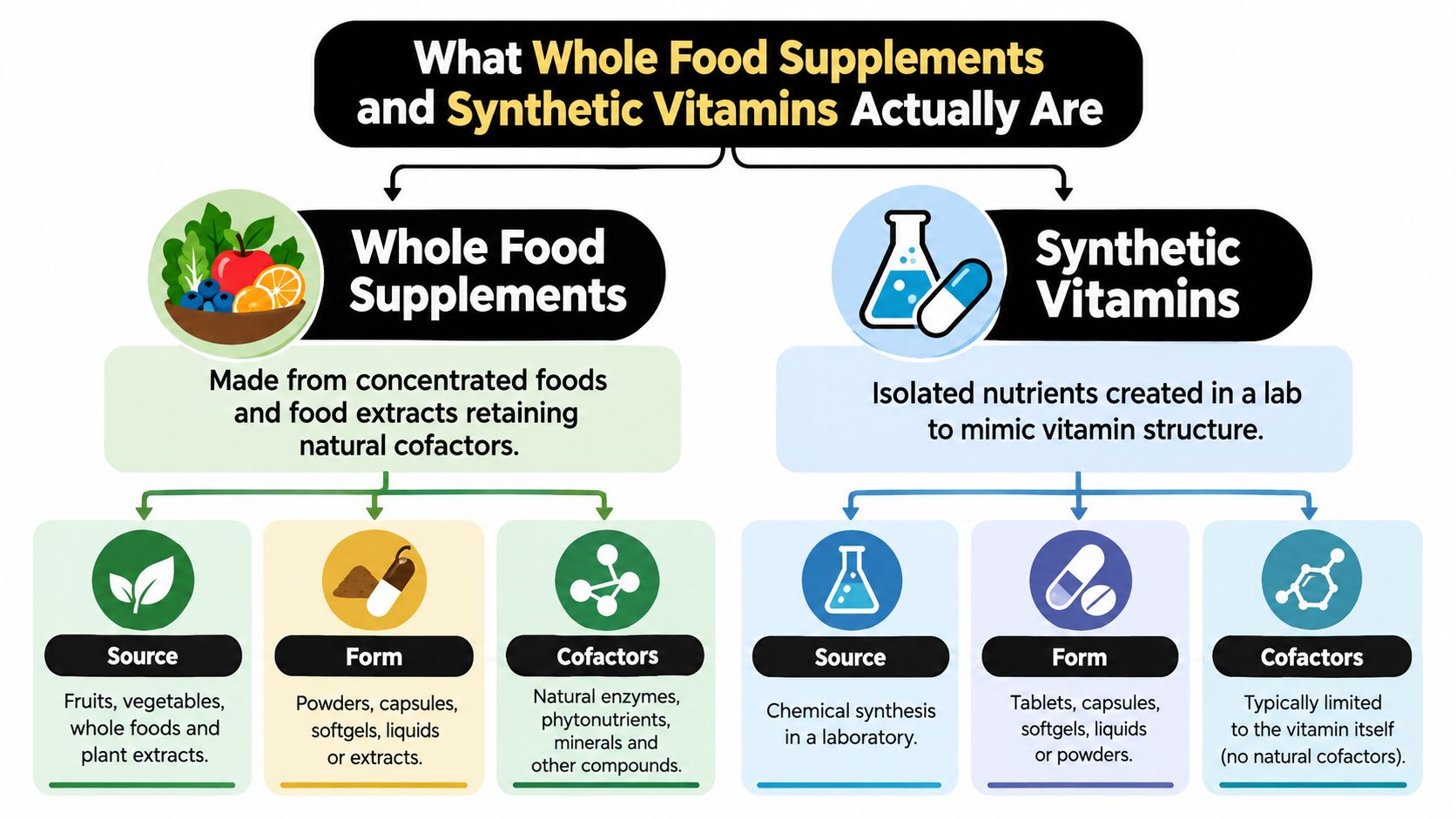
Whole food supplements are generally made from concentrated foods, food powders, or food extracts. The selling idea is that nutrients arrive alongside other naturally occurring compounds from those foods.
Synthetic vitamins are isolated nutrients made to match a vitamin's chemical structure. They're usually chosen because they let brands deliver exact amounts in a stable, standardized way.
What legally counts as a dietary supplement
In the US, the FDA defines a dietary supplement as a product taken by mouth that contains a dietary ingredient intended to supplement the diet. The FDA lists vitamins, minerals, herbs, amino acids, enzymes, live microbials, and concentrates, metabolites, constituents, extracts, or combinations of those ingredients as dietary ingredients, as explained in the FDA's questions and answers on dietary supplements.
That means a supplement can legally contain a wide range of ingredient types. It also means the phrase “whole food” on the front doesn't tell you everything by itself.
What's usually inside each type
Here's the plain-English version.
- Whole food style products might include powdered greens, fruit concentrates, mushroom powders, or herbs. A formula like organic ashwagandha root powder is easy to recognize because the ingredient is the plant itself, not a lab-made vitamin.
- Synthetic vitamin formulas usually list isolated nutrient names and forms on the Supplement Facts panel. That can be useful when you want to know the exact amount of a nutrient in each serving.
- Hybrid formulas also exist. These combine food-based ingredients with isolated vitamins or minerals.
Where readers often get tripped up
A front label can say natural, food-based, or whole food, but those terms don't all mean the same thing in practice. Some brands use a small amount of food powder for marketing appeal while relying mostly on isolated nutrients for potency.
That's why I always tell people to look past the headline claim and study the ingredient list. If the natural-versus-synthetic conversation reminds you of other health categories where sourcing and processing matter, this overview of thyroid glandular vs synthetic thyroid is a useful example of how “natural” and “synthetic” can mean very different things depending on the product type and intended use.
Read the Supplement Facts panel first. The front label sells the dream. The side panel tells you what you're actually buying.
How Absorption and Efficacy Really Compare
You grab two bottles off the shelf. One says whole food. The other lists isolated vitamins with exact amounts. The easy story is that one must absorb better because it sounds more natural. Human research is more practical than that. Absorption depends on the nutrient, the form, the dose, and what else comes with it.
Similar blood levels can come from very different products
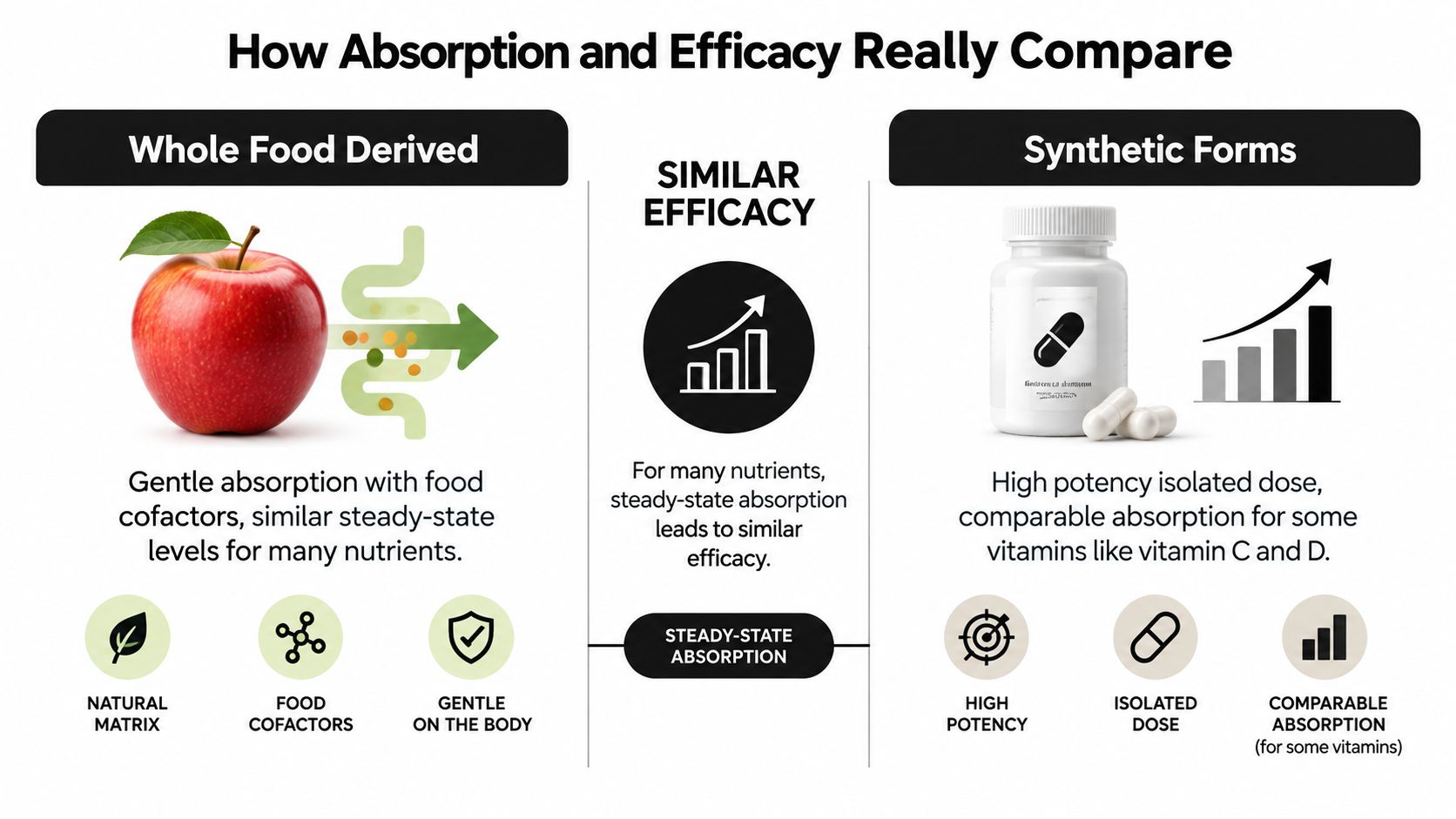
Vitamin C is a good place to start because it clears up a lot of confusion. A randomized human study found no significant differences in plasma, urine, leukocyte, or skeletal-muscle vitamin C bioavailability between kiwi-derived vitamin C and an equal-dose chewable tablet. A review of comparative human studies also concluded that steady-state trials showed little or no bioavailability difference between synthetic vitamin C and vitamin C from fruits, juices, and vegetables in this review on vitamin C bioavailability.
That matters because it shifts the question. Instead of asking, “Is synthetic always worse?” it helps to ask, “For this nutrient, in this form, in this dose, what changes in the body?”
Vitamin C often acts like a measured scoop of flour versus flour already mixed into a muffin. If your goal is the vitamin itself, the body may end up with a very similar amount either way. The whole-food version still brings extra plant compounds. Those extras may matter to you, but they are different from saying the vitamin always absorbs better.
Some nutrients depend more on form and delivery
Folate is a better example of why context matters. An EFSA-linked review reports that food folate has lower bioavailability than folic acid from fortified foods or supplements taken with food, suggesting that the synthetic form can have higher uptake under those conditions in this review on natural and synthetic B-vitamins.
That does not mean every synthetic vitamin wins. It means folate has different chemistry and a different delivery story than vitamin C.
A pilot clinical trial comparing natural and synthetic B-vitamin formulations found comparable overall bioavailability and no statistically significant differences in metabolic markers, while the natural formulation showed slightly stronger trends in some endpoints in this clinical paper on multivitamin bioavailability. That is why broad claims fall apart so quickly. The form can matter. The food matrix can matter. The outcome you care about also matters.
Whole food formulas often help in a different way
Whole food supplements usually make their best case through context, not purity language. They may package nutrients alongside fibers, phytonutrients, cofactors, or fats that make the formula feel more like a meal than a chemistry set. For some people, that translates to gentler digestion or a product that fits better into a food-first routine.
Synthetic forms can still be the better tool when you want precision. If you need a specific amount of a nutrient, or you are correcting a known gap, isolated forms are often easier to dose and compare.
That is the frame I use when I shop independent brands myself. I do not sort products into “natural good, synthetic bad.” I look at delivery. I look at what job the formula is trying to do.
If you want practical help with the day-to-day side of absorption, such as taking fat-soluble nutrients with meals or spacing minerals that compete with each other, the Yuve vitamin absorption guide is a useful everyday read.
This short video gives a helpful visual overview of the comparison.
Safety Dosing and Quality Differences You Should Know
Absorption is only half the buying decision. The other half is whether the dose, form, and product quality make sense for your routine.

More isn't always better
Shoppers get pulled in by high numbers. A giant dose can feel reassuring, but higher potency doesn't automatically mean a smarter formula.
A synthetic nutrient can be helpful when you need precise correction or a clearly measured amount. It can also overshoot what you wanted from a daily product. Whole food formulas sometimes look lighter on the label for that reason. They're often built for steady support, not maximum visible numbers.
One reason context matters is folate. As covered above, synthetic folic acid can have higher uptake than food folate under certain conditions. That can be useful, but it also means you should pay attention to why the nutrient is there and how much you're taking.
The label isn't the same as the product story
Quality differences often matter more than the natural label alone. I'd rather buy a transparent, well-made synthetic formula from a careful maker than a vague “whole food” product that doesn't explain sourcing, processing, or what the food ingredient contributes.
Here's what I look for before I reorder:
- Clear ingredient identity. Can you tell whether a nutrient comes from concentrated food, an isolate, or a blend of both?
- Dose matched to purpose. Is this for everyday maintenance or a targeted need?
- Transparent maker information. Do they explain sourcing and testing in normal language?
- Simple routine fit. A thoughtful product you'll take beats a complicated one that sits in a cabinet.
- Formula logic. Do the ingredients belong together, or does the label look like a buzzword collection?
A bundled routine like this daily supplement system bundle can be useful if the pieces are clearly explained and fit your daily needs. The key is still the same. Look at form, purpose, and transparency before convenience.
Why regulation and trust signals matter
Regulators are still updating dietary supplement guidance, including FDA educational materials on new dietary ingredient notifications and other compliance actions in 2025 and 2026, which is one reason claims can outpace evidence, as shown on the FDA's what's new in dietary supplements page.
Buying rule: Trust the brand that makes it easiest to verify what's in the bottle, why it's there, and how it's meant to be used.
That's especially important with independent brands. The best local makers usually welcome hard questions. If a brand can't explain its sourcing or leans only on dreamy language like “pure,” “natural,” or “detox,” keep moving.
Which Option Fits You Best by Real Life Scenario
This choice gets easier when you stop asking which category wins and start matching the format to the situation.
If you eat well but want gentle backup
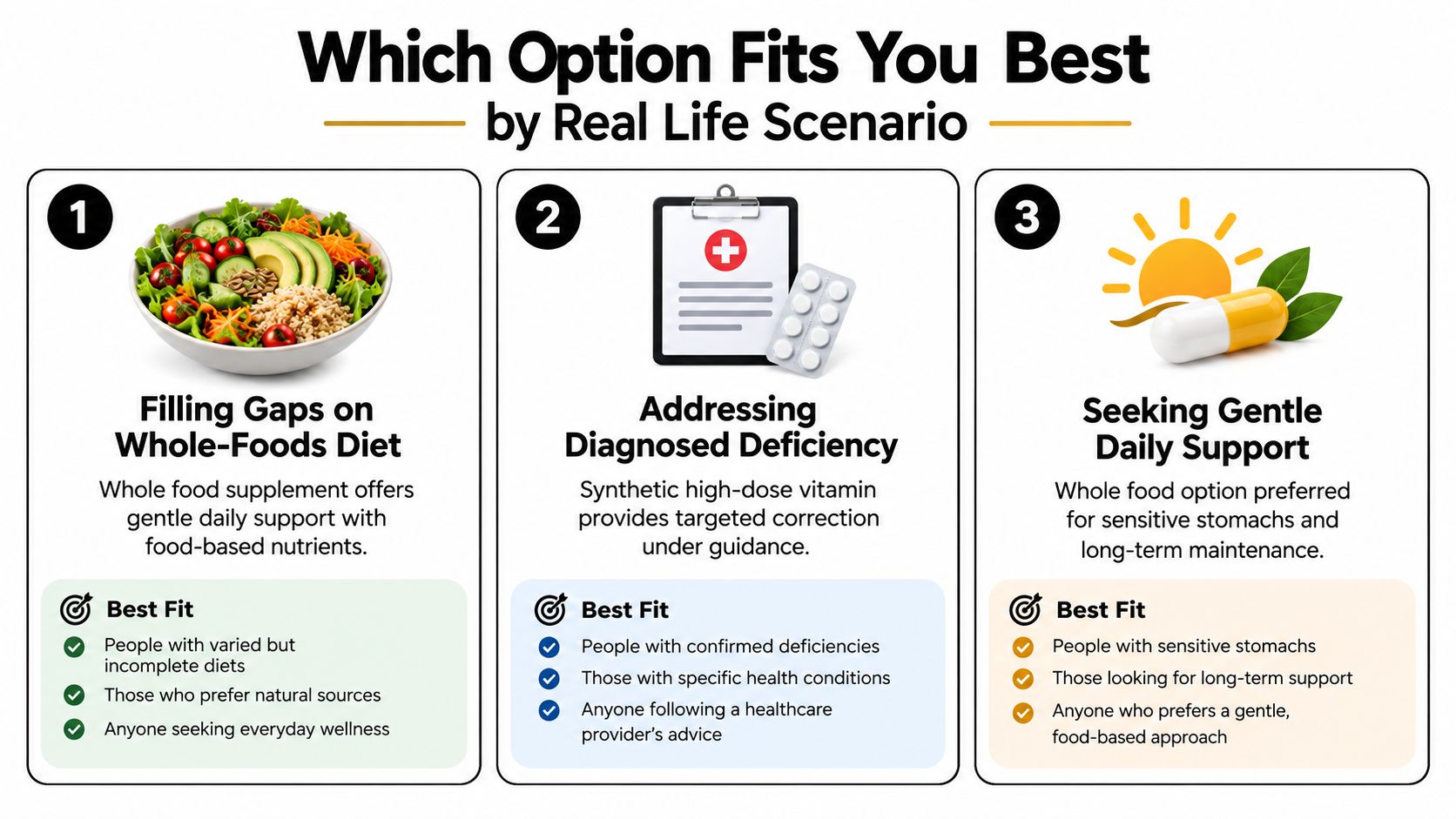
If your diet is already built around real meals and you're looking for a little insurance, a whole food supplement often makes sense. This is the person who wants a greens powder, a food-based multi, or a simple herbal support product that feels close to food.
You may like this route if you care about ingredient sourcing, lighter daily support, and a formula that doesn't feel aggressively dosed.
If you're addressing a specific deficiency
A synthetic or isolated nutrient can be the better tool when precision matters. If you know exactly what nutrient you need and want a clearly measured amount, this route is often more straightforward.
That doesn't make it less legitimate or less “healthy.” It just means the goal is targeted correction, not broad food-style nourishment.
If you're sensitive to formulas
Some people do better with simpler products. Others prefer food-derived powders because they feel gentler in the routine. This is one of those areas where personal experience matters.
Here's a quick matching guide:
| Your situation | Often the better fit | Why |
|---|---|---|
| Daily maintenance | Whole food supplement | Broader food-style support |
| Known nutrient gap | Synthetic vitamin | Clear amount and direct dosing |
| You want a cleaner label | Whole food or hybrid | Better fit if sourcing is transparent |
| You want to keep cost tighter | Synthetic vitamin | Isolated nutrients can be more straightforward |
| You want one product with a food-first feel | Whole food supplement | More aligned with a whole-food routine |
You don't have to “pick a side.” Plenty of smart routines use both, depending on the season, the goal, and the product quality.
If you care most about the experience of the product
This part gets overlooked. Some shoppers choose independent brands because the formula feels more thoughtful, the ingredient list is easier to trust, and the maker explains what they're doing. That matters. The best product is not just the one with the strongest claim. It's the one you understand and feel good about using consistently.
How to Choose Quality Options and Buy Directly From Independent Makers
When you're ready to buy, the fastest way to avoid disappointment is to use a short checklist. Not a perfect checklist. Just one that catches the products trying too hard to sound healthy without saying much.
Start with the side panel
Ignore the front for a minute. Turn the bottle around or open the full product details page.
Check these things first:
What form is this really?
Is it concentrated food, an isolated vitamin, or a mix of both? Brands should say that clearly.Does the dose fit the goal?
Daily support and targeted correction are different jobs. Buy the formula built for the job you have.Is there plain-English sourcing detail?
“Whole food” should lead to a real explanation, not just a pretty phrase.
Questions worth asking the maker
Independent brands are often better here because you can buy directly from the maker and ask real questions instead of guessing.
- Where do the core ingredients come from?
- Why did you choose this form of the nutrient?
- Is this food-based, synthetic, or hybrid?
- Who is this formula for, and who should skip it?
- How do you suggest people reorder or use it regularly?
If a brand answers clearly, that's a strong sign. If the response is all mood and no substance, I'd pass.
What meaningful whole-food claims look like
A meaningful whole-food claim usually comes with details. You can tell what foods are included, what role they play, and whether the product relies on those foods as the nutritional backbone or just as a marketing accent.
I'd also watch for products that combine categories in a smart way. A powder made from recognizable plant ingredients tells a very different story than a multi that uses food imagery but depends mostly on isolates.
For shoppers who want to compare direct-from-maker wellness options from independent brands, a collection like Earth Made Naturals is useful because you can evaluate ingredient style, product philosophy, and label transparency without a big-box retail filter.
Simple filter: If you can't explain to yourself what the product is after reading the label twice, don't buy it yet.
Buying directly has another benefit. There's no middleman blurring the product story. You can compare makers, save the ones you trust, and set up a regular delivery rhythm only for products that earn a place in your routine.
Our Recommendation for Your Next Supplement Choice
You're standing in front of two bottles. One says “whole food” with pictures of berries and greens. The other lists a precise dose of a single nutrient in a lab-made form. If you've ever felt like one must be the “clean” choice and the other the “less natural” one, that frame usually makes the decision harder than it needs to be.
A better question is simpler. What are you asking the supplement to do?
Choose a whole food supplement if you want daily support that fits into a food-first routine. This can make sense when your goal is gentle coverage, you already eat fairly well, and you care about the food matrix around the nutrients, not just the isolated amount on the label. In plain terms, a whole food formula works more like a meal support product than a precision tool.
Choose a synthetic vitamin if you want a specific form, a specific dose, or a targeted result. That can be the better fit when you and your clinician are trying to correct a gap, use a form with known stability, or keep the formula simple and measurable.
Neither category wins by default.
Delivery system matters. Context matters too. A capsule built around concentrated food ingredients may be a smart everyday choice. A single isolated nutrient can be the smarter choice when you need accuracy and consistency. Many good products are hybrids, using both food-based ingredients and selected synthetic forms for a reason.
My recommendation is to buy for the job in front of you, not for the label story.
Here's the short version:
- Buy the product that matches your real goal, daily support or targeted support.
- Pay attention to the nutrient form and the dose, not just whether the front label says whole food.
- Treat “whole food” as a meaningful advantage only when the brand clearly shows what foods are included and why they matter.
- Use synthetic forms without guilt when precision, stability, or a well-studied dose is the point.
- Skip any formula that leaves you confused after reading the label twice.
I also put a lot of weight on who made it and how clearly they explain it. Independent brands often do this better because they have to earn trust with specifics, not shelf placement. If you want to compare products without defaulting to mass-market formulas, Loyaltie is a marketplace where people discover and buy directly from the best independent brands in the US. It's a practical place to compare ingredient philosophies, check whether a maker explains sourcing and form clearly, and reorder directly from brands you trust.
So my real recommendation is this. Stop treating the choice as a purity test. Choose the delivery system that fits your body, your goal, and your routine. That's usually how you end up with a supplement you'll feel good about taking, and one that makes sense to keep using.