Organic milk is defined by a strict, audited 12-month farm management system, including mandatory pasture grazing and 100% organic feed, rather than a simple test of the final liquid in the jug. The rules also require at least 120 days of grazing each year and an average of 30% of a cow's dry matter intake from pasture during that grazing season.
The popular advice is often to look for the word “organic” and stop there. That's where shoppers miss the useful part. The label matters because it records how the cow was fed, managed, and cared for over time, not because organic milk is automatically higher in protein, lower in sugar, or universally safer than conventional milk.
If you're trying to understand what makes organic milk organic, start at the farm gate. The most meaningful differences involve pasture, feed sourcing, animal management, certification, and the records a dairy producer must maintain. Those details give you something better than vague grocery-store marketing. They give you standards you can verify.
Table of Contents
Beyond the Label on the Jug
An organic seal isn't merely a decorative marketing sticker. In the United States, milk can be labeled organic only when the dairy animals have been managed organically for at least 12 months before the milk is sold, and the farm follows USDA requirements for feed, pasture, animal care, and certification. The USDA Economic Research Service explanation of organic dairy standards describes organic milk as the result of a documented production system, not a single additive test performed after milking.
That distinction clears up a common misunderstanding. Organic milk doesn't promise that every nutritional feature will be dramatically different, and it doesn't mean conventional milk is automatically unsafe or poor quality. The organic label primarily tells you how the dairy system operates.
The farm system behind the product
A certified organic dairy has to coordinate several moving parts:
- Feed sourcing: Dairy animals receive organic agricultural feed, subject to USDA rules.
- Pasture management: Cows must have year-round outdoor access and graze during the regional grazing season.
- Animal care: Organic management includes preventive health practices, outdoor access, sunlight, fresh air, and freedom of movement.
- Recordkeeping: Producers need an organic system plan and documentation that certifiers can review.
The result is a label with traceable meaning. A producer can't change the wording on a bottle after adopting one preferred farming practice. The farm has to bring feed, land, livestock, pasture, and handling procedures into one compliant system.
The useful question isn't “Is organic milk magically better?” It's “What farming practices does this label require, and can the maker explain them clearly?”
That question is especially valuable when you buy from an independent local dairy. A direct conversation may reveal how the cows use pasture, where the feed comes from, and which certifier reviews the operation. You're no longer treating the package as the entire story. You're evaluating the work behind it.
The 12-Month Transition and Management Rules
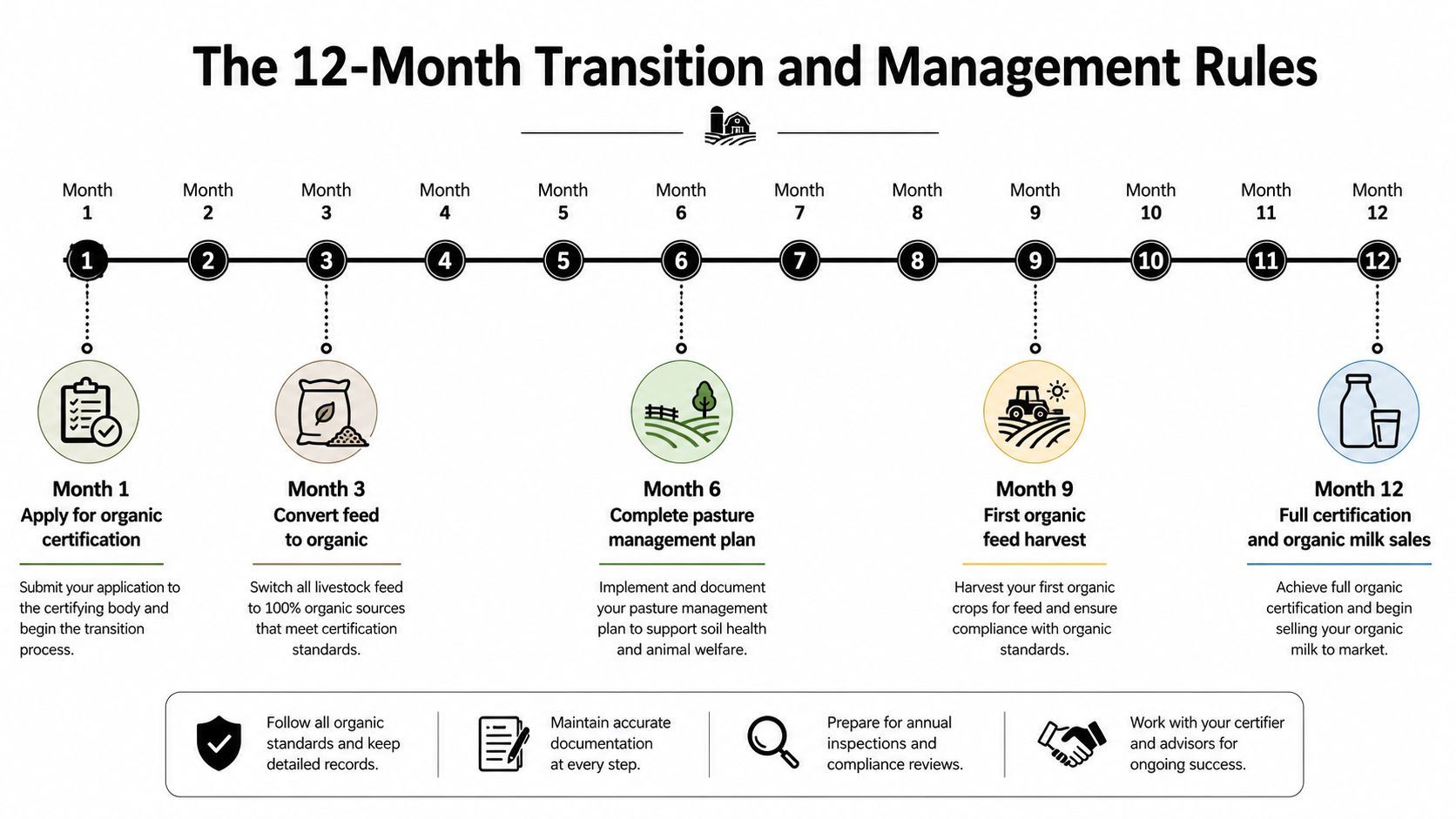
Organic certification follows a timeline because the milk reflects the animal's management history. A dairy can't switch a cow to organic feed on Monday and sell that cow's milk as organic on Tuesday. The animal must be managed organically for at least 12 months before the milk or dairy product can be sold, labeled, or represented as organic, as stated in the USDA organic production and handling standards.
The timeline protects the meaning of the label. Feed, pasture, health care, and outdoor access need to function as a complete system before the milk qualifies.
How the requirement works
Think of the rule as a continuous management period rather than a one-time conversion.
- The farm establishes organic management. The producer begins following the organic system plan, including compliant feed, pasture practices, and animal-care procedures.
- The animal remains under that system. The dairy animal must stay within organic management for the required period. Gaps in feed sourcing or pasture compliance can create certification problems.
- The producer documents the process. Organic certification depends on records and inspection, not the farmer's intention.
- The milk becomes eligible only after the period is complete. The 12-month requirement applies before the milk can be sold or represented as organic.
USDA standards also address the animal's history before the milk enters the organic market. The rules require continuous organic management from the last third of gestation onward, with a narrow exception for newly certified operations. That provision connects the milk to the broader livestock system rather than treating the cow as a blank slate at the moment of certification.
The practical effect is significant for independent makers. A dairy producer planning to become certified has to make decisions about land, feed contracts, pasture rotation, herd management, inspections, and marketing well before the first qualifying bottle reaches a customer.
The timeline also gives shoppers a useful way to think about organic claims. A credible maker should be able to explain not only what the cows eat today, but how the farm maintains certification over time. If the answer focuses only on the final processing step, you haven't yet heard the part that defines organic dairy.
Pasture Requirements and Feed Standards
Pasture is one of the clearest places where organic dairy rules become visible. Organic ruminants must graze certified organic pasture throughout the grazing season in their region. That season must last at least 120 days per year, and the cows must obtain an average of at least 30% of their dry matter intake from pasture during that period, according to USDA organic livestock and dairy standards.
This isn't the same as saying a cow occasionally steps outside. Outdoor access and meaningful pasture intake are built into the organic system. Producers also need a pasture management plan, which turns grazing from a broad promise into a managed agricultural practice.
The numbers that define the system
| Requirement category | Minimum threshold |
|---|---|
| Organic management before organic milk sales | 12 months |
| Grazing season | 120 days per year |
| Pasture contribution during grazing season | 30% of average dry matter intake |
| Agricultural feed | 100% organic |
| Land history for feed crops | 3 years free of prohibited substances |
The feed rule reaches beyond the barn. Organic dairy cows must receive 100% organic agricultural feed, with permitted vitamin and mineral supplements. Crops used for that feed must come from land that hasn't been treated with prohibited substances for at least 3 years before harvest, as explained in USDA Organic 101 guidance on the lifecycle of organic food production.
That land requirement makes organic feed a supply-chain issue. A farmer has to know not only what goes into the ration, but where those crops were grown and how the land was managed. Feed records, pasture plans, and sourcing documents all become part of the certification picture.
Why pasture intake matters
Pasture contributes fresh forage and changes the balance between grazing and stored or concentrated feeds. The rule doesn't require cows to live exclusively on grass, but it does require pasture to play a meaningful role during the grazing season.
For shoppers, that helps separate several labels that are often blended together. Organic refers to a certified production system. Grass-fed describes diet. A milk may carry one claim, the other, or both, so you should read the exact wording and ask the producer how the terms apply.
If pasture-raised food is part of your broader buying routine, you might also enjoy this grain-free edible cookie dough made with pasture-raised butter, though its pasture reference describes an ingredient rather than establishing that the product itself is organic milk.
How Grazing Changes the Milk Profile
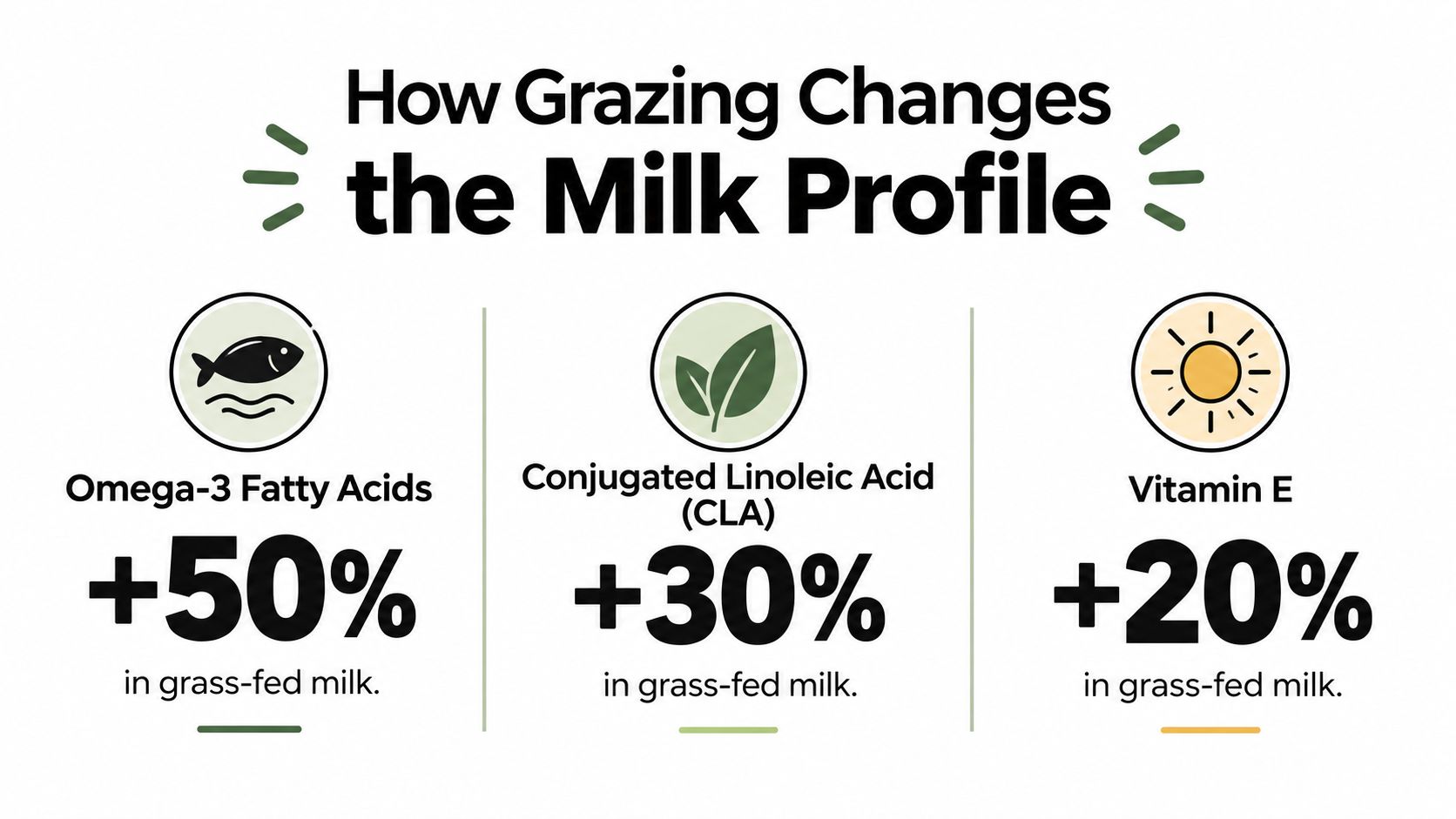
The pasture rule matters beyond animal management because a cow's diet influences the composition of milk fat. A large review in PLOS ONE on organic and conventional milk composition found that organic milk tends to contain more nutritionally favorable fatty acids, including omega-3 and conjugated linoleic acid, along with a lower omega-6 to omega-3 ratio.
The likely driver is diet structure. Organic systems generally place greater emphasis on grazing and roughage relative to concentrate feed, and that difference can show up in the milk's fatty acid profile. The benefit isn't created by pouring a synthetic ingredient into the bottle. It develops through what the cow eats and how the producer manages forage.
What the research can and can't tell you
One comparative study included in the review reported 25% less omega-6 fatty acids and 62% more omega-3 fatty acids in organic milk than conventional milk. Those figures belong to that comparison, not to every carton from every farm. Breed, season, forage quality, geography, processing, and herd management can all affect milk composition.
The broader takeaway is more reliable than treating any one figure as a shopping guarantee. Pasture-based feeding can shift the milk fat profile, which gives organic dairy a measurable compositional distinction connected to the farm's diet structure.
That's also why “organic” shouldn't be treated as a promise of universally superior nutrition. The label tells you the production system meets USDA rules. It doesn't guarantee a particular protein level, sugar content, or fatty acid result in every bottle.
Organic farming practices can influence milk composition, but the label's core promise remains the audited farm system.
When a local maker talks specifically about pasture quality, grazing management, and forage, you're hearing information that connects the certification rules to the liquid itself. That's far more useful than a vague claim that a product is “better.”
Decoding Labels and Verifying Claims
A package can use several organic phrases, and they don't all mean the same thing. For multi-ingredient products, the USDA framework distinguishes between “organic”, which requires at least 95% certified organic content, and “made with organic”, which requires at least 70% certified organic content, as outlined in USDA's organic standards guidance.
Milk is usually a simpler product than a bar, sauce, or snack, but the distinction still matters when you shop across categories. A product can contain organic ingredients without qualifying for the same label category as a product carrying the USDA Organic seal.
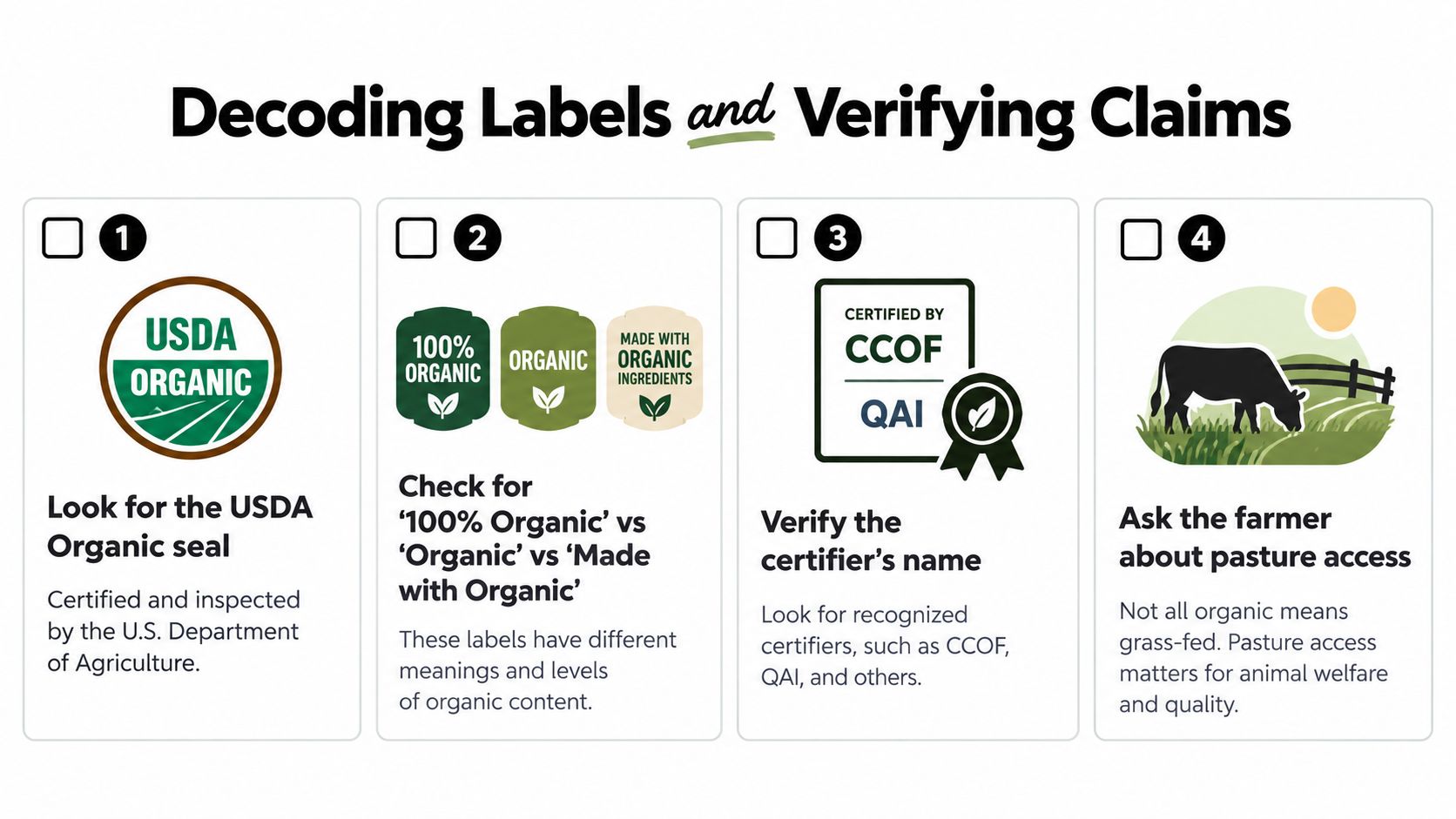
A practical label check
Use the package as a starting point, then look for details that support the claim.
- Find the USDA Organic seal: A certified claim should connect to the USDA organic program rather than relying only on green colors, farm illustrations, or words such as “natural.”
- Read the exact category: “Organic” and “made with organic” carry different content requirements for multi-ingredient products. Don't assume they're interchangeable.
- Look for the certifier: The certifier's name helps you identify who inspected and reviewed the operation.
- Ask about pasture: Organic dairy requires pasture access and pasture intake during the grazing season, but organic and grass-fed aren't identical terms.
The last point causes plenty of confusion. Grass-fed describes a diet, while organic describes the wider certification system. For a useful plain-language comparison of pasture and diet terminology, see Shopifarm's guide to meat labels.
Questions worth asking a maker
At a farmers market, farm shop, or direct-order page, ask where the feed comes from and how the dairy manages grazing. You can also ask which organization certifies the farm and whether the producer can explain the organic system plan in everyday language.
A clear answer won't necessarily include every technical document, but it should connect the label to real practices. For a different organic pantry example, you can browse these USDA Organic cherry licorice laces and apply the same habit: read the claim, identify what it covers, and avoid assuming that one appealing word explains everything.
Sourcing Directly from Independent Local Makers
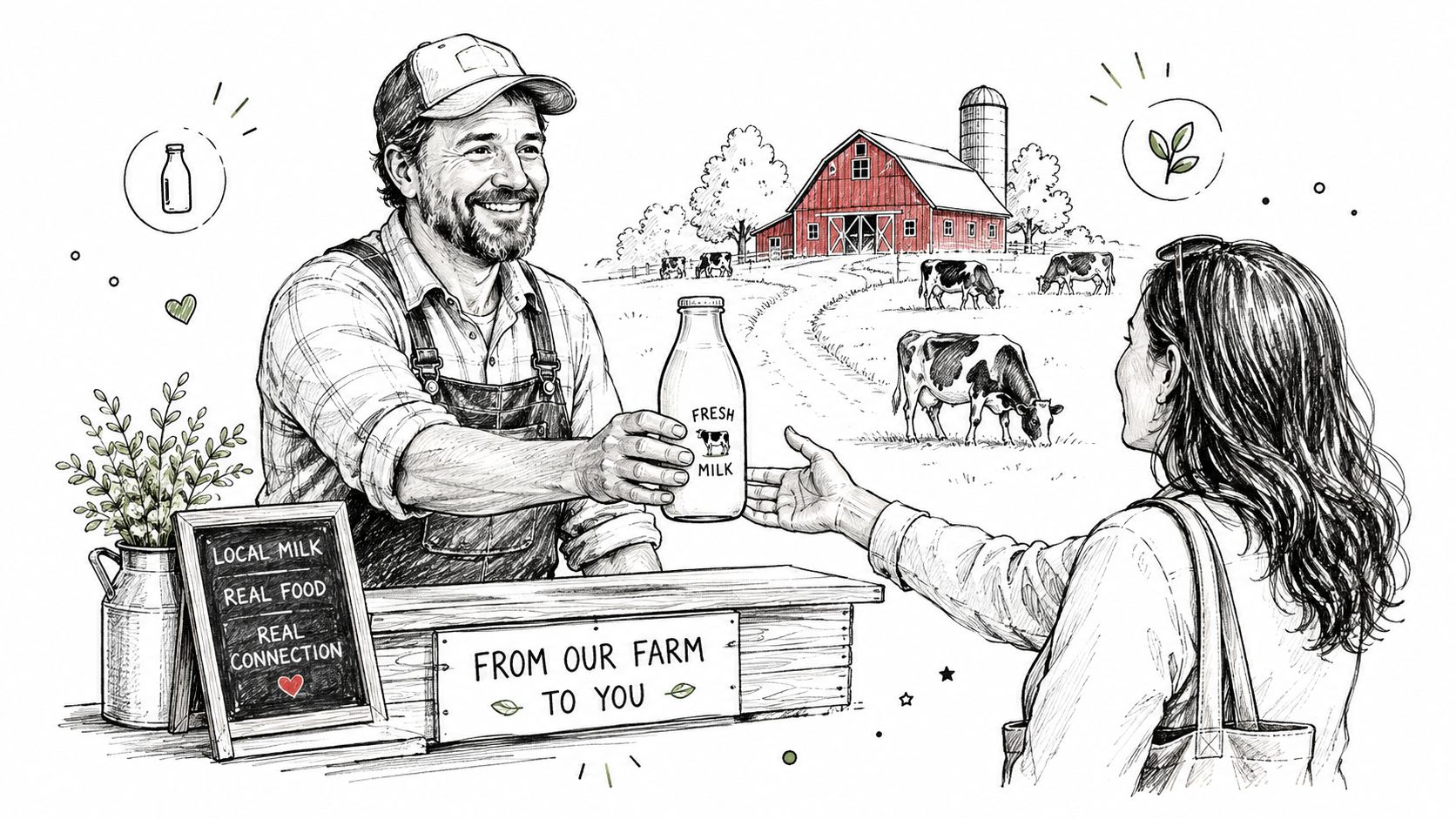
Buying directly from an independent dairy can improve the quality of your information before it changes the quality of your cart. You can ask the person behind the product how the cows are managed, where the feed is grown, how often the herd grazes, and which certifier reviews the farm. A mass-produced carton may be convenient, but a direct relationship often gives you a clearer view of the choices behind it.
That's the appeal of independent brands and local makers. It isn't charity, and it isn't about choosing a product merely because the producer is smaller. The quality upgrade comes from traceability, attention to process, and fewer layers between the farm and your kitchen.
How shoppers can buy with confidence
Start by searching local dairy directories, farm markets, co-ops, and direct-order pages. Look for producers who explain certification rather than decorating a product page with broad wellness language.
A useful shopping routine looks like this:
- Identify the farm or maker. You should be able to find a real producer, not only a brand name.
- Check the certification claim. Look for the USDA seal and certifier information where applicable.
- Ask focused questions. Feed sourcing and pasture management reveal more than a generic “healthy cows” statement.
- Choose the buying format that fits your household. Farm pickup, local delivery, regular delivery plans, and simple reorders can all help you keep buying from the same trusted source.
If you care about quality beyond milk, direct discovery works across everyday categories. A maker's process matters in skincare too, whether you're comparing ingredients in a goat milk face soap or evaluating how a local food producer handles feed and land.
Notes for independent dairy producers
Certification should appear as useful product information, not as a badge without context. Explain what your organic status requires, describe pasture access accurately, and make it easy for customers to understand how feed and animal management work together.
A producer can also build trust through dependable fulfillment. Clear pickup windows, local delivery routes, and a buy-on-a-plan option help customers reorder without forcing them to decode a new marketing message every time. The strongest direct relationship combines honest farm details with a buying experience that respects people's time.
That approach lets the producer compete on documented quality and transparency, rather than trying to imitate the scale or packaging of a national dairy company.
Your Guide to Better Dairy Choices
You don't need to memorize every line of the organic code to shop intelligently. Keep the central question in view: does the label connect the milk to a certified, documented farm system involving feed, pasture, animal management, and time?
Use this checklist when you're comparing cartons or talking with a local maker:
- Confirm the management period: Organic milk comes from dairy animals managed organically for at least 12 months before sale, labeling, or representation as organic, according to the USDA standard cited earlier.
- Look for meaningful pasture access: The system requires a grazing season of at least 120 days and an average of 30% pasture dry matter intake during that season.
- Check feed sourcing: Organic dairy animals receive 100% organic agricultural feed, while feed crops must come from land managed without prohibited substances for at least 3 years before harvest.
- Separate production from nutrition claims: Organic describes how the milk is produced. It isn't a blanket promise of higher protein, lower sugar, or universally safer milk.
- Ask who certifies the farm: A named certifier and a producer who can explain the system are stronger signals than vague nature imagery.
- Buy as directly as practical: Direct purchasing gives you a better chance to learn who made the product and how the farm operates.
The same clarity helps independent brands in other categories. If you're building a direct-to-consumer food or wellness brand, guidance on SEO for consumer brands from Reddog Consulting Group can help customers find the information you're already working to provide.
Organic milk is best understood as a farm-management promise with auditable requirements. Once you know the pasture, feed, timeline, and certification markers, you can choose based on the practices you value instead of relying on the loudest package claim.
Loyaltie is a marketplace where people discover and buy directly from the best independent brands in the US, including local food, wellness, skincare, and everyday products made with care. Visit Loyaltie to find makers you can learn about, buy from directly, and reorder with confidence.