
Community commerce is shopping that happens inside trusted groups, where authentic content and peer recommendations lead straight to purchase. Its scale is already enormous: the global social commerce market was valued at USD 1,484.46 billion in 2025 and is projected to reach USD 17,828.84 billion by 2033, with a 37.4% CAGR from 2026 to 2033.
If you're a local maker, wellness seller, or independent brand, you've probably felt the old playbook getting harder. Paid ads feel impersonal. Marketplaces can make your products look interchangeable. And even when people like what you make, there's still a gap between interest and trust.
Community commerce closes that gap. It works like a farmer's market brought online. People discover products through creators, groups, neighbors, and repeat buyers they already pay attention to. Then they can act on that recommendation without breaking the moment by jumping through a maze of tabs, redirects, and checkout steps.
For the Loyaltie audience, that's the opportunity. This isn't only about going viral on a massive platform. It's about building a digital version of the kind of commerce local sellers already understand: conversation, reputation, repeat faces, and products people recommend because they personally use them.
Table of Contents
Beyond the Buzzword What Is Community Commerce
A lot of people hear the phrase and assume it's just another way to say social selling. It isn't.
Community commerce is commerce driven by trust inside a group. People don't just see a product. They see who uses it, who recommends it, why it matters, and whether it fits the identity or needs of that group. The sale grows out of belonging, not just exposure.
That matters because retail behavior has shifted in a big way. According to Grand View Research's social commerce market analysis, the global social commerce market was valued at USD 1,484.46 billion in 2025 and is projected to reach USD 17,828.84 billion by 2033, with a 37.4% CAGR from 2026 to 2033. For small brands, that signals something bigger than a passing content trend. It shows that people increasingly discover and buy in the same digital environment.
Why the idea feels familiar
Local sellers already know the offline version of this.
At a farmer's market, someone samples a jam because another shopper mentions it. A ceramic mug catches attention because the maker explains the glaze. A neighbor says, "I bought from them last month," and that lowers hesitation immediately. Community commerce takes that same social proof and moves it into digital spaces.
Practical rule: If people need to trust the person, the group, or the story before they trust the product, you're already in community commerce territory.
That's why the importance of community building matters so much here. Before a community can support sales, it has to exist as a place where people feel recognized, heard, and connected.
For makers looking for a practical place to start selling in a community-centered marketplace, Sell on Loyaltie is one example of an online path that connects local businesses and independent sellers with buyers.
What makes it different from ordinary online selling
Three things usually show up together:
- Trusted discovery: People find products through creators, peers, or niche groups.
- Context: The recommendation sits inside a conversation, routine, or shared interest.
- Low-friction purchase: Buyers can act while interest is still warm.
The simple version is this. Community commerce turns "Who made this?" and "Who else likes it?" into part of the buying experience.
How Community Commerce Actually Works
Community commerce works best when a seller behaves more like a shop owner who knows the regulars than an advertiser buying attention.
A standard online store often asks the product page to carry the whole sale. Community commerce spreads that job across the surrounding experience too. People see how others use the product, ask questions in public, and pick up cues about whether the item fits their needs, habits, or values.
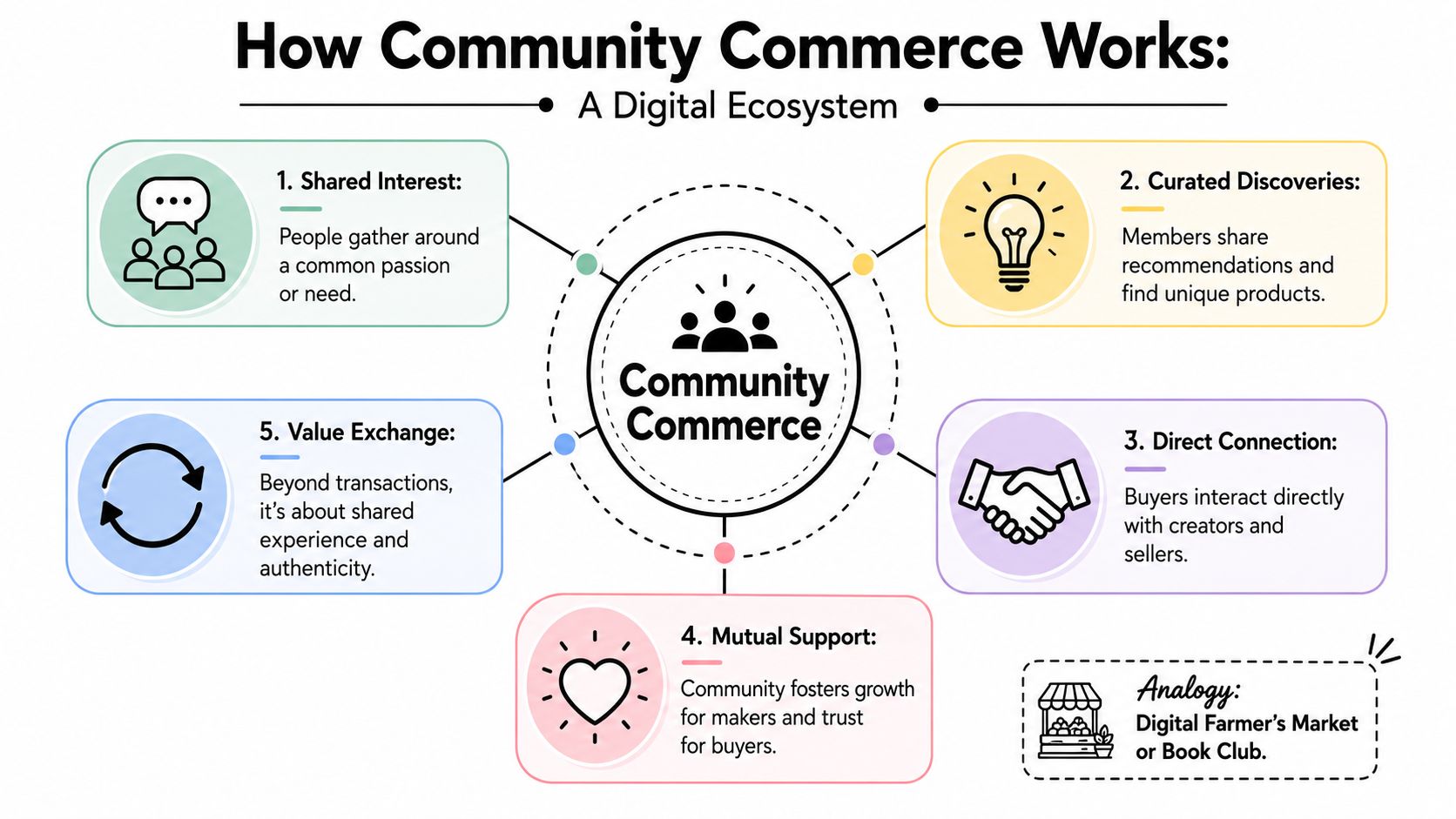
A useful comparison is a digital book club built around products instead of novels. The group forms around a shared interest, such as skincare, coffee, ritual tools, neighborhood food finds, or sustainable home goods. Members are not only asking, "Should I buy this?" They are also asking, "Who here has tried it?" "What happened when you used it?" and "Does this match what this group cares about?"
That shift matters because buyers are not making the decision in isolation. They are using the room around the product to judge it.
For local businesses and independent makers on Loyaltie, that can be a big advantage. A small seller rarely wins by outspending bigger brands on ads. They win when buyers can see the maker, hear the story, and watch trust form in real time through comments, repeat purchases, recommendations, and shared routines.
A simple example helps. Picture a wellness-focused group discussing intention-setting habits and daily rituals. In that conversation, a product like Abundance Manifestation Ritual Kit Box, Intention-Setting Tools, Prosperity & Wealth Focus, Gift Set (Contents Listed) | Glowsip by Loyaltie makes sense because it answers a need already being discussed. The product is not interrupting the conversation. It is joining one.
The four conditions that make it work
The Institute for Digital Transformation's discussion of the rise of community commerce explains that this model works best when a group has clear membership, mutual influence, shared needs, and emotional connection. Those conditions lower hesitation because buyers rely less on polished marketing and more on signals from people they recognize.
Here is what that means in everyday language:
- Clear membership: People know who the space is for. It could be local shoppers, tea lovers, new parents, or clean-beauty buyers.
- Mutual influence: Members affect each other's decisions. They ask follow-up questions, compare experiences, and notice what keeps coming up.
- Shared needs: The products address recurring problems or goals the group already discusses.
- Emotional connection: People care about belonging to the group, not only completing a purchase.
Communities do not drive sales because they are noisy. They drive sales because buyers feel more confident when decisions happen with context and company.
That gives independent sellers a simple test. If you post products into a space where nobody interacts, nobody recognizes each other, and nobody comes back to continue the conversation, you are mostly distributing links. If you sell in a space where members trade advice, remember each other's preferences, and return for more than one transaction, you are much closer to community commerce.
For a practical companion on building that kind of online gathering place, REACH's guide to community building is a useful reference because it explains how communities form, participate, and stay active.
Comparing Community Social and Affiliate Commerce
These terms get lumped together all the time, which is why sellers often pick the wrong strategy for the job.
Where people get mixed up
All three models involve online discovery. All three can involve creators, recommendations, and product links. But they don't run on the same engine.
Social commerce usually means buying through social platforms or social content. Affiliate commerce usually means someone refers a buyer through a trackable link or code. Community commerce adds a different layer: the sale happens in a trust-rich environment where content, interaction, and transaction are closely connected.
Raconteur explains the operational difference well in its piece on digital storefronts and in-app shopping in community commerce. The key differentiator is that community commerce integrates the commerce layer natively within the content layer. While social and affiliate models often redirect users, platforms enabling community commerce increasingly let consumers buy effortlessly without leaving the platform where they discovered the product.
Community vs. Social vs. Affiliate Commerce
| Attribute | Community Commerce | Social Commerce | Affiliate Commerce |
|---|---|---|---|
| Main driver | Trust inside a group or recurring audience | Product discovery on social platforms | Referral from a publisher, creator, or customer |
| Source of trust | Shared identity, peer validation, repeated interaction | Platform content and visual appeal | The recommender's audience relationship |
| Primary goal | Belonging plus purchase | Fast discovery and transaction | Referred sale |
| Typical content style | Conversations, peer examples, creator content, group recommendations | Posts, videos, live shopping, tagged products | Reviews, roundups, promo links, recommendation lists |
| Where purchase happens | Close to the content and community interaction | On-platform or after social discovery | Often after clicking away to another store |
| Best fit for sellers | Brands that benefit from repeat trust and discussion | Brands that can win attention quickly | Brands that want broader referral reach |
| What gets lost when done poorly | Sense of belonging | Context and trust | Authenticity |
A simple way to tell the difference is to ask one question: Would the recommendation still work if you removed the group context?
If yes, it may be affiliate commerce or ordinary social selling. If no, because the trust comes from ongoing participation and shared norms, that's community commerce.
Decision shortcut: Use affiliate tactics when you need referral distribution. Use social commerce when you need discoverability. Use community commerce when trust and identity shape the sale.
For many independent brands, these models can overlap. But if you're selling products people want to discuss, compare, repeat-buy, or recommend carefully, community commerce usually gives you a stronger long-term foundation than a one-off click.
See Community Commerce in Action
The easiest way to understand community commerce is to watch how it shows up in ordinary buying moments.

Interest-based communities
Start with a coffee group. Members swap brewing tips, talk roast preferences, compare gear, and share what they're drinking this week. When someone posts about a new bag from a local roaster, the recommendation carries weight because it appears inside an ongoing conversation among people with the same taste language.
That is very different from seeing a random coffee ad while scrolling.
The same pattern shows up in food, wellness, beauty, and pet care. A product gets discovered because it belongs in the conversation already. Someone isn't interrupting attention. They're adding something useful to it.
Creator-led communities
In creator-led spaces, trust often starts with a recognizable voice. A creator builds an audience around a theme such as clean ingredients, slow living, neighborhood food finds, or mindful routines. Over time, followers learn what that creator notices, what they reject, and what standards they use.
Bazaarvoice describes community commerce as creator- or peer-driven product discovery embedded inside social content. It also notes that the #TikTokMadeMeBuyIt trend had over 7.5 million posts, showing how authentic product content can connect viewers to brands and drive immediate purchase decisions through word-of-mouth style discovery in content environments, as covered in Bazaarvoice's explanation of community commerce.
That example comes from a giant platform, but the principle scales down well for independent sellers. A local herbalist, food creator, or neighborhood style curator doesn't need celebrity reach to influence buying. They need consistent trust with the right audience.
Here's a useful visual example of how social content can shape product discovery over time:
Location-based communities
The model holds particular relevance for Loyaltie's audience.
A neighborhood group, local parent network, or city-specific wellness circle already has built-in relevance. Members care about nearby makers, reliable pickup options, regional ingredients, and businesses they may meet in person. The recommendation isn't abstract. It lives close to everyday life.
For example, someone in a local buying community might browse a marketplace focused on nearby sellers and discover Three Avocados on Loyaltie while looking for products shared by people in their area. The trust doesn't come only from a product description. It also comes from the local context and the sense that the purchase supports a real business in the buyer's community.
A few places where this often shows up:
- Neighborhood food circles: People trade recommendations for coffee, pantry staples, produce, or prepared foods from nearby sellers.
- Wellness groups: Members share routines, ingredient preferences, and products they use themselves.
- Maker communities: Buyers follow local potters, candle makers, textile artists, and small-batch producers because they value the person behind the product.
The through line is simple. The product fits into a relationship network that already exists.
Why This Model Benefits Both Buyers and Makers
Community commerce works because it gives each side something the other side wants more of. Buyers want confidence. Makers want trust that lasts longer than one click.

Benefits for shoppers
Buyers often feel overwhelmed online. There are too many options, too many polished claims, and not enough context for deciding what deserves attention.
Community commerce helps by adding human signals back into the process.
- More believable discovery: Products show up through people and groups buyers already follow.
- Better fit: Recommendations come with context, such as skin type, taste preference, routine, values, or local relevance.
- More satisfying purchases: Buying from a real maker or small business can feel more meaningful than dropping another item into a giant anonymous cart.
- Closer connection to quality: Shoppers can often learn who made the product, why it exists, and how other customers use it.
When people buy through community, they aren't only asking "Is this good?" They're asking "Is this good for someone like me?"
That question matters a lot for wellness, food, beauty, and lifestyle products where buyer preferences are personal.
Benefits for makers
For independent sellers, the biggest advantage isn't hype. It's alignment.
When your product reaches the right community, you spend less time trying to persuade people who don't care and more time serving people who already understand the category. That can make content easier to create, feedback easier to interpret, and repeat business easier to earn.
Community commerce also improves the quality of interaction around a product. Instead of collecting random attention, sellers hear real questions, objections, and use cases from people who are close to buying or already have.
A local artisan or small CPG brand can benefit in several practical ways:
- Clearer positioning: The community tells you what language people use when they describe the problem your product solves.
- Stronger repeat behavior: Buyers who feel connected to the maker or the group have more reason to come back.
- Useful word of mouth: Recommendations become more specific because customers can explain why a product fits the group.
- Healthier brand identity: You're building recognition around values and relationships, not only price.
The long-term value is that your store starts to feel less like a shelf and more like a gathering place.
Your First Steps into Community Commerce
You don't need a giant following to start. You need a real group, a clear product fit, and a buying path that doesn't interrupt trust.
If you sell
Start smaller than you think.
- Pick one community first: Choose a narrow group that already matches your product. That could be local coffee drinkers, ingredient-conscious shoppers, or people interested in intention-setting rituals.
- Post useful content, not only offers: Answer common questions, show product use in ordinary life, and explain decisions behind your product.
- Watch for language: Save the exact phrases customers use in comments, messages, and reviews. Those phrases often become your best product copy.
- Reduce friction: Make sure interested buyers can move from discovery to checkout without confusion.
- Measure community health, not just reach: Look for repeat questions, recurring buyers, direct messages, recommendations, and conversation quality.
If you want practical selling guidance, Loyaltie's seller resources provide help for merchants learning how to list and sell in a local marketplace environment.
If you shop
Buyers play a real role in this model too. A healthy community gets stronger when shoppers participate honestly.
A few habits help:
- Follow people with a point of view: The best recommendations come from creators or peers whose standards you understand.
- Look for context: A useful recommendation explains who the product is for and how it fits into real life.
- Notice repeated trust signals: Consistent feedback, thoughtful discussion, and clear seller identity matter more than polished presentation alone.
- Support businesses you want to keep around: Community commerce works best when buyers treat purchases as part of a local or interest-based ecosystem, not just a one-time deal hunt.
The heart of it is simple. If traditional ecommerce feels like walking through a giant warehouse, community commerce feels like buying from people who know your name, or could.
Loyaltie is a marketplace for buying local from nearby businesses, independent makers, growers, and producers, with direct purchasing and order support built into the experience. If you want a more community-centered way to shop or sell online, you can explore Loyaltie.
Published via Outrank app