
You're standing in front of two products that look almost the same, cost almost the same, and solve the same basic problem. One gets picked up because it gives you a reason to care. The other gets passed over because it only tells you what it is.
That's the whole difference between a product and a brand story. If you're shopping for better coffee, skincare, wellness, food, or pet products, the story is often the thing that helps you spot the maker who cares about the details, not just the packaging. If you're building one of those products, the story is what helps people remember you after the cart is closed.
Table of Contents
- The Moment Two Products Become Very Different
- What Brand Storytelling Actually Means
- Character means the customer goes first
- Conflict names the real friction
- Resolution shows the new state
- Truth is what only you can say
The Moment Two Products Become Very Different
A Sunday morning coffee shelf makes this easy to see. Two bags of beans sit side by side, both single-origin, both honest, both real. One bag tells you where the roaster came from, why they chose that origin, and what kind of cup they wanted you to taste on your counter. The other gives you altitude, varietal, and tasting notes, which is useful, but it still feels like a spec sheet.
The first bag gives you a person to remember. The second gives you information to file away.
That's why brand storytelling matters for independent brands. People don't just buy caffeine, lotion, or dog treats. They buy a sense that a real maker chose the ingredients, the process, and the point of view with care. When that feeling is missing, shoppers compare by price and move on. When it's present, the product becomes easier to recall, easier to trust, and easier to buy again.
Practical rule: if a shopper can describe your product but can't tell someone why you made it, your story still isn't doing its job.
The good news is that this isn't magic. It's structure. A strong brand story turns a product listing into something that feels alive, while still staying concrete enough to be believable. A bag of coffee can still be a bag of coffee. The story just gives the buyer a reason to care which bag reaches their kitchen counter.
What Brand Storytelling Actually Means
Brand storytelling is the deliberate use of narrative to communicate a brand's identity, values, and message so people feel something before they read a feature list. That's the plain version. It's not a slogan, and it's not just prettier copy.
It's also not the same as copywriting or content marketing. Copywriting is about getting the next click, purchase, or signup. Content marketing earns attention over time. A slogan is a short line people can repeat. Brand storytelling is the through-line that keeps every page, email, post, and reorder message tied to one clear reason the brand exists.
The easiest way to think about it is this. Your story is the reason. Your product is the proof. Your packaging is the reminder. If any one of those three is missing, the message gets weaker.
That's also why the best brand stories feel stable across channels. The same voice should show up on the site, in email, in a social caption, and in a reorder note. A shopper shouldn't have to re-learn who you are every time they open a new touchpoint. A consistent narrative helps that memory stick, and memory matters, because research frequently cited in marketing shows facts are 22 times more likely to be remembered when they're part of a story, while people retain only 5% to 10% of information presented as statistics alone, with story-based information often reported at 65% to 70% memory retention, according to the marketing summary referenced here.
The same idea shows up in consumer response too. In 2015, Headstream summarized major-market research showing 79% of UK adults thought it was a good idea for brands to tell stories, and 64% said brands were already good at it, with a clear preference for stories about regular people and customers over celebrities or founders, as summarized in that same source. That matters because shoppers tend to trust narratives that sound human, not polished beyond recognition.
For a better-working mental model, think of brand storytelling as a product of three things. The first is truth. The second is clarity. The third is repetition across every place a customer sees you.
<iframe width="100%" style="aspect-ratio: 16 / 9;" src="https://www.youtube.com/embed/Kx5oSFfVtbM" frameborder="0" allow="autoplay; encrypted-media" allowfullscreen></iframe>If you want the bigger strategic lens behind that, the brand story guide at Loyaltie is a useful companion because it frames story as part of how a brand shows up, not just what it says once.
The Four Ingredients Every Brand Story Needs
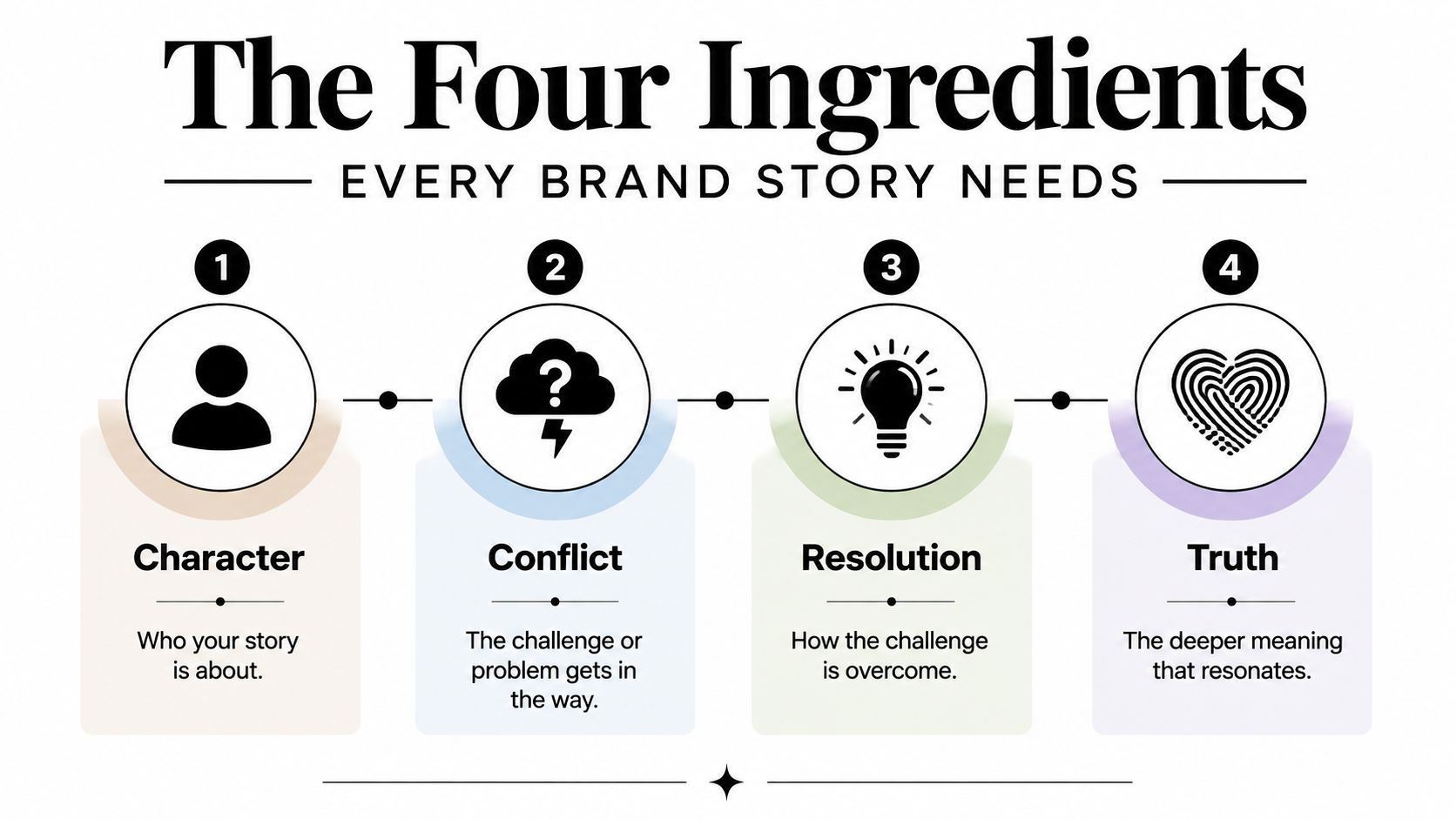
A useful brand story doesn't need to be dramatic. It needs to be complete. The easiest way to check that is to look for character, conflict, resolution, and truth.
Character means the customer goes first
The customer is usually the main character, not the founder. That's where a lot of brand stories go sideways. A maker may have a moving origin, but if the story stays trapped inside the founder's life, the shopper never gets to see themselves in it.
Think about a skincare buyer who's tired of guessing whether an ingredient list will calm their skin or irritate it. That person is the character. The founder can still appear, but as the guide who understands the problem and made something to help solve it.
Conflict names the real friction
Conflict is the reason the product exists. For coffee, that could be boring taste and uncertainty about what you're buying. For pet food, it might be a refusal to settle for something overly processed. For skincare, it could be the gap between “clean” claims and ingredient transparency.
Conflict gives the story a pulse. Without it, the brand sounds like a catalog.
Resolution shows the new state
Resolution isn't hype. It's the shift the customer reaches after buying. A good resolution sounds like a practical outcome, not a dream sequence. Better mornings. Less second-guessing. A routine that feels simpler. A product that earns a regular place in the kitchen, bathroom, or pantry.
Truth is what only you can say
Truth is the line your competitor can't copy without sounding fake. It might be where the ingredient came from, why the maker started, or what standard they refuse to compromise on. The exact wording changes by brand, but the test is simple. If anyone could say it, it's not yet specific enough.
A strong reference point for this customer-first structure is the guide from Moonb, especially if you're thinking about how narrative, proof, and format need to work together instead of living in separate silos.
The brand is the guide, not the hero. Once you shift that role, your copy gets clearer and your customer feels seen.
A Simple Four-Part Story Framework You Can Fill In Today
The fastest way to turn brand storytelling from an idea into something usable is to write a one-page brief. Keep it short enough that you'd use it in a listing, email, or product launch.
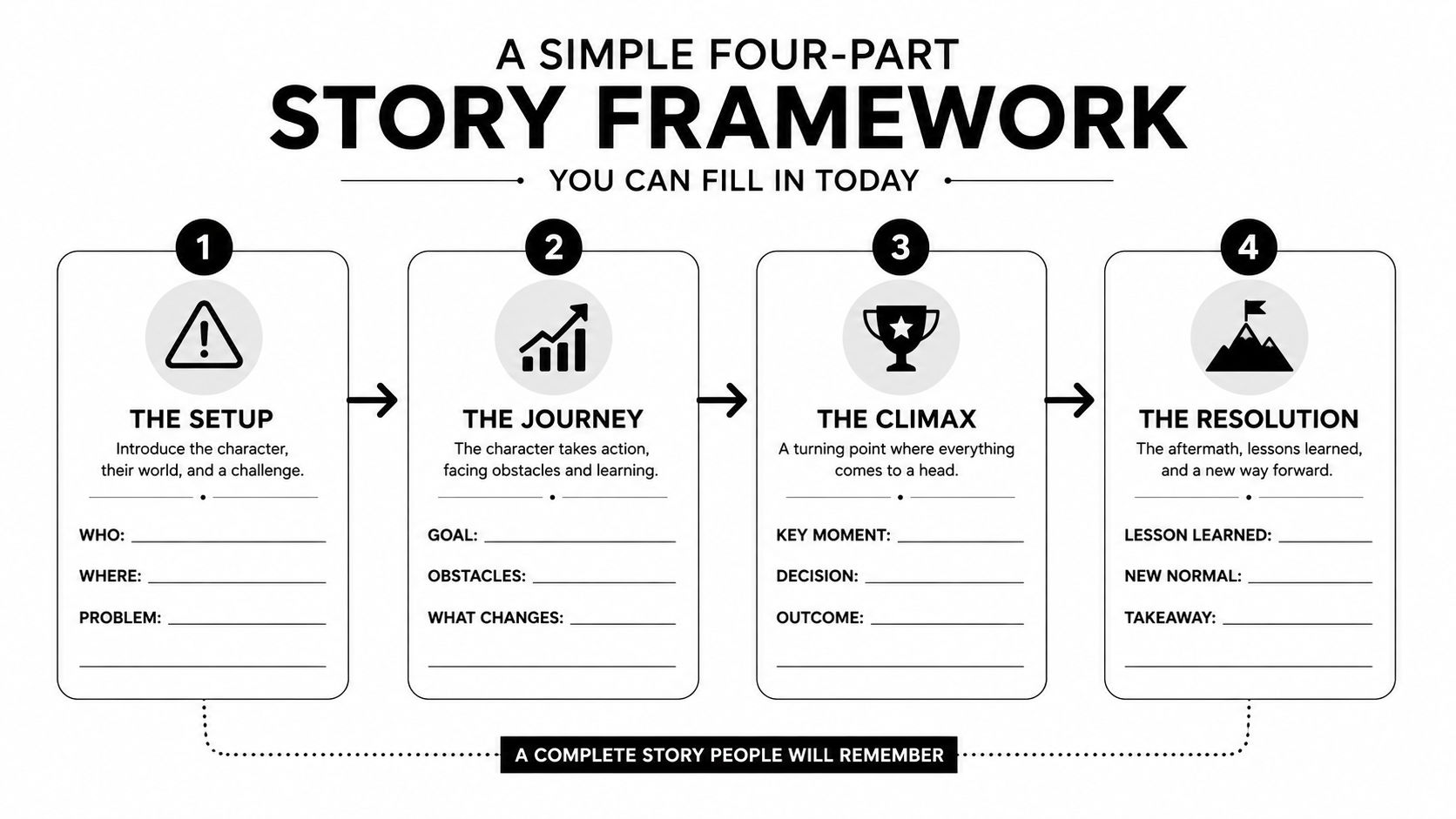
Origin
Why did this brand start? What was broken, frustrating, or missing before you made the thing?
A fictional coffee roaster might write, “I started roasting because I was tired of coffee that tasted flat and felt anonymous.”
Customer
Who is this for, and what does their day look like?
A better line would be, “This is for the person who wants a smoother cup in the morning without needing to become a coffee nerd.”
Promise
What outcome can the buyer expect, in plain language?
Try, “You get a bag that helps you find your favorite roast profile without guessing your way through a whole pound.”
Proof
What can you show that makes the promise believable?
Sourcing, testing, founder history, ingredients, reviews, or process notes come in. For some products, proof is a lab result. For others, it's a clear sourcing note or a customer review that says the product did what it claimed.
The Single Origin Coffee Sampler, Brazil Colombia Ethiopia, Flavor Discovery Pack, 6 x 2oz Bags (12oz Total) | Cozy Notes Coffee Co by Loyaltie fits this logic neatly because the product snapshot itself is straightforward, it lets people explore six single-origin coffees without committing to full bags, and it introduces origins like Brazil and Ethiopia in a way that helps the buyer map flavor to decision.
If you want to keep the brief handy, the resource section at Loyaltie is a sensible place to organize story notes before they turn into copy.
Two Makers, Two Listings, and What the Difference Looks Like
A spec-sheet listing says what's in the bag. A story-led listing tells the shopper why it exists and why they should care right now.
Here's the difference with a fictional sweet potato donut mix. The flat version leads with ingredients, baking instructions, and the fact that the mix makes donuts. It answers the basic question, but it gives the reader nothing to hold onto emotionally. The stronger version opens with the founder baking gluten-free donuts because she wanted Sunday morning treats that felt joyful instead of restrictive, names the person who gets to enjoy them at home, and ends with the feeling of pulling a warm tray from the oven.
That's not fluff. It's positioning.
Small signals matter more than people think
A real founder photo on the listing does more work than a polished stock image because it confirms there's an actual person behind the product. A short note on the back of the bag can reinforce why the brand exists. Even the first reply to a customer review can carry story if it sounds human and specific instead of scripted.
For a visual version of how product presentation supports that message, the product demo guide by Screen Charm is useful because it helps you think about showing the product in use, not just describing it.
The point isn't to make every listing sentimental. The point is to make every listing legible. A shopper should see the customer, the reason, the proof, and the next step without having to dig.
Use this checklist for your own page:
- Hook sentence first: Open with the customer problem or desired outcome.
- Founder presence visible: Add a real photo where people can see it.
- One line of purpose: Say why the brand exists in plain language.
- One line of proof: Show the ingredient, review, or process detail that backs it up.
- Clear reorder path: Make it easy to come back and buy again.
That pattern is exactly what makes a marketplace listing feel coherent instead of random. If one page sounds like the founder and the next sounds like a factory sheet, the buyer feels the break.
How to Tell If Your Brand Story Is Actually Working
A story that doesn't change behavior is decoration. The easiest way to test whether yours is working is to treat it like a simple experiment, not a brand personality exercise.
Track the signals that matter
You don't need a heavy marketing stack to know if the story is landing. You need a few signs that shoppers are paying attention and coming back.
| Storytelling Metrics a Solo Founder Can Track | ||
|---|---|---|
| Signal | Where to Look | Healthy Shift in a Quarter |
| Repeat orders | Store or order history | More customers come back without needing a discount |
| Story recall | Customer reviews, messages, replies | Buyers mention your reason for making the product |
| Time on page | About page or listing analytics | People stay long enough to read the story, not just skim the price |
| Referral language | DMs, emails, word-of-mouth | Customers repeat your framing when they recommend you |
Watch for warning signs
If people like your photos but never reorder, the story might be pretty but not persuasive. If traffic is high and conversion is low, the problem may be that the page is vague or the promise is buried. If reviews never mention the founder, the why, or the customer experience, the story probably isn't clear enough to stick.
A good story should make at least one of those signals move over time. If nothing changes, the message is probably too product-heavy or too self-focused.
Useful test: if a shopper can't repeat your story in one sentence after reading your page, the page has too many ideas and not enough direction.
That matters most for independent brands, because trust is the whole game. The story isn't there to decorate the product. It's there to help a stranger feel safe enough to buy directly from the maker.
Putting It All Together on Loyaltie This Week
Start with one page, not ten. Write the Origin, Customer, Promise, Proof brief first, then trim it until it fits on a single sheet you'd use.
Rewrite the first three lines of your Loyaltie listing so they speak to the customer's problem or goal before they describe the product itself. Add a real founder photo and one short line about why the brand exists. Then send a simple reorder message that mentions what a customer said, and what you changed or noticed because of it.
Watch one number for the next 30 days. It might be repeat orders, story mentions in reviews, or time spent on the listing. You're not trying to prove everything at once. You're trying to find the line between copy that sounds good and copy that helps people buy.
That's where Loyaltie fits in. It's a marketplace where people discover and buy directly from the best independent brands in the US, which means your story reaches shoppers who already want better products and want to buy from the maker without the middleman getting in the way. When your story is clear, that kind of audience has less friction, more trust, and a much easier path to checkout.
If you're ready to turn your product story into something shoppers remember, visit Loyaltie and see how buying directly from the maker can feel simpler, clearer, and more connected. You can discover independent brands across categories like coffee, skincare, wellness, food, and pet products, then put a stronger story behind every reorder.