
Secure checkout means your card details are encrypted while they travel, raw card numbers aren't stored on the seller's servers, fraud screening checks the order, and recognizable buyer protections stand behind the payment. Baymard found that 19% of shoppers abandoned checkout because they didn't trust a site with their credit card information in a 2025 study of 1,026 U.S. internet adults.
You may feel that doubt yourself. You've found a local coffee maker, skincare brand, wellness product, or hand-drawn card you'd rather buy directly from the maker than pick up from a mass-produced chain. The product feels personal and well made, but the checkout page is unfamiliar. Your cursor hovers over Pay, and you wonder whether the site is safe, whether the brand is real, and what happens if the order goes wrong.
That pause isn't irrational. A checkout asks you to exchange sensitive information for a promise of delivery, often from a brand you've only just discovered. Secure checkout is the quiet bundle of safeguards beneath that moment, not merely a padlock icon or a reassuring phrase.
Table of Contents
The Moment You Hesitate Before Hitting Pay
You've probably experienced the pattern. You search for a better everyday product, discover an independent brand, read the ingredient list or product description, and add something to your cart. Maybe it's a locally made wellness item, a bag of coffee, or a paper good from a maker whose work feels more thoughtful than what you usually see in a large retail aisle.
Then you reach payment.
The page may look polished, but you're still asking practical questions. Does the address belong to the store? Will my card details be protected? Is this seller accountable if the package never arrives? A checkout can look professional and still leave you unsure because visible design and actual protection aren't the same thing.

Baymard's research connects that hesitation to real purchase loss. Its broader research estimates that U.S. retailers lose about $260 billion each year through cart abandonment, with security fears among the major causes, as explained in its analysis of perceived payment-form security. The issue isn't that every unfamiliar independent brand is risky. It's that shoppers need enough evidence to make a sensible decision.
What secure checkout promises
A trustworthy payment flow should protect information in transit, limit what the seller stores, identify suspicious transactions, and give you a clear route to help after payment. Those safeguards should work whether you're buying from a large retailer or an independent maker.
The human side matters, too. Recent Experian research found that only 19% of consumers trust retailers to protect them online, while 52% expect retailers to do so. That gap explains why a simple badge rarely settles the question. You're looking for a combined picture, technical protection supported by a real business, clear policies, and recognizable payment infrastructure.
For a broader look at how businesses create confidence online, the build customer trust guide offers useful context beyond the payment page. The practical definition to keep in mind is simple: secure checkout protects your payment details and gives you meaningful recourse if the transaction fails.
How Secure Checkout Actually Works Behind the Screen
Think of payment as sending a valuable item through several checkpoints. No single checkpoint does every job. The system becomes safer when each layer limits a different kind of risk.
First, protect the journey
Your browser should connect to the payment page through HTTPS using TLS, the current security layer that scrambles information as it moves between your device and the website. TLS works like a sealed envelope. Someone who intercepts the traffic shouldn't be able to read the card details inside it.
Modern payment guidance recommends TLS 1.2 or later, because earlier versions have known vulnerabilities, as outlined in secure online payment processing guidance. A padlock tells you the connection is encrypted, but it doesn't independently prove that the company behind the domain is honest.
Next, replace the card number
A payment processor such as Stripe or Adyen can use tokenization. Instead of sending the raw card number into the seller's database, the processor replaces it with a token, a stand-in value that's useful for the approved payment but not a readable card number.
That distinction matters after a breach. If an attacker intercepts encrypted traffic, they should see unreadable data. If someone breaks into the merchant's storage, they should find placeholders rather than a ready-to-use collection of card numbers.
A processor-focused explanation of this architecture appears in PCI-compliant payment gateway insights. PCI DSS, first introduced in 2004, remains the global benchmark for protecting cardholder data during online transactions.

Finally, assess the order
Fraud screening adds another layer. Processors can evaluate signals such as the device being used, location, behavior, and transaction patterns in real time. A low-risk purchase may pass without interruption, while an unusual order may trigger another verification step or be blocked before authorization.
That's the full mental model:
- Encryption protects the card details while they move.
- Tokenization limits what the merchant retains.
- Fraud monitoring checks whether the transaction looks legitimate.
A secure checkout isn't one feature. It's these overlapping routines working quickly enough that you can complete a normal purchase without needing to understand the machinery.
For example, the A2 Celebration Greeting Card, 100% Recycled Paper, Blank Inside, Hand-Drawn Congrats Card, Includes Kraft Envelope | Chika Paper Studio by Loyaltie has a product description that tells you what you're buying. Secure checkout addresses a different question, whether the payment process handles your information safely.
Signs You Can Spot on Any Checkout Page
Visible trust cues help you decide whether to continue, but each cue has a limited meaning. Treat them as clues, not proof. A padlock confirms encrypted transport, for example, but it doesn't tell you whether the seller will ship your order or answer your email.
| Visible Signal | What It Actually Means |
|---|---|
| HTTPS and a padlock | The connection between your browser and the site is encrypted. |
| Visa, Mastercard, PayPal, Apple Pay, or Shop Pay | The checkout works with a recognizable payment network or processor. |
| Clear returns information | The seller has explained what happens when you need a refund or exchange. |
| Contact details and a physical address | You have more evidence that an accountable business operates behind the page. |
| Correct spelling in the domain | The address is less likely to be a simple imitation, though careful checking still matters. |
| Clean page without pressure tactics | The design gives you room to review the purchase rather than pushing rushed decisions. |
| A verification badge | The badge may indicate a provider relationship, but you should be able to identify who issued it. |
Read the whole page, not one badge
Recognized payment options can provide reassurance because the seller has connected the checkout to established payment infrastructure. They don't guarantee that the product will arrive, and they don't replace your need to review the merchant's policies.
A clear return policy near the payment button is more useful than a vague promise of satisfaction. So are specific delivery expectations, a visible support channel, and a total price shown before you submit the order. Checkout guidance also emphasizes transparent pricing, specific delivery dates, clear returns information, and guest checkout as practical trust signals. You can find a fuller breakdown in this analysis of trust signals and checkout abandonment.
Typos, strange redirects, urgent countdowns, and requests for information unrelated to the order should make you slow down. A clean page helps, but appearance alone can't establish legitimacy.
For a second perspective on checking website safety, the WP Triage security guide is a useful resource. The best habit is to combine technical cues with business accountability. Ask whether the site protects the connection, whether you understand the seller's policies, and whether you know how to get help.
The Protections That Quietly Cover You After You Pay
Security shouldn't end when the payment is authorized. The meaningful question is what support exists if your card is used without permission, the package doesn't arrive, or the order differs materially from what you purchased.
A chargeback lets you ask your card issuer to investigate certain disputed transactions, including unauthorized card use. Merchant responsibility can also matter when goods never arrive or aren't as described. The exact process depends on your payment method and issuer, so keep your receipt, confirmation email, and communication with the seller.
Verification and responsibility
Some checkouts use 3D Secure or another additional authentication step. When the issuer verifies that you're the genuine cardholder, responsibility for certain types of card fraud may shift toward the issuing bank under the applicable rules. That doesn't mean every dispute automatically goes in your favor, but it creates a clearer record of the authentication event.
Payment processors also monitor transactions and help merchants handle disputes. For you, that infrastructure becomes useful only when the store provides a working support route and preserves an accessible order record.

An independent brand can make an excellent product and still need dependable payment operations. That's where a marketplace can add structure around the maker. Loyaltie describes its buyer and platform practices in its privacy policy, while the broader principle is straightforward, buyers should know what data is handled, who can help, and what records to keep.
Consumer trust is especially fragile after a payment incident. One study found that 65% of online shoppers are likely to end their relationship with a retailer after a single instance of data theft or payment fraud, according to Security Boulevard's discussion of checkout trust. A secure payment is therefore not only about preventing an incident. It's also about making the recovery path understandable.
How Loyaltie Builds a Secure Checkout You Can Trust
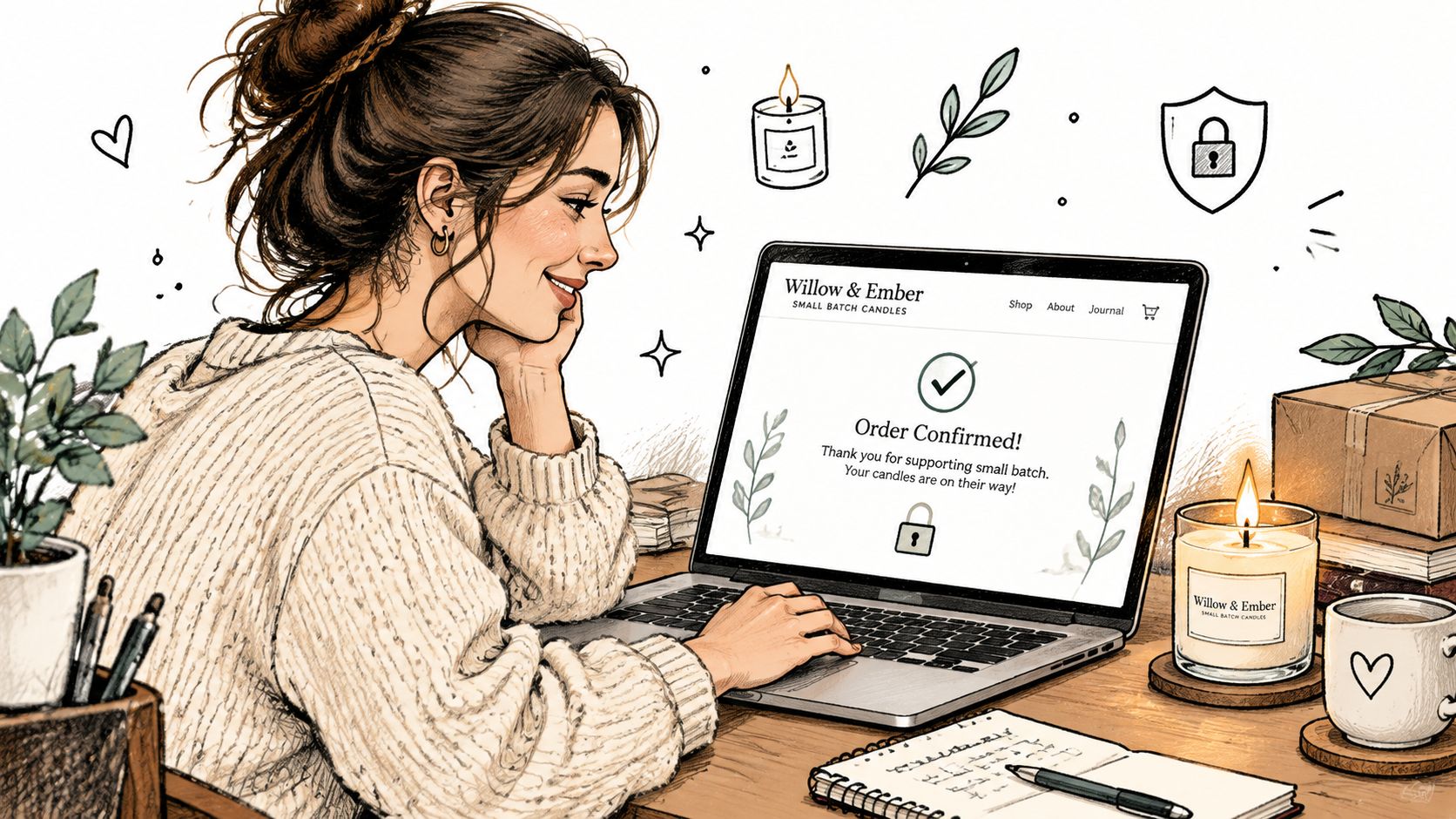
Suppose you discover a candle maker through Loyaltie and decide to place an order. You review the product, enter your shipping information, and reach payment without being pushed into an unfamiliar environment or asked to email card details. The checkout should feel ordinary because the protective work happens underneath the form.
Loyaltie uses encrypted payment fields and PCI-compliant payment processors. Higher-risk regions or transactions may require additional 3D Secure verification, while ordinary orders can move through a lighter flow. After payment, a clear confirmation email and reference ID give you something concrete to save and use if you need support.
The platform's role
The important distinction is that the marketplace can connect the buyer to independent brands while adding payment and order structure around the transaction. Instead of asking you to trust an unfamiliar maker with every part of the process, the checkout gives you recognizable payment handling and an order record.
Loyaltie also holds payment until the seller ships, which addresses a specific concern with buying directly from a newly discovered maker. You're still choosing based on the quality of the product, the maker's approach, and the information on the listing. The platform adds a layer between your payment and the seller's fulfillment.
This is why checkout security matters for independent commerce. A local skincare maker or food producer may know its products without having the resources to build every payment control alone. A marketplace such as Loyaltie can provide the connective tissue, letting you discover and buy directly from independent brands while the payment flow, verification, confirmation, and order support follow a consistent process.
The result isn't a promise that nothing can ever go wrong. It's a more useful promise, that the payment is handled through protective systems and that you have a defined path when something needs attention.
When Security Slows Things Down
More checks don't automatically create a better checkout. A mandatory verification prompt can stop a fraudulent payment, but it can also interrupt a legitimate buyer who has already decided to purchase. Recent UK consumer research found that four in ten shoppers abandoned an online purchase because of a security check, showing the tradeoff clearly in coverage of security checks and checkout speed.
You may have seen the friction yourself. A payment page sends you to another screen, asks for a one-time passcode, rejects a billing address that's correct, and then asks you to repeat the process. Each step may exist for a reason, but a confused buyer can't tell whether the problem is security, a bank rule, or a broken form.
Good security is selective
Risk scoring helps a platform choose when to add friction. A routine purchase from a familiar device and location may pass smoothly, while an order with unusual signals can receive extra scrutiny. The goal isn't maximum interruption. It's appropriate verification for the level of risk.
Mastercard's 2024 checkout whitepaper describes the combined importance of protection and convenience. It reports that 8 out of 10 online shoppers abandon their cart, and nearly half blame the lack of a frictionless payment experience. The same whitepaper cites research in which 89% of respondents considered secure checkout and personal-data protection essential to trust, while 85% valued a smooth experience. Those figures appear in Mastercard's global checkout whitepaper.
That balance is part of what a marketplace's seller resources can help explain to independent brands. A checkout should challenge suspicious transactions without treating every customer as suspicious.
A Quick Checklist Before You Pay Anywhere Online
Use this as a portable habit, not a ritual you perform only when a store feels unfamiliar. You can apply it to a marketplace, a maker's own site, or a larger retailer without turning a simple purchase into an investigation.
Before entering payment details
- Check the address: Confirm that the page begins with HTTPS and that the domain is spelled correctly.
- Inspect site identity: Use the padlock or browser site-information control to confirm the connection details.
- Look for accountable contact information: Find a support email, returns page, and business details before paying.
- Review the total: Make sure product cost, delivery charges, and any other visible fees are included before submission.
- Notice the tone: Be cautious if the page relies on urgent pressure, strange redirects, or requests for unrelated personal data.
A recognizable trust seal can help if it identifies the provider behind it. An unexplained badge is decoration, not evidence.
While entering information
Watch how the form behaves. Established payment processors may host the card fields or redirect you to a familiar payment environment. Tokenized fields can mean the merchant's own database isn't receiving the raw card number, although you don't need to identify the token itself to benefit from that architecture.
Choose guest checkout when it's available and suitable. Creating a permanent account or storing payment details can add convenience, but it also creates more information that needs protection.
After you pay
- Save the confirmation: Keep the order email and reference ID.
- Check the receipt: Make sure the item, delivery details, and final amount match what you approved.
- Keep support visible: Save the seller or marketplace contact route in case the order needs attention.
- Watch your account: Review your payment activity and report anything you don't recognize to your issuer.
If a page passes these checks and still feels wrong, you're allowed to leave. A good product isn't worth overriding your judgment.
Why Buying From Independent Makers Feels Different Now
Buying from an independent maker used to require a larger leap of faith. You might find a great coffee roaster, supplement brand, pet-food producer, or skincare maker through word of mouth, but the online payment experience could feel improvised. The product quality and the checkout quality weren't always connected.
That gap is closing. TLS encryption protects the trip from your browser to the payment system. Tokenization limits the value of what a merchant stores. Processor-level fraud screening evaluates the order. Human protections then give those technical controls practical meaning, through confirmation records, dispute routes, responsive support, and clear policies.
The change is especially noticeable when you buy directly from an independent brand. You're not choosing a product only because a large retailer has made it familiar. You're responding to the maker's ingredients, materials, process, or point of view. That first order is a small act of trust, and the checkout needs to make that trust reasonable rather than asking you to ignore your concerns.
Discovery and confidence can share one flow
Loyaltie brings discovery and payment into the same marketplace experience. You can find independent brands and local makers across everyday categories, then buy directly through a checkout designed to give the order a recognizable structure. There's no need to treat quality and security as competing priorities. A carefully made product deserves a payment experience that handles your information with equal care.
That doesn't mean a padlock can tell you everything. It means you can look for the complete picture: protected data, a known payment route, clear order information, a real support path, and buyer protections that remain available after you click Pay.
The emotional payoff is quiet but important. Curiosity becomes a confident order. You can try the coffee, skincare, wellness product, pet item, or paper good that caught your attention without pretending risk doesn't exist. You've checked that the process gives you sensible protection if the transaction doesn't go as planned.
Explore Loyaltie, a marketplace where you can discover and buy directly from independent brands and local makers across the US. Visit Loyaltie to find better everyday products and place your next order through a checkout built to make independent shopping feel clear and secure.