
Pasture-raised means the animal spent most of its life outdoors on land covered mainly by living plants, not confined in barns or feedlots, and USDA has no single universal definition behind the phrase. The benchmark producers are asked to document is the majority of the animal's life, from birth to slaughter, on ground that's mostly rooted vegetation.
So why can two cartons with the same three words describe two farms that look nothing alike? Because the phrase isn't a rating with a fixed number of stars. It's a claim. Some claims arrive with paddock records and a named certifier. Others arrive with a nice drawing of a barn. What does pasture raised mean in practice? Whatever the producer can show you, which is exactly why it's worth learning to read the fine print before you spend money.
Table of Contents
- What Pasture-Raised Means in Plain Language
- Pasture-Raised Compared With Other Animal Claims
- Why the Label Is Looser and What to Ask
- Pasture-Raised for Meat, Dairy and Eggs
- What Pasture Changes and What It Doesn't
- How to Pick a Pasture-Raised Product You Can Trust
What Pasture-Raised Means in Plain Language
A useful pasture-raised description gives you a picture of daily farm life: the ground animals used, the time they spent there and the feed they ate. Those details make the claim easier to judge. A green hillside on a package leaves those questions unanswered.
Start with the ground itself. Pasture means land covered mainly by living, rooted vegetation, such as grass or other plants. An outdoor dirt lot offers fresh air, but it does not describe the same setting. Time matters, too: occasional access tells you much less than a description covering the animal's life.
Most of a life, not a visit. Producers should document pasture use for the majority of an animal's lifespan, from birth until slaughter, along with mostly rooted vegetation on that pasture, according to the FSIS guideline on substantiating animal-raising claims. Read that as a documentation benchmark, rather than a precise description of every farm using the phrase.
The United States has no general labeling policy for pasture-raised. The phrase has no fixed national threshold. Species, outdoor access, diet and grazing duration can differ between operations, so the wording needs a farm-specific explanation.
A farm description works like a caption beneath a photograph: it supplies the details the image cannot show. “Pasture-raised” gives you the broad subject. Information about grazing months, supplemental feed and verification makes that description useful.
The honest version: a label that names a practice and the person who checked it gives you more to assess than pastoral imagery alone.
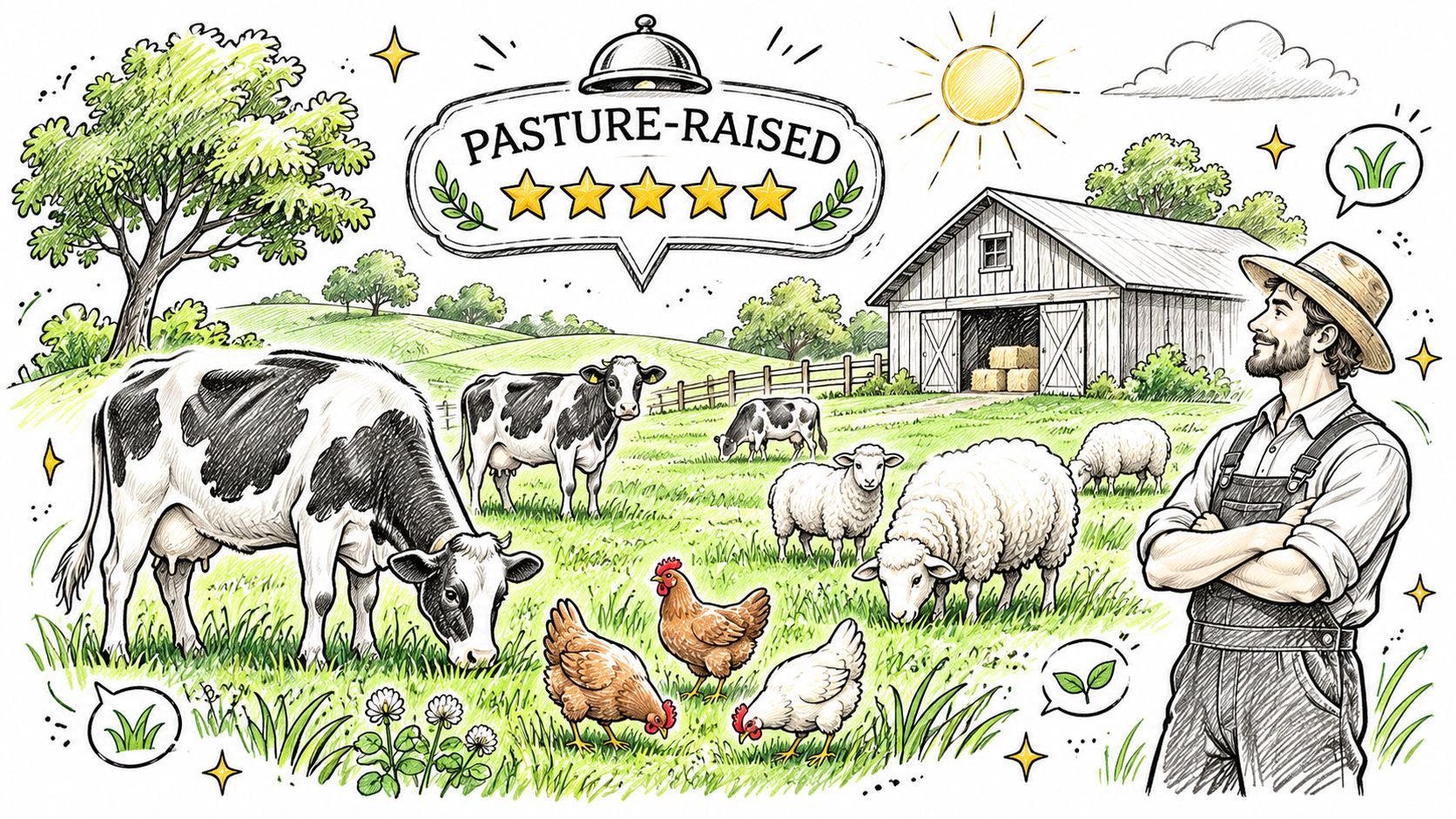
The illustration below captures the setting people often associate with pasture. The questions to carry beyond that image concern the animals' routine and the records supporting it.
These details turn a broad claim into something you can examine:
| Detail | What good documentation shows | Why it matters |
|---|---|---|
| Share of life on pasture | Most of the animal's life, birth to slaughter | Outdoor access alone is not enough |
| Ground cover | Mostly rooted grass or other plants | A dirt lot is not pasture |
| Feed | Whether hay or grain supplemented grazing | Pasture-raised does not mean grass-only |
| Grazing season | How many months animals were on pasture each year | Seasonal access differs from year-round access |
| Verification | Producer records or a third-party certifier | Seller statements vary in strength |
Keep the feed question separate from the pasture question. Animals can spend time grazing and also receive supplemental feed. Likewise, a description of summer grazing leaves you needing an explanation of the rest of the year.
Organic is a separate claim with its own requirements, explained in USDA's guide to organic standards. That guide should not stand in for a farm's explanation of what it means by pasture-raised.
Look for the sentence after the label: which animals, which ground, how much of the year, what feed and who checked. A specific description gives you something concrete to evaluate, whether you buy directly from the producer or from a store.
Pasture-Raised Compared With Other Animal Claims
Most label confusion comes from stacking, not from any single word. Each claim answers a different question about an animal's life, so put them side by side and the tangle mostly unravels.
| Claim | Federal rules | What it covers | What it does not promise |
|---|---|---|---|
| Pasture-raised | No general USDA labeling policy | Time on vegetated pasture | A grass-only diet, organic status or a set stocking density |
| Grass-fed | USDA standard for ruminants | Forage-only diet with pasture access during the growing season | Organic status or antibiotic-free production |
| Organic | USDA certified | Organic feed, daily grazing in season, outdoor access year-round for ruminants | A grass-only diet unless also labeled |
| Free-range | Substantiation required, no set pasture rule | Outdoor access for poultry, area size often unspecified | Pasture coverage or a grazing diet |
| Raised without antibiotics | Substantiation required on meat labels | No antibiotic use | Pasture access or a grass diet |
The mix-up I see most often is treating pasture-raised and grass-fed as synonyms. USDA guidance keeps them apart. Under the grass-fed standard for ruminants, the diet must come solely from forage, with no grain or grain by-products, and the animals need continuous pasture access during the growing season until slaughter, per USDA's FSIS guide to animal-raising claims. Pasture-raised documentation is about where the animals lived and whether pasture covered most of their lifespan. A pasture-raised chicken can still eat grain. A pasture-raised steak can come from an animal that finished on corn.
Organic runs on its own track because it's a certification with inspectors attached, rather than a phrase a producer applies to itself. Even then, it doesn't promise a forage-only diet unless the package says that separately.
Antibiotic claims are narrower still. They cover medication use and tell you nothing about grass, dirt or square feet. Free-range is the loosest of the bunch. For poultry it means outdoor access, and the size and quality of that outdoor area vary enough that the term says far less than the carton art suggests.
If you keep your own flock, or you're curious what the organic side looks like from the hen's end, how to raise hens organically walks through feed, housing and pasture rotation in practical detail.
The same tangle shows up outside the meat aisle. A balm made with grass-finished tallow tells you about an animal's diet, not about how much of its life it spent outdoors. Makers who understand the difference tend to spell it out, the way the listing for this unscented tallow balm with cold-pressed olive oil for sensitive skin names the feed claim directly on the page.
Read each claim on its own terms and the picture sharpens. Pasture-raised can be grain-fed, organic isn't automatically grass-fed, and a grass-fed label says nothing about antibiotics.
Why the Label Is Looser and What to Ask
What does a farmer have to show before a package says pasture-raised? The honest answer is thinner than many shoppers expect. The phrase sounds precise, as if a government office set one square-foot number and one outdoor-days number. It works more like a production claim that needs support, rather than a single universal recipe.
The Federal Register notice on USDA's updated guidance for animal-raising claims spells out the gap. Federal guidance doesn't establish one universal duration, stocking density, geographic definition or minimum amount of forage across all products. The Federal Register notice on USDA's updated guidance for animal-raising claims says FSIS does require documentation for claims such as pasture-raised, and describes pasture as land primarily covered by rooted vegetation where animals are raised for the majority of their lifespan. Approval can rest on company documentation with no mandatory third-party audit, and poultry labels don't necessarily have to explain the claim to shoppers at all.
That means the front label can be a doorway, not a full description. A producer's record is closer to the floor plan. It tells you where the animal lived, what it ate and which parts of the year counted as pasture time. One farm description might say the birds spent spring through autumn on grass paddocks, moved into a barn over winter and received a grain supplement alongside forage. That wording sounds less poetic than a large pasture-raised stamp, yet it answers the questions a shopper has. It gives you a season, a housing practice and the line between grazing and feed.
You can compare that description with another farm's version. A front label with no detail gives you very little to set beside it. Treat the claim like a receipt with missing line items: it may be valid, but it cannot tell you what went into the total.
Four questions worth asking before you buy
- How much of the animal's life was outdoors? Ask for months, or for the share of life from birth to slaughter. "It saw the sky" isn't an answer.
- Was pasture access continuous or seasonal? Year-round grazing and a five-month grazing season are different products, and the second one usually involves hay, grain or housing for the rest of the year.
- What share of the feed came from pasture? A bird that forages all day and still draws much of its energy from bagged feed is pasture-raised and grain-fed at once. Neither fact cancels the other, and you get to decide which one matters to you.
- Who verified the claim, and how? A named certifier, an independent farm audit and a producer's own records are three different levels of proof. All three can coexist. You just want to know which one you're buying.
The advantage of buying directly from the maker is that these questions have somewhere to go. The person who raised the animal is often the person answering the message, and one specific reply tells you more than a shelf of front labels. A good answer stays concrete: which species, which months, which feed, who checked.
If diet is what you care about, ask the grass-fed question on its own. It's a separate standard with a separate answer, and a pasture claim won't cover it.
Pasture-Raised for Meat, Dairy and Eggs
The claim behaves differently depending on what's in the package, and knowing where the weight sits saves a lot of squinting.
For beef, pork, lamb and goat, the producer's own record carries most of the load. USDA's organic certification overview notes the agency doesn't maintain a general labeling policy for pasture-raised products, while its meat-labeling guidance asks producers using terms like pasture raised, pasture grown or meadow raised to document that most of the animal's life happened on pasture and that the pasture was mostly covered by grass or other plants. When you buy from an independent farm, that record is a conversation rather than an archive.
Species matter more than most shoppers expect. One farm might run its cows across rotating paddocks and keep its hens housed for most of the year. Ask which species the claim covers, and check each product separately instead of assuming the whole farm runs one way.
For chicken and eggs, the package may not explain the claim at all, so the detail has to come from the product page or from the maker. Some listings do state it plainly. The Korean Samgyetang Ginseng Chicken Soup, Organic Pasture-Raised Chicken from Nourish Meal Delivery names the raising method in the product title, which is the level of specificity worth looking for.
When you buy eggs, dairy or meat from a local maker, ask whether every animal of that type on the farm is raised the same way. The answer tells you whether you're buying a farm standard or one special batch.
What Pasture Changes and What It Doesn't
What does a pasture day change? The label describes where and how an animal lives, while the product and the land depend on what happens inside that system. Think of the front label as a gate. It tells you the animal had access to pasture, but it leaves the management details outside.
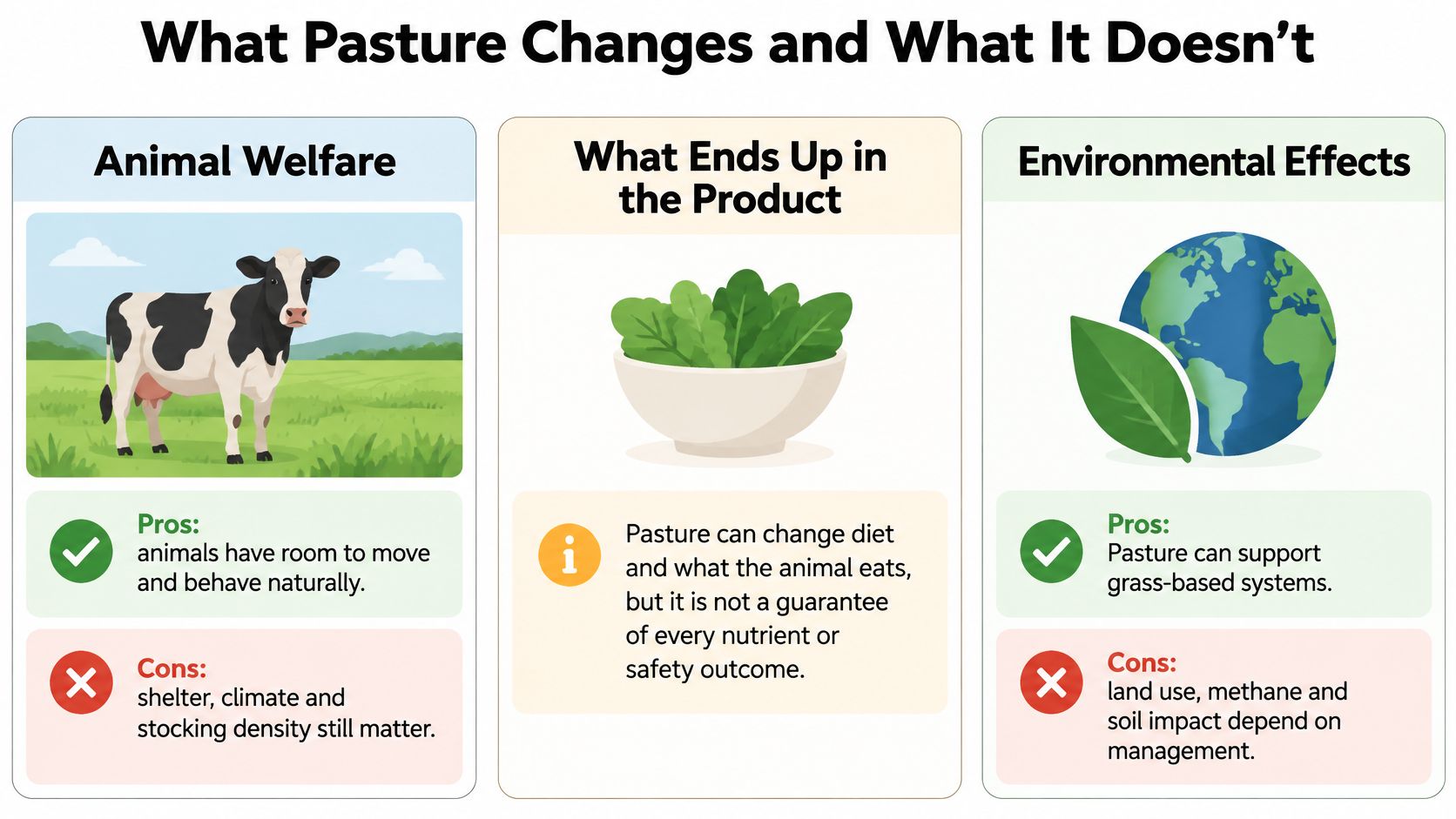
On welfare, pasture gives animals room to move and behave like the animal they are. That means more scope for ordinary behavior than a system built around confinement. The result still depends on shelter, climate, stocking pressure and veterinary care. A crowded, badly sheltered pasture can be worse than a well-run barn. The word "pasture" opens the gate, but it does not describe the whole yard.
In the product, the effect is real but conditional. A review of pasture-fed livestock production in Animal Frontiers reports that pasture-fed meat tends to be leaner and can contain more omega-3 and other polyunsaturated fatty acids, conjugated linoleic acid, and vitamins A and E than typical grain-fed alternatives. A comparison review of pasture-fed livestock production in Animal Frontiers noted that pasture-based diets could raise muscle linolenic acid and long-chain polyunsaturated fatty acids by up to fourfold and lower the omega-6 to omega-3 ratio. Breed, forage species, season, slaughter age and finishing diet all move those outcomes, so the phrase alone cannot predict a nutrient panel.
On the land, management decides nearly everything. Well-managed rotational or adaptive grazing can improve soil structure, biodiversity and water retention. The basic idea is like moving a lawn mower before one strip is scalped: plants get time to recover, roots hold soil, and manure is spread rather than concentrated. Overgrazing can degrade soil, disrupt nutrient cycling and raise nitrogen losses to waterways. The same review notes that year-round grazing may produce greater nitrogen losses than housed or feedlot systems in some settings, which is why "always outside" needs a question mark unless the producer can explain the grazing plan.
If you'd rather watch the systems side by side, this covers the difference in a few minutes.
Pasture-raised describes a production condition, and the farm's practices determine the rest. Animal welfare, nutrient profile and land effects are separate outcomes, each shaped by daily choices on the farm.
How to Pick a Pasture-Raised Product You Can Trust
Start by finding the farm's definition of pasture-raised before you trust the front label. USDA's updated substantiation guideline treats animal-raising and environment-related claims on meat and poultry as claims that need substantiation and label approval, and it still leaves shoppers to compare how each producer describes days outside, forage, rotation and housing. Grass-fed speaks to feed, raised without antibiotics speaks to medication, and organic follows its own certification rules. Work through four checks and most labels stop sounding alike.
- Read the front, then hunt for the back. The front label is a headline. The product page, back panel or a quick message to the maker is where the paddock detail lives.
- Stack only the claims you care about. If diet matters, look for grass-fed. If medication matters, look for raised without antibiotics. One strong adjective should answer one question.
- Choose your proof level. Third-party certification gives you an audited standard applied by someone with no stake in the sale. A detailed producer statement can give you the specifics an audit summary flattens, such as rotation length, supplemental feed and winter housing.
- Buy directly from the maker when you can. Questions reach the person who did the work. Feed claims can turn up in unexpected places too, including a tallow body balm made with grass-fed tallow and lemongrass essential oil where the maker names the fat's source right on the listing.
A certification tells you a standard was met. A producer tells you how. Listings with both leave the fewest blanks.
A dependable description sounds plain: where the animals lived, how long they were outside, what they ate and who can answer follow-up questions. When those details are easy to find, the phrase has evidence behind it.
The next time a pasture-raised label catches your eye, start with the maker instead of the marketing. At Loyaltie you can browse nearby makers, growers and producers, read how each one raises and feeds its animals, and buy straight from the people doing the work. When a description leaves you with a question, you're usually one message away from the person who can answer it.