


A lot of advice about small batch food brands starts in the wrong place. People tell you to buy them because they're cute, local, or worth supporting. That's not the point. You buy them because the good ones taste sharper, feel fresher, and often show more discipline in the kitchen than mass-produced food ever will.
The label itself doesn't mean much. Some brands use it as a mood. The ones worth your money use it as an operating choice, and that shows up in sourcing, formulation, and the way the product lands on your table.
Table of Contents
- Why Small Batch Food Brands Are Winning Over Shoppers
- Ingredient sourcing changes the outcome
- Formulation freedom is the hidden advantage
- One hot sauce tells the story
- Lock the formula before you chase sales
- Choose a production setup that fits your stage
- Price for survival, not vanity
Why Small Batch Food Brands Are Winning Over Shoppers
The old assumption says small batch is just a marketing label wrapped around a higher price. That's lazy thinking. In packaged foods, smaller consumer packaged goods companies were growing materially faster than large incumbents in the early 2010s, with 6.2% CAGR from 2009 to 2012 versus 1.6% for large players, and they gained 1.7 percentage points of market share while large players lost 0.7 points (Strategy+Business). That kind of shift doesn't happen because people got sentimental. It happens because buyers keep choosing food that feels more alive.
What makes this persuasive is that the pattern shows up in mainstream categories, not just niche shelves. Bakery, dairy, snacks, and ready meals all proved that smaller brands can become a real growth engine when they bring tighter control to ingredients and product development. If you've spent time at farmers markets, you already know the difference between a maker who's locked into a corporate spec and one who can adjust a recipe because the tomatoes ran sweeter or the beans were roasted a little darker that week.
A good small batch food brand usually gives up some uniformity in exchange for better judgment. That trade is visible in the food itself. You get shorter ingredient lists, more direct sourcing, and products that aren't designed first to survive a shipping network, then taste good if there's room left over. For buyers, that's the actual upgrade. You're not paying for a feeling. You're paying for food that was made with more care and less compromise.
Practical rule: if a brand's only pitch is “small batch,” keep walking until you see the ingredients, the process, or the source.
That's why a simple treat like Milk Chocolate English Toffee, Buttery Small Batch Candy, Non-Stick Crunch, 6 oz Bag matters more than the label suggests. The point isn't novelty. It's whether the maker can deliver a cleaner, better-textured product because they're working on a smaller, more controlled scale.
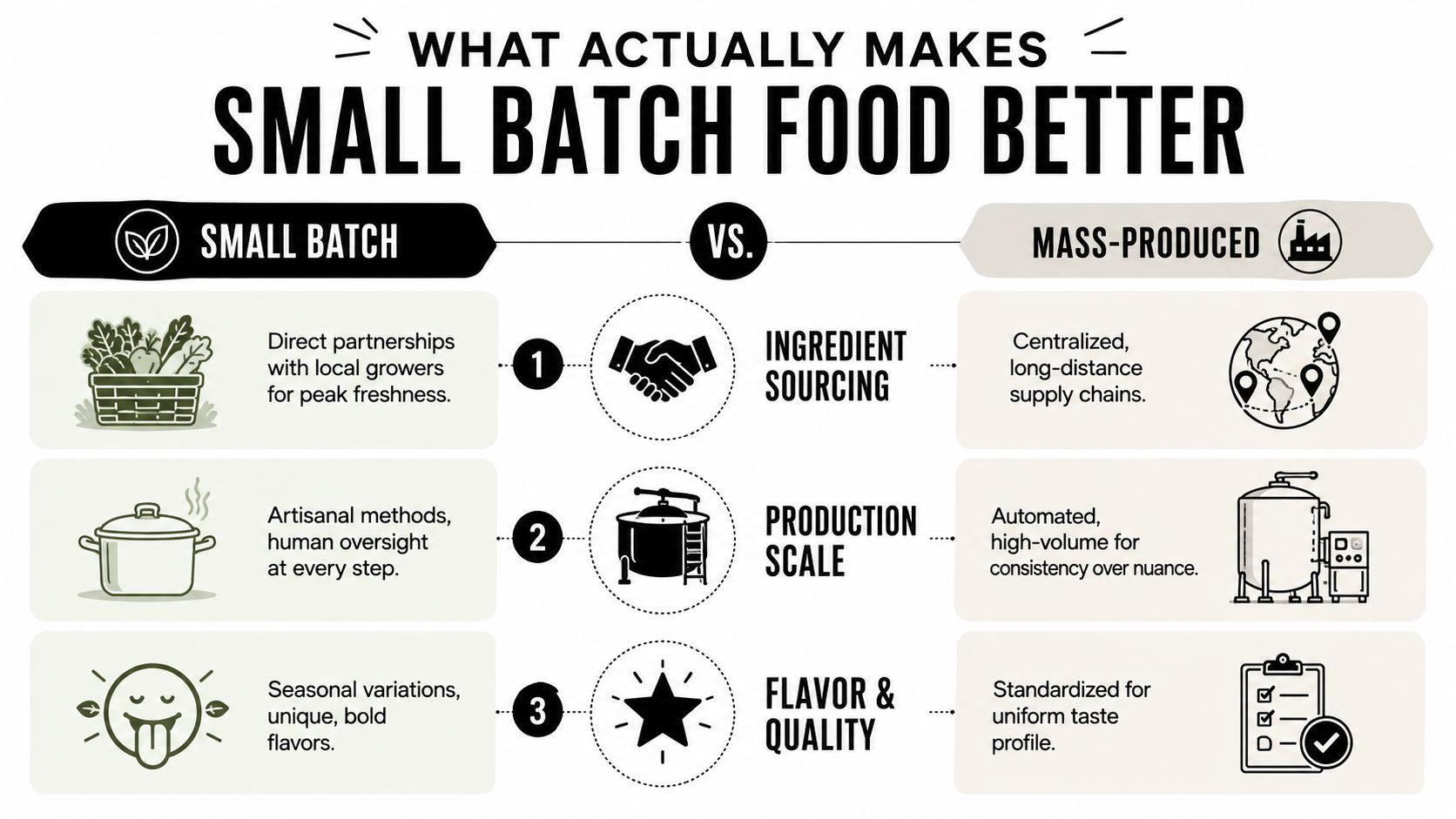
What Makes Small Batch Food Better
Ingredient sourcing changes the outcome
The best independent makers do not buy ingredients the way giant brands do. They build direct relationships, pull from specialty lots, and choose what suits the product instead of what moves easiest through a warehouse. That shows up fast in coffee, hot sauce, jams, and pantry staples because raw material quality does not hide for long. A roasted bean that started cleaner, a pepper picked closer to peak ripeness, or a fruit base made without generic concentrate all hit the palate differently.
There is also more room for restraint. A mass producer often has to stabilize a product for a long distribution chain, while a small batch maker can keep the formula closer to the raw ingredient. The reason is practical, not romantic. Fewer shortcuts usually mean more flavor.
Formulation freedom is the hidden advantage
Small batch makers can choose flavor over shelf-life optimization more often than large brands can. That does not mean they ignore safety, it means they are not forced to flatten everything into the same industrial profile. A small batch coffee roaster can focus on origin character. A sauce maker can keep brightness and bite instead of sanding it down for supermarket uniformity. A wellness brand can avoid filler-heavy compromises if the product is meant for direct sale and quick turnover.
Buyers notice that freedom immediately. You taste more distinct fruit notes, more heat that builds instead of blaring, and pantry products that line up with the ingredients on the label.
One hot sauce tells the story
Jalapeño Tomatillo Verde Hot Sauce, Lime & Cilantro, Medium Heat, Small-Batch Green Sauce, 5 oz is a clean example because the profile is specific, not vague. The snapshot points to a bright, tangy verde flavor with a smooth medium kick, with freshness from lime and cilantro. That is the kind of product you buy when you want tacos, eggs, or marinades to taste better without leaning on sugar or muddled heat.
A good small batch product usually tastes like somebody had to answer for every ingredient.
How to Evaluate Small Batch Food Brands Before You Buy
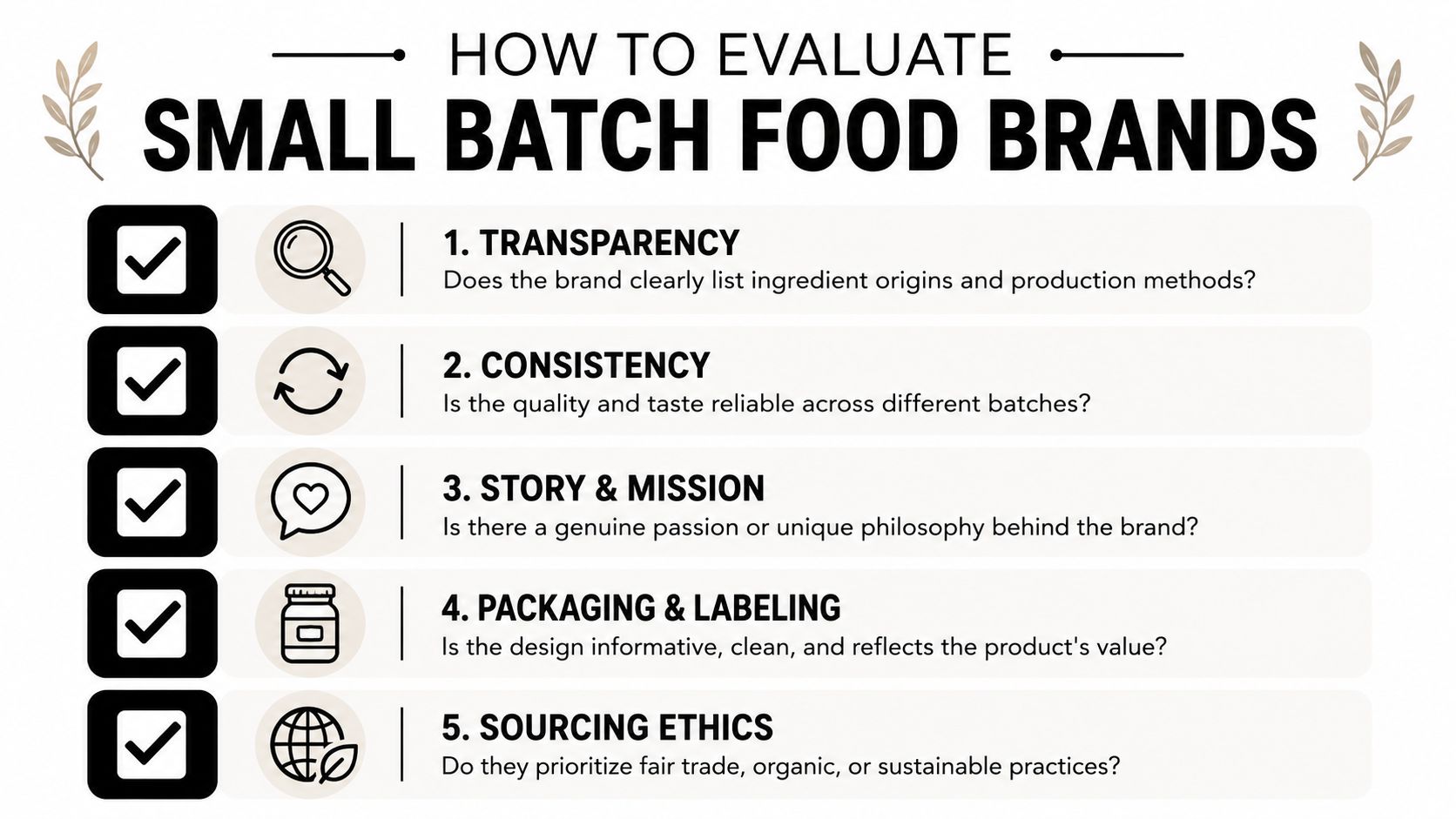
Don't let the phrase small batch do the work for the brand. Judge the product. Start with the ingredient panel and ask whether you can understand what you're reading. Short lists, recognizable ingredients, and the absence of industrial stabilizers tell you a lot before you even taste the thing.
Transparency matters just as much. If a maker names the farm, the roaster, the mill, or the source region, that's usually a sign they care about control and traceability. If the storytelling is all mood and no sourcing detail, the label is doing more heavy lifting than the kitchen.
Packaging gives away more than people think. Look for freshness dates, batch numbers, and sealing that seems built for protection rather than decoration. If the packaging looks beautiful but doesn't tell you when it was made or how to handle it, that's not craft, that's gloss.
You can use a simple filter when you're browsing a farmers market or an online shop.
- Transparency: Does the brand tell you where the ingredients come from and how the product is made?
- Consistency: Does the maker show signs of repeatable quality, not just one lucky run?
- Story and mission: Is there a real reason for the product to exist, beyond sounding local?
- Packaging and labeling: Does the label help you understand freshness and use, or just decorate a jar?
- Sourcing ethics: Do they talk plainly about organic, fair trade, or sustainable practices when those claims matter?
For coffee, a good test is whether the brand explains the roast and origin in plain language. A product like Organic Dominican Whole Bean Coffee, Ramirez Estate, Low Acid, Smooth Sweet Notes, Small Batch Whole Bean Bag earns attention because the sourcing detail is specific enough to evaluate.
Where to Discover Independent Food Makers Across the US
You already know the obvious places, farmers markets, co-ops, specialty grocers, and pop-ups. Those are still the best places to taste before you buy, especially if you want to compare sauces, coffee, baked goods, or snacks side by side. But if you stop there, you miss a lot of the country's better independent makers.
The digital route is where the search gets smarter. Many makers sell directly from their own sites, and curated marketplaces make the hunt less chaotic. A marketplace like Loyaltie lets you discover and buy directly from independent brands in one place, which matters when you're trying to skip the middleman and get fresher stock without crawling through dozens of separate shops. That's especially useful if you're building a pantry around makers you trust and want to reorder without starting from zero each time.
If you're looking beyond food, the same logic helps in adjacent categories too. For example, a guide to Japanese food delivery options shows how shoppers increasingly use online discovery to find specialty products that local shelves may never carry. The pattern is the same, better goods are easier to buy when someone makes them searchable.
Use location-based search like a buyer, not a tourist. Search by product type, region, and ingredient, then check whether the maker names the farm, roaster, or kitchen. If the brand offers regular delivery or a buy-on-a-plan option, use it only after you've tried a first order and know the product deserves repeat purchase.
Midway through your search, don't ignore category-specific marketplaces and brand lists. They often surface the better makers faster than general retail does.
Buying direct makes the most sense when you want something you'll keep restocking. Coffee, sauces, snacks, and pantry staples are easier to settle into when you're dealing with the maker instead of a chain buyer who rotates stock every time a planogram changes.
Starting Your Own Small Batch Food Brand
If you're building a food brand, start by making one product unreasonably good. Don't launch with a dozen SKUs. Launch with one thing people want to buy again. That keeps your recipe testing, packaging, and compliance work focused, which is the only sane way to start.
Lock the formula before you chase sales
Test the recipe until it behaves the same way more than once. If the product changes too much from batch to batch, you'll spend your life fixing complaints instead of growing the brand. For lightly cooked or shelf-stable goods, keep process control tight and validate the final product under the storage conditions you plan to use.
The food safety side is not decorative. In smallgoods, shelf-stability depends on variables like storage temperature, pH, salt in the water phase, lactic acid, diacetate, nitrite, and smoke phenols. Those inputs only matter if the full formula is validated against the final shelf life and handling conditions (MLA smallgoods safety guidelines).
Choose a production setup that fits your stage
A home kitchen can be enough for a first test if your local rules allow it. A shared commercial kitchen makes more sense once you need cleaner separation, more volume, or a path to wholesale. The right move is the one that protects consistency and keeps your paperwork manageable.
If you want a practical reference for structured quality systems, look at defect prevention in manufacturing. The label on the site isn't the point. The useful lesson is that early checks beat late fixes, and food brands need the same discipline.
Price for survival, not vanity
Too many makers price like they're hoping the product will justify itself. It won't. You need to cover ingredients, packaging, kitchen time, testing, and the overhead that comes with making food people can trust. If you can't explain the margin on paper, you don't have a business yet.
Here's the simplest path to first buyers.
- Start local: Farmers markets and pop-up events let people taste the product before they trust it.
- Sell where buyers already browse: Online marketplaces can reduce setup friction and put your product in front of the right shopper faster.
- Make repeat purchase easy: If a customer likes the first order, give them a simple way to reorder.
Loyaltie belongs in that mix because it gives makers a direct way to reach buyers without having to build a full standalone store from day one. That's useful when you're trying to prove demand before you add more complexity.
Why Buying Directly From the Maker Matters
The retail chain takes a real bite out of food brands. Public food-brand gross margins are often only 21% to 38%, with a median around 33%, and grocery or FDM trade spend can take 15% to 25% of revenue once a brand gets promoted at retail (Eightx food financial benchmark). That's why a jar on a supermarket shelf costs more than you'd expect, and why the maker often earns less than you think.
| Channel | Maker Revenue | Middleman Costs | Buyer Price Impact |
|---|---|---|---|
| Direct from maker | Higher share of the sale stays with the maker | Fewer layers between production and checkout | Often better value for fresher product |
| Grocery or retail | More revenue gets absorbed by the channel | More trade spend, slotting, and promotion costs | Higher shelf price is common |
Buying direct is not charity. It's a cleaner transaction. The maker keeps more of the sale, you get a product that's usually fresher, and neither side has to pretend that a chain buyer improved the recipe.
This is also where scale gets complicated. Independent brands can grow without disappearing into the same blandness as mass-market competitors, but only if they keep control of the product and the customer relationship. That's why direct channels matter so much. They let the maker expand without handing the whole experience over to a middle layer that doesn't care how the food tastes once it scans at checkout.
If you've ever wondered whether the sticker price is worth it, stop looking at the shelf tag alone. Look at how much of that price is paying for distribution friction.
Building a Better Pantry With Independent Brands
Build your pantry the way a buyer with taste would, one category at a time. Start with the products where small batch makes the biggest sensory difference. Coffee is the easiest place to notice origin and roast. Sauces and condiments are next, because freshness and balance show immediately. After that, move into spices, snacks, and shelf-stable staples where ingredient quality still matters every day.
Don't treat this like a crusade. Treat it like an upgrade path. The best independent brands earn repeat purchases because they're better, not because they're local. If a maker can't hold quality across multiple orders, the story doesn't matter.
For gift buying, this logic works too. A curated basket that includes a few standout foods from independent makers can feel a lot more thoughtful than a random box of generic items, and resources like gourmet gift baskets from OnlineGifts.us can help when you want something assembled quickly without giving up on better ingredients.
The smartest move is simple. Try a few brands, keep the ones that consistently outperform what you used to buy, and set up regular delivery or reorder only for the products that prove themselves. That's how you build a pantry that tastes better every week.
Loyaltie makes it easier to discover and buy directly from the best independent brands in the US, without the usual maze of middlemen and scattered storefronts. If you want better coffee, sauces, pantry staples, and other everyday products made by real people, visit Loyaltie and start with a few brands that earn a spot in your kitchen.