
You've already done the hard part. You made something worth buying.
Maybe it's a coffee blend people reorder because it tastes distinct. Maybe it's a scrub, soap, or supplement with ingredients you chose carefully, packaged in a way that feels like you. Then you launch the product page, share it on Instagram a few times, maybe send an email, and wait for Google to do its thing.
Nothing much happens.
That's the frustrating part of selling direct as an independent maker. Your page can look beautiful and still stay invisible. Meanwhile, shoppers are actively searching for the exact kinds of products you sell. Organic search still drives a huge share of ecommerce discovery, with 43% of all ecommerce traffic coming from organic Google search and 23.6% of ecommerce orders directly linked to organic traffic, according to this ecommerce SEO statistics roundup.
That gap is where SEO for product pages matters. Not as a technical hobby. As a way to help the right people find what you've made.
Table of Contents
- From Great Product to Ghost Town
- Start with the words people actually search
- Write descriptions like a good in-store conversation
- Give the page enough depth to rank
- Your images carry search value
- Schema is how you hand Google the facts
- What this looks like in practice
From Great Product to Ghost Town
A pattern shows up again and again with independent brands.
A founder spends weeks refining a formula, testing packaging, rewriting labels, and getting the product exactly right. They finally publish the page. The photos are solid. The branding feels cohesive. The product itself is better than what most big retailers carry. But the page gets a trickle of visits, mostly from social and direct links, then goes quiet.
That doesn't mean the product is weak. It usually means the page was built like a shelf listing instead of a search landing page.
Google can't infer everything from a pretty layout. It needs clear signals. What is the product? Who is it for? What terms match the shopper's intent? Why is this page distinct from ten other similar items? If those answers don't exist in the title, URL, body copy, image details, and markup, the page often disappears into the catalog.
Great products don't automatically become discoverable products.
This is especially true for makers selling coffee, skincare, wellness, food, supplements, or pet products directly to customers. You're often competing against bigger stores with larger catalogs, stronger domains, and teams dedicated to merchandising. The win isn't trying to out-corporate them. The win is building clearer, more useful pages around products with real specificity.
SEO for product pages works best when you stop thinking like a catalog manager and start thinking like a shopper. A person doesn't search for “No. 03.” They search for “orange lavender body scrub,” “cold process lavender soap,” or “mushroom coffee for focus.”
That's good news. It means the fix is usually practical, not expensive.
Writing Product Pages That People and Google Love
Most product pages fail in the same three places. The title is too clever. The URL is vague. The description is thin.
Those are fixable.
Start with the words people actually search
If your product title only makes sense to someone who already knows your brand, it's doing half the job.
A strong title usually combines the product name with the plain-English description a shopper would type into Google. For example, a maker might love the internal name “End of Summer Scrub,” but search engines need more context. Is it a body scrub? Is it for hands and face too? Does scent matter? Ingredient style? Skin concern?
That's why titles, page URLs, H1s, and meta titles should reflect the main keyword naturally. Google's SEO Starter Guide emphasizes optimizing URLs, titles, descriptions, and images around useful, user-focused content.
Use this simple comparison:
| Weak version | Stronger version |
|---|---|
| End of Summer | End of Summer Body Scrub |
| /products/eos-01 | /products/orange-lavender-body-scrub |
| Glow Bar | Lavender Glow Bar Soap |
The point isn't to stuff every phrase in. It's to remove ambiguity.
If you want a solid copy framework that can also boost Shopify product page conversions, that guide is useful because it pushes beyond feature lists and into buyer-focused writing.
Write descriptions like a good in-store conversation
A good product description doesn't read like a spec sheet. It sounds like a knowledgeable seller answering the questions a customer would ask if they were standing in front of the table.
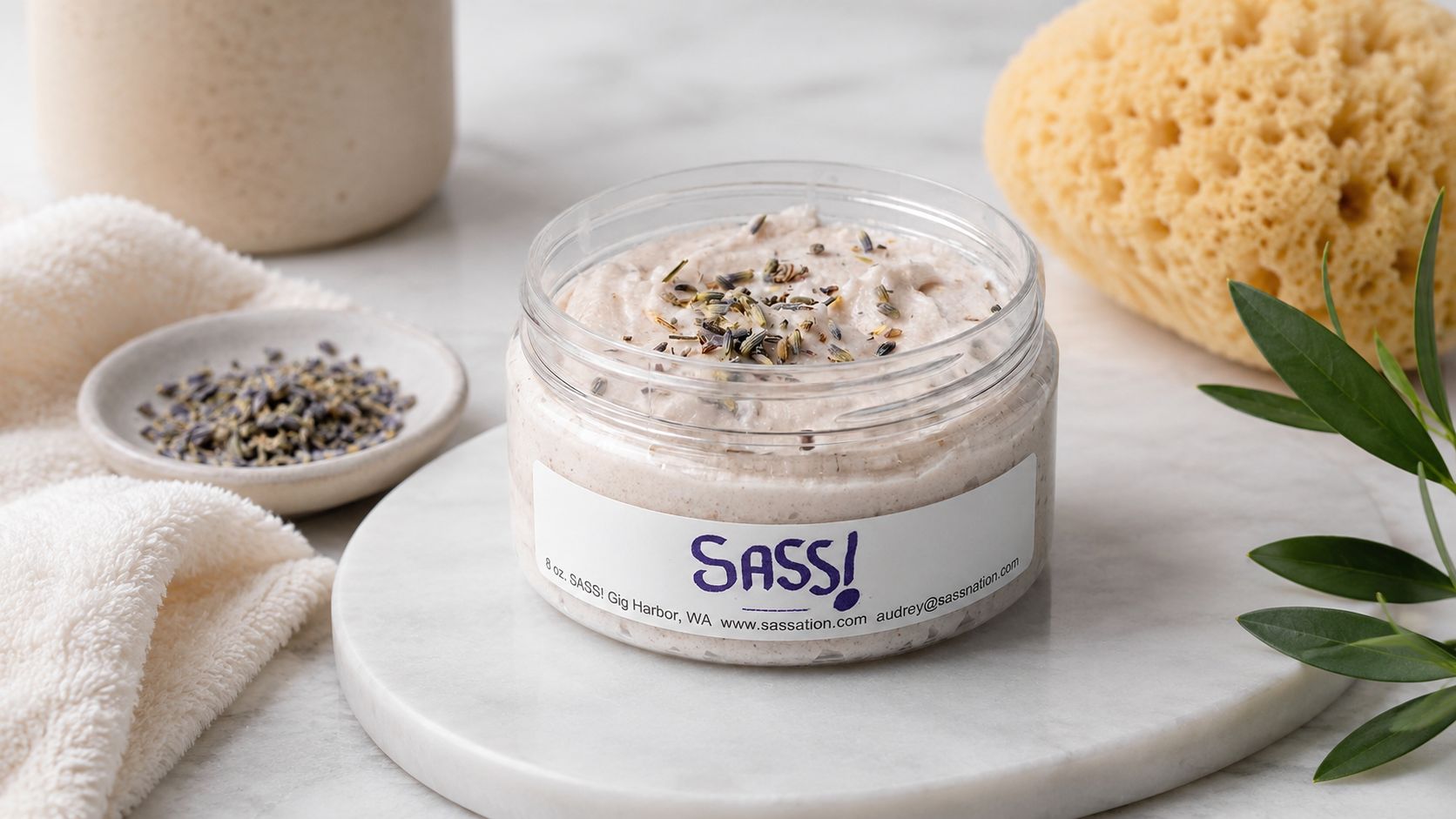
Take End of Summer Scrub for Hands, Face and Body! | SASS! by Loyaltie. The factual snapshot tells you it's a hand-made, all-natural, small-batch scrub for hands, face, and body, made to exfoliate dry, dead skin and buff away dullness and patches. That's already stronger than a vague “refreshing exfoliator” label because it names use case, format, and benefit.
Now turn that into copy with search intent in mind:
- Lead with what it is: “A hand-made orange lavender body scrub for hands, face, and body.”
- Add who it's for: dry, dull, rough-feeling skin.
- Describe the result: softer, smoother skin and a more polished texture.
- Include key attributes: all-natural, small-batch, exfoliating.
- Answer friction questions: texture, scent, how to use it, where to use it, and what makes it different.
Practical rule: If a customer would ask it before buying, your description should answer it before they have to leave the page.
A lot of independent brands underwrite here because they don't want to sound repetitive. But repetition isn't the enemy. Empty language is. Saying “orange lavender body scrub” once or twice in a natural way helps. Filling the page with “clean,” “luxury,” or “self-care” without specifics does not.
For more practical writing resources and merchant guidance, Loyaltie keeps seller materials in its resources for brands and makers.
Give the page enough depth to rank
Thin copy is one of the biggest missed opportunities in seo for product pages.
The same Google guide above is often cited alongside practitioner guidance that advises a minimum of 350 words, with an ideal product description length of 500 to 800 words when you want to compete across both informational and commercial intent on the same page.
That doesn't mean every product needs a rambling essay. It means the page needs enough substance to do several jobs at once:
- Explain the product clearly
- Answer common pre-purchase questions
- Use relevant search language naturally
- Support trust with specifics
- Help the shopper picture using it
A strong structure for maker brands looks like this:
- Opening paragraph: what it is, who it's for, main benefit
- Details block: ingredients, materials, flavor notes, skin feel, scent, size, usage
- Use guidance: how and when to use it
- Fit guidance: who it suits and who may prefer something else
- FAQ or short Q&A: practical concerns in plain language
That's enough depth to help search engines understand the page and enough clarity to help a shopper decide.
Making Your Products Stand Out in Search Results
A search result is your first shelf. If it looks incomplete, generic, or hard to trust, people scroll past.
Independent brands often assume big retailers have an unfair edge in this area. They don't, at least not automatically. A well-built product page can look far better in search than a bloated enterprise listing.
Your images carry search value
Search engines can't experience your product in person, so your images do extra work.
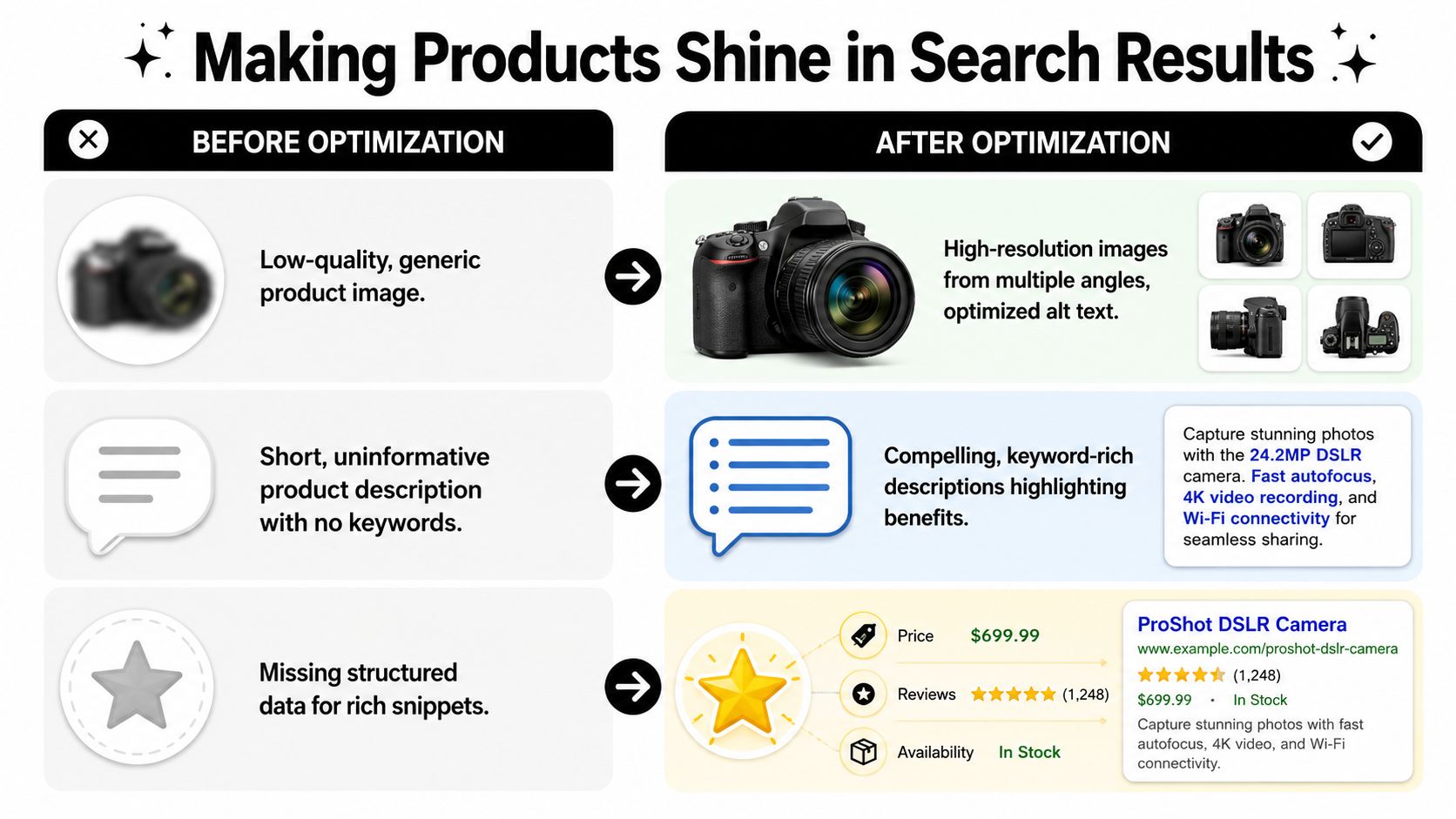
First, use high-quality photos that make the product obvious. That means clear main images, helpful close-ups, and angles that show size, texture, packaging, and real-world use where appropriate. Don't upload files named IMG_4482.jpg if you can avoid it. Rename them to something descriptive like orange-lavender-body-scrub-jar.jpg.
Then write alt text that describes the image plainly. Not a pile of keywords. A real description.
Here's the difference:
- Weak alt text: product image
- Better alt text: orange lavender body scrub jar for hands face and body
- Too much: best orange lavender exfoliating hydrating natural body scrub skincare product
The goal is clarity.
If you're still dialing in what customers are searching for, this guide from Outrank on finding high-intent keywords for ecommerce is a useful companion to your copy work.
Schema is how you hand Google the facts
Structured data sounds technical, but the idea is simple. You're labeling the important facts on the page so search engines can read them cleanly.
For product pages, that usually means Product, Offer, and sometimes Review schema. Those can help search engines understand details like price, availability, and ratings when those elements are present and correctly marked up.
Richer product results are more informative before the click. They can look more complete, more trustworthy, and easier to compare.
Prefixbox notes that optimized product pages that improve usability and present clear information through elements like structured data can increase conversion rates by up to 200% in a published case example, as discussed in its guide to product page SEO fixes.
If your page already states the facts, schema simply makes those facts easier for search engines to parse.
That's not just a coder's problem. Most modern ecommerce platforms and apps can handle much of it. Your job is to make sure the underlying page content is complete and accurate.
What this looks like in practice
Here's the before-and-after logic:
| Before | After |
|---|---|
| One image, generic filename | Multiple clear images with descriptive filenames |
| Thin description | Detailed copy with attributes and buyer questions answered |
| No markup | Product and offer details exposed through schema |
| Vague snippet | Search result that gives shoppers more confidence |
For makers selling through multiple channels, consistency matters too. Your product title, image set, and key attributes should align everywhere a customer might encounter the item, whether on your own site or a marketplace like Loyaltie's shop for independent brands, where people browse and buy directly from makers.
The Technical Side of a Great Product Page
This is the part people avoid because the word “technical” sounds expensive.
Most of it isn't. It's housekeeping. Good housekeeping just happens to affect rankings and sales.
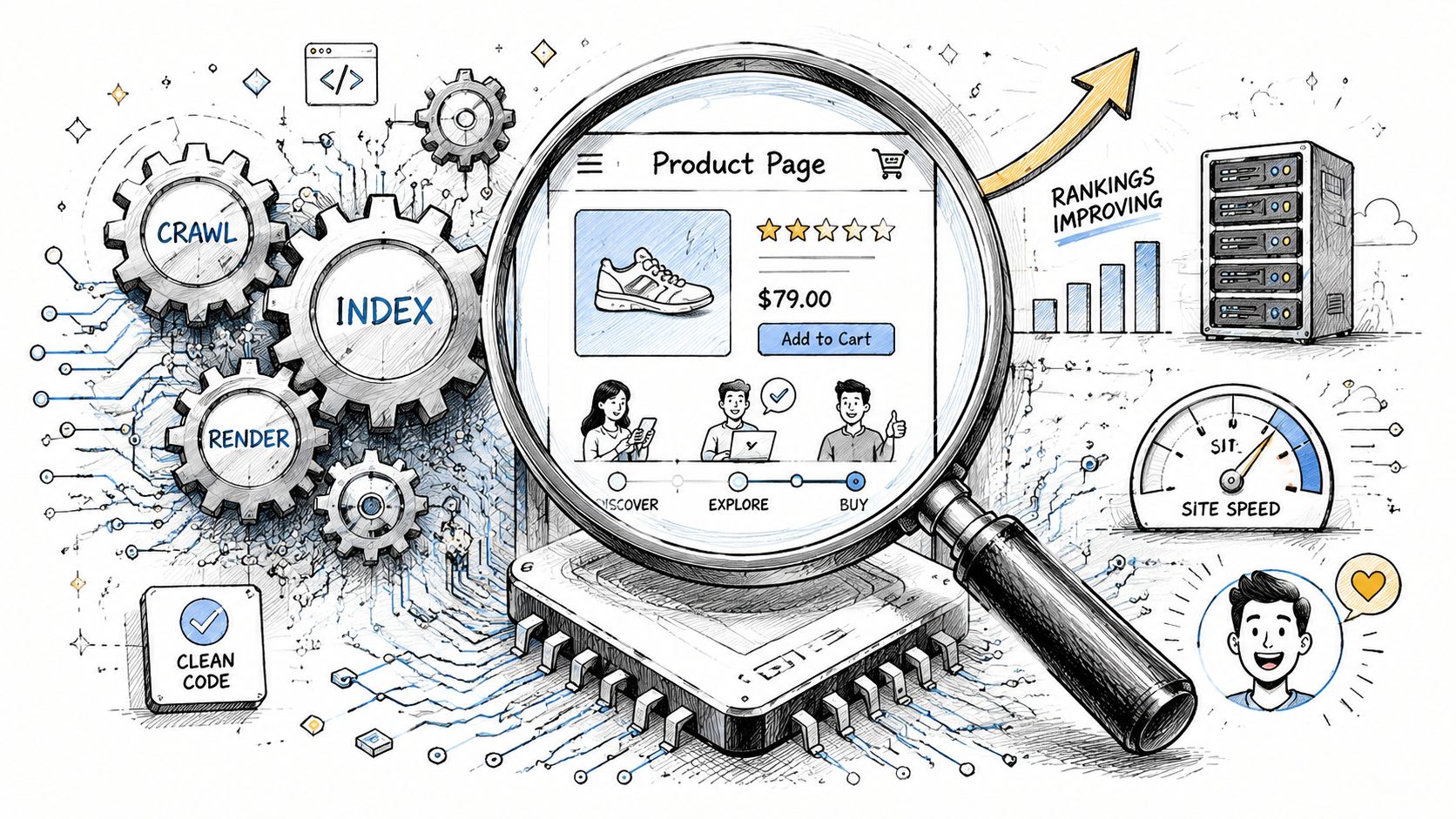
Fast beats fancy
Shoppers won't wait around while a huge hero image, five popups, and autoplay widgets drag your page to a crawl.
A fast product page usually comes from boring decisions:
- Compress images before upload: Keep visual quality, trim file weight.
- Limit unnecessary apps: Many stores pile on widgets that add scripts but little value.
- Use fewer homepage-style effects on product pages: Motion and layered sections often slow the page without helping conversion.
- Keep templates clean: Product pages should prioritize information, not decoration.
There's a simple rule here. If a design element doesn't help someone understand the product or buy it, question it.
Mobile is the real storefront
A lot of maker brands still build pages on desktop and only glance at the mobile version later. That's backwards.
Your customer is usually discovering products on a phone. They're comparing options while in line, on the couch, or halfway through another task. On mobile, the page has to answer key questions fast. The title has to make sense. The image gallery has to work. Ingredient lists, scent notes, sizes, and usage details need to be readable without pinching and zooming.
Check these basics on your own phone:
- Can you understand the product in a few seconds?
- Is the add-to-cart area easy to find?
- Do images load cleanly and swipe properly?
- Are variant selectors obvious?
- Can you read the key details without effort?
If not, fix that before chasing more traffic.
A mobile-friendly page doesn't just rank better. It wastes fewer visits.
Handle variants without confusing search engines
A lot of independent CPG brands get tangled up.
Maybe you sell one soap in five scents. Maybe the same coffee comes in whole bean and ground. Maybe a tincture comes in multiple sizes. The question isn't “Should every variant get its own page?” The question is whether each page serves a distinct search purpose.
Ahrefs highlights this trade-off directly in its ecommerce product page SEO guide. For sellers with many similar SKUs, a key decision is whether to optimize every page or use noindex on low-demand items and focus on main category pages instead.
That matters because near-duplicate pages can dilute your effort. If ten pages are almost identical except for one scent or one size, Google may struggle to tell which one deserves visibility.
A practical decision table helps:
| Situation | Better move |
|---|---|
| Strongly different product types | Separate pages |
| Minor scent, color, or size differences | Often keep on one main page |
| Variant has unique search demand and unique copy | Separate page can make sense |
| Low-demand duplicate-like variant | Consider noindex or consolidation |
Canonical tags come in when similar pages must exist. A canonical tells search engines which version is the main one. That helps avoid duplicate-content confusion, especially when filters, variants, or tracking parameters create multiple versions of near-identical pages.
Use separate pages when the shopper intent is different. Consolidate when it isn't.
Connecting Your Shop for Smarter Browsing
A shopper lands on one candle, one snack, or one serum. They like what they see, but the next step is unclear. No obvious collection link. No related product that fits the same need. No path to compare scents, sizes, or flavors. Many small brands lose sales right there, not because the product page is weak, but because the store gives the shopper nowhere useful to go.
Category pages do the heavy lifting
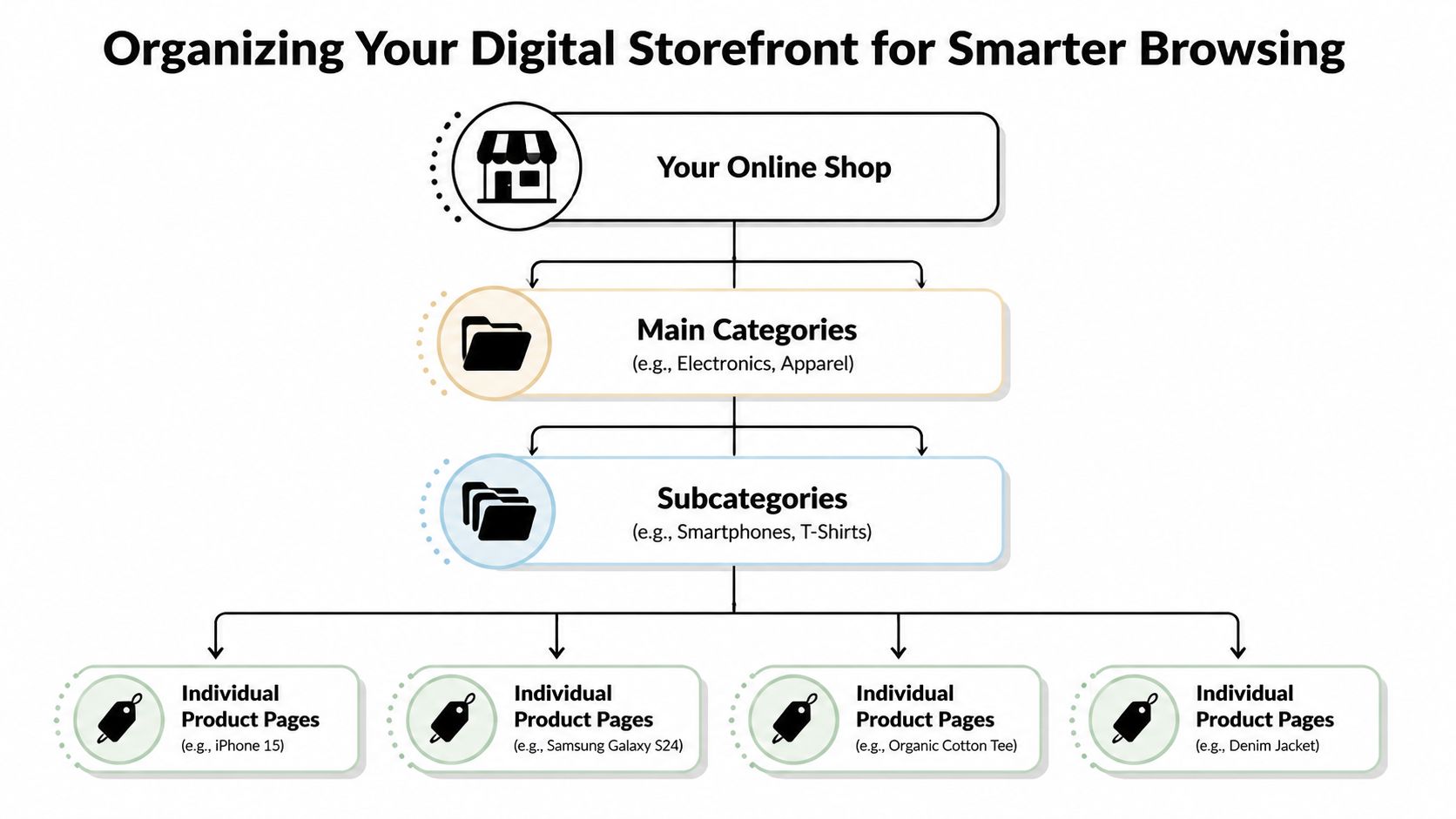
Independent makers and CPG brands usually have tighter catalogs than big retailers. That is an advantage if the structure is clear. A few well-built category or collection pages can guide both search engines and first-time shoppers through the whole range without forcing you to create dozens of thin pages.
Category pages support broader browsing intent. A product page answers a specific need. A collection page helps people compare options, understand the range, and keep moving.
For a small shop, a practical setup often looks like this:
- Top level categories: Skincare, Coffee, Wellness, Food, Pet
- Subcategories where needed: Body Scrubs, Bar Soap, Herbal Tea
- Product pages underneath: specific items with unique copy
That hierarchy also keeps the catalog manageable. If you sell twelve products, you do not need a complex menu system copied from a department store. You need a structure that makes sense in two clicks and gives each collection a clear purpose.
Internal links should mirror how people actually shop
Good internal linking is less about SEO theory and more about merchandising.
A body scrub can link to the matching soap. A decaf roast can link to the espresso blend for customers comparing brew styles. A protein bar can link to the mixed pack for shoppers who are not ready to commit to one flavor. These links help search engines understand product relationships, but more importantly, they reduce dead ends.
Use internal links where they help a real buying decision:
- From category to product: the core path into the catalog
- From product to related product: comparison, cross-sell, or alternate format
- From product to category: a quick way to browse the full range
- From educational content to product: useful when the article answers a purchase question
One trade-off matters here. Automatic related-product blocks save time, but they often surface random items that do not belong together. For a smaller catalog, hand-picking a few strong links usually works better than relying on a generic app widget.
If you sell across your own store and marketplaces, keep those discovery paths consistent. Loyaltie's seller information page shows one example of how independent brands can list products in a marketplace built around discovery and direct purchase.
Search behavior is also shifting beyond standard category browsing. SearchMention on ecommerce AI search explains how product discovery is changing, which is useful context if you want your catalog structure to stay findable as search interfaces evolve.
Your Product Page SEO Checklist
A lot of founders treat SEO like packaging. They do it once, publish, and move on.
That's usually why pages stall. Product page SEO isn't a one-time setup. It's an ongoing listening process. You publish. You see what gets impressions. You notice which queries show up. You improve what's vague, thin, or underperforming.
Start with the essentials.
The repeatable checklist
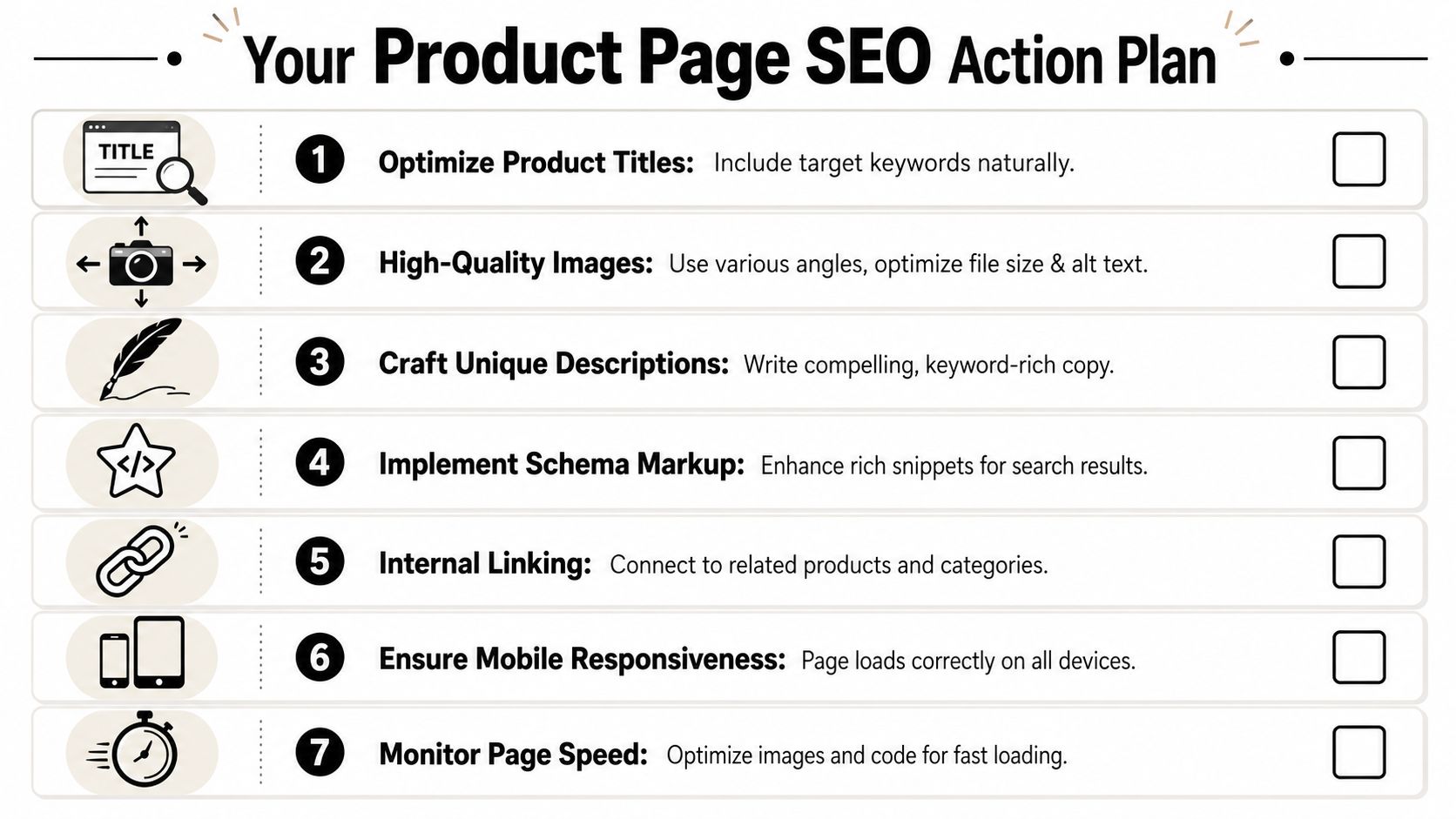
Use this every time you add or refresh a product page:
- Title and URL: Make them clear, specific, and aligned with how people search.
- Unique description: Write original copy for the product. Don't paste manufacturer text or clone the same paragraph across variants.
- Image details: Upload sharp images, rename files sensibly, and add descriptive alt text.
- Schema markup: Make sure product facts are structured clearly for search engines.
- Internal links: Connect the page to relevant categories and nearby products.
- Mobile check: Review the page on your own phone before you call it done.
- Speed review: Remove heavy elements that slow down the buying experience.
Here's a helpful walkthrough if you're thinking about where search is heading next. SearchMention has a practical piece on AI search for ecommerce, which is worth reading if you want your pages to stay useful beyond classic blue-link rankings.
Modern product page SEO increasingly has to account for AI-generated search experiences and richer product result formats. That makes structured data, unique images, and FAQ markup more important for visibility in newer search interfaces, as discussed in this product page SEO guide focused on modern search behavior.
A short video can help if you want to review the basics in a different format.
Watch what shoppers are telling you
You don't need an analytics team for this.
Look for simple signals:
| Signal | What it may mean |
|---|---|
| Impressions, low clicks | Your title or snippet isn't compelling enough |
| Clicks, no sales | The page attracts interest but doesn't answer buying questions |
| Product not appearing for expected terms | Your copy may be too vague or too short |
| One category outperforms others | Your site structure may be clearer there |
Don't “set and forget” a product page. Revisit it after real shoppers interact with it.
The goal isn't vanity traffic. It's qualified discovery that turns into orders. For independent brands, that usually comes from clearer pages, better structure, and a tighter match between what you make and how people search for it.
If you want another channel for discovery while keeping the direct-from-the-maker feel, Loyaltie is a marketplace where people discover and buy directly from the best independent brands in the US. For makers selling coffee, skincare, wellness, food, supplements, pet products, and other everyday goods, it's one more place your well-built product pages can meet shoppers who already want better alternatives to mass-produced products.