
An order comes in at 10:12 a.m. The buyer lives a few miles away. You know the product is on your shelf right now, ready to go. But the usual routine kicks in anyway. Box, label, carrier pickup, and a delivery timeline that feels slow for something that could have been at their door before lunch.
That gap is where same day local delivery starts to make sense for independent makers.
If you sell coffee, pantry staples, skincare, supplements, pet products, or prepared foods, local delivery can feel like the most obvious thing in the world and the hardest thing to launch well. The appeal is simple. You get your product into a customer's hands faster, with fewer touchpoints and no middleman. The hard part is everything behind the promise: cost, route planning, packaging, cutoff times, and protecting product quality all the way to the doorstep.
The good news is that you don't need a giant retail operation to do this well. You need a narrow service area, a clear promise, and a delivery setup that matches your margins and your product type.
Table of Contents
- Your Customers Are Local Why Not Your Delivery
- Start smaller than you want to
- Price for reality not optimism
- Build the flow before demand shows up
- Protect the product not just the speed
- Communication saves orders
Your Customers Are Local Why Not Your Delivery
A lot of makers have had the same thought after seeing a nearby order come through. Why is this package going on a multi-stop shipping journey when the customer is practically around the corner?
That question matters more now because speed has changed from a pleasant surprise to a buying condition. FedEx reported in 2026 that 96% of shoppers define fast delivery as same-day, and 80% want a same-day option at checkout in its SameDay Local launch announcement. For a local maker, that doesn't mean you need to promise instant delivery everywhere. It means buyers already think locally when they think about convenience.
The practical upside is bigger than speed alone. Same day local delivery can help you keep fragile items out of long carrier networks, reduce packaging strain, and create a more direct buying experience for nearby customers. If someone is ordering granola, skincare, or fresh juice from a maker in their own city, fast local fulfillment feels natural.
Practical rule: If your buyer is local, your delivery promise should feel local too.
A lot of the work comes down to operations. If you're still mapping that out, this guide to understanding delivery operations is useful because it breaks down the moving parts behind dispatch, routing, and order flow without turning the topic into pure logistics jargon.
You can already see how this plays out on marketplaces built around local buying habits. A category page like meal delivery options on Loyaltie makes the customer expectation easy to understand. If the brand is nearby and the product is part of someone's regular routine, they're often hoping for convenience that matches the distance.
Designing Your Same Day Delivery Strategy
Offering same day local delivery without a plan is the fastest way to lose margin. The service sounds simple from the customer side. It rarely is on the maker side.
The biggest mistake is starting with the question, “How fast can we go?” Start with, “Where can we deliver profitably and consistently?” Cost is the pressure point. A 2026 consumer survey found that 76% of consumers would choose same-day delivery when it's free, but 81% avoid it because it's too expensive according to same-day delivery survey reporting. Customer interest is there. The problem is how you fund it without turning every local order into a margin leak.
Start smaller than you want to
Your first delivery zone should be boringly manageable. A tight radius around your kitchen, studio, warehouse, or retail counter is usually better than trying to cover an entire metro area.
Use these boundaries first:
- A simple geographic limit: Pick nearby zip codes or a tight mileage radius you can serve without long deadhead trips.
- A realistic order cutoff: Morning cutoff for afternoon drop-offs, or early afternoon cutoff for end-of-day delivery.
- A narrow product set: Start with items that are easy to pick, pack, and hand off quickly.
This is especially important if your catalog includes lower-ticket items. Local delivery can make sense for basket-building products, but it can fail fast on single-item orders with thin margins.
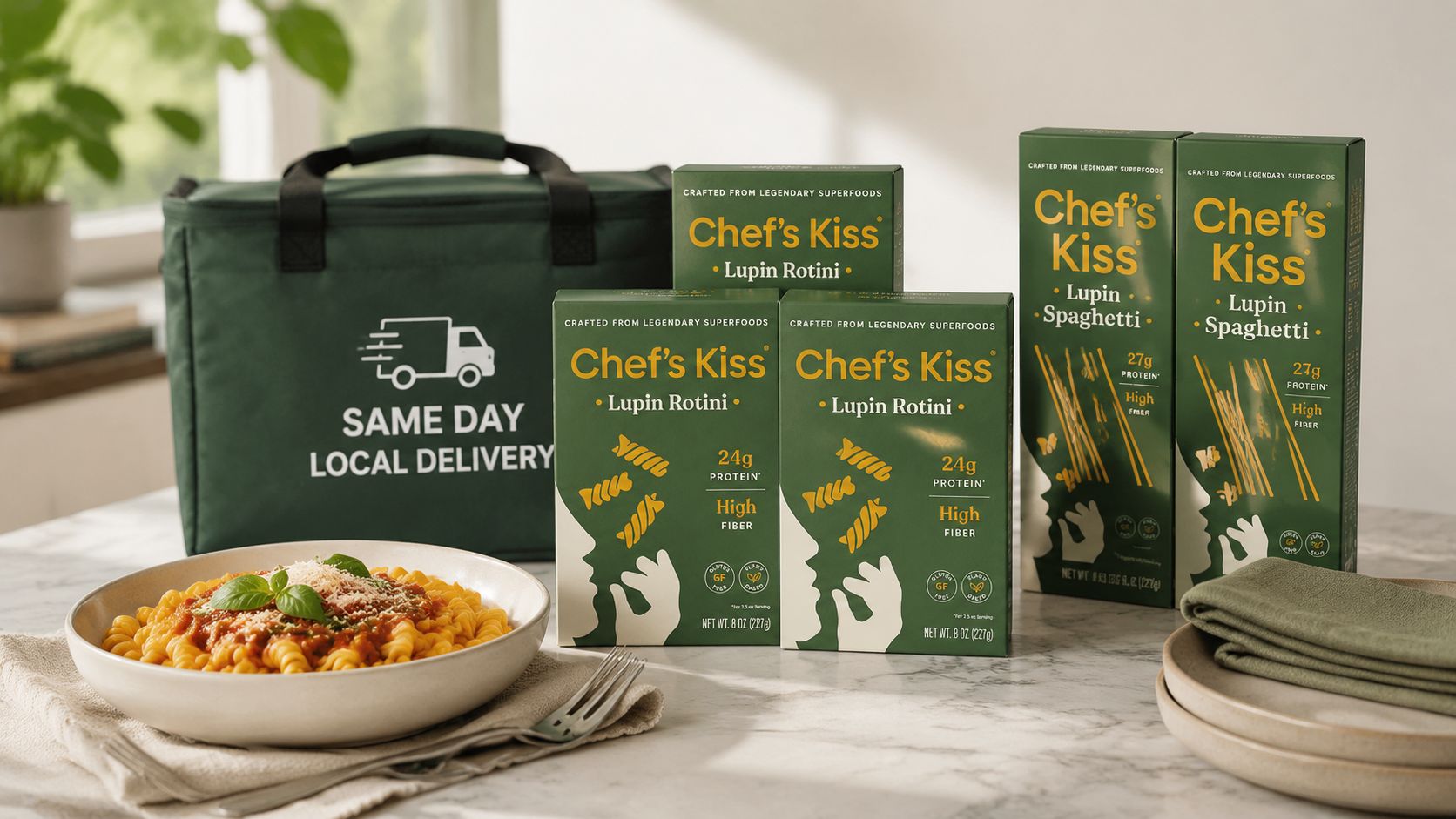
For example, a pantry product like High-Protein Lupin Pasta Bundle, Lupin Flour & Psyllium, Gut-Friendly Fiber, Gluten-Free, 5 Boxes (2 Spaghetti, 3 Rotini) | Chef's Kiss by Loyaltie is a useful reminder that some items naturally fit local delivery better when the basket is substantial and easy to batch. The snapshot describes it as real pasta-night comfort with a more filling, steadier-energy twist, packed with protein and gut-friendly fiber from lupin flour and psyllium husk.
Price for reality not optimism
Public advice about same day delivery often skips the ugly costs. That's the part makers can't afford to ignore.
The economics get tougher because last-mile delivery is widely recognized as the most expensive segment of the supply chain, and margin pressure hits especially hard on lower-priced goods, as noted in industry coverage discussing local fulfillment economics. So your pricing model has to absorb more than the driver fee.
Hidden costs usually include:
- Packing labor: Someone has to stop what they're doing, pick the order, and prep it fast.
- Delivery exceptions: Missed handoffs, address issues, or customer changes can turn one clean trip into two.
- Packaging upgrades: Local doesn't always mean less packaging, especially if breakage or temperature matter.
- Order disruption: Same-day orders can interrupt your normal production or fulfillment rhythm.
Same day local delivery works best when the promise is narrow, the basket is healthy, and the route is dense.
Most makers do better with one of these models:
| Model | When it works | Main risk |
|---|---|---|
| Flat local fee | Simple, easy to explain | Can undercharge long stops |
| Free above order threshold | Encourages larger baskets | Threshold may still be too low |
| Tiered by zone or speed | Better margin control | More setup and customer explanation |
If you're just starting, keep the offer simple enough that a customer can understand it in a glance and your team can execute it without checking a spreadsheet every time.
Choosing Your Delivery Fleet In-House vs Third Party
A maker selling cold-pressed juice, bath soaks, or fresh pastries is not only choosing a courier. They are choosing how much risk to keep. If the product is fragile, temperature-sensitive, or easy to damage with one bad handoff, fleet choice affects margins just as much as speed.
In-house delivery gives you direct control over the parts customers notice and the parts they never see. You set packing cutoffs, driver instructions, proof-of-delivery rules, and how orders are handled if nobody answers the door. That control matters for products that can melt in a parked car, tip over in transit, or need a quick explanation at handoff. A local wellness brand with a narrow radius and repeat buyers can make this model work well, especially if the delivery experience is part of the brand, as shown in examples like Complete Body Juice Bar's local ordering setup.
The trade-off is workload. Running your own fleet means dealing with driver coverage, insurance, payroll, dispatch, route planning, and the awkward gaps between orders when a paid driver is waiting for the next run. For small makers, that idle time is often the hidden cost that turns an appealing idea into a thin-margin service.
Third-party delivery is usually faster to launch. It is also easier to test by zone, product type, or daypart before you commit to staff and vehicles. Shopify's guide to third-party logistics for ecommerce businesses explains why many smaller operators outsource early: it reduces setup burden and gives access to delivery capacity without building the whole system themselves.
That convenience comes with limits.
A third-party driver may not treat a box of truffles, a cake, or a glass wellness shot the way your team would. Brand presentation can vary. So can handoff quality, customer communication, and willingness to follow special instructions. If a delivery goes wrong, you still own the customer relationship, which is why it helps to keep a ready set of email apology to customer templates for delays, damaged orders, or missed drops.
A practical comparison
| Factor | In-House Delivery | Third-Party Service |
|---|---|---|
| Control | Highest. You set handling and service standards. | Lower. You work within the partner's process. |
| Product integrity | Better for fragile, perishable, or high-touch items. | Acceptable if packaging is strong and instructions are simple. |
| Startup effort | Higher. Hiring, scheduling, and dispatch are on you. | Lower. You can launch faster. |
| Customer experience | More consistent if your team is trained well. | More variable across drivers and shifts. |
| Coverage | Usually tighter and more local. | Often broader and easier to extend. |
| Cost structure | Better at steady volume and dense routes. | Better for testing demand or handling uneven order flow. |
Many independent makers do best with a hybrid setup. Keep nearby, high-risk orders in-house. Send overflow, longer-distance stops, or lower-risk products to a delivery partner. That approach protects product quality where it matters most and avoids overbuilding too early.
A simple rule helps. If the order needs careful handling or the customer is buying into your brand experience, keep more control. If the order is standardized and demand is still unpredictable, use a partner first.
The Operational Playbook From Click to Doorbell
Same day local delivery succeeds or fails in the handoffs. Not the marketing promise. Not the checkout badge. The handoffs.
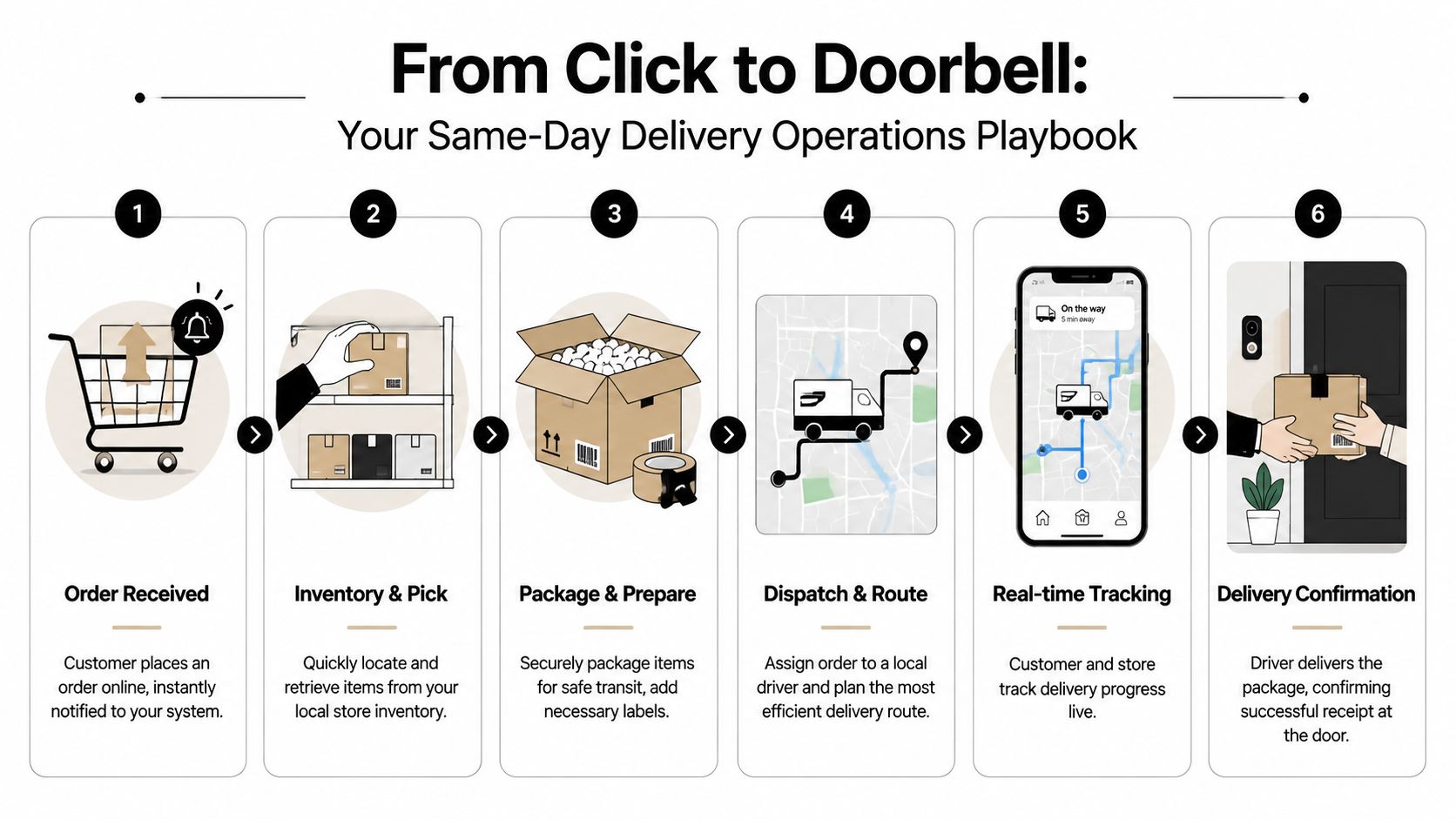
A practical workflow looks like this: customer order, immediate order processing, picking and packing from a store, microhub, or warehouse, assignment to a nearby courier, then delivery inside the promised window, as outlined in Easyship's overview of same-day delivery operations. The reason this feels harder than standard shipping is simple. Every step has less room for delay.
A visual flow helps when you're training your team.
Build the flow before demand shows up
Your first operational checklist should be short and strict:
- Order review happens immediately. Don't leave local orders sitting in the same queue as standard shipping.
- Inventory has to be accurate in real time. If the product isn't available, same-day turns into a broken promise fast.
- Pick paths should be obvious. The team should know exactly where local-delivery items live.
- Courier assignment should happen early. Waiting until everything is packed sounds efficient, but it often creates late windows.
- Customer updates should be automatic where possible. Silence creates support tickets.
If you sell multiple categories, batch by route and product type instead of strict order time. A juice order, skincare order, and pantry order going to the same area can often move together if their handling needs match. That saves miles and keeps dispatch cleaner.
For a local category built around freshness and routine buying, juice and wellness sellers on Loyaltie are a good example of why tight operational timing matters. The faster and cleaner the handoff, the more the delivery feels like an extension of the product itself.
Here's a useful walkthrough before you finalize your process:
Protect the product not just the speed
For food, supplements, and skincare, the biggest risk isn't a delivery that arrives later in the day. It's a delivery that arrives on time but in poor condition.
Recent operations reporting points to the harder issues behind these categories: cold-chain handling, packaging dwell time, and proof of condition at handoff. If those fail, you can end up with spoilage, returns, and trust loss even when the order technically arrived the same day, according to reporting on time-definite last-mile handling for sensitive goods.
That means your packaging rules need to answer practical questions:
- Will heat or cold damage the item during the route?
- How long can the product sit after packing before pickup?
- Does the courier know which orders need upright handling or extra care?
- Can the driver prove condition at handoff if there's a complaint later?
A fast bad delivery is still a bad delivery.
For prepared foods or temperature-sensitive wellness items, dwell time matters. Don't pack too early just because the order is in. Pack to match dispatch timing.
Communication saves orders
Customers are forgiving when they know what's happening. They're frustrated when they don't.
Send three core updates: order confirmed, out for delivery, and delivered. If there's a delay, own it early and say what changes next. If you need help writing those messages without sounding robotic, these email apology to customer templates are useful as a starting point for service recovery language.
Local delivery feels personal. Your communication should match that.
Showcasing Local Delivery on Your Loyaltie Store
A good delivery offer can still underperform if shoppers don't notice it until the last screen.
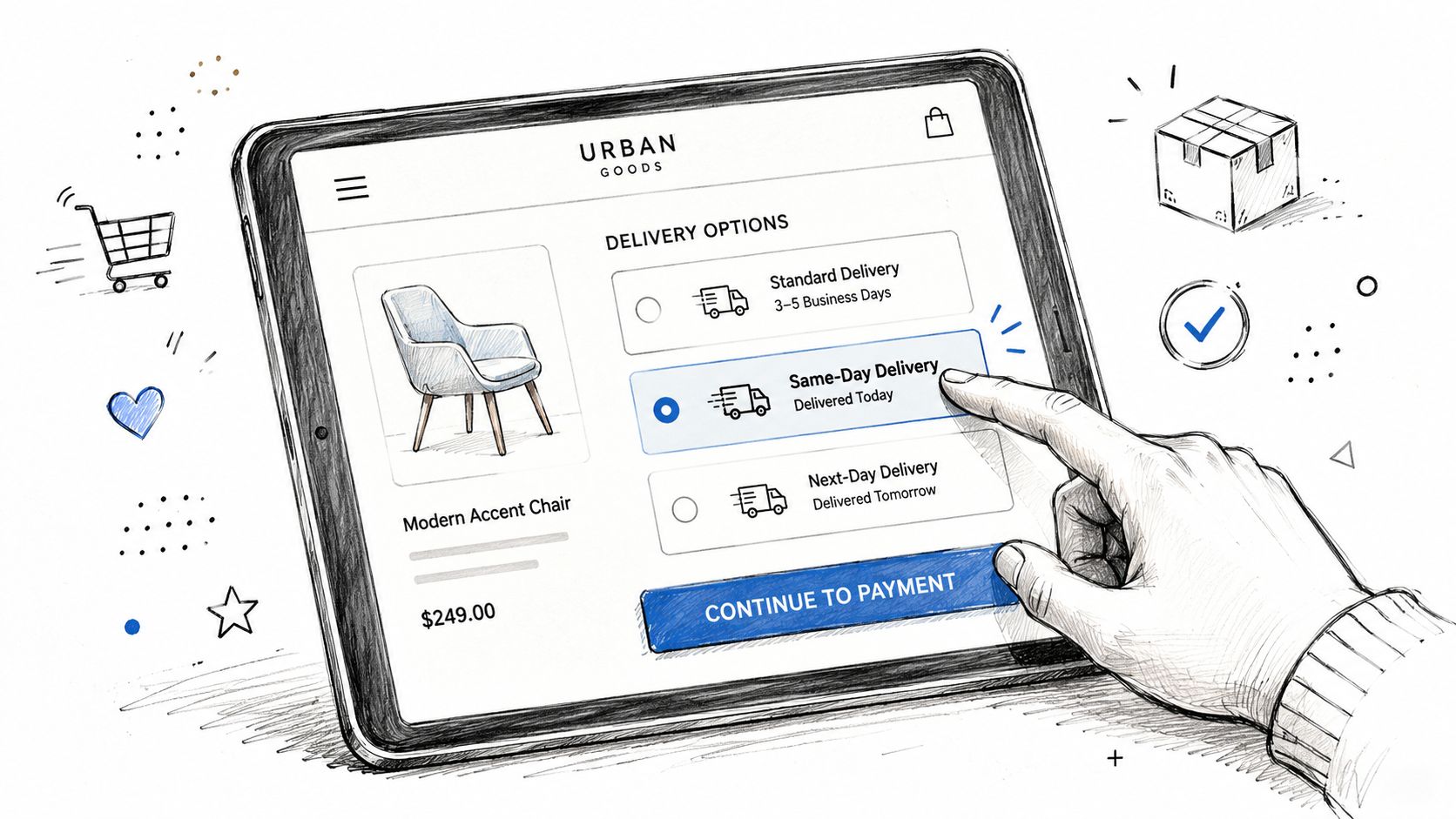
On your storefront, same day local delivery should appear before a customer starts comparing alternatives. If you wait until checkout to explain it, many buyers will never factor it into the decision.
Make the offer visible early
Use plain language in the places people naturally scan first:
- Store banner: “Local delivery available today in eligible areas.”
- Product page note: Show eligibility near the add-to-cart area, not buried in shipping FAQs.
- Cart reminder: Reinforce the cutoff time before checkout friction sets in.
The offer works best when it answers the buyer's immediate questions. Can I get this today? Am I in the zone? What's the cutoff? What will it cost?
Set expectations before checkout
The storefront side matters because same-day fulfillment depends on clear rules. A practical workflow relies on real-time inventory, clear cutoff times, and route optimization, and your storefront has to communicate those rules clearly to prevent failed orders, as noted in the earlier Easyship section.
That means your delivery messaging should be specific, not broad. Don't say “same-day available” if only some products, hours, or neighborhoods qualify.
A clean setup usually includes:
- Defined delivery zones so the wrong customers don't see the wrong promise
- Visible cutoff messaging on product and cart pages
- Simple rate logic that doesn't surprise the customer late in checkout
- Local-only badges for items that can be dispatched today
If you're managing this on a marketplace where people discover and buy directly from independent brands in the US, keep the operational side synced with what the storefront says. The seller help material at Loyaltie seller resources is the kind of place you'd want to keep handy when you're configuring delivery settings, policies, and customer-facing details.
Measuring What Matters and Improving Your Service
Once your local delivery service is live, the focus shifts to pattern spotting. Which orders are easy money, which ones create support issues, and which zones look good on a map but don't work in practice?
The same-day delivery category itself keeps expanding. Fortune Business Insights says the global same-day delivery market was valued at USD 12.12 billion in 2025 and projected to reach USD 14.66 billion in 2026, while separate reporting in the same source set notes 3,827 U.S. same-day delivery service businesses in 2024, up 3.2% from 2023 in its same-day delivery market coverage. That growth doesn't help your brand unless your own local unit economics and service quality keep improving.
Track the numbers that change decisions
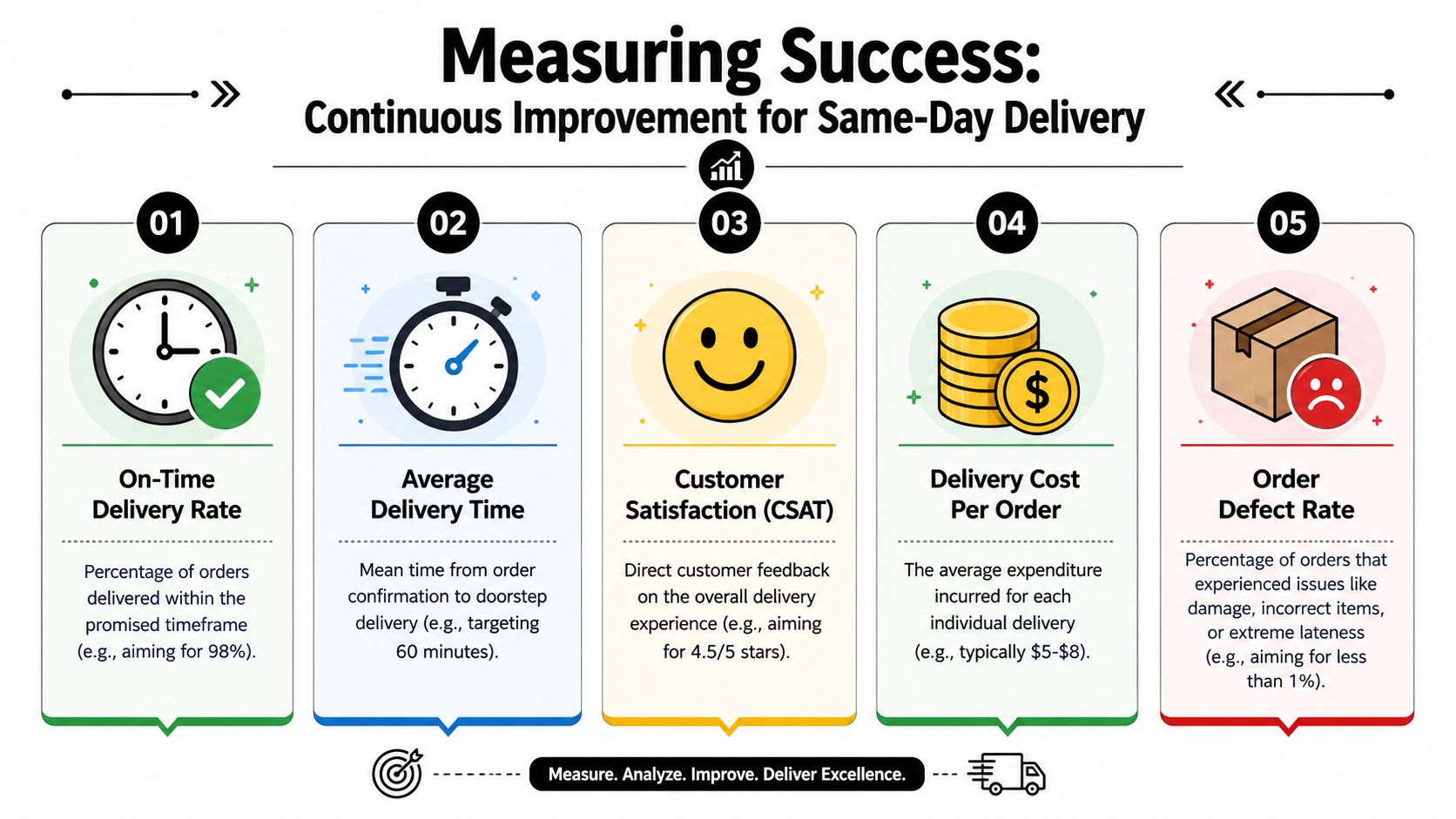
You don't need a giant dashboard. You need a short list you'll review.
Start with these:
- On-time delivery rate: Did the order arrive inside the promised window?
- Delivery cost per order: What did that order really cost once labor, packaging, and route time are included?
- Failed or exception deliveries: Which orders needed redelivery, refund discussion, or customer support?
- Average basket quality by zone: Are local orders large enough to support the service?
- Repeat local orders: Are buyers using the service again, or only once?
Look at those numbers by delivery zone, not just in aggregate. One nearby neighborhood can still be unprofitable if parking is difficult, handoffs fail, or order sizes stay low.
Use customer feedback as operating data
Feedback about delivery shouldn't live only in customer service. It should shape the operation.
If customers say the product arrived warm, late, dented, or with little warning, those aren't just complaints. They're clues. Maybe your route sequencing is wrong. Maybe your packaging sits too long before pickup. Maybe your cutoff time creates a rush your team can't reliably fulfill.
The best local delivery systems improve because the operator treats each miss as process data, not random bad luck.
A simple review rhythm works well:
| Review cadence | What to check | What you might change |
|---|---|---|
| Daily | Late orders, damaged orders, customer messages | Driver assignment, packing order, dispatch timing |
| Weekly | Cost by zone, basket patterns, repeat purchases | Delivery fee, zone boundaries, threshold rules |
| Monthly | Product mix, service complaints, operational bottlenecks | Packaging standards, eligible SKUs, staffing coverage |
The service gets better when you trim what doesn't work. Tighten zones. Remove fragile products that create too many issues. Raise the basket requirement if the economics are off. Add delivery windows that better match your actual flow instead of your ideal one.
Same day local delivery isn't valuable because it sounds modern. It's valuable when it helps people buy directly from the maker with less friction and better product quality than they'd get through a generic retail channel.
If you want to see how local commerce can work online without losing the direct connection, explore Loyaltie, a marketplace where people discover and buy directly from the best independent brands in the US. It's a practical way for shoppers to find everyday products from real makers, and for sellers to meet nearby demand with clearer local fulfillment options.