
A raisin dropped into Champagne starts rising within a few seconds, lifted by bubbles that form in the creases of its skin, and it keeps bobbing up and down only while dissolved gas is still in the glass. It doesn't put carbonation back, so a bottle that's already flat stays flat.
So why does the trick look like it's fixing something? Because your eye reads rising bubbles as freshness. A glass that's been open since yesterday can be nudged into a lively little show with one dried grape, and the wine underneath is exactly as tired as it was a minute earlier. That gap between what you see and what you taste is the whole story.
The physics is fun, and it's testable at your own table with two glasses and ten minutes. Start with what the raisin is doing, then work out why the dance varies, how to run a fair test, what the taste tests show about flat wine, and where this pairing came from in the first place.
Table of Contents
- What a Raisin Actually Does in Bubbly
- What Makes the Show Stronger or Weaker
- Try the Raisin Experiment at Home
- Does a Raisin Bring Back Flat Champagne
- Where the Raisin in Champagne Idea Came From
- Keeping Your Bottle Fizzy After Opening
- Safety, Etiquette and Deciding to Drop One In
What a Raisin Actually Does in Bubbly
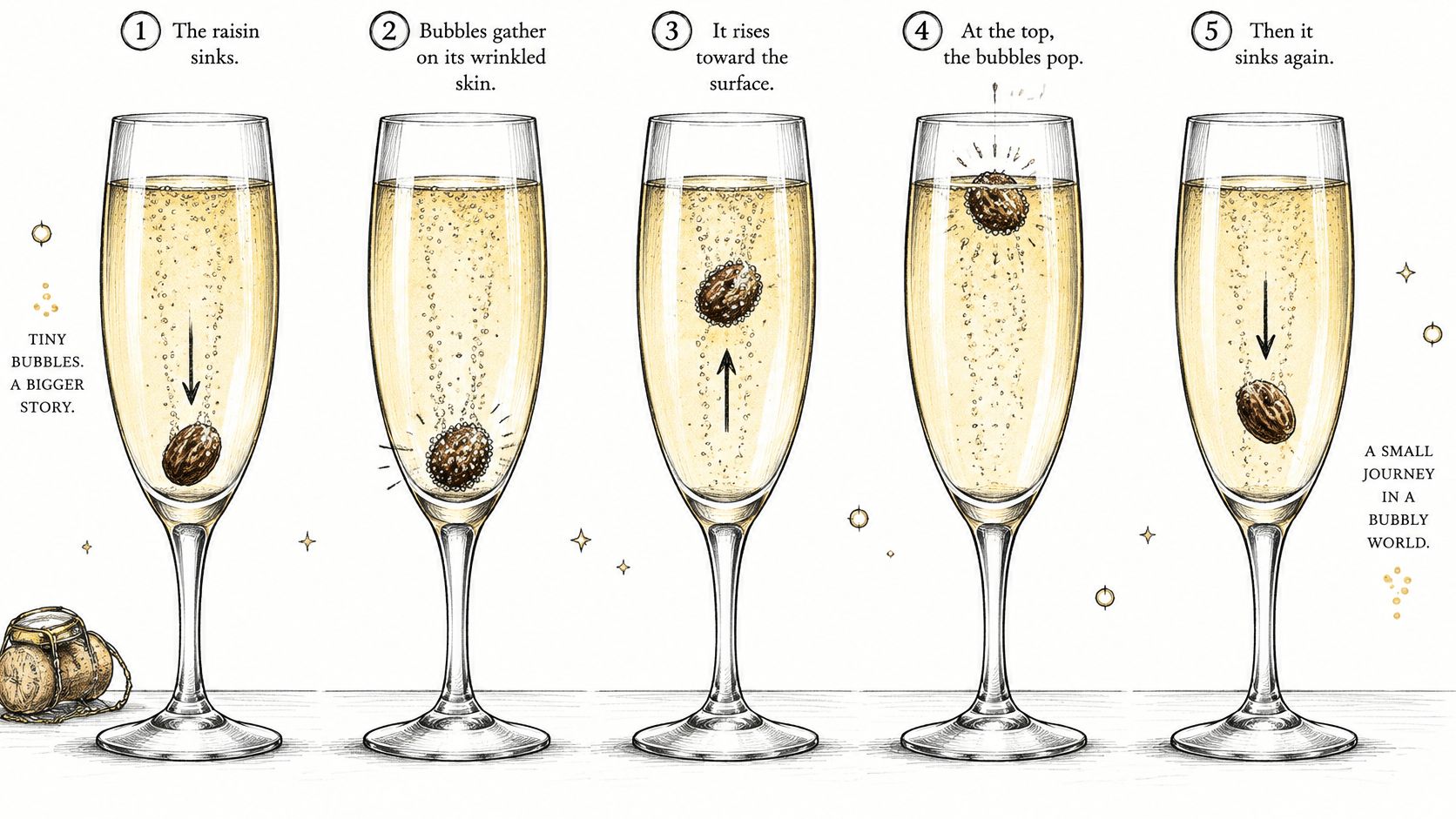
Drop a raisin into a fresh pour and watch the first thirty seconds. It sinks, sits, then lifts off like a tiny elevator, climbs to the surface, drops back down, and does it again. The show starts almost immediately, because enough bubbles can gather on a wrinkled surface within a few seconds to float the fruit, as physics coverage of the effect describes.
Here's the part most social posts skip. The raisin isn't making fizz. It's giving dissolved gas somewhere to gather, which turns invisible carbon dioxide into visible bubbles, and that process is a one-way exit for the gas. Nothing in a raisin can rebuild the pressure you released when the cork came out.
Think of it as an elevator that only runs while passengers keep boarding. Each bubble is a passenger hitching a ride upward. When the passengers get off at the top floor, the car drops back to the lobby, and when the queue of passengers runs out, the elevator stops altogether.
The cycle, step by step
The motion is a buoyancy loop rather than a chemical reaction, which is the framing used in a published analysis of the raisin cycle. The sequence runs like this.
- The raisin sinks. A raisin is denser than the wine, so it drops straight to the bottom of the flute or coupe.
- Gas gathers in the creases. Its wrinkled skin is packed with tiny pits, and those pits act as nucleation sites where dissolved carbon dioxide forms bubbles instead of drifting loose in the liquid.
- The bubble load adds lift. Enough bubbles collect to add upward buoyant force, so the raisin and its bubble coat push aside more liquid than the bare raisin did.
- The raisin rides up. It climbs to the surface, often wobbling as bubbles detach unevenly on the way.
- The lift vanishes at the top. Bubbles burst when they reach the surface and the gas leaves the wine, so the raisin is once again denser than the liquid and sinks.
- The loop repeats while gas remains. New bubbles form back at the bottom and the ride restarts, and it stops for good once there isn't enough dissolved carbon dioxide left to produce bubbles.
That's the entire secret. It's a party move, not a sommelier technique, and it tells you about gas and surface texture rather than about the wine itself. What changes from glass to glass is the interesting part, and a few conditions make the dance strong or weak.
What Makes the Show Stronger or Weaker
The cycle is identical in every glass. Its intensity isn't. Six conditions decide whether you get a two-minute show or one sad half-rise.
| Factor | Effect on the dance | Why it matters |
|---|---|---|
| Carbonation level | Fresh, lively bottles give a stronger show | More dissolved CO₂ is left to escape |
| Time since opening | The dance fades over minutes to hours | Dissolved CO₂ drops as gas escapes |
| Temperature | Cold wine holds more CO₂ at first; warm wine releases it faster | Changes how long bubbles keep coming |
| Glass surface | Etched or textured glass may offer more bubble starting points | Smooth glass may offer fewer sites |
| Raisin wrinkles | Deeper creases give more bubble sites | Smooth dried fruit produces a weaker dance |
| Liquid type | Champagne and prosecco differ in bubble size and pressure | Not established; alcohol may change bubble adhesion |
Start with the obvious one. A bottle opened five minutes ago has more dissolved gas in it than one opened at the start of dinner, so the first glass dances and the last glass sulks. Temperature runs alongside that: a chilled bottle holds its gas longer, while a warm one gives it up in a hurry, so a raisin in tepid wine can look frantic and then quit early.
Glass texture is the variable people underestimate. Manufacturing marks, etching, and even a stray drying smear give bubbles a head start, which is why the same raisin can behave differently in two flutes poured from the same bottle. If you're buying glassware with a deliberately textured bowl, a set of etched flutes for the bridal party is the shopping version of this idea: more starting points built into the glass on purpose. The raisin itself matters too. A plump one with deep creases gives bubbles far more footholds than a thin, flat raisin that's been drying out in a cupboard.
A vigorous dance tells you gas is escaping fast. It says nothing about whether the wine is any good.
For your garnish bowl, a mix of dehydrated fruit cocktail garnishes gives you pieces of different textures to compare, so you can see for yourself which ones perform. Liquid type is the one row I'd flag as uncertain. Champagne and prosecco differ in pressure and bubble size, and alcohol may change how readily bubbles stick, but nobody has published a clean comparison, so treat it as an open question rather than a settled fact.
Try the Raisin Experiment at Home
Ten minutes with two glasses turns a viral clip into something you understand. The point is to control one variable at a time, which is also how a write-up of the dancing raisin demonstration suggests turning the trick into a reproducible test.
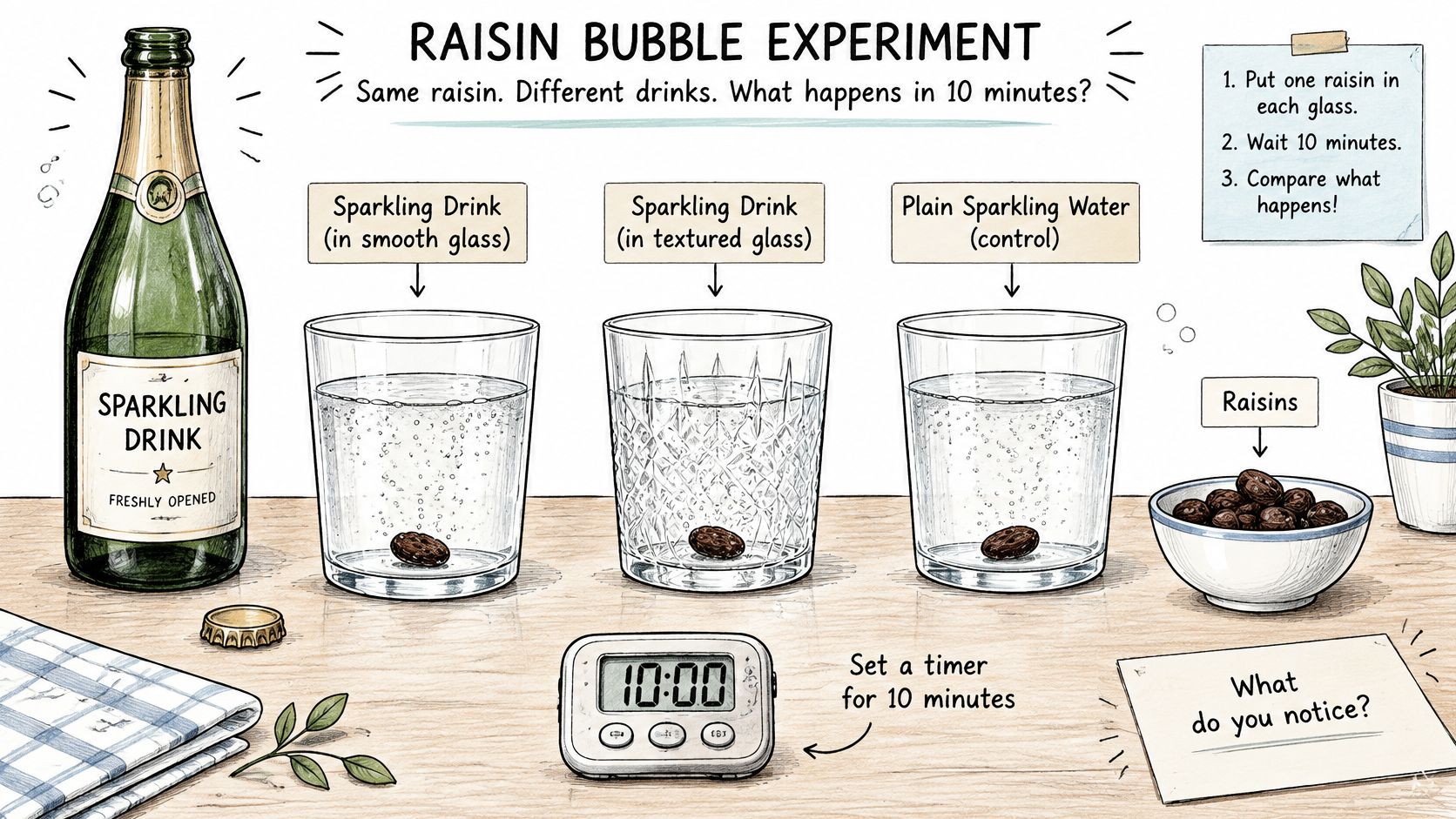
Gather a freshly opened bottle, a smooth flute, an etched or textured glass if you own one, a glass of sparkling water as a control, and a few plump raisins. Keep the glasses clean, since a greasy film kills bubbles faster than anything else in the room, and use a fresh raisin for every run so you're not comparing a waterlogged one against a dry one.
- Pour both glasses at the same time. Same wine, same pour height, so the only difference left is the glass itself.
- Write down the start time and temperature. Note how long the bottle has been open and roughly how cold the wine is, because both will shape what you see.
- Drop one raisin into each glass. Let them settle to the bottom without stirring.
- Count the rises for two minutes. Just tally how many times each raisin reaches the surface and estimate how dense the bubble coat looks.
- Run the sparkling water control. Same raisin, same count, and this is the step that shows how much the whole effect depends on dissolved gas rather than on the wine's character.
- Compare and log the numbers. A longer, stronger dance in the textured glass points to surface texture. A weaker one in the water tells you the gas supply is the engine.
Here's the video version if you want to watch the cycle before you set it up.
Then leave the wine out, come back in a few hours, and repeat. The dance should fade as the theory predicts, and that slide is the most convincing part of the whole exercise. If you'd rather your glass taste of peach than of raisins, a peach bellini cocktail jar is the better route to a flavored pour, and you can save the raisins for the experiment.
Does a Raisin Bring Back Flat Champagne
The myth is simple: a raisin revives a bottle that's gone quiet. It doesn't, and the tests are worth knowing before you try it on wine you were hoping to drink.
What changes when you drop one in is visual. Bubbles become more obvious for a short stretch, because the rough surface gives dissolved gas an escape route it didn't have before. What doesn't change is the carbonation itself, the aroma, the sweetness, the mouthfeel, or how fresh the wine tastes. Those are the things you were hoping to save, and none of them come back.
What the taste tests found
The clearest evidence comes from a Cook's Illustrated test of the trick. Four-day-old sparkling wines stayed less fizzy, less aromatic, and sweeter than fresh wine, and tasters couldn't identify a meaningful improvement after the raisin treatment. A second test found the same pattern: a temporary jump in visible bubbles, with the original taste and mouthfeel still missing.
The honest version: bubbles are being released, not created. The trick speeds up the loss of the gas that's left.
That reframes what you're watching. A raisin in a half-flat bottle is a degassing tool with a cute face. It makes the remaining carbon dioxide leave faster, which is fine if you're treating the glass as a spectacle and less fine if you were counting on it for dinner.
None of this makes the trick a con. It's fun to watch, it's a great icebreaker at a table where half the guests don't care about wine, and it gives you something to do with a bottle that's already past its best. Just don't use it as a rescue plan for something you want to taste properly. Keeping gas in the bottle from the start is the fix that works, and that's a habit rather than a hack.
Where the Raisin in Champagne Idea Came From
A historical Champagne punch offers one documented example of raisins in a drink: Regent's Punch, associated with Britain's Prince Regent and described in a New York Times account of Champagne's history.
The recipe combined Champagne with Madeira, German white wine, brandy, another fortified wine, citrus, sugar, green tea, and raisins. In a bowl like this, raisins were an ingredient in a mixed drink, contributing sweetness and fruit character. That's a different role from the raisin in today's party trick, which is dropped into bubbly to make bubbles visibly rise.
The historical record doesn't establish a single inventor or precise starting date for the Champagne-and-raisin pairing. It does show that raisins appeared in Champagne punch recipes. They are not part of Champagne production itself: the wine is made from grapes, while raisins enter the story as an ingredient added to drinks or sweets.
Keeping Your Bottle Fizzy After Opening
If a raisin can't save a flat bottle, what can? Habits, mostly, and they take about fifteen seconds each.
Chill it immediately. Cold wine holds its dissolved carbon dioxide longer, so get the bottle back into the fridge or an ice bucket as soon as the first round is poured. A bottle sitting on a warm counter through a long dinner will be noticeably duller by dessert.
Reseal with a proper stopper. A pressure-rated sparkling-wine stopper is the tool for this job, and it holds carbonation far better than cling film, a cork shoved back in, or anything you drop into the wine. Make sure it's clean and seated firmly every time you put it back on.
Same-evening habit: pour what you're drinking, reseal, and chill. Repeat. The bottle you seal and chill between pours will taste livelier the next day than the one you left open on the table.
Pour smaller rounds. Every pour releases gas, so filling glasses halfway and going back for a top-up costs you more fizz than pouring once. And if you're opening a second bottle, open it after the first is finished rather than lining up three at once.
Set a realistic expectation. A bottle sealed and chilled the same evening will hold up reasonably into the next day. A bottle left open overnight won't, no matter what you float in it. If a bottle is already going flat, chill it first and then judge by taste rather than by counting bubbles, because visible bubble activity and actual freshness have come apart by that point.
Safety, Etiquette and Deciding to Drop One In
Would you drop a raisin into a bottle everyone is sharing? Keep the trick to a bottle you would enjoy even if it tastes flat, and ask the host before adding anything.
A raisin is a choking hazard. Keep it away from small children and pets, and don't swallow one with a sip of wine. Use clean, unchipped glassware, too. A chipped rim can cut a drinker, and a raisin-driven burst of bubbles may catch someone by surprise.
The fizz is a physical effect, not a chemical change to the wine. As Food Republic explains in its look at the raisin trick, treat the bubbles as a visual novelty, not evidence that the wine's freshness has returned. For preserving carbonation, resealing with a pressure-rated stopper is the practical choice.
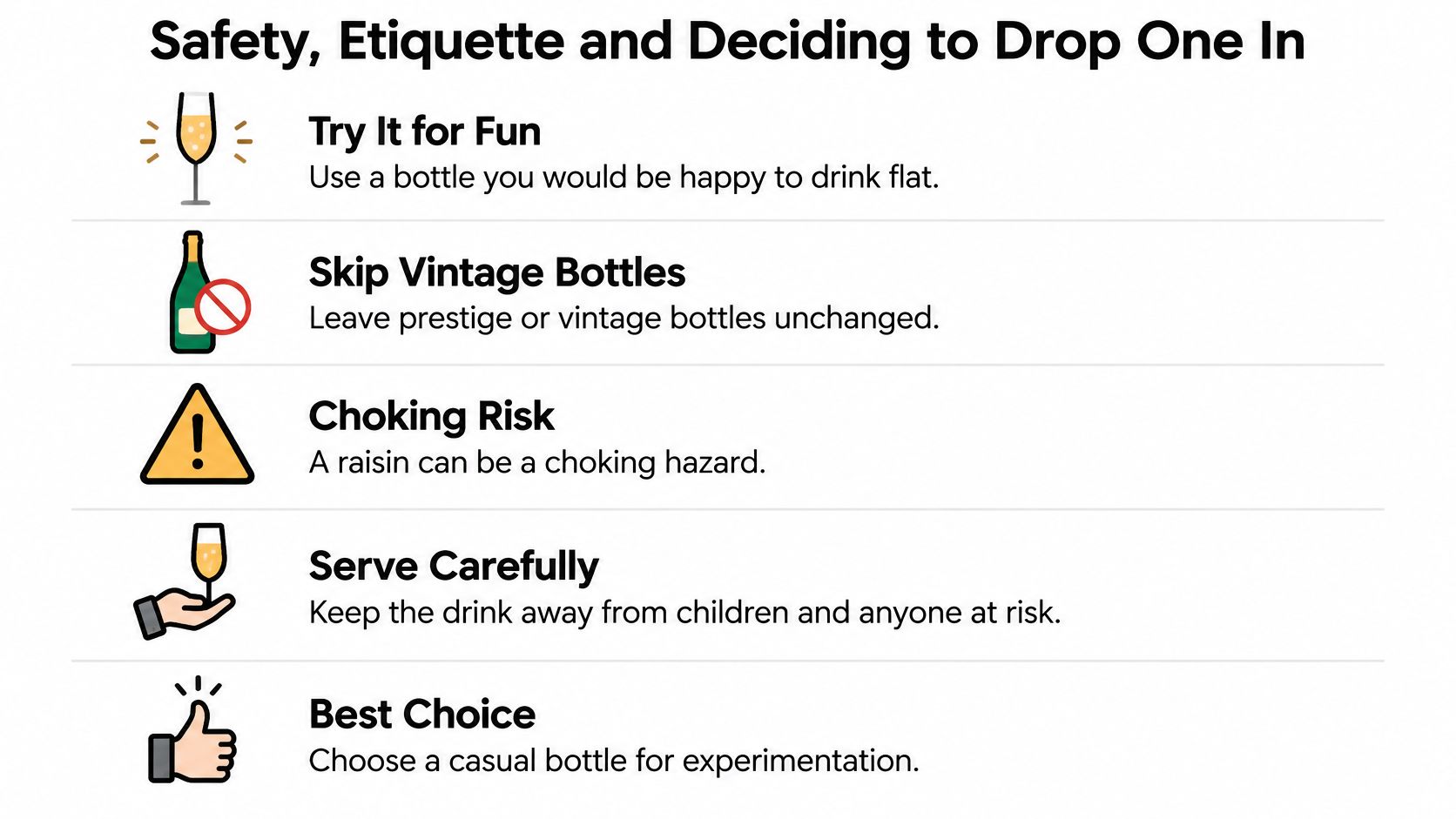
Etiquette is simple: keep the experiment in your own glass, and never add a raisin to someone else's pour. If you're visiting a winery, check the seasonal happenings at the Calistoga estate before planning your day. The trick works best when everyone at the table is in on it.
Before you try it, ask yourself:
- Is this a bottle I'd happily drink flat?
- Has the host agreed?
- Is the glass clean and unchipped?
- Is the raisin fresh, and am I treating this as a bit of fun rather than a fix?
For a fruit-forward pour that doesn't depend on bubble count, a sangria cocktail infusion jar kit offers another option for the gathering.
That's the idea behind Loyaltie, a marketplace where shoppers can discover and buy directly from nearby businesses, independent makers, growers, and producers. Every order is backed by Loyaltie. Browse the makers and find local products for your next gathering.