
59% of dog owners and 52% of cat owners reported using calming products in 2024, according to the American Pet Products Association's Dog and Cat Owner Insight Report. That's a useful reminder that pet wellness isn't just about vitamins anymore. It includes products for comfort, behavior, grooming, digestion, and the everyday routines you share with your pet.
But popularity doesn't tell you whether a particular chew, powder, or spray deserves a place in your home. The better question is whether you can understand its purpose, check its ingredients, and judge its evidence. Independent brands can offer a quality upgrade through clearer formulations and direct access to the people behind them, provided you hold their products to a practical standard.
Table of Contents
What Pet Wellness Products Cover
Pet wellness products are everyday items intended to support comfort, preventive routines, and daily health, rather than stand in for treatment of a diagnosed disease. Think toothbrushes, grooming wipes, targeted supplements, and food chosen for a particular nutritional need.
The category sits within a substantial market: the American Pet Products Association reported approximately $152 billion in total U.S. pet-industry expenditures in 2024, including $41.0 billion for veterinary care and product sales. Those are broad spending categories, not a measurement of supplement sales alone.
Pet wellness categories at a glance
| Category | Main purpose | Common formats | Best for |
|---|---|---|---|
| Supplements | Joint, digestive, and skin and coat support | Chews, powders, liquids | Adult pets with a specific goal |
| Calming aids | Stress around travel, storms, or separation | Chews, sprays, diffusers, treats | Anxious pets, with vet input |
| Dental care | Plaque, breath, and gum health | Chews, water additives, brushes | Most dogs and cats |
| Grooming | Coat, skin, and odor between baths | Shampoos, wipes, brushes | All pets, using species-appropriate tools and formulas |
| Specialty food | Targeted nutrition for weight or sensitive stomachs | Kibble, wet food, toppers | Pets with diet needs |
Choose the category before the product
Formats matter because you have to use the product consistently. A powder isn't convenient if your cat refuses food with anything sprinkled on it. A dental brush won't help much sitting unopened beside the sink.
For dental products, look for a Veterinary Oral Health Council seal as an independent check that the relevant plaque or tartar claims have been reviewed. Keep the purpose straight, too: a breath-freshening product isn't automatically a substitute for brushing or a dental examination.
When you're browsing, resources such as Joyfull's wellness choices for pet parents can help you explore options. Treat a collection page as a starting point, then check the individual product's intended user, ingredients, and directions.
The same approach applies to a listing for organic cat grass ball planters. Read the product's actual purpose and care instructions rather than assuming every cat-oriented wellness item addresses the same need.
Start with the need: Match a category to something you've actually noticed, not to a routine you think every responsible pet owner must buy.
Most pets don't need every category at once. Itchy skin, persistent bad breath, and panic during fireworks are different problems, and each deserves a different first question before anything goes into your cart.
Ingredients to Know and What the Evidence Says
An ingredient name can help you understand a product, but it can't tell you everything about the bottle. Amount, formulation, intended species, and the evidence behind the exact use all matter.
Common wellness ingredients and their evidence
| Ingredient | Often used for | Evidence strength | Watch for |
|---|---|---|---|
| Omega-3 fatty acids | Skin, coat, and joint comfort | Moderate, dose-dependent | Unstated amounts per serving |
| Probiotics | Digestive regularity | Strain-specific | Generic strain names with no counts |
| Glucosamine and chondroitin | Joint comfort | Mixed, many small studies | Dosage not tied to body weight |
| L-theanine | Calm, relaxed behavior | Limited in dogs and cats | Dose not tied to body weight |
| Melatonin | Sleep and calm | Limited, needs vet dosing | Human-strength dosing |
| Turmeric | Joint inflammation | Limited and inconsistent | Unlabeled curcumin content |
Read beyond the familiar ingredient
Omega-3 fatty acids have comparatively consistent support among these ingredients, but a label that says fish oil without stating useful active amounts makes comparison difficult. Ask about the amounts of EPA and DHA, not just the total amount of oil.
With probiotics, look for an identifiable strain and a stated count. Evidence for a particular strain doesn't establish that every product labeled probiotic will produce the same result.
Glucosamine and chondroitin deserve realistic expectations. Mixed findings and small studies don't justify treating every joint chew as an established answer to stiffness.
L-theanine and melatonin also need careful interpretation because research in dogs and cats is limited. Don't borrow a human dose or assume a calming blend is appropriate just because the ingredients sound gentle.
Turmeric is another familiar name that can create more confidence than the evidence warrants. Limited, inconsistent findings make the actual formulation and curcumin content more useful than a brightly colored ingredient image.
Separate effectiveness from quality testing
An ingredient study asks about a particular substance under particular conditions. A finished-product trial evaluates the actual formulation being sold. A certificate of analysis, often shortened to COA, documents testing of a sample; it doesn't by itself prove a health benefit.
The transparency gap is substantial: a review of pet-supplement product pages found that 61% omitted quantitative amounts for each active ingredient, 99% lacked a published clinical trial on the exact finished product, and 92% lacked a publicly available certificate of analysis, as described alongside the APPA supplement-use findings. Missing public evidence doesn't prove that a product is ineffective or contaminated, but it limits what you can verify before buying.
Safety also requires reading the entire formula. Xylitol is dangerous for dogs, including when it appears in products meant for people. Essential oils in calming sprays need particular caution around cats; don't assume a pleasant scent makes a formula suitable for them.
For topical products, natural grooming advice from Evo Dyne Products offers another place to build your ingredient vocabulary. Still, natural origin isn't a safety test.
Before choosing between similar bottles, ask:
- Amount: How much of each active ingredient is in a serving?
- Testing: Can the maker supply a relevant certificate of analysis?
- Evidence: Has this exact finished product been tested, or only an ingredient?
Those answers are more useful than an impressive list of botanicals.
When a Wellness Product Helps and When it Distracts
A 40-pound dog starts gaining weight, walks look harder, so the owner adds a joint supplement but keeps the same portions and skips the evening walk. Buying something feels like action while the routine underneath stays unchanged. That pattern is substitution, and it is the most common way a wellness product distracts from the change that would help. Watch for its three usual shapes: the product replaces a vet visit, three products start at once so nothing can be traced to a cause, or the label's wellness language does the persuading instead of a stated job.
A supplement can work alongside a sensible care plan. It cannot make oversized portions appropriate, and it cannot explain why a dog has become reluctant to move.
Interest in pet nutrition runs high: 85% of pet owners believe proper nutrition and supplements are as important for pets as for humans, according to coverage in Petfood Industry. Believing that is not the same as needing an added product. A healthy pet eating a complete diet may have one specific support need; everything beyond it is noise.
Know when shopping should stop
Prevention and treatment are different jobs. A diagnosed condition calls for a veterinarian's plan rather than an improvised collection of bottles.
Arrange a veterinary assessment before experimenting when you notice:
- Movement changes: Limping or stiffness that persists.
- Weight changes: Unexpected gain or loss.
- Digestive trouble: Vomiting or diarrhea that doesn't settle.
- Other symptoms: Unusual thirst, skin sores, or a marked change in behavior.
- Medication considerations: Your pet already takes medication or has an established health condition.
Urgent or severe symptoms need prompt care, not a product trial. Bring the food label, treat list, and any existing supplements so your vet can see the whole routine at once.
Give a product a fair, measurable job
Pick an outcome that fits your pet's body condition, age, species, diet, and medical history. For digestive support, record stool consistency. For mobility support, note comfort on the same familiar walk. A chew such as collagen sticks still has to fit that plan. Check its feeding directions and where it lands in your pet's daily intake rather than treating the word collagen as permission to ignore everything else.
A useful trial starts with a question you can answer at a date you set in advance.
Introduce one product and agree with your vet on a trial window and a review date before the first serving. Keep walks, portions, and treats steady so any change has a single plausible cause. Record what you see at the same intervals and in the same words, so one good week doesn't read like a breakthrough.
If nothing has changed by the review date, stop. Stopping an unhelpful product after the agreed review date is the correct outcome.
Reading Labels and Choosing a Local Maker
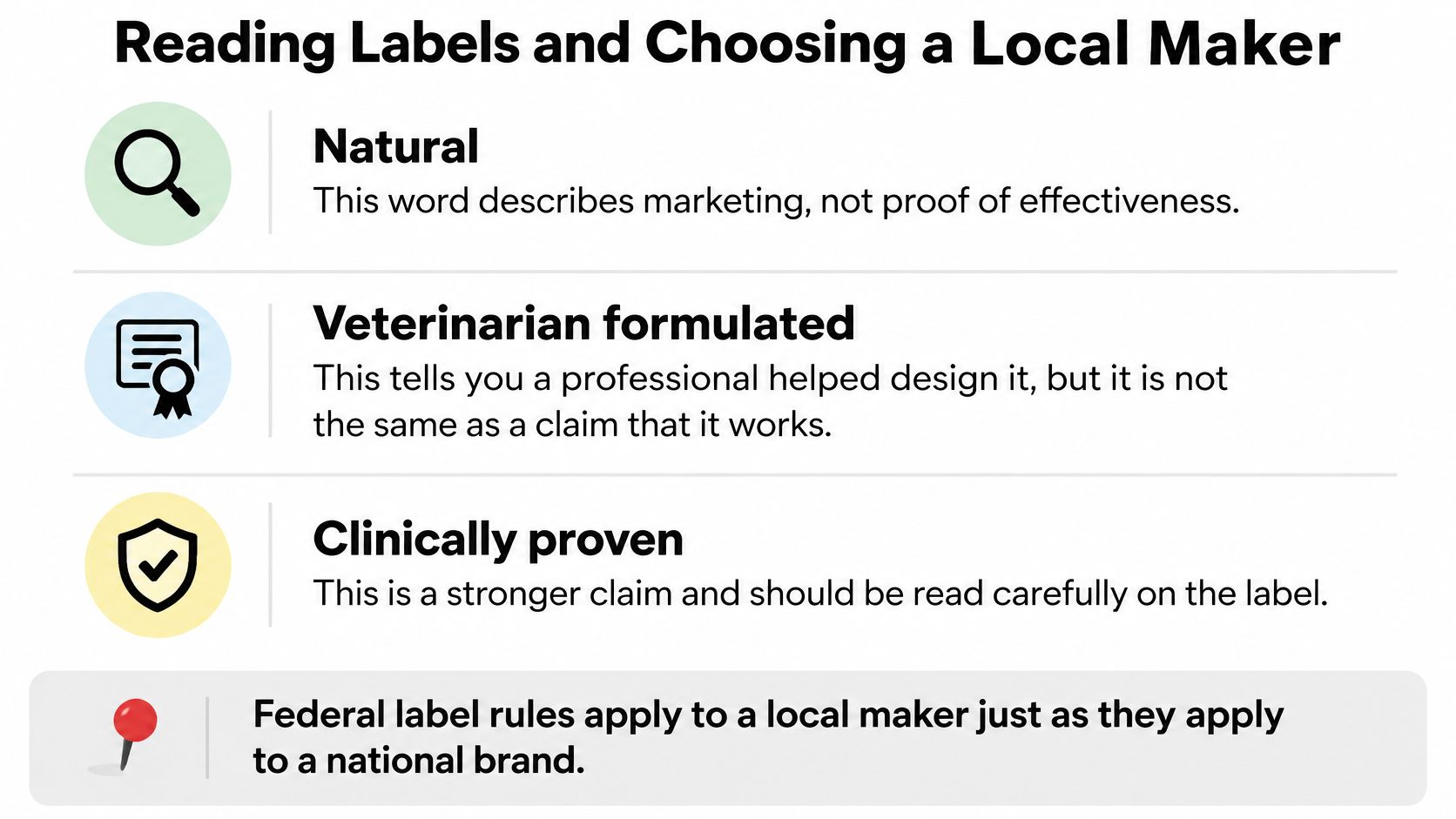
Natural, veterinarian formulated, and clinically proven describe different things. Natural describes sourcing or processing, not proof that a product works. Veterinarian formulated describes professional involvement, not necessarily a clinical trial. Clinically proven calls for a closer look at what was tested, in which animals, and for which outcome.
Federal pet-food labeling rules apply whether you buy from a national company or a local maker. The FDA's pet-food guidance identifies required label information including product identity, net quantity, the manufacturer or distributor and place of business, and ingredients listed from greatest to least weight.
Use the terminology to form questions you can ask.
Run the label checks in order
The checks below combine basic label requirements with additional transparency standards worth using when you shop. Not every quality document or dosing detail listed here is a universal federal labeling requirement.
Identify the product and responsible company. Can you find the product name, net quantity, and manufacturer or distributor with a place of business? A social-media handle alone doesn't give you the same information. You should know what you're buying and who stands behind it.
Read the complete ingredient list. Check ingredients in descending order by weight. Don't stop at the ingredient highlighted on the front. Review flavorings, carriers, sweeteners, and other additions, particularly if your pet has a known sensitivity.
Find active amounts and serving guidance. For a targeted supplement, look for the amount of each active ingredient per serving and guidance appropriate to the intended species and body weight. A blend total doesn't tell you how much of each component your pet receives.
Check the feeding instructions. Can you tell how much to give your pet, how often, and how to introduce it? Scoops and droppers should have understandable measurements. If the directions leave you guessing, get clarification before opening the package.
Look for traceability and testing. Find the lot number and ask for a COA relevant to that lot, or a named contact who can explain the available testing. Ask what was measured, which laboratory performed the work, and whether testing covered identity, potency, or contaminants.
Examine the claims. Disease promises require special scrutiny. A nutritional product that claims it cures a condition, prevents disease, or replaces your vet deserves a pause, not an automatic purchase.
Confirm the intended purpose. The maker should plainly explain whether the product provides nutritional support, topical grooming, or another specific function. A nutritional-support statement is helpful, but it doesn't cancel contradictory disease claims elsewhere on the page.
The category matters. The FDA's animal-food overview explains that animals don't have a separate dietary-supplement category equivalent to the human category; ingredients and intended use determine whether a product is treated as animal food or a new animal drug.
For dog and cat foods intended to supply all or most daily nutrients, the FDA's guidance on disease-related diet claims explains how claims to diagnose, cure, mitigate, treat, or prevent disease can bring those products under drug regulation. The words on the label can change how the product is regulated.
Turn the checks into a buying decision
A good independent maker makes the details inspectable: a clear formulation, a named person accountable for questions, and answers that help you decide whether the product fits. Being local doesn't change which label checks you run.
Use this buying sequence:
Name the outcome. Write something specific, such as calmer car rides or comfortably formed stools. Avoid a goal as broad as better wellness.
Check the maker. Find out who runs the brand, where the product is made, and who handles formulation and manufacturing questions. A founder may use a manufacturing partner; what matters is a clear explanation of responsibilities.
Confirm the label checks. Save the ingredient panel and directions. If you're still learning the terminology, label reading with Pure Paw Labs can provide another educational reference while you compare the actual packages.
Read the purchase terms. Look at returns, refunds, opened-product restrictions, and any trial terms before paying. Don't assume a product can be returned just because your pet refuses it.
Ask who can answer formulation questions. Find out whether the person answering knows the manufacturing process or can route you to someone who does. A short path to a knowledgeable contact is more useful than a polished sales page.
Check the package information before you open it. Confirm that the lot number, directions, and use-by or expiration information are visible on the package you receive. Keep that information with your receipt.
A useful shopping rule: If a label fails two or more of your checks, skip it until the missing information is resolved.
Buying directly from the maker can make questions easier to route to someone who understands the product. It doesn't guarantee that the person answering personally formulated it. Notice how the maker responds. A clear explanation of limitations is more reassuring than a confident promise that the formula works for every pet. You're looking for someone who can help you make a good decision, including the decision not to buy.
Buying Sustainably and Securely Over Time
The smartest reorder is the product that has earned its place in your routine. Don't set up regular delivery for everything you tried just because reordering is convenient.
Choose larger containers only when your pet uses the product consistently and the label's shelf-life guidance supports finishing it. An oversized jar that expires half full isn't better value.
Keep the routine lean
Fewer, well-chosen products mean less money tied up in unfinished purchases and fewer packages to manage. Ask about refillable or recyclable packaging, then check whether your local recycling program accepts the material.
Packaging still has to protect the contents. Don't transfer a product into a decorative container if you'll lose its directions, expiration information, or lot identification.
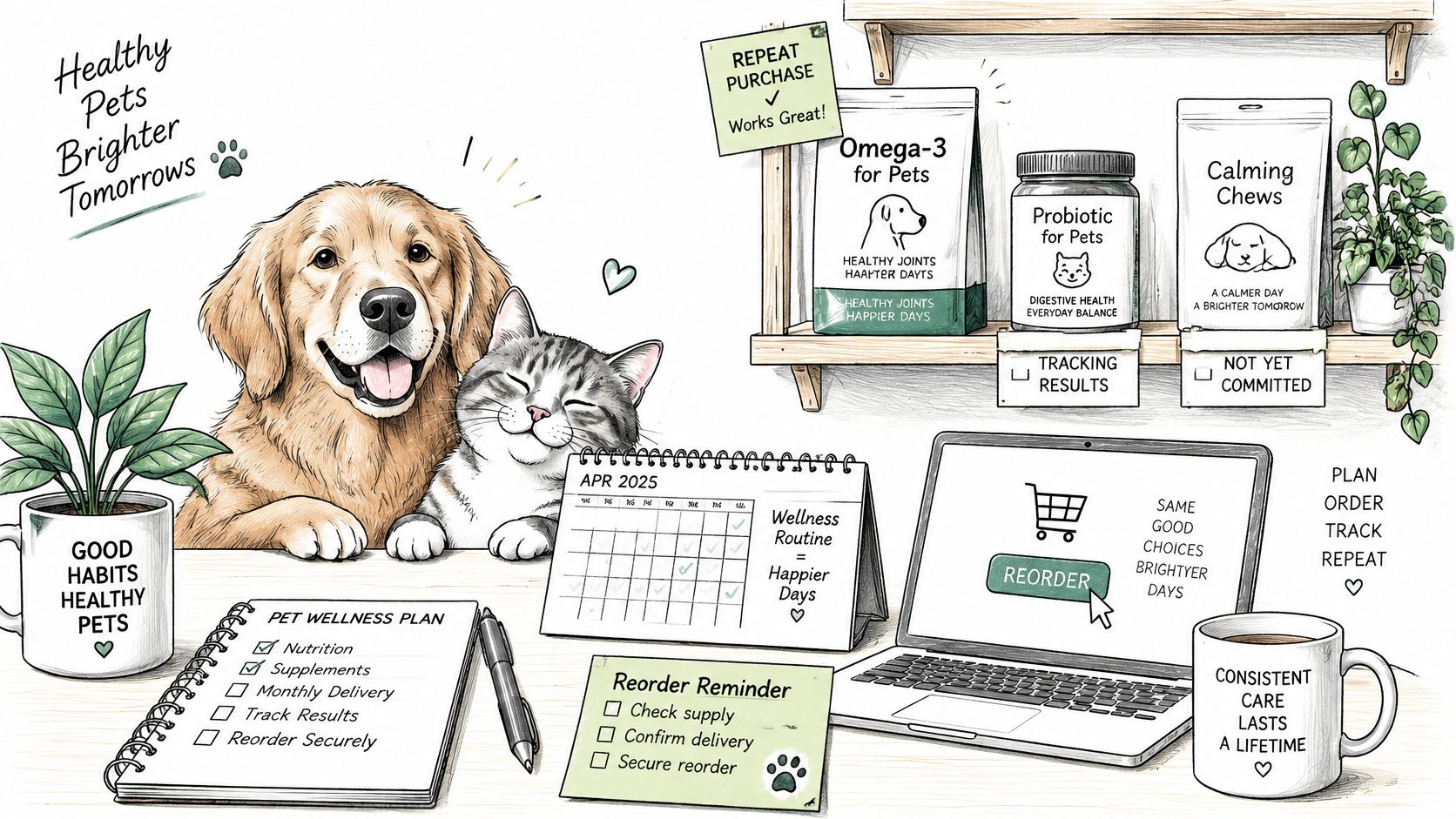
A simple planner can help you keep the practical details together.
Protect the purchase and the product
Use the seller's secure checkout rather than sending payment through an unfamiliar message or payment request. Confirm that the seller's contact details work before you need help.
Keep a compact purchase record:
- Receipt and seller details: Save the order confirmation and a usable contact.
- Package information: Photograph the label, ingredient panel, expiration information, and lot number.
- Use notes: Record when you opened the package and any changes you noticed.
- Reorder decision: Note whether the product achieved the outcome you bought it for.
Store products in a cool, dry place unless their label specifies otherwise. Follow temperature guidance for liquids and chews, close containers securely, and keep them away from children and animals they aren't intended for.
Watch for changes in appetite, stool, energy, or behavior after starting something new. If your pet consumes more than directed, contact your veterinarian or a pet poison hotline promptly, with the package available; don't wait for symptoms before asking for advice.
A good product should make your pet's care routine simpler, not leave you managing a crowded shelf of uncertain purchases.
Start With One Product and Ask Your Vet
Pick one category tied to something you have observed: itchy skin, bad breath that warrants a dental check, or fireworks anxiety that needs a plan. A general-purpose wellness bundle spreads your attention and your budget across problems you have not defined.
Once you have a shortlist, show your vet the full label and ask whether this formulation, serving, and intended outcome fit your pet, especially if your pet takes medication or has a health condition. That conversation is the single checkpoint before you start, and it keeps supplements in their proper role alongside diet, exercise and veterinary care.
Compare makers without rushing
Loyaltie is a marketplace where shoppers can discover and buy directly from nearby businesses, independent makers, growers, and producers. Treat independent-brand shopping as a search for better explanations and accountable products, with a fixed budget and a short list.
Loyaltie also lists everyday products in categories such as coffee, skincare, snacks, and pet food, so pet-care shopping can sit alongside other household purchases. The habit carries across categories: understand what you are buying before you commit to a repeat order.
- Browse deliberately: Compare a few makers and look for specific ingredient and sourcing details.
- Resolve uncertainty: Ask for missing label information before paying.
- Keep your standard: Reorder only when the product remains useful and appropriate.
A single product that earns its place has a defined job, a label you can read without guesswork and a result you can observe in your pet.
Discover independent brands and buy directly from their makers at Loyaltie. Bring your pet's specific need, compare labels and maker explanations, and choose one product to start with.