
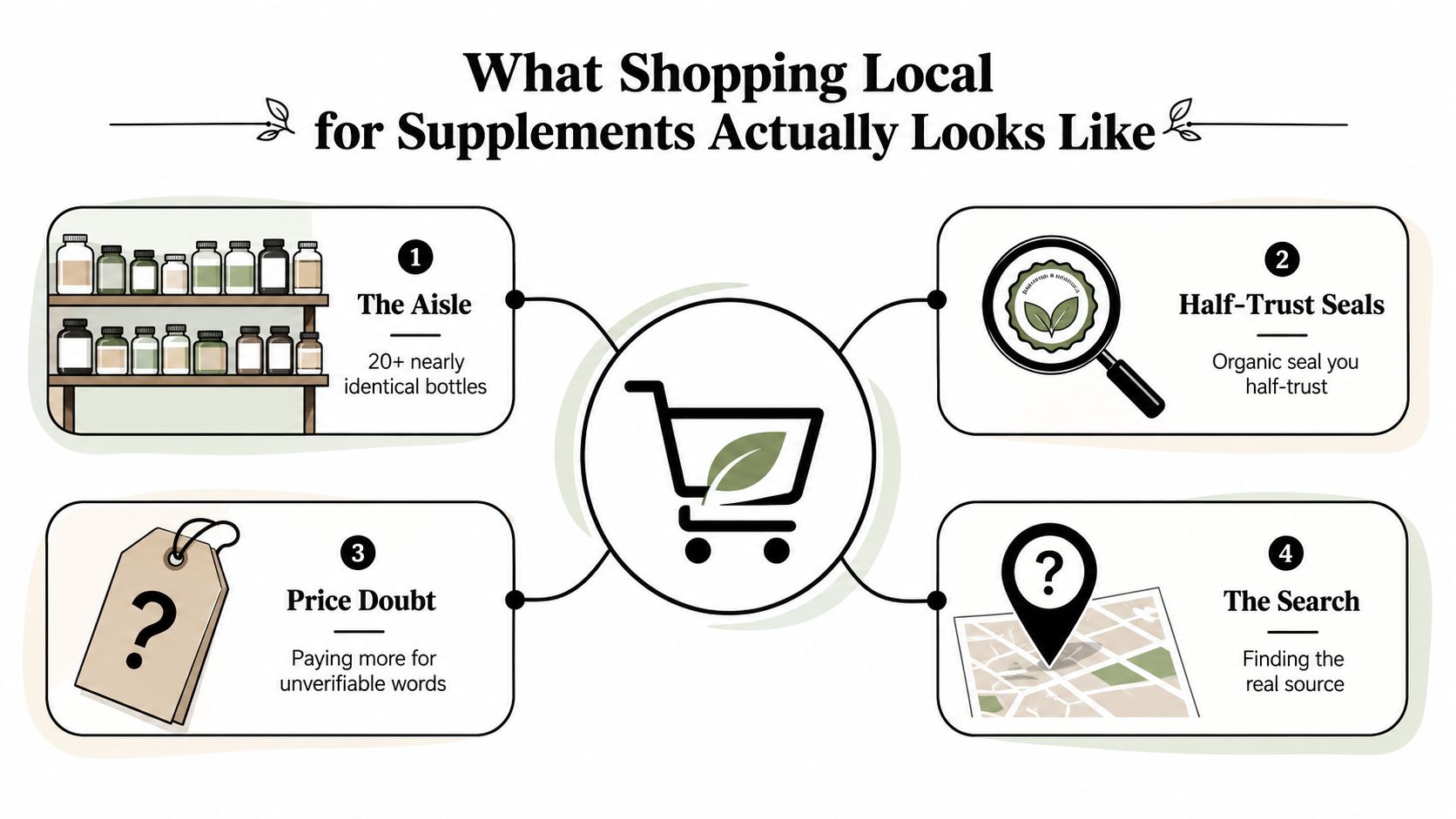
You're standing in the supplement aisle, and every bottle looks like it was designed to win on vibes instead of facts. One jar says organic, another says natural, a third has a seal you half-recognize, and all of them cost more than you want to spend. The problem with searching for organic supplements near me, you're not just looking for something close by, you're trying to figure out which bottle is legit before you hand over your card.
The good news is that this gets easier once you stop treating local shopping like a geography question and start treating it like a verification problem. If you know what a real organic claim means, what quality signals matter beyond the badge, and how to spot independent makers who'll answer questions directly, you can buy with a lot more confidence. That matters in a market that's already broad and recurring, not niche, with U.S. supplement use deep enough that shoppers are actively comparing ingredients, sourcing, and trust signals before they buy organic supplement market data and U.S. organic marketplace growth data.
Table of Contents
- Testing matters because the label doesn't prove cleanliness
- The FDA reality makes diligence non-optional
What Shopping Local for Supplements Actually Looks Like
You're in a store aisle with twenty bottles that all swear they're clean, organic, or made for wellness. The labels blur together fast. One bottle uses earthy colors, another leans on a leaf icon, and a third says almost nothing except “natural” in big letters, which is exactly the kind of thing that should make you suspicious.
Proximity changes the trust equation
Buying local isn't just about getting the bottle faster. It puts you closer to the person who made it, stocked it, or chose it for the shelf. That gives you a better shot at asking direct questions about sourcing, testing, and why one formula exists instead of another.
There are a few kinds of local sellers worth knowing. Independent health food stores usually curate tighter assortments and lean into brands they can stand behind. Co-ops often carry community-minded labels and are more likely to know where products come from. Farmers' markets can be useful for wellness vendors who sell direct, but those booths need the same scrutiny as any shelf, because a friendly setup doesn't prove a label claim. Regional brands online and local makers selling through their own sites can be even better when you want to buy directly from the maker, with no middleman.
Practical rule: The closer you are to the maker, the easier it is to ask how the product was made, who tested it, and what the seal on the front actually means.
Who you're really buying from
The cheapest big-box bottle usually comes with the most distance. You get a warehouse chain, a private-label formula, and a lot of marketing copy. That isn't automatically bad, but it's rarely the shortest path to clarity.
Independent sellers work differently. They tend to know their formulas, their suppliers, and their margin structure better because the business is closer to the product. That matters when you want a supplement that's traceable rather than just branded well.
The point isn't to romanticize local. It's to recognize that shopping near you can mean better access to the person who can answer the uncomfortable questions. That's a real advantage when supplements are involved, because trust is the product before the capsule ever is.
What Organic Really Means on a Supplement Label
A lot of shoppers use “organic” like it's a general vibe. It isn't. For supplements in the U.S., the label claim determines what the formula can legally contain, how the ingredients are sourced, and what kind of claim the bottle can make in the first place.
The label category changes everything
A product labeled “organic” must meet the USDA rule that organic percentage is calculated from the combined organic ingredients by weight or volume, excluding water and salt. A “made with organic” claim needs at least 70% certified organic ingredients by weight, and nonorganic ingredients can only come from the National List and may not exceed 5% of the finished product, according to the AHPA white paper on USDA organic composition rules USDA organic composition rule details.
That means a shift from 69% to 70% organic content isn't a cosmetic tweak. It changes the legal category, the marketability, and sometimes the shelf position. If a bottle only says “made with organic,” that's a weaker claim than full organic certification, even if the packaging tries to dress it up.
What seals actually carry weight
The USDA Organic seal is the one that matters when you want a federally regulated organic claim. Third-party certifications can add confidence, but they're not the same thing as a USDA organic designation. Clean-label language like natural, pure, or clean can sound reassuring and still tell you almost nothing about how the product was made.
Here's the quick read:
| Claim | What It Requires | Trust Level |
|---|---|---|
| USDA Organic | Meets USDA organic standards for the product's category | High |
| Made with organic | At least 70% certified organic ingredients by weight | Medium |
| Non-GMO | No genetically engineered ingredients, but not necessarily organic | Medium |
| Natural | No consistent organic or safety standard by itself | Low |
| Clean | Marketing language, not a formal certification | Low |
If you want a practical companion guide on how brands talk about ingredient quality, the guide to clean ingredients for fitness is useful because it shows how easy it is for labels to sound clean without proving much.
Quality Signals That Go Beyond the Organic Badge
Organic status is useful, but it doesn't guarantee a safe or well-made supplement. That's the mistake too many shoppers make. A bottle can be organically sourced and still be sloppy on microbes, heavy metals, or potency control.
Testing matters because the label doesn't prove cleanliness
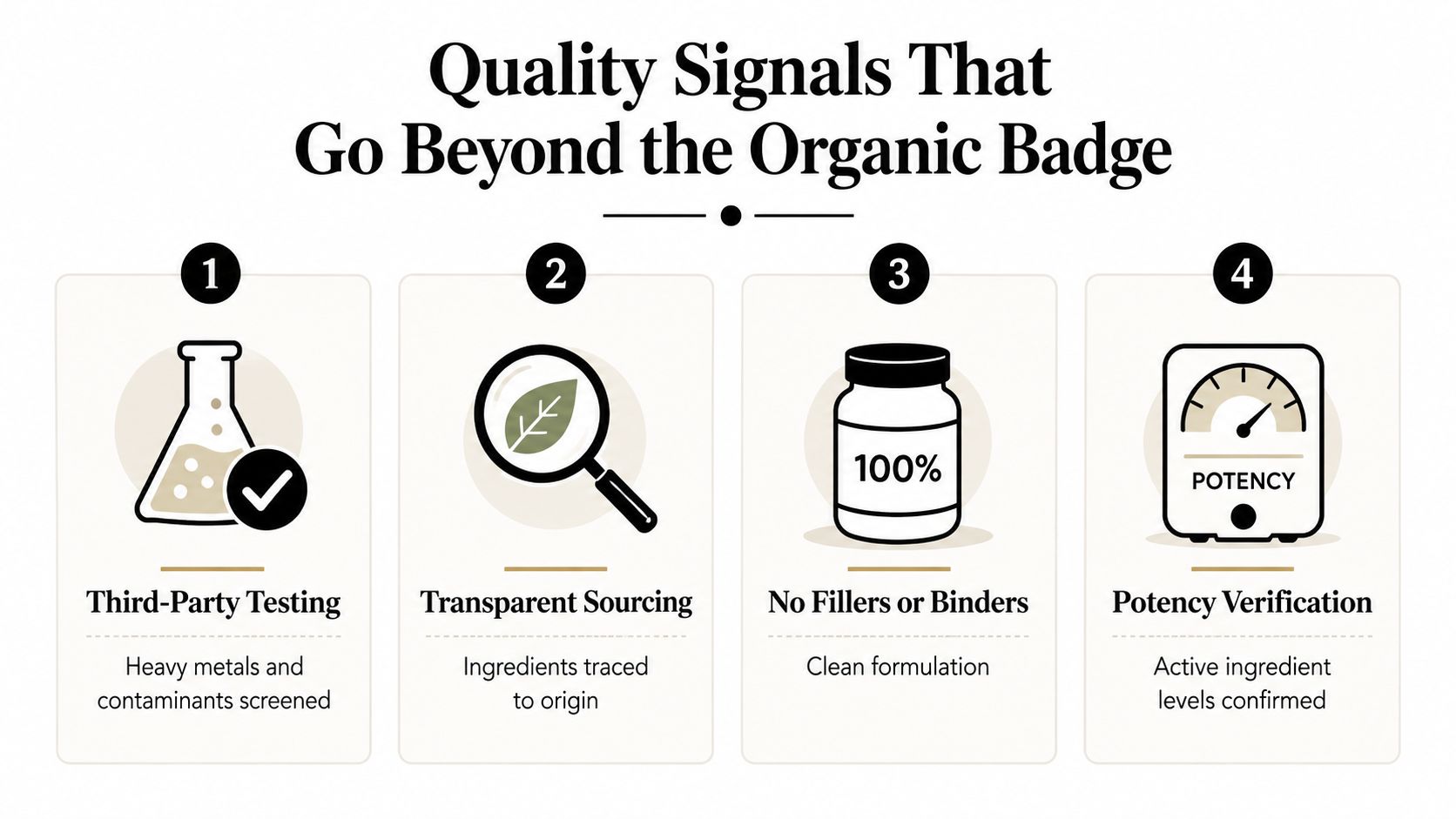
One organic multivitamin ingredient specification sets total plate count at 1,000 cfu/g, yeast and mold at 100 cfu/g, coliforms at 10 cfu/g, and requires Escherichia coli to be negative per 10 g. It also caps heavy metals at 10 ppm total, with lead at 2 ppm, cadmium at 1 ppm, arsenic at 1 ppm, and mercury at 0.1 ppm organic multivitamin ingredient specification. Those limits tell you why third-party lab verification isn't a nice extra. It's the thing that separates a credible supplement from a pretty bottle.
Direct takeaway: Organic ingredients can still carry contamination risk, so test results matter as much as the plant source.
The FDA reality makes diligence non-optional
The FDA says dietary supplements don't need premarket approval, and manufacturers are responsible for making sure products are safe and properly labeled FDA supplement marketing and labeling responsibility. That means the burden shifts to you. If the seller can't show a Certificate of Analysis, explain who tested the batch, or describe the manufacturing standards, you're buying on faith.
A few markers are worth asking about every time:
- Third-party testing: Ask whether the product was screened for microbes, heavy metals, and potency.
- COAs: A real Certificate of Analysis should match the product and batch, not just exist as a vague promise.
- GMP compliance: Good Manufacturing Practices matter because they point to process discipline, not just ingredient claims.
- Transparent sourcing: You want to know where the ingredients came from and who handled them.
For a concrete example of how producers can publish testing information, the yeast infection product potency reports page is a useful model of what buyers should look for when they want proof instead of packaging theater. And if you're browsing products on Loyaltie, a nearby-style supplement listing like Blood Sugar Support Supplement Healthy Glucose Energy Capsules Tablets Full Supplement Facts Count Serving Size is exactly the kind of item where you should check the facts panel before you assume the marketing is doing the heavy lifting.
If you're looking outside capsules and powders, the same discipline applies to other wellness items too. The Activated Bamboo Charcoal Toothpaste, Aloe Vera & Turmeric, Teeth Whitening & Fresh Breath, SLS-Free Vegan, 4 oz | Life Gardening Tools by Loyaltie listing uses product language about a cleaner-feeling mouth and a brighter-looking smile, but the point is the same, you still want to know what's inside and what the formula avoids.
Where to Actually Find Organic Supplements Near You
The best local search strategy isn't “find the nearest store.” It's “find the nearest store that can prove what it sells.” That's a different hunt, and it saves you from wandering into a place that calls everything wellness and certifies nothing.
Start with the stores that already curate
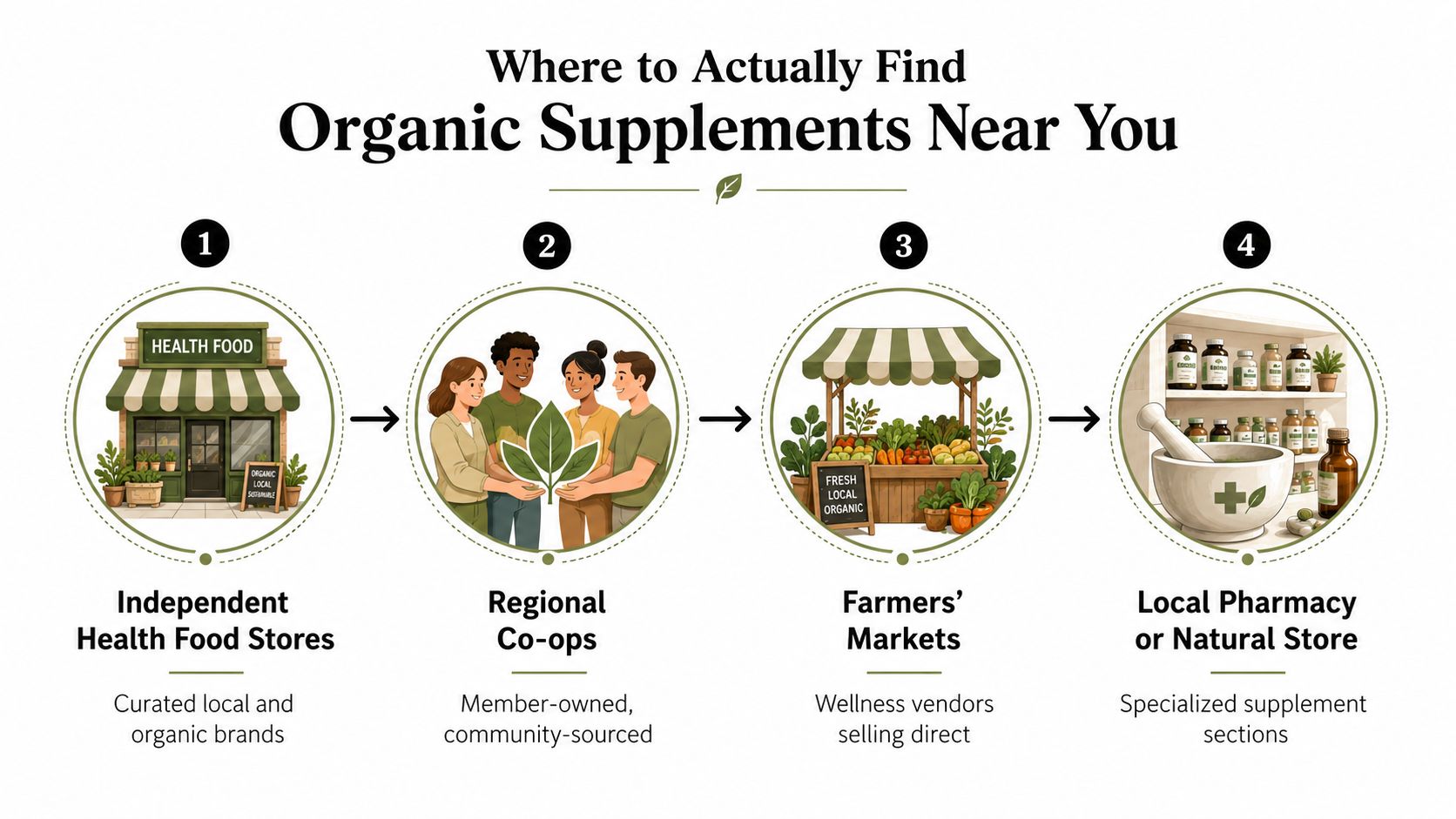
Independent health food stores are the first stop because they usually stock fewer, more deliberate brands. Regional co-ops are next if you want staff who tend to know their inventory and care about sourcing. Farmers' markets can be great for direct-from-maker products, but only if the vendor can answer the same questions you'd ask in a store.
Local pharmacies and natural grocers can also be useful, especially when they have a dedicated supplement section instead of a random shelf near the checkout. The trick is not the category of retailer. It's whether the retailer can distinguish between a legit organic supplement and a wellness-branded product pretending to be one.
Use search tools that shorten the trust gap
Store locators still matter because they tell you who has a local footprint. The Vitamin Shoppe says it has more than 600 stores across the U.S., and its store locator is meant to help people find organic vitamins and supplements nearby The Vitamin Shoppe organic supplements page. That's a concrete reminder that “near me” usually starts with retail density.
Search operators help too. Use phrases like “organic supplements near me”, “USDA organic vitamins [city]”, or “independent health food store [neighborhood]”. Add “COA,” “third-party tested,” or “GMP” if you want to separate real makers from polished shelf dressing.
You can also skip the guesswork entirely and buy directly from independent makers through curated marketplaces. That can turn “near you” into a shipping question instead of a shelf hunt, especially when the platform is designed for direct discovery. A useful example is the Daily Supplement System Bundle Electrolytes Digestive Support Bloat Relief 3 Pack 25 30 30 Servings, which shows how a product can be surfaced in a way that puts the maker and the formula front and center instead of burying them under retail clutter.
Why Independent Makers Are Worth a Second Look
Independent brands are usually where the better buying experience lives. You're not just getting a different logo. You're getting shorter supply chains, faster answers, and formulas that weren't diluted by a committee trying to fit every channel at once.
Real people can answer real questions
When you buy from a maker directly, you can ask who produced the supplement, what testing they use, and why they chose one ingredient source over another. That's hard to fake for long. Large mass brands can be polished, but they often keep buyers a few layers away from the people who know the formula.
That transparency is the whole point. If a brand can explain its ingredients without hiding behind generic wellness language, you're in a better position than you'd be staring at a crowded shelf with no staff who can answer anything useful.
Loyaltie fits the practical version of local shopping
Loyaltie is a marketplace where people discover and buy directly from the best independent brands in the U.S., with every order backed by Loyaltie for added confidence. That matters because it gives you local-maker quality without forcing you to physically drive all over town looking for it. You can browse the maker, read the product story, and place an order without losing the direct connection that makes local shopping worthwhile.
The Organic Ashwagandha Root Powder Withania Somnifera Stress Support Adaptogen Fine Grind 1 Pack Size Listed listing is a good example of the kind of independent product people are looking for when they want something organic and specific, not just a generic capsule from a warehouse brand.
Bottom line: independent doesn't mean fragile or cute. It usually means the maker has a tighter grip on sourcing, testing, and product story.
Questions Worth Asking Before You Buy
Keep this part on your phone the next time you're in a store. If a seller can answer these questions cleanly, you're dealing with a much better product conversation. If they dodge them, move on.
What to scan on the bottle
Start with the label itself. Look for the USDA Organic seal, or at least a clear explanation of why the product only qualifies as made with organic. Then check whether the bottle names the manufacturer, the country of origin for key ingredients, and any third-party testing standard.
For prenatal supplements, the label conversation gets even more serious because ingredient sourcing and verification matter a lot. The raw code prenatal vitamin insights page is a helpful reminder that not all nutrient formulas are built the same, and that reading beyond the front label saves you from vague promises.
Questions that separate real makers from dressed-up brands
Ask these directly:
- Who manufactures this product? You want a real company name, not a foggy brand persona.
- Where are the ingredients sourced? “Sourced globally” isn't enough if they can't narrow it down.
- Do you publish batch test results? If yes, ask how you can see them.
- What does the organic claim cover? Full organic, made with organic, or just a marketing look?
- Who signs off on quality checks? A maker who knows this answer usually knows the rest too.
Simple filter: if the answer sounds rehearsed but not specific, you probably don't have enough information to buy yet.
Red flags are easy to spot once you know what to listen for. “Proprietary blend” with no meaningful breakdown. “Clinically inspired” without proof. “Natural” used as a substitute for organic. A seller who gets annoyed when you ask about testing. Those are all reasons to keep walking.
A Smarter Way to Stock Your Routine
Buying organic supplements near me gets easier when you use three habits together. Know what the label really means. Know where independent makers and trusted local stores show up. Ask for testing and sourcing before you buy, not after you've already convinced yourself the bottle must be fine.
You don't need a whole new routine. You just need a better default. Loyaltie is a straightforward place to start if you want to browse independent makers, buy directly from the source, and reorder products that earn their spot without losing the personal connection that makes local shopping worth it.
If you want a cleaner way to shop local without guessing, visit Loyaltie and browse independent makers that sell directly with more transparency than the average shelf brand. It's a simple way to compare real formulas, find products you can trust, and keep your supplement routine tied to people who know what's in the bottle.