

You're standing in a supplement aisle with two bottles in your hands. One has a sleek label promising organic calcium, algae-derived minerals, and a gentle formula. The other is a budget bottle of calcium carbonate with a much shorter ingredient list. You turn both around, squint at serving sizes, and wonder whether “organic” means better absorbed, easier on your stomach, or just more expensive.
That hesitation makes sense. Choosing organic calcium supplements isn't just about finding the biggest calcium number on the front. You're deciding which form fits your digestion, how much elemental calcium you're getting, whether you need to take it with food, and whether the maker can back up its sourcing and testing claims. A little label literacy can make the choice much less mysterious. If you want broader guidance before comparing formulas, Lila's guide to choosing supplements with confidence is a useful companion.
Table of Contents
- Standing in the Supplement Aisle Trying to Choose
- What Organic Calcium Actually Means
- Organic Calcium Forms Compared
Standing in the Supplement Aisle Trying to Choose
The shopper in front of you picks up a bottle labeled “whole-food calcium,” reads the words “plant-based,” then puts it back. The next bottle says calcium citrate, includes vitamin D, and costs more than the carbonate option. A third product lists several calcium compounds, but its serving requires multiple capsules. By now, the front labels have turned into a blur of promises about purity, absorption, bones, and clean ingredients.
Most buyers eventually have to answer four practical questions:
- Which form fits my body? Calcium carbonate packs more elemental calcium into less material, while citrate is less dependent on stomach acid.
- What dose do I need? The number that matters is elemental calcium, not the total weight of the calcium compound.
- Should I take it with food? Carbonate generally works best alongside a meal. Citrate is more flexible.
- Do I trust the maker? A clear Supplement Facts panel, disclosed manufacturing information, and credible testing matter more than polished packaging.
The word “organic” adds another layer of confusion because it can describe the sourcing and certification story without telling you that the product absorbs better. A calcium ingredient may come from algae, a mineral salt, or a conventional source, yet the final buying decision still depends on its chemical form, dose, and delivery format.
This is also where independent brands and local makers can offer a more useful shopping experience. Buying directly from the maker may give you access to clearer ingredient explanations, responsive answers, and documentation that a mass-produced bottle doesn't make easy to find. That doesn't mean every independent product is automatically better. It means you have an opportunity to inspect the details instead of relying on a familiar logo.
By the time you finish your coffee, you should be able to move from the front-panel language to the fine print on the back, then decide whether a product fits your stomach, schedule, and values.
What Organic Calcium Actually Means
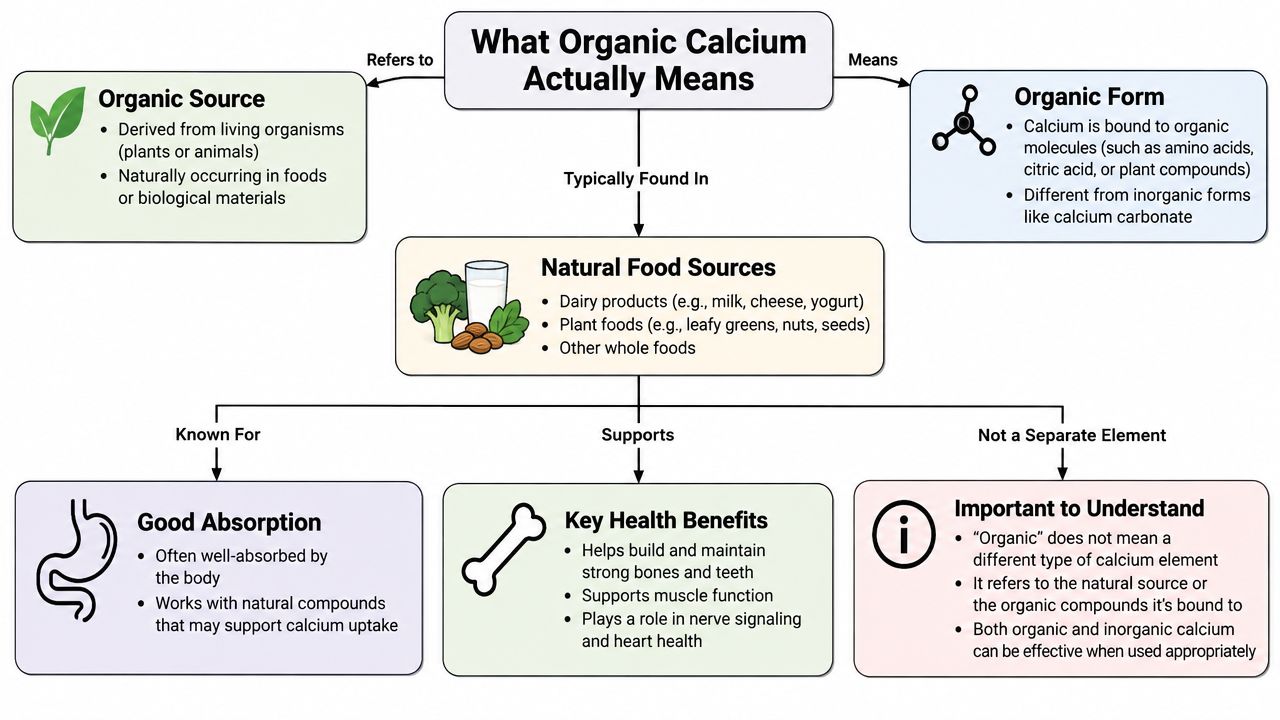
On a calcium label, organic usually describes sourcing, processing, or certification, not superior absorption. The term can point to a food-based or plant-derived origin, a clean-label formulation, or an organic certification connected to the product's ingredients. It doesn't automatically identify the calcium salt or explain how much of the mineral your body will use.
A true organic-positioned formula might use algae-derived calcium, marine shells collected under stated environmental protocols, or a calcium compound paired with an organic acid or amino acid. Some products may display certifications such as USDA Organic or QAI, but you'll need to check what the certification covers. A product can contain an organic ingredient without every ingredient or the finished supplement meeting the same certification standard.
Think about organic coffee. The coffee bean still contains caffeine, but the farming, soil, and chemical-handling story may be different. In the same way, organic calcium positioning may appeal to you because you care about agricultural standards, traceability, environmental sourcing, or avoiding unnecessary additives. Those are valid reasons to buy. They're different from an absorption claim.
Calcium carbonate shows why the distinction matters. It's a mineral compound commonly sourced from limestone, and its elemental calcium content is high. In 2023, calcium carbonate was renewed for use in organic handling as a nonagricultural substance under USDA National Organic Program standards, according to the Future Market Insights calcium supplements market report. That example shows that a mineral doesn't need to come from a crop to fit an organic-handling framework.
The useful question isn't “Is organic better?” It's “What does organic mean on this particular label?”
Separate source terms from form terms. “Algae-derived,” “food-based,” and “organic certified” describe origin or standards. “Carbonate,” “citrate,” “lactate,” “malate,” and “chelate” describe chemistry. A product can be algae-derived and still need to be evaluated for its calcium salt, elemental dose, and serving instructions.
For a real-world example of how a red mineral algae calcium product is presented, you can review Supplemynts Inc red mineral algae calcium. Read it as a product page, not as proof that the source is more absorbable.
Comparing the Main Forms Side by Side
The easiest way to compare calcium products is to use the same questions for every form. How much elemental calcium does it provide? How large is the serving? Does it need food? How might your stomach respond? What does the price reflect?
The table below uses verified elemental-calcium benchmarks for carbonate and citrate. Chelated and food-derived products vary by compound and formulation, so their labels deserve closer inspection rather than a single assumed percentage.
Organic Calcium Forms Compared
| Form | Elemental Calcium % | Take With Food? | Common Side Effects | Typical Cost |
|---|---|---|---|---|
| Calcium carbonate | About 40% | Generally yes | Constipation, bloating, stomach discomfort for some people | Often lower per serving |
| Calcium citrate | About 21% | No, it can be taken with or without food | Usually considered gentler, though digestive effects vary | Often higher per serving |
| Chelated calcium | Varies by compound | Depends on the formula | May be easier for some people, but tolerance varies | Often higher than basic carbonate |
| Food-derived or algae-based calcium | Varies by source and compound | Follow the product directions | Depends on the mineral matrix and added ingredients | Often higher because of sourcing and traceability |
Calcium carbonate is the compact option. At about 40% elemental calcium by weight, it can deliver a substantial amount in fewer tablets than calcium citrate, which is about 21% elemental calcium according to NIH information on calcium forms. That density can make carbonate look efficient, but it works best with a meal and may feel heavy or constipating for some users.
Calcium citrate takes up more product space for the same elemental amount, but it doesn't depend as heavily on stomach acid. That flexibility can matter if you take acid-reducing medication, have low stomach acid, or don't eat consistently at the time you take supplements. The NIH calcium fact sheet for health professionals confirms that carbonate is absorbed best with food, while citrate can be taken with or without food.
Chelated forms bind calcium to another molecule, such as an amino acid. Food-derived and algae-based formulas may contain a broader mineral matrix or emphasize traceable sourcing, but “natural” doesn't tell you the elemental dose or guarantee a gentler experience.
Cost comparisons also need context. A higher price may reflect source documentation, testing, capsule material, or a larger serving, not better calcium absorption. If you're comparing wellness products more broadly, even something like Earth Made Naturals magnesium chloride body spray shows why the delivery format and intended use should be assessed separately from the ingredient's general reputation.
Choose the form that you can take consistently, not the one with the most impressive front-panel number.
How Your Body Actually Absorbs It
Calcium absorption depends on a combination of salt chemistry, meal timing, and dose size. The word organic doesn't override those variables.
Calcium carbonate relies more on stomach acid to dissolve. That's why taking it with food generally makes sense, and why it may be less suitable for people with reduced stomach acid or those using acid-suppressing medication. Calcium citrate is more flexible because it can be taken on an empty stomach or with a meal. The difference is practical, not merely theoretical. A formula that looks efficient on paper won't help much if it repeatedly causes discomfort or gets forgotten because its timing is inconvenient.
Clinical evidence also favors citrate in several comparison settings. An NIH-linked meta-analysis found calcium citrate absorption was about 20% higher overall, with reported advantages of 24% in one subgroup, 27.2% when taken on an empty stomach, and 21.6% with meals in the study analysis. Those findings appear in the PubMed summary of the calcium citrate and carbonate meta-analysis.
That doesn't mean citrate always wins in every product. A comparative human study found calcium carbonate powder produced greater short-term absorption than calcium citrate tablets at four hours in healthy premenopausal women, as described in this clinical comparison of calcium carbonate and calcium citrate. Particle size, tablet design, excipients, and the person taking the supplement can change the outcome.

The dose matters too
Your digestive system doesn't absorb unlimited calcium from one large serving. Practical guidance commonly keeps individual supplemental doses at roughly 500 mg elemental calcium or less, because absorption efficiency can fall when a single dose gets larger. Overall absorption from supplements is generally only about 20% to 30%, so consistency and split dosing matter more than taking one oversized serving.
A sensible timing rule looks like this:
- Take carbonate with a meal.
- Take citrate with or without food.
- Follow the product directions for chelated or food-derived forms.
- Split a larger daily amount rather than swallowing it all at once.
That's the same reason you should judge a mineral product by its actual use pattern, not just its ingredient list. For example, Thryve Systems electrolyte hydration powder has a specific serving format that affects how a buyer uses it. Calcium deserves the same attention to serving design.
Safe Daily Doses and What to Avoid Mixing
Start with your food, not the bottle. Dairy foods, fortified plant milks, tofu, leafy greens, beans, and other calcium-containing foods may already cover much of your daily intake. A supplement is best treated as a targeted top-up when your normal meals leave a gap.
NIH consumer guidance lists adult upper limits of 2,500 mg per day for adults aged 19 to 50 and 2,000 mg per day for adults aged 51 and older, counting calcium from food and supplements together. The same guidance lists upper limits ranging from 1,000 mg per day for infants to 3,000 mg per day for children aged 9 to 18 and pregnant or breastfeeding teens. Review the NIH calcium consumer fact sheet for the age-specific limits that apply to you.
Use a simple budget:
- Estimate your daily calcium from food.
- Decide whether you need a supplement at all.
- Subtract the food amount from your intended intake.
- Divide the remainder into doses of about 500 mg elemental calcium or less.
- Recheck the total if you change products or add fortified foods.
A daily calcium budget at a glance
| Time of Day | Supplement Action | Food Pairing | Avoid Taking With |
|---|---|---|---|
| Morning | Take citrate if you prefer a fasted routine, or wait for breakfast if using carbonate | Breakfast foods that already contain calcium can be counted toward the day | Thyroid medication unless your clinician gives different timing advice |
| Lunch | Use a second split dose if your food intake leaves a gap | A meal works well for carbonate | Certain antibiotics, iron, or zinc at the same time |
| Dinner | Reassess whether you still need the planned dose | Take carbonate with the meal | Another large calcium dose |
Calcium can interfere with the absorption of levothyroxine and some antibiotics when taken too close together. It can also compete with iron and zinc, so check the instructions for every medication and supplement in your routine rather than guessing at timing.
Large, unnecessary doses may contribute to constipation and can raise concerns such as kidney stones in susceptible people. Vitamin D works as a partner because it helps the body absorb calcium, but adding vitamin D or K2 doesn't make an oversized calcium dose sensible.
If you're managing menopause nutrition, dietary restrictions, medication use, or bone-health concerns, Manifest Nutrition's menopause nutrition ebook may help you organize food and supplement decisions. For medication interactions or a history of kidney stones, ask a clinician or pharmacist before buying.
Reading Labels and Finding Independent Makers
Turn the bottle around before you fall for the front panel. Start with the line that says Calcium, not the line that names calcium carbonate, citrate, or algae. The Supplement Facts panel should tell you how much elemental calcium one serving provides. The compound's total weight can be much larger, but that isn't the amount your body receives as calcium.
The Daily Value can also confuse shoppers. Calcium labels commonly use a 1,000 mg reference value, which may not match your personal needs or the guidance your clinician has given you. Treat the percentage as a labeling reference, then calculate your intake from food and supplements.
A formulator's label scan
Look for these details in order:
- Elemental calcium: Find the actual calcium amount per serving.
- Chemical form: Identify carbonate, citrate, malate, lactate, gluconate, or a chelated compound such as bisglycinate.
- Serving burden: Count capsules, tablets, scoops, or gummies required for the stated amount.
- Added ingredients: Check sweeteners, colors, binders, flow agents, and flavors.
- Testing evidence: Look for credible third-party programs such as USP, NSF, or ConsumerLab, while remembering that a seal should be verifiable.
- Source language: See whether “organic” connects to a specific ingredient, certification, algae source, food source, or merely general brand positioning.

A credible maker should be able to explain where the calcium comes from and how the finished product is tested. Ask whether the company can provide a current Certificate of Analysis, identify the manufacturing facility, and clarify whether testing covers identity, potency, contaminants, and microbes. You don't need a dramatic story. You need specific answers.
That's where independent brands can be a quality upgrade. Buying directly from the maker may let you ask the person responsible for formulation why they chose calcium citrate over carbonate, how they handle batch testing, and whether the organic claim applies to the calcium source or the complete product. Local makers may also appear in state directories, farmers-market vendor lists, wellness directories, and regional producer networks.
You can search for US-based makers by checking:
- Maker directories: Look for independent supplement and wellness producers that disclose their location.
- Farmers-market lists: Vendors often link to their own product pages and contact details.
- State records: Confirm relevant registrations where those records are publicly available.
- Product documentation: Request a Certificate of Analysis rather than accepting a vague “lab tested” statement.
- Facility information: Check whether the label or website identifies where the product is made and packaged.
No middleman can make an unclear label clear. A direct relationship can, if the maker shares the information you need.
Putting It All Together Before You Buy
At checkout, bring the decision back to three things: the calcium form, the elemental dose, and the timing required. Carbonate offers high elemental density but usually belongs with food. Citrate offers more flexible timing and may suit people whose stomach acid is reduced. Chelated and food-derived options can appeal to buyers who prioritize a particular source or gentler formulation, but the label still has to show the elemental amount.
Your body and routine should guide the shortlist:
- If you tolerate larger tablets and take calcium with meals: Carbonate may be a practical choice.
- If you use acid-reducing medication or often take supplements away from meals: Citrate may fit more easily.
- If you care about a specific source or have had trouble with basic formulas: Investigate chelated, algae-based, or food-derived products, then compare their actual calcium content.
- If you dislike swallowing several capsules: Check serving size before getting attached to a low-dose formula.
- If you're already eating calcium-rich foods: You may need a smaller top-up, or none at all.
Your three-minute product-page check
Open one product page and ask:
- Is the elemental calcium amount clearly stated?
- Which calcium compound is used?
- Does the serving size fit your routine?
- Does the product explain whether to take it with food?
- Is “organic” connected to a named source or certification?
- Does the maker disclose manufacturing or testing information?
- Can you request a Certificate of Analysis?
- Is the country of origin clear?
- Are shipping times and return terms realistic?
- Does the total calcium fit within your food-plus-supplement budget?

Certification can strengthen a product's sourcing story, but it isn't a substitute for knowing the calcium form. A USDA Organic or QAI reference may matter to you, while USP, NSF, or ConsumerLab involvement speaks more directly to independent quality evaluation. Look for both the meaning of the seal and the scope of the claim.
Independent US makers are worth exploring when they provide the details that help you make a sound choice. A transparent facility, reachable maker, clear ingredient panel, and accessible testing documentation tell you more than a label covered in words like pure, natural, or advanced. Loyaltie is a marketplace where people discover and buy directly from independent brands in the US, so you can compare wellness products and contact makers without relying only on mass-retail listings.
A good calcium purchase should make sense before you swallow the first capsule.
Choose the product that matches your digestion, meal schedule, sourcing priorities, and actual calcium gap. If you have kidney disease, a history of kidney stones, osteoporosis, thyroid treatment, or other medication concerns, get individualized guidance before changing your intake.
Visit Loyaltie to discover independent US brands and buy wellness products directly from the maker. Browse the label, ask about sourcing and testing, and choose organic calcium supplements from a seller whose product details fit both your values and your everyday routine.