
The first sign your fulfillment is drifting isn't a late truck. It's the dining table that never clears, the roll of labels you can't find, and the one order you swear you packed correctly but still ended up back in your inbox. If you sell coffee, skincare, tea, supplements, pet products, or anything else people reorder, the order fulfillment process is where a promising product either feels effortless or starts to feel fragile.
For an independent brand, fulfillment doesn't need warehouse theater. It needs a clean routine, a few reliable tools, and enough discipline to keep every order moving the same way every time. That's especially true if you're building a brand from a kitchen, garage, or small studio, where time disappears fast and one sloppy handoff can turn into a whole afternoon of fixes.
Table of Contents
What an Order Fulfillment Process Actually Looks Like for a Small Brand
A maker's version of fulfillment often starts with a crowded table and a sense of urgency. You've got three bags of coffee to send out, two soap bars in paper wraps, and a notebook open to a shipping list that's already out of date because another order just came in. The work isn't dramatic, but it's constant, and it's usually the difference between a side hustle and a business that feels under control.
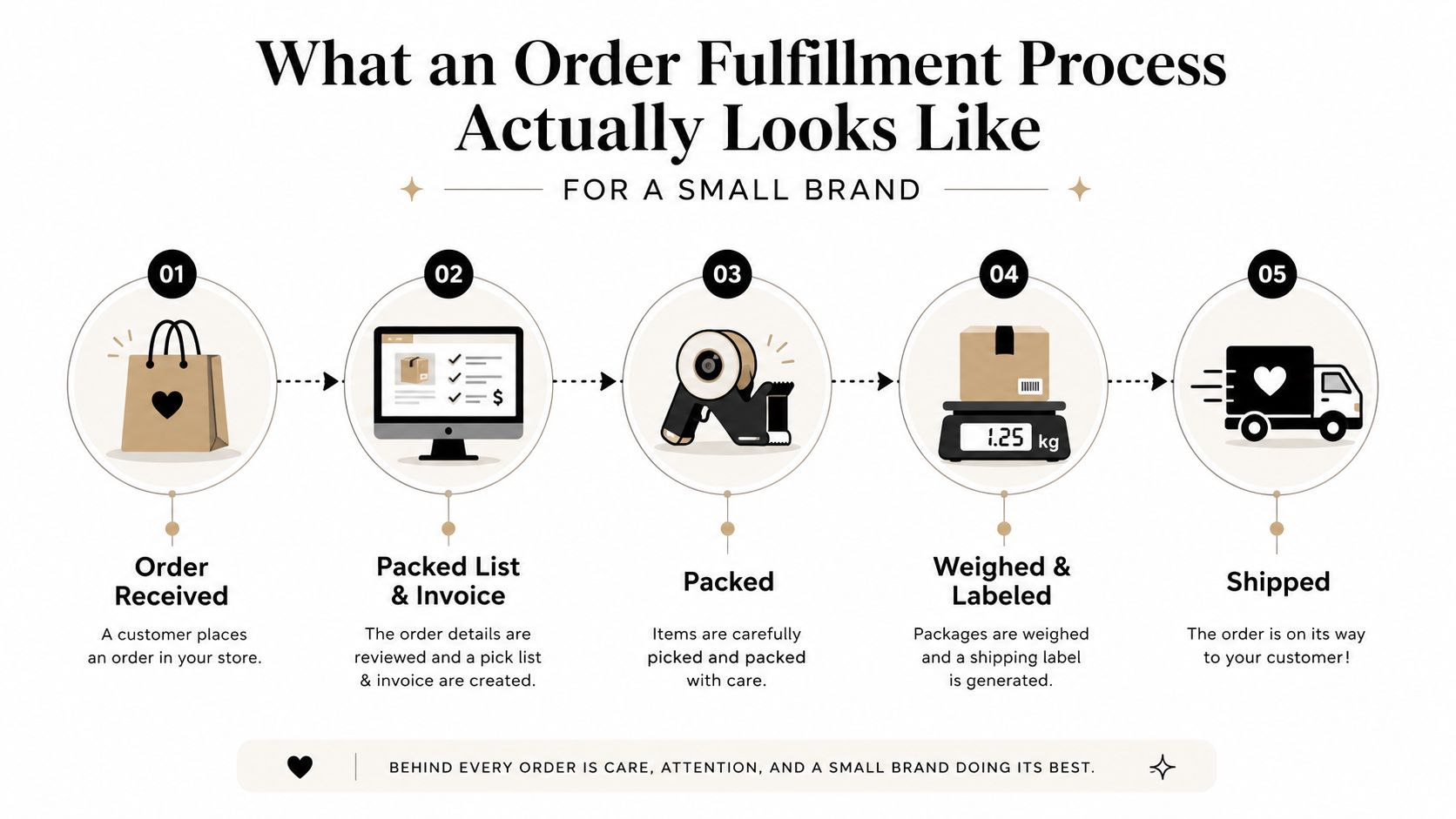
The sequence is simple. An order comes in, the details get captured, inventory gets pulled, the item gets packed and labeled, and the package gets handed off for shipping. That sounds obvious, but the work behind it is a chain of small decisions, and each one can either save time or create a future problem.
The part people underestimate
For a small brand, fulfillment starts before the box does. You're choosing where the item lives, whether the address is usable, whether the payment is safe to capture, and whether the order needs special handling. SAP's process map treats those control points as part of the workflow, not as side notes, and that's the right way to think about it when you're shipping from your own space. If the intake is sloppy, the packing table just inherits the mess. A practical reference for teams handling the digital side of orders is PledgeBox's guide on how to manage backer data and delivery, because the same discipline applies whether you're shipping a campaign reward or a jar of face balm.
Practical rule: If an order can't be understood from a single glance at the ticket, it's not ready to hit your table.
The cleanest way to think about this is in five steps. Receive the order. Confirm the details. Pick the product. Pack it so it survives the trip. Ship it in a way the customer can track. If you want a simple place to organize the selling side of that workflow, Sell on Loyaltie gives local brands a direct path to list products and take orders without building a heavy setup from scratch.
The less you treat fulfillment like a vague back-office chore, the faster you spot where your time goes each week. That's the win, because once you can see the chain, you can tighten the chain.
Capturing Orders the Right Way at Checkout
The fastest way to clean up fulfillment is to stop bad orders before they reach your workspace. Most headaches I've seen didn't start with tape or bubble wrap, they started with missing apartment numbers, unclear delivery notes, or a payment that shouldn't have been released yet. Good checkout design solves more problems than a better packing table ever will.
What an order record needs
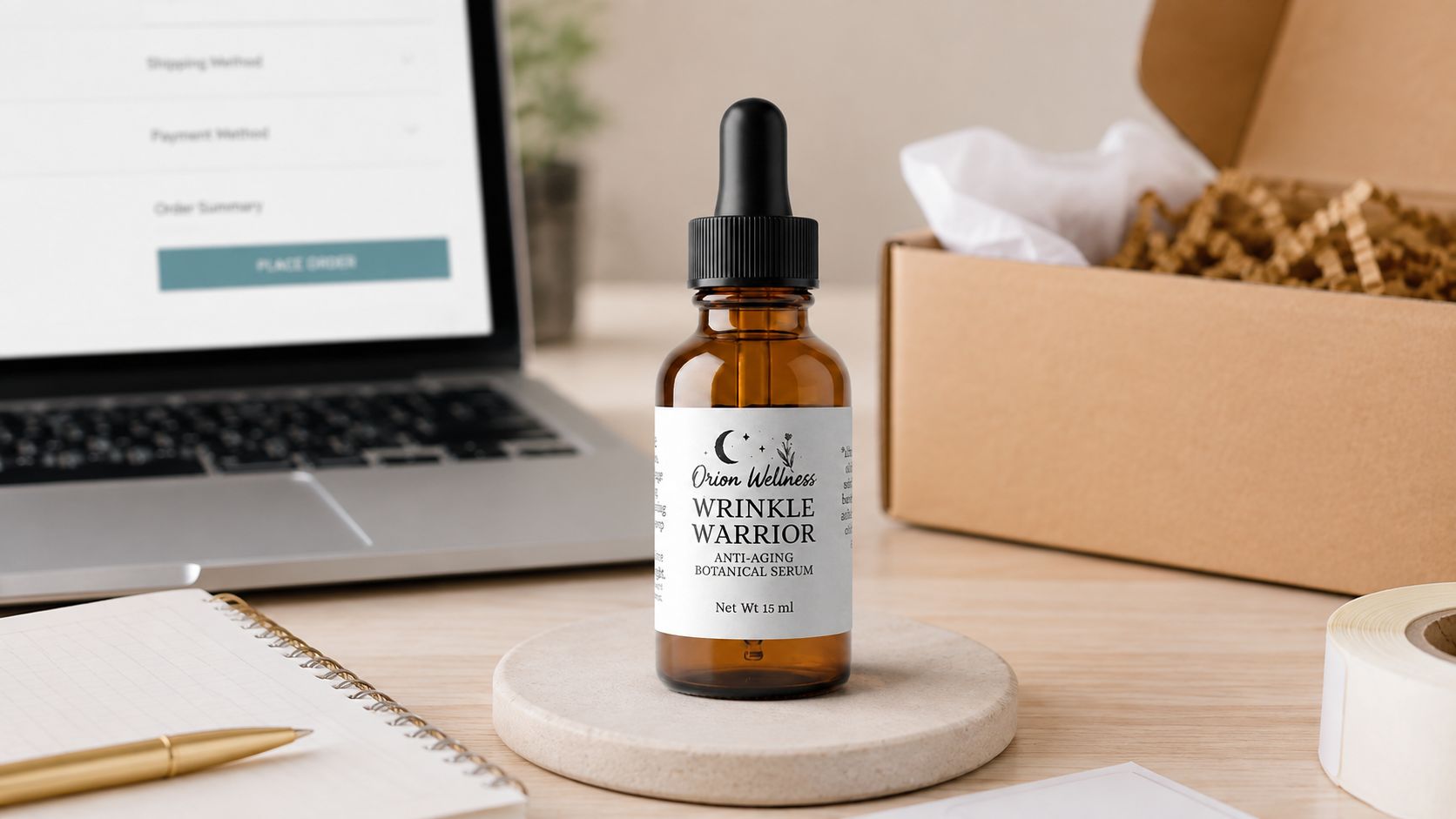
At minimum, every order should carry the shipping address, billing address, payment details, and any special requests. Several fulfillment references treat those fields as the beginning of the process, not the end, because the order isn't really usable until those details are complete. If you sell something like the Firming Facial Oil, Prickly Pear + Rosehip + Bakuchiol, Fine Line Smoothing, Dropper Bottle (Size Listed) | Orion Wellness by Loyaltie, the order record needs to be clear enough that you can pick the right item without second-guessing what the customer meant.
The useful habit is to collect the shipping and billing information before you finalize the payment flow. That gives you one more chance to catch a typo or a mismatched detail before the order becomes a physical task. If the item is fragile, temperature-sensitive, or has a note attached, surface that early so it's visible on the packing slip.
Fraud and first-time orders
You don't need a complicated fraud stack to be careful. SAP's workflow calls out first orders and unusually large baskets as the kinds of signals that should trigger a closer look, and that's a practical rule for smaller sellers too. A one-off high-value basket from a new customer deserves more review than your usual repeat coffee order.
Flag the weird orders early. It's much easier to pause an order before packing than to reverse it after postage is printed.
If you're using a checkout system that captures these fields automatically, your job gets simpler. Loyaltie's checkout flow is built to collect the basic order details without forcing you to hand-build custom forms, which matters when you're working nights and weekends and don't want to babysit every intake. The goal isn't more data, it's better order records and fewer surprises when you reach the table.
Storing and Organizing Inventory You Can Find
Inventory storage is where small brands stay nimble or lose whole afternoons to searching. A shelf that makes sense in your head is useless if you cannot find the right bag, the right soap wrap, or the right supplement jar after a few days of orders. The best setup is the one you can keep using without overthinking it.
Home storage that holds up
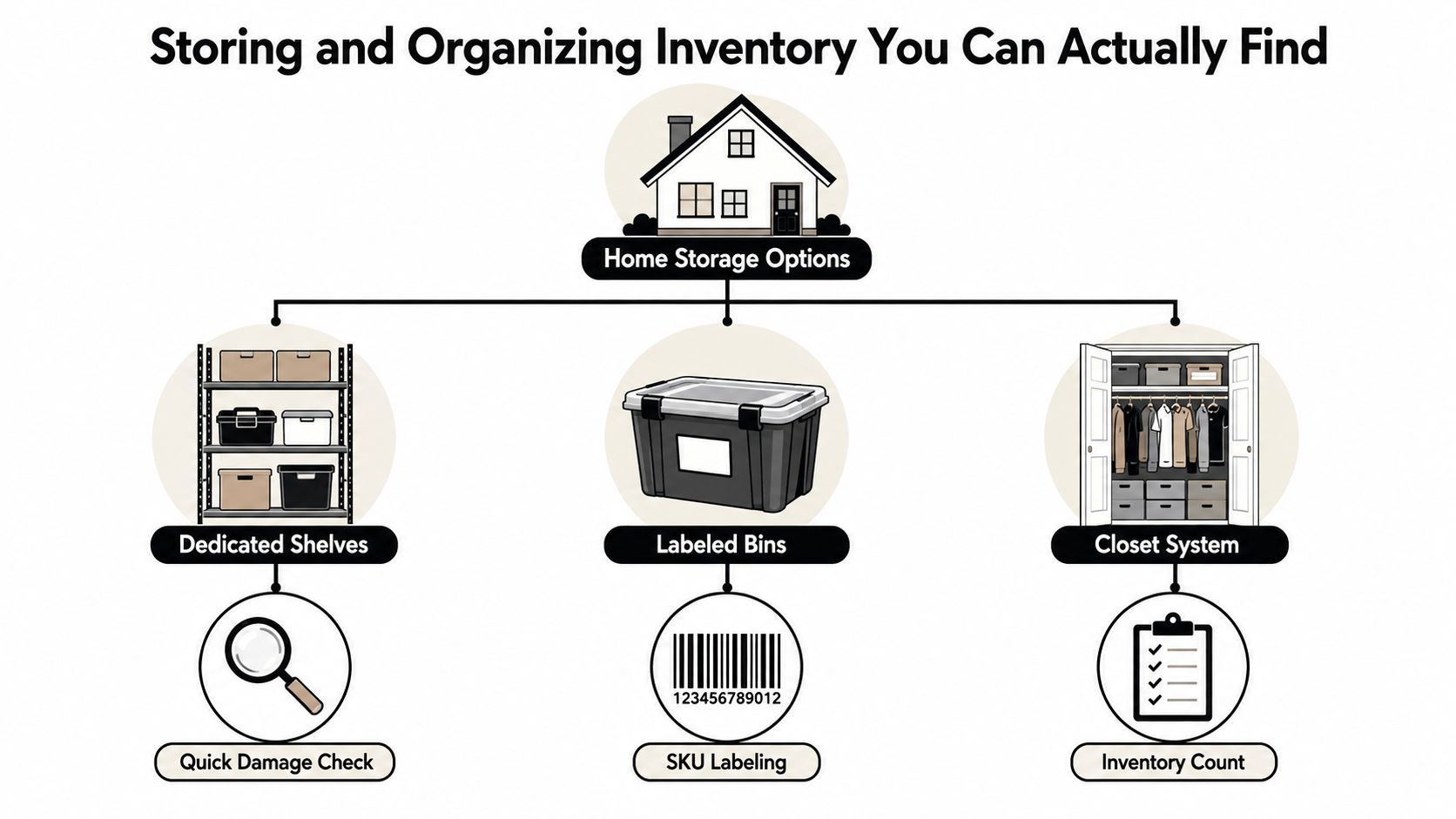
For a maker working out of a home or studio, the basic options are dedicated shelves, labeled bins, and a closet system. Each one can work if inventory lives in the spot the label says it should. That sounds simple because it is, but most oversells and mis-picks start when items get moved “just for now” and never make it back to the right place.
A quick damage check should happen when goods arrive, before put-away. NetSuite's fulfillment guidance puts receiving, quantity checks, and damage checks at the center of the process for a reason. If something arrives dented or leaking, you want to catch it before it gets stored with sellable units and throws off your count.
The storage area should also match the order of your workflow. Put fast-moving items where you can reach them without crossing the room, and keep backups or overflow in a separate, clearly marked spot. That keeps the packing table from turning into a search problem every time a popular item sells out. A handheld label maker with item codes works better than handwritten tags because the labels stay readable when the room gets busy.
When home storage stops being enough
The question is not whether home storage looks professional enough. The question is whether you can still find everything fast enough to ship without hesitation. Once your pack table starts mixing with your family table, or you are storing overflow in too many corners, the process begins to cost more time than it saves.
A small rented shelf or micro-fulfillment partner can make sense when your inventory is still modest but your space is not. A small 3PL starts to matter when you spend more time moving boxes than making and selling. The trade-off is plain. You give up some control, and you gain room and consistency.
If you cannot point to an item and pull it in under a minute, your storage system is already too loose.
Loyaltie's resources for sellers are useful here because the practical advice matters most when it stays realistic for a lean brand. Reconcile your count against orders monthly, then adjust the labels or shelf map after each sales spike so the system stays aligned with what you are shipping.
Picking and Packing Without the Mistakes
Picking is where the day gets expensive if you're not careful. Industry review work says order picking is often the most labor-intensive and costly warehouse activity, and that tracks with small-scale reality too, because every wrong grab creates a second task before the package even leaves the room. The goal isn't speed for its own sake, it's a repeatable routine that makes the right item almost impossible to miss.
Build one packing station, not five
A good small-brand packing station has a clear layout. Put the inventory picks on one side, scales and labels in the middle, and finished parcels on the other. Keep tape, inserts, scissors, and void fill in the same spots every time, because nothing kills flow like hunting for a roll of tape while you're halfway through a coffee order.
Use one confirmation step before anything gets sealed. That can be a barcode scan, a photo check, or a written checklist. A barcoded bag of coffee and a wrapped soap bar may look similar on a crowded table, and one extra check keeps them from swapping places.
Pack for the product, not the box
Fragile, messy, or scent-heavy items need different handling. A soap bar needs to be protected from rubbing and crushing. A bag of fresh coffee needs a seal that holds and a package that doesn't look sloppy when the customer opens it. You don't need fancy materials first, you need packaging that matches the product's real risks.
The best packing rule is the one a helper can follow without asking you three follow-up questions.
That's why a one-page packing checklist works so well. List the item, the count, the insert if there is one, the label, and the final weight check. If a family member or part-time helper can run that list without touching your brain for every order, you've built something usable.
Packing mistakes usually come from overconfidence, not ignorance. The helper thinks the bin is obvious. The maker assumes the label is clear. The fix is to make the station so plain that there's nothing to interpret.
Shipping, Local Delivery, and Pickup Options
Once the parcel is packed, the question becomes how you want it to travel. For independent makers, the choice is rarely about one perfect carrier. It's about matching the package, the customer's location, and your own margin reality without making the process harder than it needs to be.
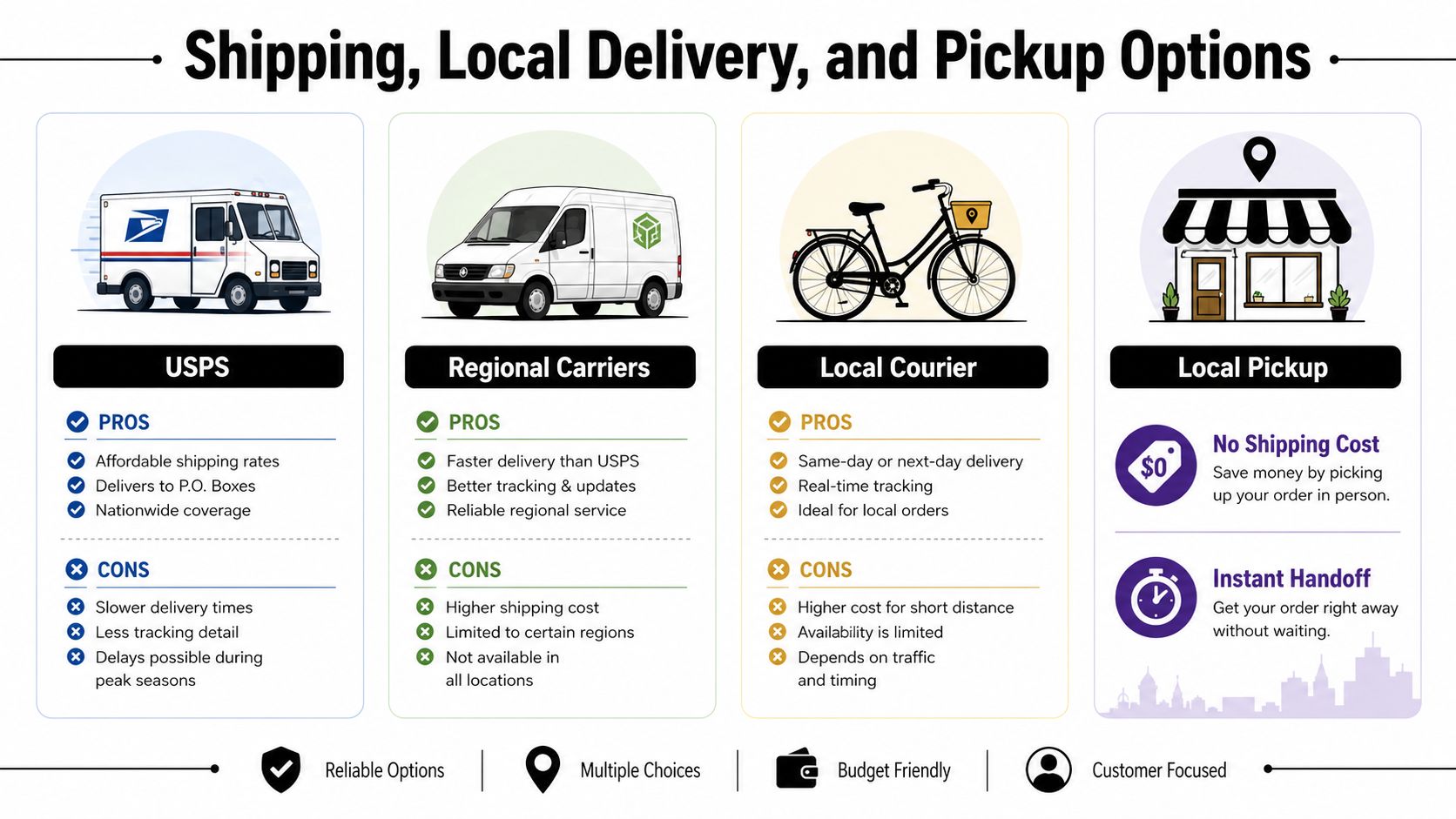
The practical options side by side
USPS is usually the baseline for small parcels because it's familiar and widely accessible. Regional carriers can make sense when your delivery zone is tight and you're trying to balance cost and speed. Local courier services work better when the customer is nearby and wants a direct handoff. Pickup is the cleanest option of all when both of you want zero transit friction.
| Shipping Options for Independent Sellers | Best For | Trade-Off |
|---|---|---|
| USPS | Everyday small parcels | Broad reach, but not always the simplest for local handoff |
| Regional carrier | Repeated shipments within a defined area | Coverage is narrower than national services |
| Local courier | Same-day or near-local delivery | More coordination on your side |
| Local pickup | Nearby customers who want convenience | Requires a clear pickup window and a handoff point |
If you want to improve efficiency on local routes, OnRoute's advice on how to cut fuel costs with routing is a helpful reminder that delivery planning matters as much as the packaging itself. For a small maker making neighborhood drop-offs, route order can save a surprising amount of windshield time.
When split shipments become real
Split shipments usually show up when one item is at home, another is in a local partner location, or one channel is selling faster than the rest. That can be fine, but only if the customer knows what's happening. Don't let a split look like a mistake.
Keep the message simple. One order, one expectation, one tracking path if possible. If you can't keep it to one parcel, explain the parts clearly and keep the timing tight. A customer will tolerate a split order better than a mysterious delay.
Handling Returns and Talking to Customers
Returns don't need to feel like a failure. They're part of the same promise you made when the customer clicked buy, and if you handle them cleanly, they can protect trust instead of damaging it. The goal is a returns process that feels fair, human, and predictable.
Write the policy you can live with
A good returns policy answers three things plainly. What can be returned, how the return gets started, and what happens after the item comes back. If a product can't be resold for hygiene or safety reasons, say so early. If you'll accept unopened coffee or sealed wellness products but not opened ones, keep that boundary obvious.
Don't make the policy longer than your operations can support. A generous policy that creates admin chaos isn't generous for long. The cleaner move is to define a return path you can process the same way every time.
Talk before the problem grows
Pre-shipment communication prevents more trouble than post-shipment apologizing. Send the customer a clear confirmation, the tracking update, and a simple note about what to do if something looks off. If a package is delayed or damaged, reply fast and state the next step instead of burying them in reassurance language.
Post-fulfillment support should be short and useful. If the customer says the soap arrived cracked, ask for a photo and decide whether you're replacing, refunding, or crediting. If the package is late, check the scan history before giving a promise you can't verify.
A good customer message does one job, it reduces uncertainty.
For reorder reminders, keep the tone practical. Coffee, tea, skincare, and supplements are often bought again when people run low, so a plain note that makes reordering easy is more useful than a polished campaign. If the original order went well, the second order should be easier, not louder.
The KPIs Worth Tracking and the Ones to Ignore
You don't need a dashboard full of charts to know whether your fulfillment is healthy. You need a few numbers that tell the truth, and you need them in a format you'll check. The point of tracking is not to look busy, it's to catch drift before it becomes a customer issue.
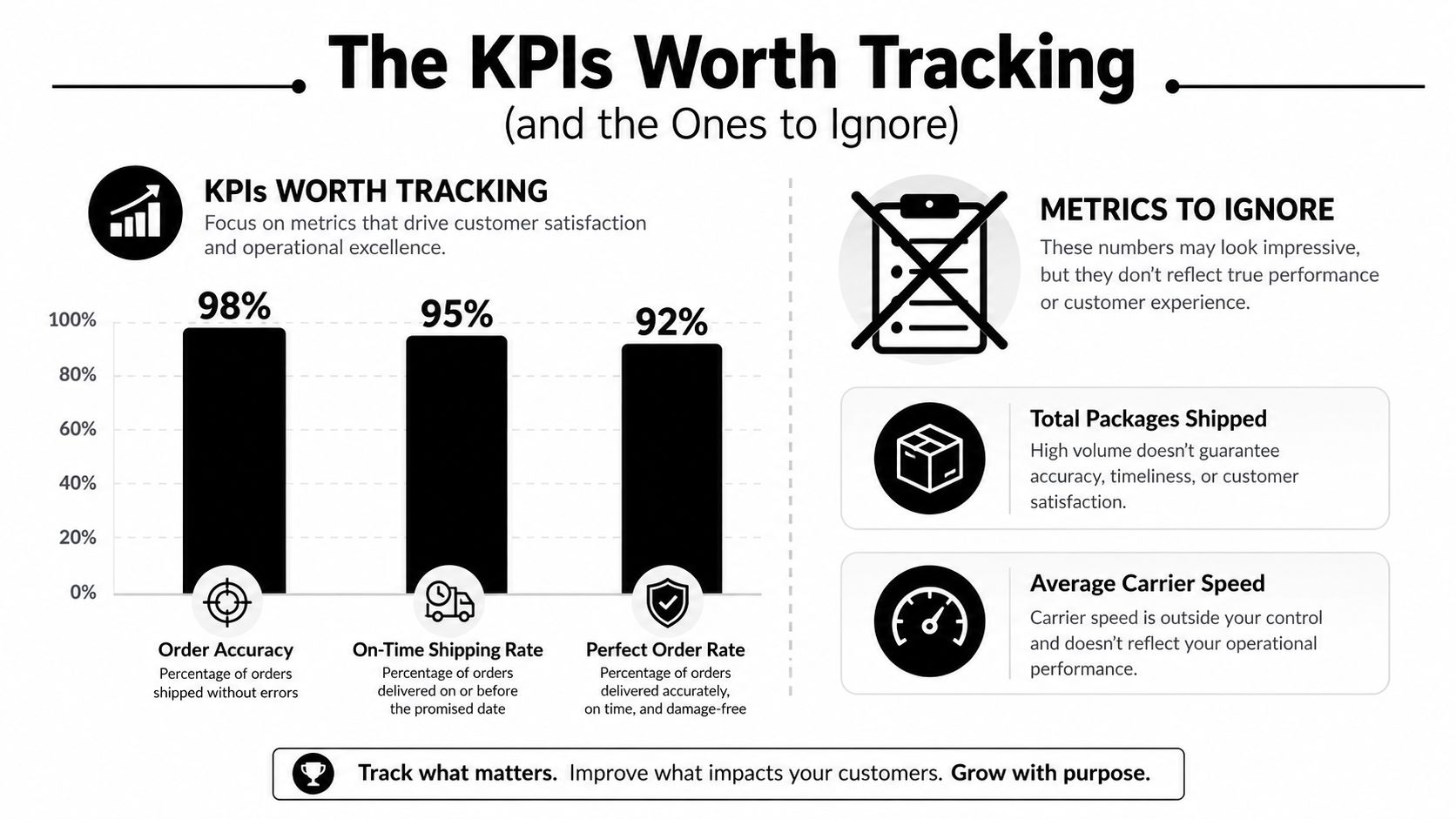
The three numbers that matter most
Order accuracy tells you whether the right item left the table. Industry data reported in 2026 puts average fulfillment center accuracy at 98.7%, while top retailers reach 99.5% worldmetrics.org. That difference matters because a small error rate compounds fast at volume.
On-time shipping rate tells you whether your promised handoff is happening on schedule. It's one of the simplest signals of whether your packing flow, carrier cutoff, and order intake are aligned. If this number slips, the problem is usually somewhere upstream, not in the label printer.
Perfect order rate is the most honest metric of the three because it bundles together completeness, correctness, damage-free delivery, documentation, and timing. SAP's fulfillment map and NetSuite's workflow both point to why that matters, because fulfillment isn't a single event, it's a chain of handoffs. If one link is weak, the order isn't really perfect.
A tiny error rate can still hurt at scale. The data above makes that clear, and it's why many operators watch fulfillment quality as a business function rather than a shipping task. If you sell direct to consumer, every mistake touches repeat purchase behavior, support load, and your own time.
What to ignore at first
Ignore vanity metrics that don't help you make a decision. Total packages shipped sounds important, but it doesn't tell you whether those packages were correct. Average carrier speed can be useful later, but it won't show you whether your process is causing the delay.
If you're starting with a spreadsheet, track date received, date packed, ship date, order status, and whether the order was correct. That's enough to spot where the wheels wobble. You can add more sophistication later, but only after the basics are stable.
A one-page starter checklist
- Choose one storage system that you can label and keep stable.
- Capture full order details at checkout so the packing slip is clean.
- Set a packing station with tape, labels, scales, and inserts in fixed places.
- Pick one shipping flow for most orders, then add local pickup or courier only if it fits.
- Write a short returns policy you can process without improvising.
- Track order accuracy first, then on-time shipping, then perfect order rate.
- Review exceptions weekly so the same mistake doesn't keep repeating.
If you're comparing where to buy from next, Loyaltie is a marketplace where people discover and buy directly from the best independent brands in the US. It's a useful place to see how a strong checkout, clean fulfillment, and direct-to-maker buying can work together for everyday goods.
If you're tightening up your own process, start with the smallest change that removes the most friction, then build from there. Visit Loyaltie to discover independent brands you can buy from directly, and use the same lean, repeatable thinking to make your own fulfillment smoother, faster, and easier to trust.