
You open the package and get exactly what you expected, which is the problem. The coffee smells flat, the skincare label says very little, and the pet treats look like they came from the same factory as every other bag on the shelf. Nothing is technically wrong, but nothing feels made for you either.
Then you remember the candle, spice blend, face oil, or small-batch coffee you noticed from an independent maker a few weeks ago. You remember the cleaner ingredients, the useful product story, or the simple fact that someone seemed to care about the details. That quiet disappointment on the kitchen counter becomes a shopping question: is convenience still convenient if it keeps sending you products you don't really want?
An online marketplace for small businesses can change the answer. Instead of starting with a giant catalog built around speed and sameness, you can shop through a marketplace that helps you find independent brands, compare their products, and buy directly from the maker. The point isn't charity. It's finding better coffee, wellness products, skincare, food, supplements, and pet products from people who have a clear hand in what they sell.
Table of Contents
- Discovery comes before comparison
- Reputation makes uncertainty visible
- Safety and fulfillment reduce friction
The Moment You Realize You Want Better Than the Default
The turning point usually arrives in a small, ordinary moment. You pull a bottle of body wash from a shipping box, twist the cap, and notice the scent is vague, synthetic, and instantly forgettable. Or you open a bag of coffee that promised a rich roast, brew a cup, and get something thin enough to disappear under milk.
You aren't asking for a luxury ritual. You want the product to do what it says. You want coffee with a distinct flavor, skincare with ingredients you can understand, food that tastes fresh, and pet products that don't feel like anonymous filler. You want the packaging to tell you who made the item and why the maker chose those materials, ingredients, or formula.
That desire is more common than the usual “support local” message suggests. In a survey summarized by Marketing Charts, 70% of US adults said perceived product quality was the top reason they shop local, while 69% believed buying local gives them access to more quality products. Those findings point to a buyer-first truth: local shopping often starts with standards, not sentiment.
A better marketplace changes what you encounter before you ever make a buying decision.
A mass catalog gives you endless options, but endless options don't guarantee useful discovery. An independent-brand marketplace can put a thoughtful coffee roaster beside a wellness maker, a regional food producer beside a skincare company, and a local pet-food seller beside a home-fragrance brand. You still need to judge each listing, but you're starting in a neighborhood where quality and identity have a better chance of being visible.
The rest comes down to understanding what a marketplace does, which safeguards matter, and how to inspect a listing before you click Buy.
What an Online Marketplace Actually Is
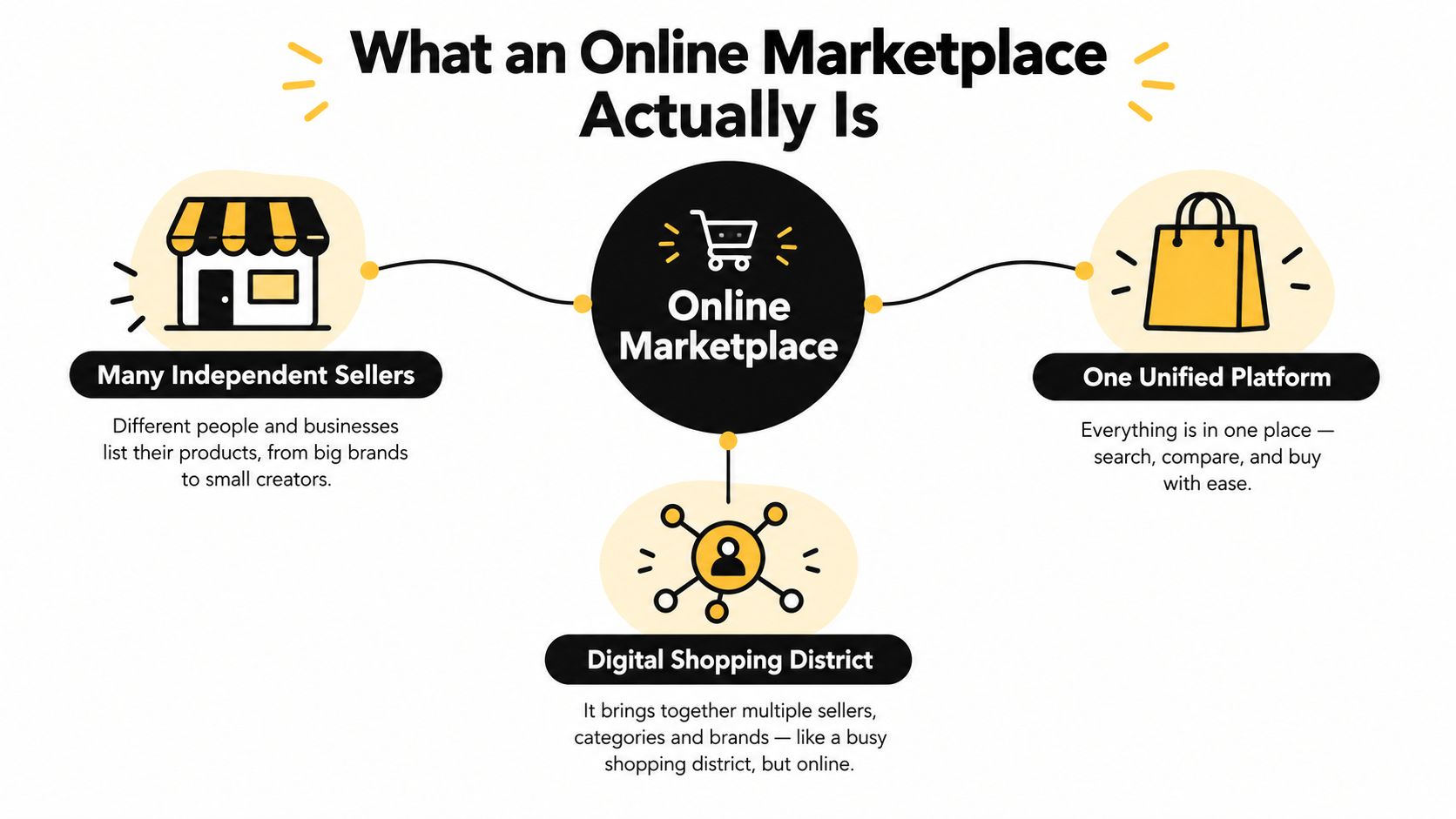
Think of an online marketplace as a digital shopping district. Each independent seller has its own stall, products, and identity, while the marketplace provides the shared street, signs, checkout counters, and basic rules.
The platform usually doesn't make the goods. It provides the storefront, search tools, product pages, payment processing, and systems for handling customer questions or disputes. A single-brand online store, by contrast, represents one company and sends you only through that company's catalog and checkout.
The buyer-facing mechanics
You browse products from multiple sellers, open individual listings, compare ingredients or materials, review shipping terms, and use the platform's payment process to complete an order. Depending on the marketplace, you may buy from several sellers in one session, though fulfillment and returns can still follow each seller's policies.
That shared structure matters because good interface design reduces confusion. If you're evaluating a marketplace storefront or improving your own shopping experience, Silva Marketing's ecommerce website redesign playbook offers useful context on making online buying journeys clearer.
You'll generally encounter three marketplace types:
- Mass marketplaces: Broad catalogs, many sellers, and strong emphasis on selection, price, and speed.
- Niche or curated marketplaces: A defined category or editorial point of view, often with tighter product standards.
- Local-focused marketplaces: A place to discover and buy directly from independent brands, makers, growers, and producers in a region or across the US.
For shoppers looking for better everyday alternatives, the third model deserves close attention. It can combine online convenience with the context that disappears in a giant catalog, including where a product comes from, who made it, and what makes it different.
You can explore that kind of buying environment through Loyaltie, which connects shoppers with independent brands and local producers through online discovery and direct purchasing.
How Marketplaces Quietly Do the Hard Work
A useful marketplace isn't just a collection of product pages. It handles several jobs that would be tiring, risky, or nearly impossible if you had to investigate every seller alone.
Discovery comes before comparison
Search, category filters, and curated collections help you find products you wouldn't think to search for directly. You might start with “coffee” and discover a regional roaster, or search for pet treats and find a maker whose ingredient list better matches what you want.
This is the first major buyer benefit: the platform expands your shortlist without forcing you to know the right brand name in advance. Research on peer-to-peer market design describes efficient discovery and matching as central mechanisms that help smaller suppliers compete with established providers through academic research on peer-to-peer platforms.
Reputation makes uncertainty visible
Ratings help, but useful reputation signals go further. Look for written reviews, buyer photos, verified-purchase markers, seller response history, and repeated comments about the same product detail. A review that describes fragrance strength, coffee flavor, fit, packaging, or freshness tells you much more than a star count alone.
A marketplace can also make seller identity and policies easier to find. That matters because you shouldn't have to guess whether the person behind a listing will answer a question or handle a damaged order.
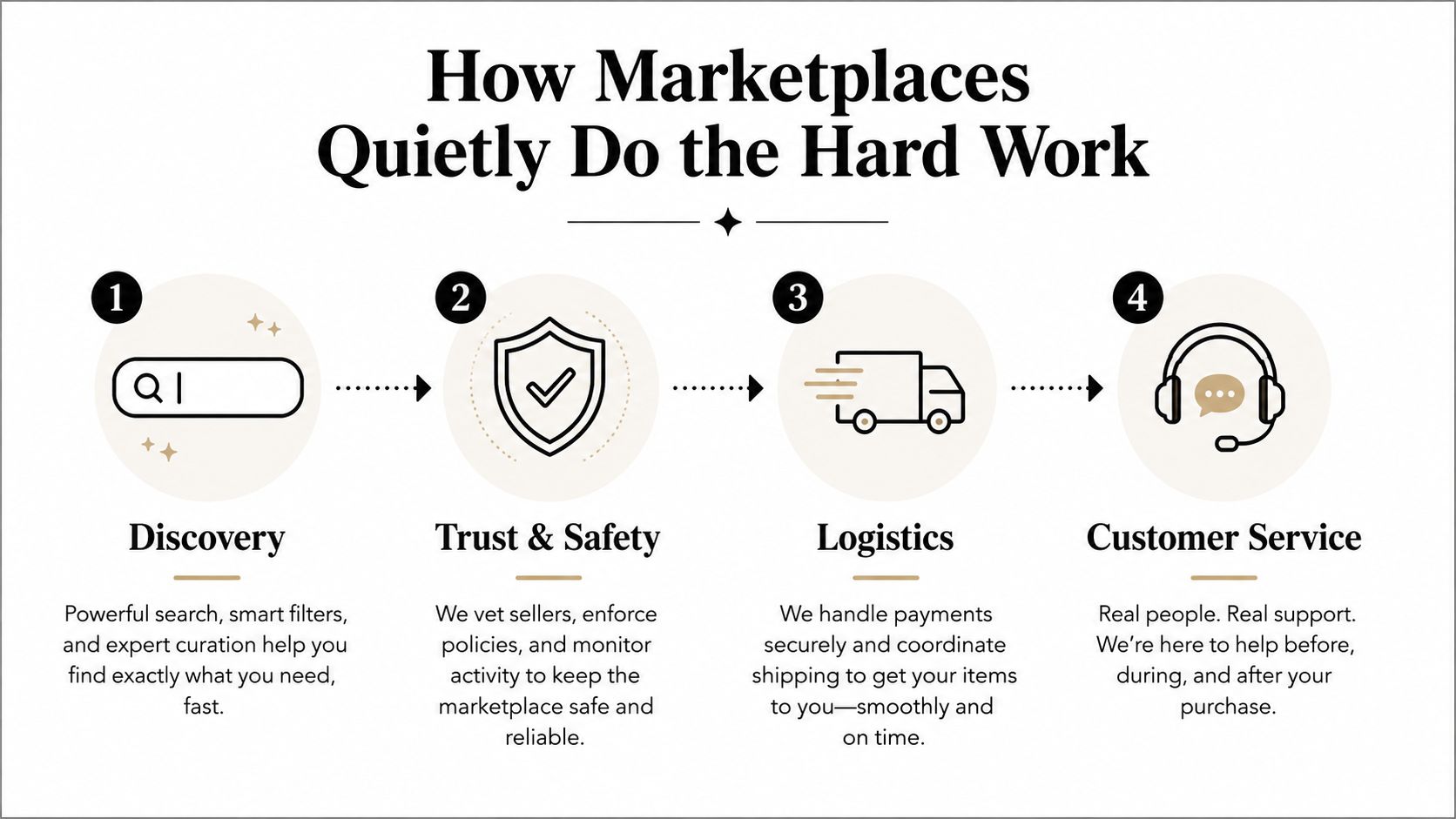
Safety and fulfillment reduce friction
Encrypted checkout, stored payment credentials, clear order records, and dispute resolution give you a path forward when something goes wrong. If an item never arrives or shows up damaged, the platform's policies should tell you who to contact and what evidence to provide.
Fulfillment may include shipping coordination, tracking, and order updates. Some marketplaces can also consolidate parts of the shopping journey, which can make multi-seller buying easier to manage. Before treating growth tactics as the whole answer, sellers and platform operators can use this AOV and scaling tactics guide to understand why operational clarity affects the customer experience.
The best result is invisible. You find a product, understand the listing, trust the transaction, and know what happens next without having to chase anyone.
You can also review the seller tools and marketplace guidance at Loyaltie's seller resources if you want to understand how independent brands present and manage their products online.
Why Local-Focused Marketplaces Are a Quality Upgrade
You open a product page because you need something ordinary, then notice details the default marketplace never gives you. The maker explains the materials, the scent has a clear character, and the listing makes it easier to judge whether the item belongs in your home.
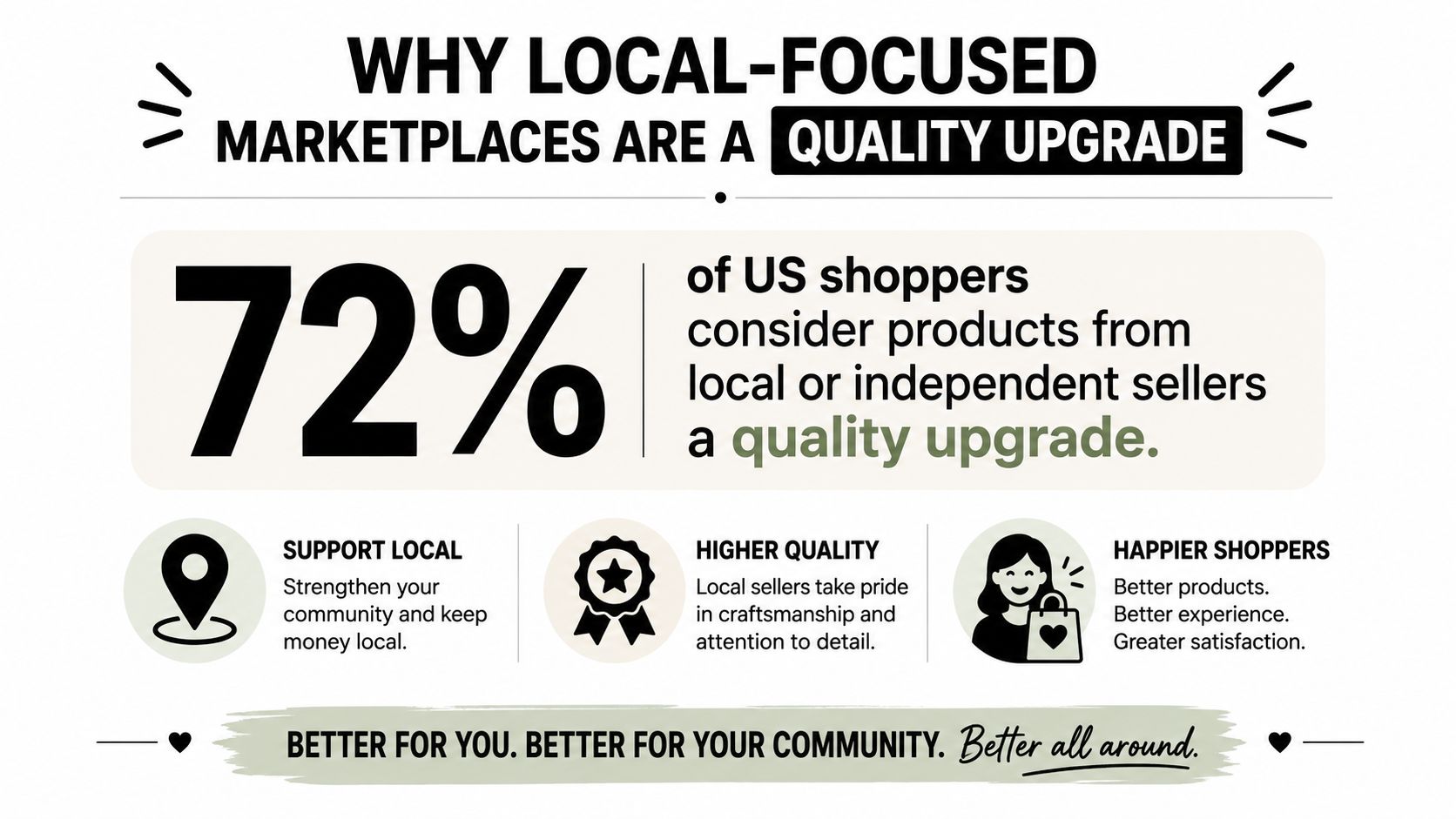
Buying from an independent brand should feel like a better way to shop for things you already need. A verified survey data from Marketing Charts summary found that 72% of US shoppers considered products from local or independent sellers higher quality than comparable products from large national brands. That view follows a practical difference: the seller often controls more of the product experience, including materials, ingredients, packaging, batch choices, and communication.
The details are easier to judge
A local-focused marketplace can give you useful context before you pay. Instead of a bare listing built around generic specifications, you may see the maker's name, location, production process, ingredient choices, or material notes.
That information changes the buying decision. A food producer can explain what makes a batch distinct. A skincare maker can identify the formula. A pet-product seller can provide a clearer ingredient list. A home-fragrance maker can describe how a scent feels in a room rather than hiding behind a broad label.
Consider the Scented Candle Travel Tin, Leather & Smoke, Amyris Musk Moss Notes, Coconut Blend Wax, 6 oz Gift Tin | Present Day Goods by Loyaltie. Its listing describes a cozy leather-and-smoke atmosphere, coconut wax, and notes of leather, smoke, amyris, musk, and moss. Those sensory and material details help you decide whether the candle suits your space before it arrives.
Human contact adds accountability
Independent sellers are often closer to the product and better placed to answer a specific question. You can ask about sourcing, intended use, sizing, ingredients, or scent before ordering. A clear answer also gives you evidence about how carefully the brand handles its products.
No independent seller is perfect. Judge the listing by its transparency, then test the experience with one item you use often. Read the description closely, ask one useful question if needed, and see whether the product feels more considered than your usual replacement. That buyer-first check is what turns a marketplace from a large catalog into a quality upgrade.
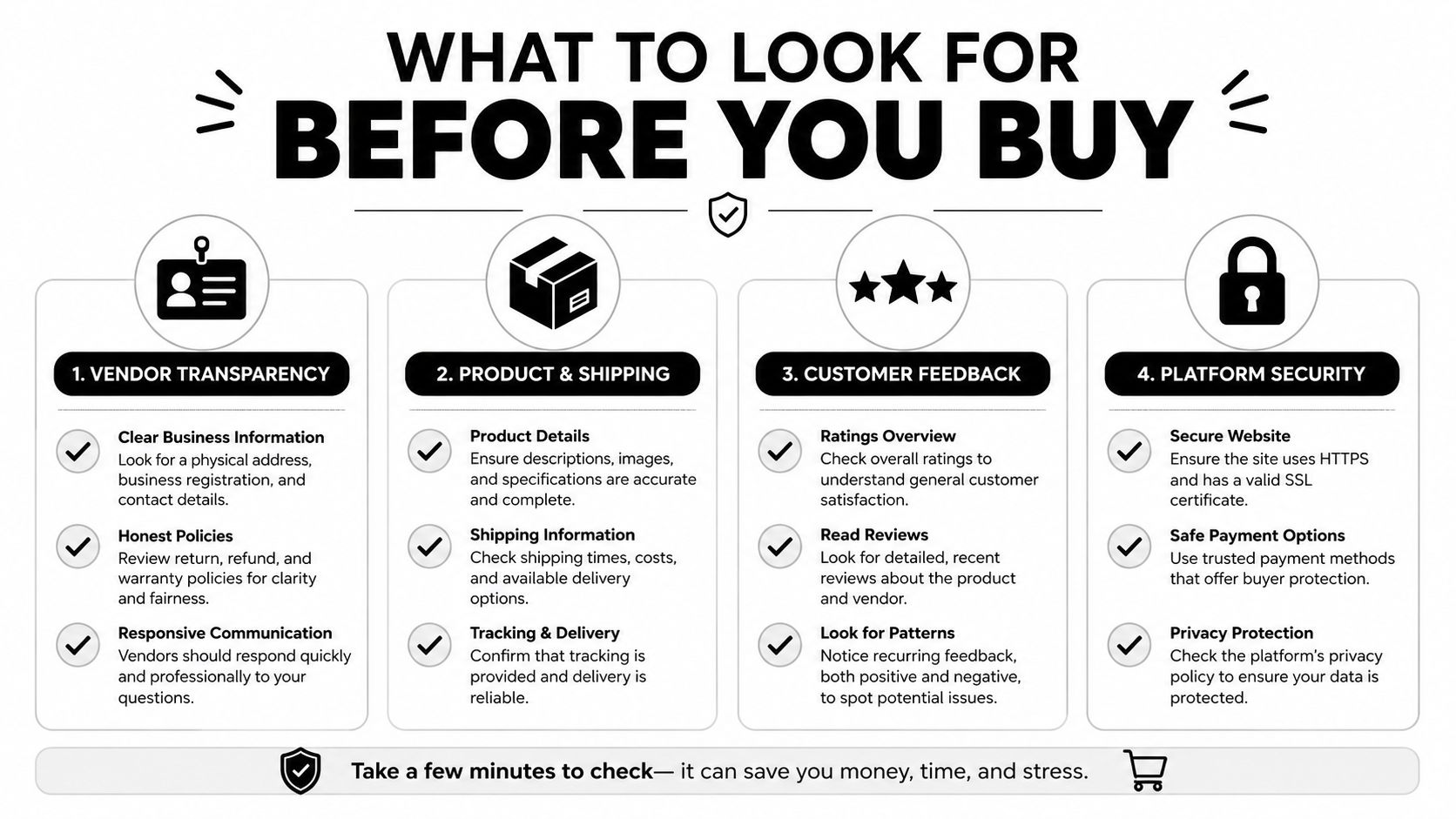
What to Look for Before You Buy
A good listing should answer your first questions quickly. If it makes you work to discover who sells the product, what it contains, how it ships, or what happens after payment, treat that friction as information.
Start with the seller
Ask yourself:
- Who made this: Can you see a real business name, location, maker profile, or useful story?
- Are the images believable: Do the photos show the actual product from several angles, rather than only polished generic scenes?
- Can I reach someone: Is there a clear way to ask a pre-purchase question and see whether the seller responds?
The seller doesn't need to write a biography. You do need enough detail to know whether you're buying directly from a real independent brand or from an unclear intermediary.
Read the product page like a skeptic
For food, supplements, skincare, and pet products, check the ingredients and any relevant usage information. For clothing, accessories, and home goods, look for dimensions, materials, care instructions, and country of origin where provided.
Then ask:
- What exactly am I receiving: Does the listing state size, quantity, materials, ingredients, and variations clearly?
- When will it ship: Does it provide a realistic shipping window rather than a vague promise?
- Can I return it: Are return, exchange, and damaged-item policies easy to find?
Don't fill gaps with assumptions. If a listing doesn't explain a material, ingredient, or delivery term, message the seller or choose another product.
Separate useful feedback from noise
A high rating can still hide a poor fit. Look for reviews that describe the actual experience, especially buyer photos and comments about scent, taste, texture, durability, sizing, packaging, or communication.
Check for signs that buyers return to the same shop, and notice whether the seller responds to concerns with specific answers. If you're researching the operational side of selling, a practical small business POS buying guide can also clarify how payment systems fit into a seller's broader customer experience.
Finally, ask what happens if the order never arrives. Secure checkout, clear platform policies, tracking, and a dispute process should be visible before you pay. A marketplace earns trust by making the safety net easy to understand, not by burying it in fine print.
Mass Marketplaces Versus Local-Focused Marketplaces
Both marketplace types have a place in your routine. The mistake is using the same decision rule for every purchase.
| Criterion | Mass Marketplace | Local-Focused Marketplace |
|---|---|---|
| Product curation | Broad selection, with more work left to you | Tighter context or curation, with fewer irrelevant listings |
| Seller transparency | Varies widely across third-party sellers | More emphasis on maker identity, location, and product story |
| Price | Often strong for standardized goods and commodity restocks | May reflect smaller batches, direct production, and more specific materials |
| Shipping speed | Usually the stronger choice when speed dominates | Shipping may vary by maker and product |
| After-sale accountability | Platform processes can be convenient, but seller contact may feel distant | Direct communication can make questions and problem-solving more personal |
The mass-market route works well for a replacement charger, household staple, or other item where you already know the exact product and care mainly about price and delivery speed. The trade-off is that broad availability can make it harder to judge who made the item or whether similar listings come from different sources.
A local-focused marketplace works better when the product itself matters. Gifts, food, coffee, skincare, wellness goods, pet products, and home items all benefit from clearer origin information and stronger product context. You may give up some delivery predictability, but you gain a better chance of understanding what you're buying and who stands behind it.
US shoppers already use direct channels for food at meaningful scale. The USDA's 2022 Census of Agriculture recorded $17.5 billion in food sales through direct marketing channels, while sales through direct-to-retail, institution, and intermediate-market channels rose 33.2% from 2017 to 2022. The USDA analysis shows why direct buying isn't a side route reserved for occasional gifts.
Rule of thumb: use mass marketplaces for commodity restocks where speed and price dominate. Use local-focused marketplaces for gifts, upgrades, and anything you want to enjoy for longer than the delivery window.
Smarter Shopping on Independent Brand Marketplaces
The best habit is simple: slow down for the few seconds that reveal whether a listing deserves your money. Filter by seller location when that information is available, and read origin claims carefully. “Local” should mean something you can understand, not a decorative word in a product title.
Read reviews for substance rather than scanning only the star average. Look for repeated details about flavor, ingredients, scent, durability, fit, packaging, and delivery. If buyers mention the same strength or problem several times, take that pattern seriously.
Before checkout, compare shipping windows and return terms. A product can be exactly what you want and still be a poor choice if the delivery timing or return process doesn't fit your needs. For food, skincare, supplements, and pet products, make the ingredient panel part of your buying decision instead of treating it as optional homework.
Build a useful personal shelf
Save promising shops for repeat visits. Sign up for new-arrival alerts from makers whose standards match yours, and keep a short list of products you'd reorder. Regular delivery or a buy-on-a-plan option can be useful for dependable essentials, but only after the first purchase proves the product works for you.
That approach is more intentional than chasing the cheapest listing. You're verifying claims, rewarding clear communication, and choosing independent brands that make products with standards you recognize. A marketplace can make those choices easier, but you still bring the judgment.
Food buyers have already shown that direct channels can support substantial commerce. The USDA's Local Food Marketing Practices Survey found 167,009 operations used direct marketing in 2015, with sales totaling $8.7 billion, including $172 million in online marketplace sales across 9,460 operations in the USDA local food survey. You don't need to change every purchase at once. Pick one category, apply the checklist, and make one considered order this week.
Browse Loyaltie's marketplace shop with the seller and product questions in mind. The goal isn't to reject convenience. It's to make convenience lead you toward products you'll be glad to use.
Loyaltie is a marketplace where people discover and buy directly from independent brands across the US, including makers and producers offering food, wellness, beauty, home, and everyday products. Visit Loyaltie this week, browse with the checklist, and choose one better alternative to your usual default.