
You're probably here because you caught that smell. Wood smoke hanging in the air near a roadside cinderblock building. Pork cooking somewhere out back. Maybe a hand-painted sign that just says BBQ, and a parking lot full of pickups at lunch. You want to know if it's worth stopping, and, beyond that, how to tell if you've found authentic barbecue.
North Carolina barbecue rewards curiosity. It's one of those foods that seems simple until someone from the state starts explaining why the sauce is thinner here, why one town swears by whole hog, and why another will gently correct you if you call their style “western” instead of Piedmont. Eat it once without context and it's delicious. Eat it with the story and suddenly every chopped tray, sandwich, and hushpuppy means a little more.
Table of Contents
- Eastern style on the plate
- Lexington style and the Piedmont story
- Eastern vs. Lexington Style Barbecue at a Glance
That Smell That Can Only Be North Carolina Barbecue
The first clue usually hits before you see the building. You're driving with the windows cracked, and the air changes. Not campfire. Not burgers. It's deeper and sweeter, with that slightly sharp edge of vinegar waiting somewhere in the background. In North Carolina, that smell tells you somebody's been tending a pit for hours, maybe since before sunrise.
That's part of why people get a little reverent about North Carolina barbecue. It isn't just smoked meat. It's a state identity with strong opinions attached. One family wants finely chopped whole hog dressed with vinegar and pepper. Another wants shoulder with a dip that carries a touch of tomato. Both will tell you theirs is the honest expression of home.

The smell tells you about the fire
If you've ever tried cooking barbecue at home, you know the wood matters as much as the meat. North Carolina's old pit tradition is tied to hardwood coals, and if you want a practical primer on flavor differences, Van Dyke Outdoors' smoking wood picks are useful for understanding why one smoke smells clean and mellow while another turns heavier and sweeter.
What makes this food fun is that you don't have to memorize everything before you eat. You just need to know that the argument you've heard about Eastern versus Lexington is real, but it's also only the front porch of the story. The deeper history lives in church fundraisers, roadside joints, county loyalties, and the kind of places where the menu doesn't need explaining because everybody in line already knows what they came for.
North Carolina barbecue isn't background food. People build outings around it.
More Than Smoke The Soul of NC Barbecue
Show up early at a church fundraiser in eastern North Carolina and you can read the whole day before you ever reach the serving line. Smoke hangs in your jacket. Someone is tending coals with the patience of a gardener. A few volunteers are chopping pork on scarred wooden blocks, and by noon the room is full of people who know one another by name. That setting gets closer to the heart of North Carolina barbecue than any trendy menu ever will.
Where barbecue lived before it lived in restaurants
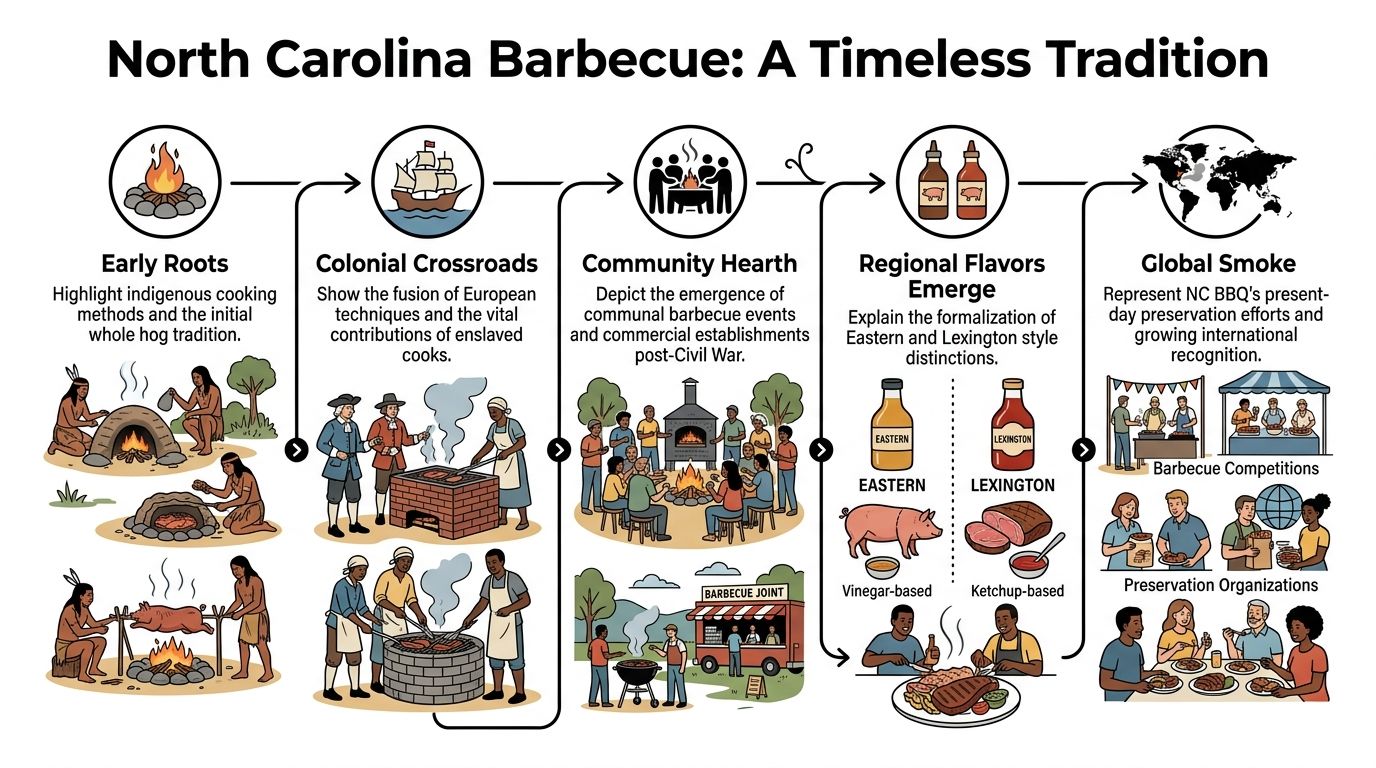
The Southern Foodways Alliance's North Carolina BBQ history traces barbecue in the state to special occasions such as harvests, fundraisers, and political rallies. That history matters because it explains why barbecue here still feels communal. It was built for crowds first, business second.
You can still feel that old rhythm in the right places. A tray hits the table, and nobody treats it like precious food that needs a speech. Hands reach for hushpuppies. Somebody asks for more slaw. Somebody else starts an argument about whose chopped pork is finer, whose dip is sharper, whose uncle still cooks a pig the proper way.
That shared habit is part of why North Carolina barbecue resists easy labels. Visitors often arrive expecting one neat state style, then find county loyalties, family methods, and a Piedmont tradition that adds its own texture to the story. The famous East versus West argument is real, but it is only the loudest chapter.
If you cook at home, that regional nuance gets even easier to taste. A thick, sweet sauce can bury the details that pit cooks work hard to preserve, which is why a date-sweetened smoky BBQ sauce made as a thick dip, glaze, or marinade makes more sense here than anything syrupy and heavy. It lets the pork stay in the lead.
Why people defend their style so fiercely
People across the state defend barbecue with the intensity usually reserved for family history because, in many towns, that is exactly what it is. Recipes travel through reunions, volunteer fire department dinners, courthouse squares, and Saturday road trips. A plate of chopped pork can carry memories of grandparents, campaign stops, tobacco barns, and high school fundraisers all at once.
That long memory gives the food its weight. Barbecue in North Carolina is tied to pork, to pit craft, and to local identity in a way that goes far beyond restaurant preference. Ask three longtime locals where to stop between Goldsboro, Lexington, and a small Piedmont town off the highway, and you may get three different answers. Ask why, and you will get stories.
A few places where that feeling shows up:
- At a fundraiser: barbecue feeds a crowd and still feels ceremonial.
- At a political stop: it gives everybody a familiar plate to gather around.
- At a family reunion: the meal turns into a debate about region, technique, and who still does it right.
Practical rule: If a place treats barbecue like a generic sauce flavor, you're probably not standing in the strongest North Carolina tradition.
The Great Divide Eastern vs Lexington Style
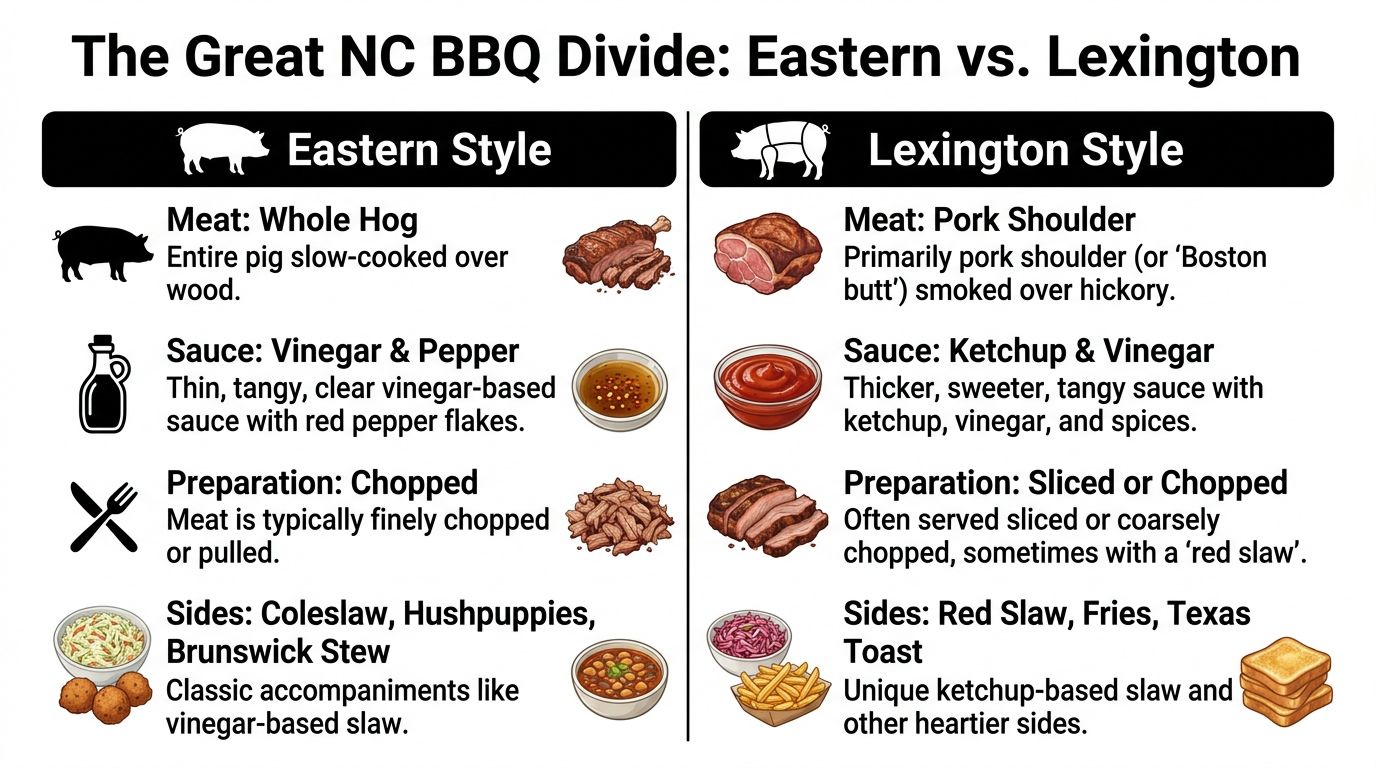
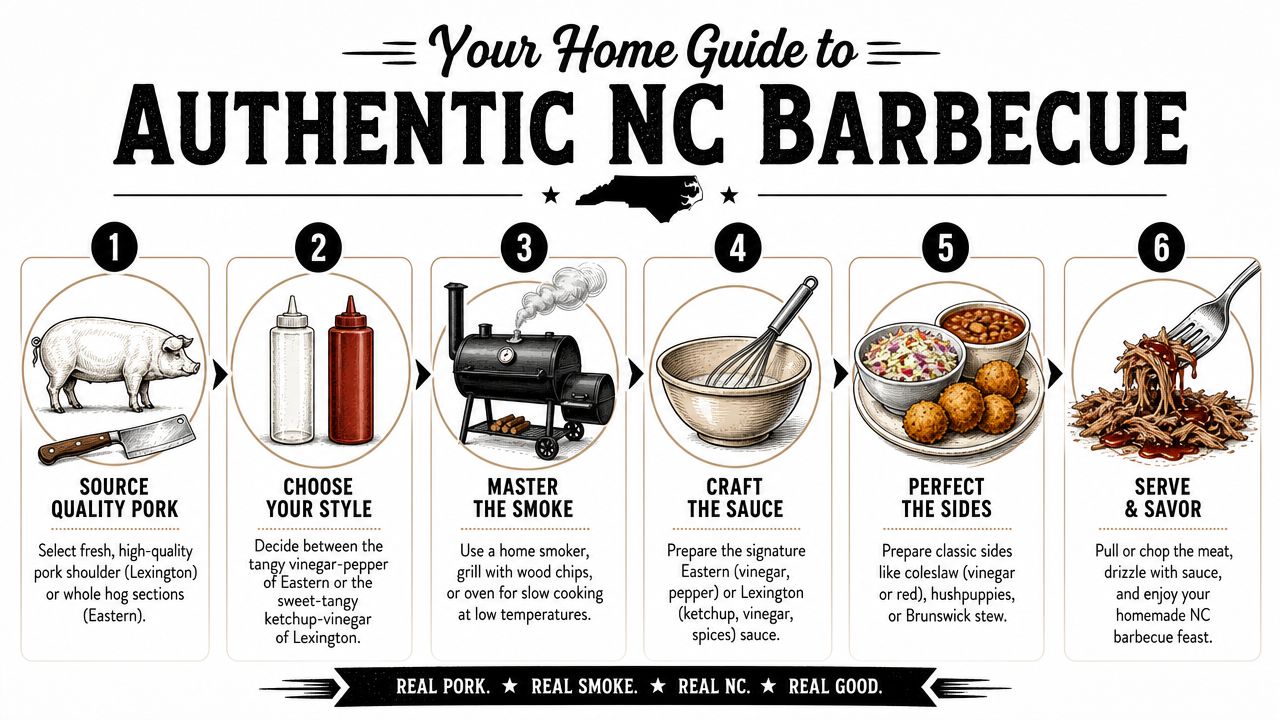
Pull into a church fundraiser in Duplin County and the chopped pork on your tray will likely taste bright, peppery, and whole-hog rich. Stop in Lexington, and the pork usually comes from shoulder, with a dip that still carries vinegar but rounds out with tomato. Both plates are unmistakably North Carolina. They just tell different local stories.
Eastern style on the plate
Eastern-style barbecue is the old coastal standard. The classic version uses whole hog, though some pits work with shoulder, and dresses the meat with a thin vinegar-and-pepper sauce. The sauce is there to sharpen the pork, not bury it.
That whole-hog tradition matters because the finished barbecue carries a little of everything. Richer bits, leaner bits, outside bark, and tender interior meat all get chopped together. A good plate has contrast in every bite. You taste smoke, salt, fat, vinegar, and pepper in quick succession.
Lexington style and the Piedmont story
Lexington-style barbecue centers on pork shoulder. The dip still starts with vinegar, but tomato gives it a darker color and a slightly fuller flavor. Pair that with the region's famous red slaw and you get a plate that feels distinct right away.
The usual East-versus-West map also leaves out an important detail. A lot of locals and pit historians use Piedmont as the more useful label, because this tradition belongs to a broader central North Carolina barbecue belt, not just one city or a simple western catchall. That matters if you want to eat beyond the tourist version of the debate. The complete story is regional, layered, and tied to towns, families, and pit habits across the middle of the state.
A simple way to read the split:
- Eastern centers the whole animal and a clean vinegar-pepper bite.
- Lexington or Piedmont centers shoulder and a vinegar-tomato dip.
- Both stay rooted in pork, smoke, and chopping traditions that define North Carolina barbecue.
If you're cooking at home and want a thicker bottle for grilled foods, this date-sweetened BBQ sauce for grilling and glazing can fill that pantry role. Traditional North Carolina sauce, especially in the East, is still much thinner and more vinegar-led.
A visual comparison helps when you're trying to sort it all out:
The shared standard is easy to miss if you focus only on sauce color. North Carolina barbecue, across regions, is still judged by the pork first. The meat should come apart readily, hold moisture, and carry smoke without turning mushy or stringy.
Eastern vs. Lexington Style Barbecue at a Glance
| Feature | Eastern Style | Lexington (Western/Piedmont) Style |
|---|---|---|
| Meat | Whole hog is the defining idea | Pork shoulder is the defining cut |
| Sauce | Thin vinegar and pepper | Vinegar base with tomato |
| Texture | Chopped or pulled, often mixed from different parts | Chopped or sliced shoulder |
| Flavor impression | Tangy, direct, bright | Tangy with a rounder, deeper edge |
| Slaw pairing | Often a simpler slaw profile | Often associated with red slaw |
How to Spot the Real Deal
You don't need to stand by the pit and interview the cook. Real North Carolina barbecue leaves clues all over the place. Some are on the plate. Some are in the air before you open the door.
Start with your nose and your eyes
The biggest giveaway is the smell. Good smoke smells like wood and meat, not chemical starter or a blast of sweet bottled sauce burning on hot steel. North Carolina barbecue is defined by a low-and-slow smoke cook of pork over hardwood or hardwood coals, usually for upward of 8 hours, with the meat taken to about 190°F internal before shredding, according to the James Beard Foundation's North Carolina pulled pork recipe. That same recipe gives a pit range of about 300°F to 325°F.
You can't always see the pit, but you can often spot the signs.
- Look for a woodpile or coal setup: Even a modest one tells you the fire matters.
- Check the menu language: “Chopped pork” and “shoulder” mean more here than generic “pulled pork.”
- Notice the sauce bottles: Thin, splashy sauce is a good sign in North Carolina.
Good barbecue rarely announces itself with flashy décor. It usually smells ready before it looks ready.
Read the texture, not just the menu
Once the tray arrives, ignore the hype and read the meat. Properly cooked pork should relax when you pull at it with a fork. It shouldn't be stringy, dry, or glued together with sauce. Fat and connective tissue should have melted down enough to give the pork moisture without making it greasy.
The texture test matters more than a clever menu description. If the meat seems rushed, no regional label can save it.
A few signs help when you're shopping for your own supplies too:
- Seasoning should support the pork. If you want a pantry shortcut for home cooks, this smoky paprika garlic pepper dry rub fits the idea of a balanced barbecue seasoning better than anything that tastes like straight sugar.
- Sauce should come after the cook, not hide it. In North Carolina, the chopped meat and finishing sauce work together.
- Texture beats smoke ring talk. A pretty slice means less here than pork that eats tender and loose.
Your Field Guide to Finding Great Barbecue
You pull into a small town at 11:15, planning to “just look around” before lunch, and a man at the gas station points you past the highway strip to a cinder-block building with two rocking chairs out front. By noon, the parking lot is full of work trucks, church clothes, and one family arguing good-naturedly about whether to order sandwiches or trays. That is how a lot of great North Carolina barbecue meals begin. Not with a billboard, but with a tip.
A trail map helps. The better move is using it as a starting point, then paying attention to the habits of the town around you. In North Carolina, barbecue is broad enough, local enough, and old enough that the famous stop is only one possible answer. The place a county loves may sit a few miles off your route, serving chopped pork from a menu board that has barely changed in years.
That changes the hunt. Stop chasing the most photographed plate online. Start looking for places that still feel tied to the people who eat there every week.
What locals notice before they order
A first-time visitor often reads the sign. A local reads the room.
They notice whether the counter staff asks, “slaw on it?” as if there is only one sensible answer. They listen for regional language. One town says Lexington. Another says Piedmont. That difference matters because it points to a living tradition, not a museum label. The closer you listen, the more North Carolina barbecue opens up beyond the simple East versus West argument.
Here are a few clues that help on the road:
| What you notice | What it can tell you |
|---|---|
| A lunch crowd heavy with locals | The place has earned regular trust |
| A short menu with pork, chicken, slaw, hushpuppies, and little else | The kitchen is focused on barbecue, not covering every craving |
| Staff asking chopped, coarse chopped, or sliced | Texture and house style matter here |
| Red slaw listed without explanation | You are likely in Lexington or Piedmont country |
| Bottles of thin sauce on the table, plus maybe a hotter house option | The pork comes first, and the sauce is there to sharpen it |
One smart way to learn the state is to compare styles on purpose. Get whole-hog barbecue in the east, then try a shoulder-focused tray farther west. If a pit stop offers a house sauce with a little more smoke and heat, a bottle like smoky habanero hot sauce with aged cayenne, ancho, and hickory smoke fits naturally beside pork without burying it.
The roadside details matter too. A hand-painted sign, a stack of to-go boxes by the register, a parking lot that starts filling before noon. Those signs do not guarantee greatness, but they usually point you closer than glossy branding does. If you plan to bring some of that spirit back to your own cookout, this guide to essential Weber grilling tools can help you set up for a better day at the grill.
Keep a few notes as you travel. Which chopped pork had the brighter tang? Which slaw belonged on the sandwich and which deserved its own fork? North Carolina barbecue gets a lot more interesting once you stop hunting for one winner and start noticing how each town tells its own story through smoke, pork, and sauce.
Bringing the Best Barbecue Home
Saturday afternoon, the rain starts right when you were thinking about driving two counties over for chopped pork. That is usually when a North Carolina cook learns the difference between buying a random bottle labeled “BBQ” and stocking a pantry with things that respect the tradition.
Good barbecue at home starts with good judgment. Around here, that means knowing whether you want the bright vinegar snap you find farther east or the slightly darker, tomato-touched dip that shows up in Piedmont barbecue joints. It also means accepting that a home cook is not trying to copy a cinder-block pit that has been smoking pork since daylight. You are trying to bring some of that same honesty to your own table.
Buying direct helps with that. Independent makers usually have a clearer point of view, and that matters with barbecue. One sauce may be built for chopped pork. Another may belong with grilled chicken, beans, or a pile of hushpuppies. The label can only say so much, but the taste usually gives away whether somebody made it with actual barbecue meals in mind.
Loyaltie is a marketplace where people can buy directly from independent brands in the US. For a North Carolina barbecue fan, that is useful because it makes it easier to find pantry pieces with personality instead of grabbing the first smoky-sounding bottle off a grocery shelf.
A simple home setup goes a long way:
- Pick a lane before you cook: If you love a clean vinegar bite, build your meal in that direction. If you want something closer to Lexington or the broader Piedmont tradition, keep room for a deeper dip and the right slaw.
- Use the grill you already own well: A kettle or basic backyard cooker can do plenty if you manage heat and keep your tools close. This guide to essential Weber grilling tools helps with the practical side.
- Keep one bottle with smoke and heat in reserve: A smoky habanero hot sauce with aged cayenne, ancho, and hickory smoke works well on chopped pork, grilled corn, beans, or even a breakfast biscuit the next morning.
The best home barbecue nights usually look a little improvised. A pork shoulder resting on the counter. Slaw chilling in a metal bowl. Sauce bottles sweating beside a stack of paper plates. That is part of the charm. North Carolina barbecue has always been bigger than one argument about east versus west, and bringing it home lets you taste that for yourself, one plate at a time.
The Perfect Plate How to Serve Your Barbecue
You see the difference the moment the tray hits the table. At a good North Carolina barbecue joint, the chopped pork sits in a loose pile, still glossy from its own juices. The slaw is close by for a reason. Hushpuppies arrive hot enough to steam when you break them open. Nothing on the plate is there by accident.
A proper plate starts with the pork, but the details tell you where in the state the meal is coming from. In the east, that slaw often brings a sharper bite. Around Lexington and across much of the Piedmont, the plate may lean a little redder, with dip on the pork and red slaw alongside it. That local nuance matters. North Carolina barbecue has never been one single style wearing two costumes.
Build the plate the right way
Start with chopped or pulled pork, then match the slaw to the style you're serving. In North Carolina, slaw belongs on the plate and often on the sandwich too. Hushpuppies fit naturally. Brunswick stew earns its place when supper turns into a full family spread.
If you're chopping pork at home, protect the surface underneath it. Repeated cleaver work can dry a wooden board out fast, so this practical guide to protecting your kitchen cutting surfaces is worth bookmarking.
Keep it simple and let the pork lead
Sweet tea does the job. An ice-cold soft drink does too.
The point is balance. You want something that cools your mouth and clears the way for another bite, not a drink that fights the smoke, vinegar, or pepper. North Carolina barbecue grew up at church picnics, family reunions, volunteer fire department fundraisers, and roadside cinder-block pits. It still tastes best when the table feels easy and generous.
A simple serving rhythm works every time:
- Sauce lightly first: You can add more at the table.
- Put the slaw where it belongs: On the side, on the sandwich, or both.
- Serve hushpuppies hot: They should still have a little crackle.
- Set out extra sauce: Eastern, Lexington, or a house version if you have one.
The first plate gives you smoke and seasoning. The second starts teaching you geography. After a few good meals, you stop chasing the tourist version of North Carolina barbecue and start noticing the authentic signals, the hushpuppies, the slaw, the dip, the way a region shows up in a tray of chopped pork.
If you want more direct-from-the-maker pantry finds for everyday cooking, Loyaltie is one place to browse, as noted earlier.