
You're scrolling through page after page of face washes, serums, and creams that all sound the same. One says clean, another says botanical, another says natural, and none of them make it easy to tell what ingredients they contain. If that feels familiar, you're in the right place, because natural skincare online gets much easier once you know which signals matter and which ones are just marketing gloss. In the U.S., 75% of women and 60% of men use skincare products regularly, and e-commerce accounted for 32% of global skincare sales in 2022, so finding better options online isn't a niche habit, it's part of how people already shop for everyday skin care products media.market.us skincare statistics and Loyaltie.
Table of Contents
Introduction to Natural Skincare Online
You open a large marketplace, search for moisturizer, and the results all start to blur together. The bottles may look similar, but the key differences lie in the ingredient list, the maker's notes, and how clearly the brand explains what the product is meant to do.
That is why local makers and independent brands matter so much online. Instead of sorting through rows of mass-market lookalikes, you can look for products made by people who explain their sourcing, testing, and intended use in plain language. A marketplace such as Loyaltie helps you buy directly from those makers, so you can spend less time guessing and more time checking the details that matter.
A good way to approach online shopping is to treat it like reading a recipe before cooking. If the steps are clear, you know what you are getting. If the explanation is vague, you have to rely on labels alone, and labels can hide more than they reveal. That is why it helps to look beyond broad claims about purity or plant power and focus on trust signals you can verify before the package reaches your door.
Understanding Natural Skincare
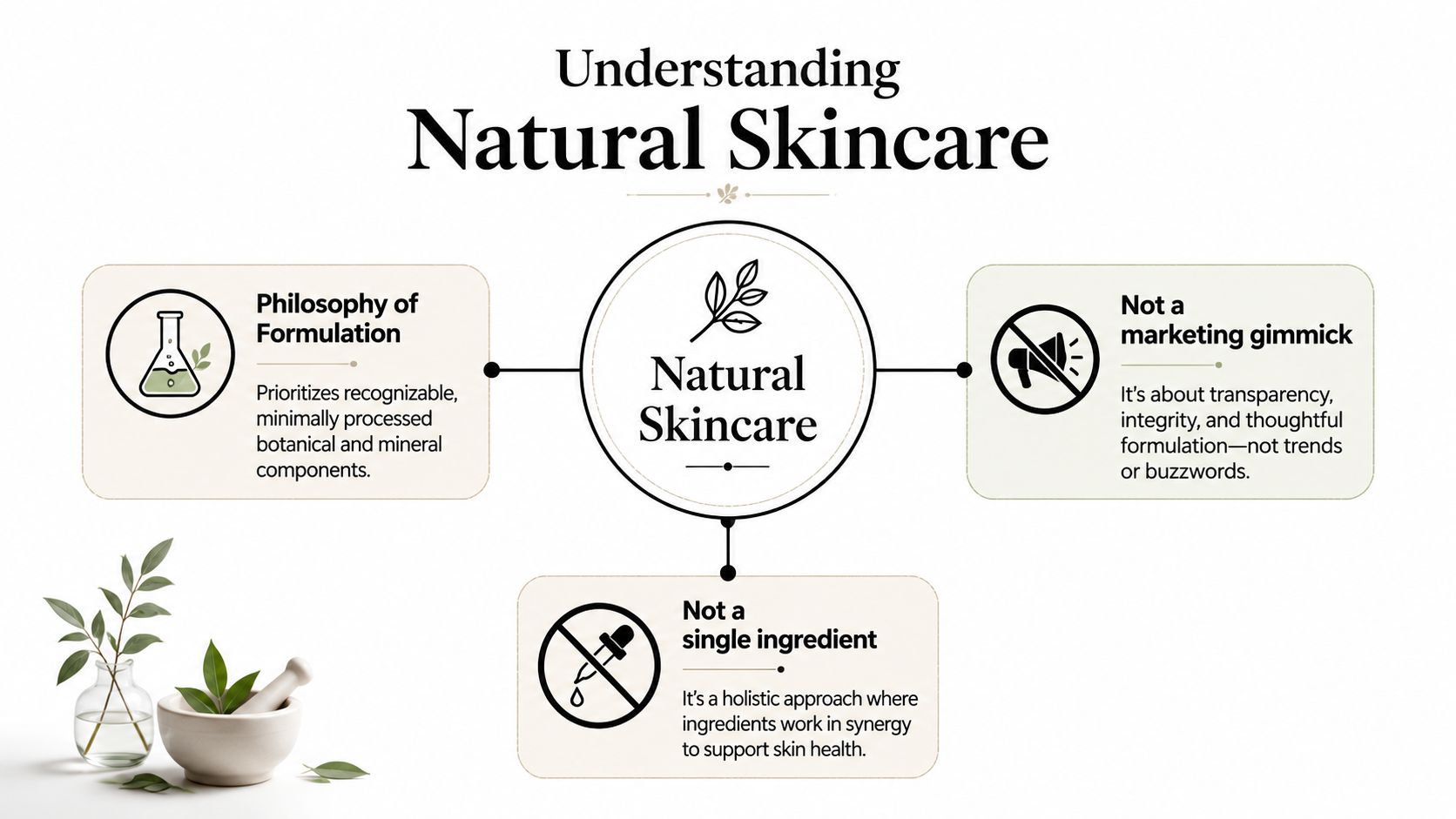
Natural skincare is best understood as a formulation philosophy, not a single ingredient or a cute label. It usually prioritizes recognizable, minimally processed botanical and mineral components, which means the formula is often built around ingredients you can name and trace. That doesn't automatically make every product better, but it does change how you judge it.
Consider the difference between a homemade soup and a canned one. Both can feed you, but the homemade version usually gives you more control over what goes in, how much is processed, and how the final result tastes. Natural skincare works the same way. The maker has to think harder about sourcing, stability, and how each ingredient behaves in the final blend.
What “natural” usually means in practice
A natural formula often leans on oils, hydrosols, butters, clays, waxes, and plant extracts. That can feel closer to a whole-food approach than a highly refined one, which is why many shoppers see it as a quality upgrade rather than a lifestyle badge. A significant advantage is that the product often comes with clearer ingredient logic, especially when the maker explains why each ingredient is there.
Practical rule: if a brand can't explain the purpose of its main ingredients in plain language, the word natural doesn't tell you much.
The tricky part is that natural doesn't mean unlimited. A formula still has to be stable, safe to store, and suited to your skin. That's why the next things to check are preservation, sourcing, and whether the product is even designed for your skin type.
Benefits and Ingredient Concerns
Natural skincare often appeals because the formulas can feel simpler, easier to understand, and more aligned with what you want to put on your skin. Consumer research highlights that ingredient transparency and sustainability are top buying criteria, and shoppers want visible proof of responsibility rather than assuming natural automatically equals safe Telmar Helixa consumer insights. That mindset fits independent makers well, because smaller brands often have a clearer story to tell about what's in the jar and why.
The upside you're usually looking for
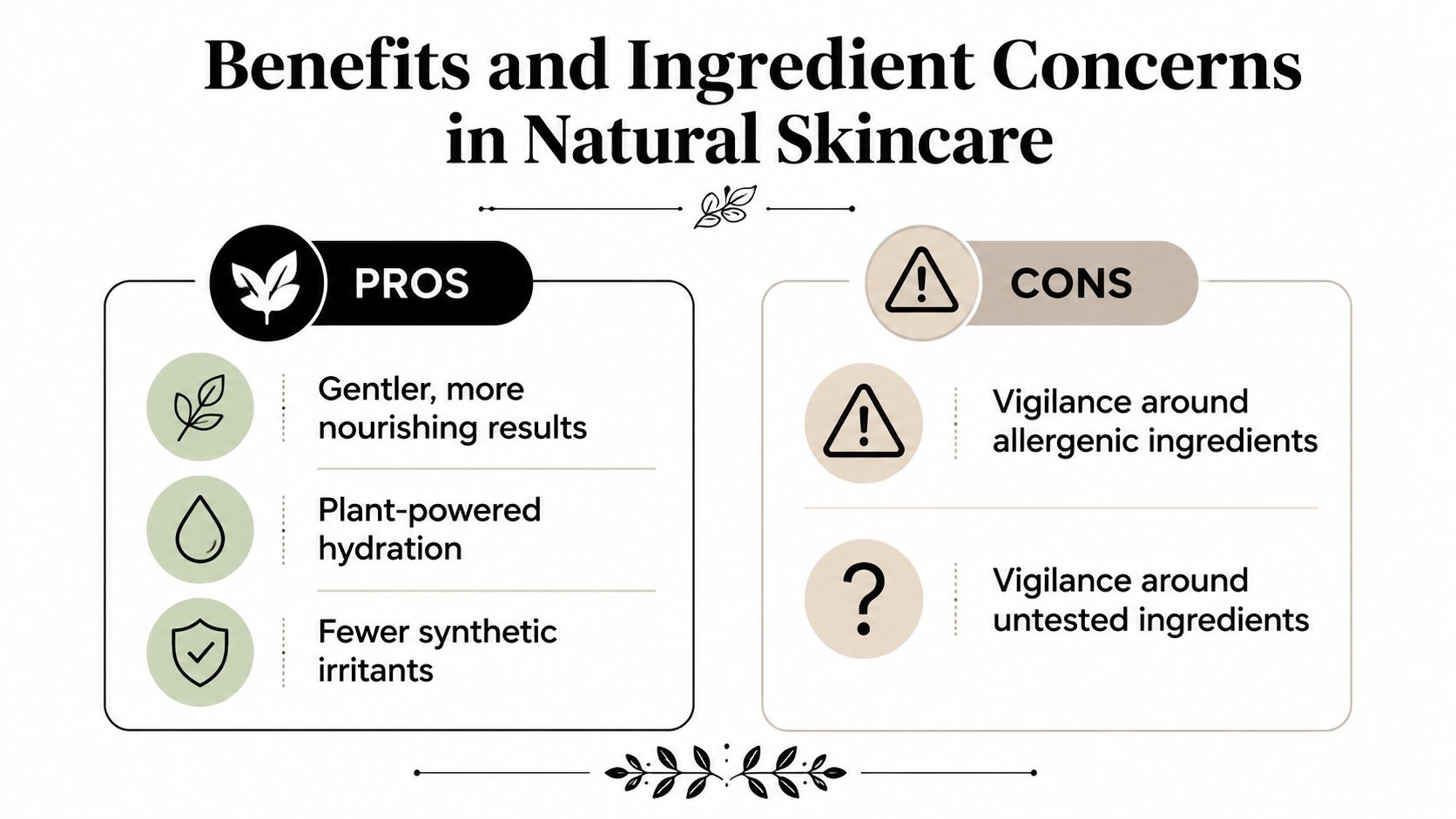
A well-made natural product can be a good fit if you want fewer synthetic irritants, a more readable ingredient deck, and formulas that feel more personal to your skin routine. Some shoppers also prefer the way natural oils and butters sit on the skin, especially when they want a richer feel or a less stripped sensation after cleansing. The appeal isn't magic, it's clarity plus texture plus intent.
The part that still needs caution
Natural ingredients can still irritate you. Essential oils, strong plant extracts, and unfamiliar botanicals can be a problem if your skin is reactive or barrier-damaged. The label may look gentle, but your skin doesn't care about branding, it responds to the actual formula.
Some of the best-looking products are the ones that deserve the most scrutiny, because plant-based doesn't automatically mean non-irritating.
A good habit is to ask two questions at the same time. First, does this formula look transparent and well explained. Second, does it suit my skin concern. If you're acne-prone, sensitive, or dealing with a stressed barrier, that second question matters just as much as the first.
Evaluating Claims and Certifications
Seals and badges can help, but only if you know what they require. For natural and organic cosmetics, NATRUE says that when a product is labeled organic, at least 95% of the natural substances of plant and animal origin and of derived natural origin must come from controlled organic farming or wild collection, and the product must be certified by a recognized body NATRUE label requirements. That's useful because it turns a vague label into a compositional rule you can verify.
The smarter move is to treat certifications as one piece of the puzzle, not the whole answer. Some standards focus on natural content, some on organic sourcing, and some on broader brand practices. The point isn't to memorize every logo. The point is to ask what the seal guarantees, and what it doesn't.
| Certification | Minimum Natural Content | Organic Sourcing Requirement | Certifying Body |
|---|---|---|---|
| NATRUE | At least 95% of the natural substances of plant and animal origin and of derived natural origin for products labeled organic | Yes, controlled organic farming or wild collection for the organic label | Recognized certification body |
| USDA Organic | Not specified in the verified data provided | Not specified in the verified data provided | Not specified in the verified data provided |
| COSMOS | Not specified in the verified data provided | Not specified in the verified data provided | Not specified in the verified data provided |
The habit to build is simple. Read the front label, then check the ingredient list, then check whether the maker says anything specific about sourcing or certification. If the brand talks about being clean but won't explain the formula, you're still guessing.
One practical example is a product listing like 4 Step Fragrance Free Skincare Set. A name like that tells you more than a shiny badge does, because it signals fragrance-free positioning and names the core ingredients before you even open the page.
Checklist for Buying Natural Skincare Online
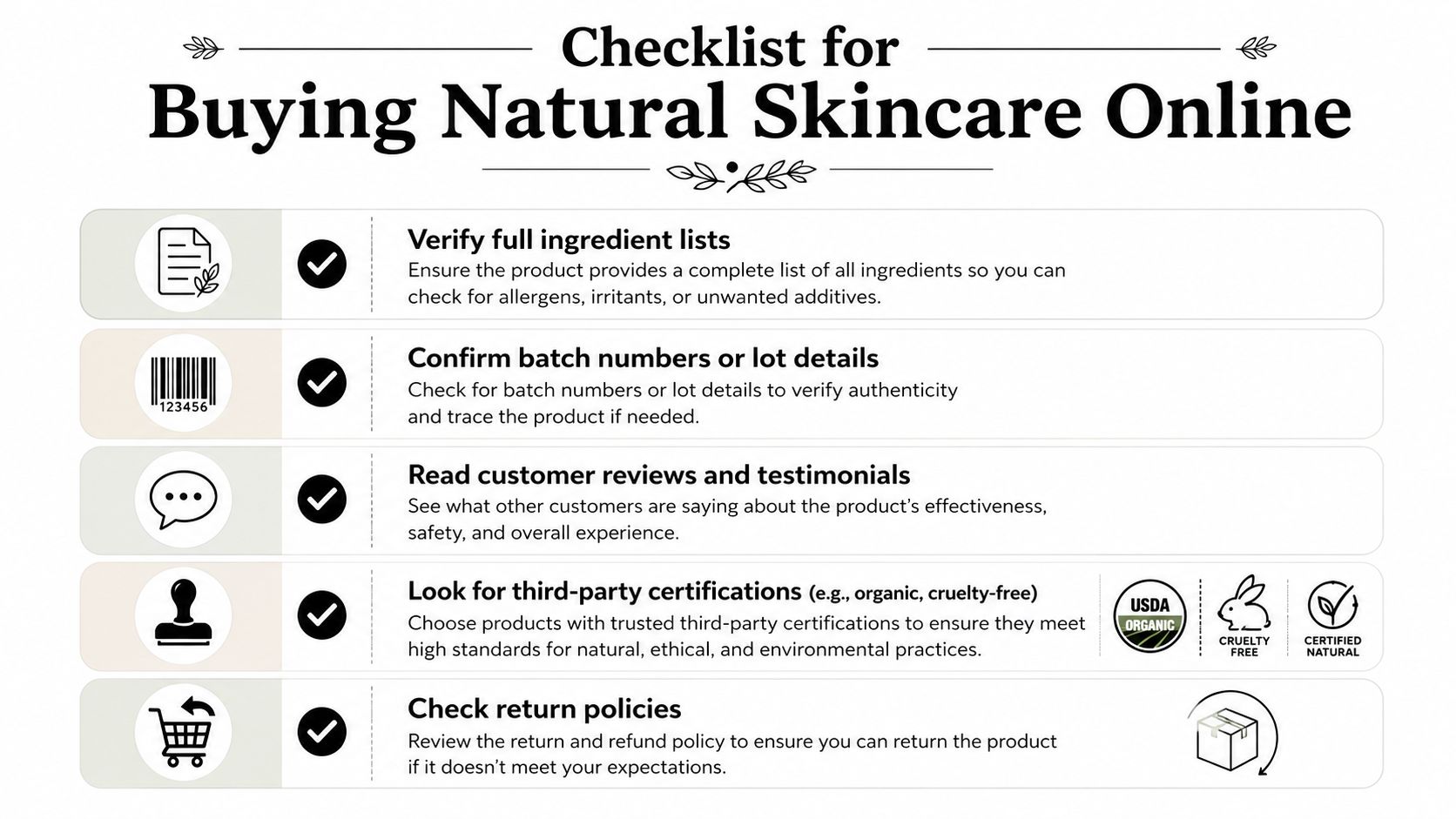
The easiest way to shop better is to use the same checklist every time. That keeps you from getting pulled in by pretty packaging or vague wellness language. A listing should help you verify what the product is, who made it, and how you're supposed to use it.
What to check before you buy
- Verify full ingredient lists. Look for the complete INCI-style list, not just a few friendly-sounding ingredients.
- Confirm batch numbers or lot details. If a brand can trace a product, that usually means it takes quality control seriously.
- Read customer reviews and testimonials. Visible reviews help you spot patterns in texture, scent, packaging, and skin feel.
- Look for third-party certifications. Organic and cruelty-free claims carry more weight when there's an outside standard behind them.
- Check return policies. If a product doesn't fit your skin, a clear return path matters.
The biggest red flags are usually the quiet ones. A listing that says “plant extract” without naming the plant, or shows stock photos instead of the actual jar, doesn't give you much to work with. Missing preservative information is another issue, especially for formulas that include water or hydrosols.
A common gap in online skincare advice is the lack of clear verification methods, and savvy shoppers now rely on full ingredient lists, batch transparency, and pricing clarity to assess new products before buying Ethical Globe on skincare verification questions. That matters because a trustworthy listing should answer your questions before you have to hunt for them.
You can also use product routines as a clue. A set like Natural Skincare Gift Set, Tallow Lotion + Oil Cleanser + Serum (DMAE, Hyaluronic Acid) + Matcha Eye Oil + Lip Balm, 5-Piece | Ojas Glow by Loyaltie shows how a maker can map out a full ritual in plain language. The listed snapshot says, “Give glowing, comforted skin in one easy ritual. This 5-piece set pairs a silky oil cleanser with a DMAE + hyaluronic acid serum and a matcha under-eye oil, then seals it in with whipped tallow lotion.” That kind of specificity is easier to evaluate than broad claims.
Finding Trustworthy Local Makers on Loyaltie
Independent beauty already has serious scale. One market commentary says independent beauty brands make up 32% of the $125 billion U.S. beauty market LinkedIn market commentary. That matters because it shows shoppers are already comfortable choosing non-mass brands when they want clearer positioning and repeatable quality.
What gives local makers an edge is the way they can answer questions directly. A maker who posts batch photos, ingredient notes, and usage guidance gives you more to work with than a faceless catalog page. If something goes wrong, you can also judge how they handle feedback, which is a big trust signal in itself. For practical guidance on that part, expert advice on review responses is a useful resource because it shows why response quality matters when buyers are evaluating a brand online.
Why direct-to-maker trust feels different
Buying directly from the maker means fewer layers between you and the person who blended the formula. You can often see who made it, what they used, and how they expect it to perform. That's especially helpful for skincare, where texture, scent, and storage can vary more than people expect.
Loyaltie fits that model because it's a marketplace where people discover and buy directly from the best independent brands in the US. It gives you a place to compare brands by product type, ingredient focus, and maker identity without losing the direct connection that makes local shopping feel more grounded. You can browse Loyaltie's natural and all-natural skincare collection and look for listings that explain the formula in plain terms.
Practical rule: if a seller explains the formula, responds to reviews, and shows the real product, you're usually looking at a more trustworthy listing than a polished page with no substance.
The best independent brands don't ask you to take their word for it. They show you enough detail to decide for yourself, which is exactly what online skincare should do.
Conclusion and Next Steps
Buying natural skincare online gets easier when you stop chasing vague labels and start checking for proof. You now have a simple way to think about the category, from understanding what natural formulation really means to spotting ingredient concerns, certification limits, and the trust signals that matter most. The big shift is this, natural is not the same thing as verified.
Use the checklist every time you browse. Read the full ingredient list, look for batch details, compare what the certification guarantees, and pay attention to how the maker answers questions. When you do that, local makers stop feeling like a gamble and start feeling like a smarter way to buy products you'll use.
If you're ready to shop with more confidence, visit Loyaltie and start comparing natural skincare from independent brands that show their work.