
You're standing in a drugstore aisle, holding a face wash with a label that reads like a chemistry exam. The front says “clean,” “botanical,” and “gentle,” but the ingredient list is long, the fragrance is strong, and you still don't know whether it'll calm your skin or leave you itchy by dinner.
So you type natural skincare near me into your phone and get a familiar mess: map pins, polished product photos, vague claims, and very little information about what's inside the jar. Local shopping can do better, but only if you treat it as an ingredient-safety search, not just a hunt for the closest store.
Table of Contents
- Why Local Natural Skincare Is Worth the Hunt
- Build the search in layers
- Use product pages to narrow the field
Why Local Natural Skincare Is Worth the Hunt
The natural skincare category has clearly moved beyond a niche. One 2026 estimate places the global natural skin care products market at about $22.8 billion in 2025, with a projection of $25.44 billion in 2026, reflecting 11.6% annual growth. Another estimate puts the broader category at about $48.0 billion in 2026, rising to $66.6 billion by 2031 at a 6.8% CAGR. Those estimates differ because market definitions differ, but they point in the same direction: natural skincare is now a commercially established personal-care segment, not a fringe shopping preference. (The Business Research Company)
That scale matters when you're buying from independent brands and local makers across the United States. You're not choosing a handmade-looking product to feel virtuous. You're looking for a better buying experience, clearer answers, and products you can evaluate before committing to a full routine.
A nearby maker may be able to tell you where an oil comes from, why a preservative is used, or whether a formula has changed. You can ask the question before spending money, and the person answering has a direct connection to the product. That accountability is a quality advantage.
The useful local-search question isn't “What's closest?” It's “Who can show me what I'm buying?”
Independent beauty brands also hold a substantial place in the US market. They controlled about 32% of the $125 billion US beauty and personal-care market in the latest 52-week period ending November 1, 2025, generating roughly $40.0 billion in sales. (Beauty Independent)
The opportunity is simple. Local discovery helps you find products with a shorter path between maker and buyer, but ingredient literacy keeps that convenience from turning into another dead end. A useful starting point is this natural-product discovery page from Loyaltie, then apply the label and patch-testing standards below before you buy.
Running a Smarter Local Search
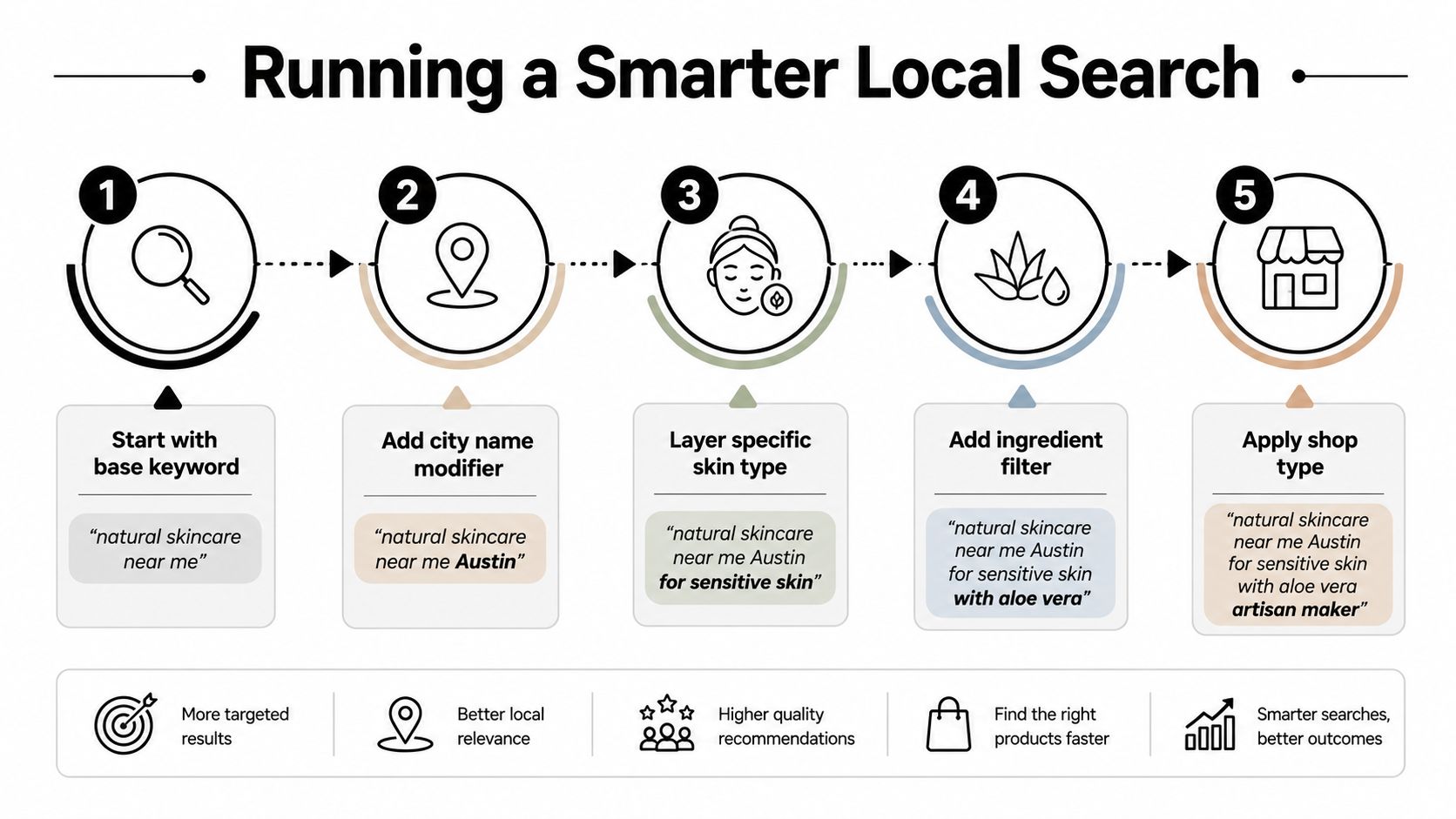
Typing “natural skincare near me” is a starting point, not a search strategy. Add modifiers that tell the search engine what kind of maker, product, and skin concern you want.
Build the search in layers
Try this sequence:
- Start local: Add your city or neighborhood, such as “natural skincare near me in Austin” or “independent skincare maker in Portland.”
- Name the product: Search for “face cleanser,” “body balm,” “soap,” or “facial oil” instead of relying on the broad skincare category.
- Add your skin concern: Use terms such as “for sensitive skin,” “for acne-prone skin,” or “for eczema-prone skin.”
- Add an ingredient filter: If you already know what you're seeking, try “with aloe vera,” “fragrance-free,” or “essential-oil-free.”
- Specify the maker type: “Made by hand,” “small batch,” “apothecary,” and “local maker” can surface more relevant results than “natural” alone.
Google Maps results need a skeptical read. Check whether the listing shows a real address, current photos, a working website, and product-specific information. A pretty storefront image doesn't prove that the business makes its own products. Look for an ingredient list, maker details, and reviews that mention the actual buying experience rather than generic praise.
Use product pages to narrow the field
A curated marketplace can save you from opening dozens of tabs, especially when it combines local discovery with direct purchasing. Loyaltie is one option for finding independent US brands and local makers with product details in one place, rather than sorting through listings that may not explain who made the item.
For example, the Lavender Sea Salt Spa Artisan Soap from Midnight Oasis Essentials is described as a small-batch bar made with coconut oil and kokum butter, with a creamy, mineral-rich cleanse intended to leave skin feeling smooth and refreshed. That kind of product detail gives you something concrete to assess before buying.
Your five-minute routine is straightforward: run a modified search, open three listings, reject pages without full ingredients, then compare the remaining makers on transparency and fit. Don't choose the first result just because it's nearby.
Reading the Label Like Someone Who Has Been Burned
“Natural” is a marketing description, not a safety category. The FDA cosmetic ingredients guidance explains that cosmetic products and ingredients generally do not need FDA approval before reaching the market, except for color additives not intended for use as coal tar hair dyes. Products still must be safe under labeled or customary conditions of use. That makes a complete ingredient list, clear maker information, and a reachable business more useful than a green label.
“Organic” does not settle the question. Under the laws it enforces, the FDA says “organic” isn't defined for cosmetics, and an ingredient's source does not determine its safety. Plant-derived ingredients can still irritate skin or trigger an allergy. Read the FDA guidance on organic cosmetics before treating organic wording as proof that a product suits you.
Scan the list in a fixed order
Use four passes. First, find fragrance terms and essential oils. Second, review preservatives. Third, mark ingredients you already know you react to, including food-allergen derivatives. Fourth, judge whether the complete formula fits your skin concern. A short list is not automatically a better list.
| Ingredient | Where it tends to appear | Why it can be a problem |
|---|---|---|
| Lavender oil | Facial oils, cleansers, soaps | A botanical fragrance ingredient that can trigger contact allergy |
| Tea tree oil | Acne-focused products, spot treatments | Can irritate sensitive skin and is repeatedly flagged in cosmetic-allergy literature |
| Propolis | Balms, salves, lip products | A natural bee-derived ingredient associated with contact allergy |
| Lanolin | Balms, creams, barrier products | Can cause reactions in some users, especially when the skin barrier is already compromised |
| Citrus oils | Cleansers, body products, facial blends | Fragrant botanicals can irritate or sensitize susceptible skin |
| Preservatives | Water-based creams, lotions, serums | Necessary for product safety in many formulas, but some preservative systems can cause allergy |
A review of cosmetic-allergy evidence recommends particular attention to botanicals and natural ingredients such as lanolin, propolis, tea tree oil, lavender oil, ylang-ylang oil, oat, wheat, and citrus oils. (Cosmetic allergens and atopic-skin product review) For cannabinoid-focused products, THC-free CBD skincare from HempWell USA offers another example of why you should examine the full formula instead of relying on the product category or marketing copy.
The rule is simple: don't confuse a pleasant story with a suitable formula. Save the label, identify questionable ingredients, and patch test before giving any local product a full-face trial.
Patch Testing Before You Commit Your Face
A new local product can look perfect on the shelf and still leave your face burning by dinner. Patch testing belongs in your routine, especially when you are buying from a maker for the first time. A 48-hour check cannot predict every reaction, but it can stop you from spreading an unsuitable formula across your cheeks, forehead, and neck.
Use this 48-hour routine
- Choose a quiet test site. Apply a small amount behind the ear or on the inner forearm. Test one new product at a time, or you will not know which formula caused the problem.
- Leave it alone. Follow the product's normal instructions. Do not scrub, exfoliate, or layer another new product over the area.
- Check at intervals. Look for itching, burning, redness, swelling, bumps, scaling, or a rash that continues after the product is removed.
- Wait 48 hours. If the area stays calm, apply the product to a small facial area before using it across your full routine.
- Stop if your skin objects. Wash it off and do not try to push through a reaction. Seek medical advice for severe, spreading, painful, or persistent symptoms.
Cosmetic allergy deserves this level of caution. In one patch-tested cohort, 4.2% of patients with contact dermatitis had cosmetic allergy, while 18.7% of reactions to the responsible cosmetic product were patch-test negative. A negative result does not completely rule out product-specific intolerance. The same study found reactions to at least one preservative in 49.4% of patch-tested patients and to at least one fragrance or botanical additive in 31.2%. (Cosmetic allergy patch-test cohort)
A calm patch test earns a cautious first use. It does not grant a lifetime guarantee.
Eczema-prone, acne-prone, and highly sensitive skin needs extra attention. In a screen of 396 skincare products used for atopic-skin contexts, 32.1% contained at least one derivative of a major food allergen, and 5.1% contained more than one. (Atopic-skin skincare allergen review) Follow this skincare allergy test guide for a practical visual walkthrough.
When a product passes your first check, introduce it gradually rather than replacing your entire routine at once. Keep the first order small, record the ingredients, and give your skin time to respond. Treat a natural skincare gift set from Ojas Glow like any multi-product purchase: test each item individually before combining formulas.
Spotting a Trustworthy Local Maker in Person and Online
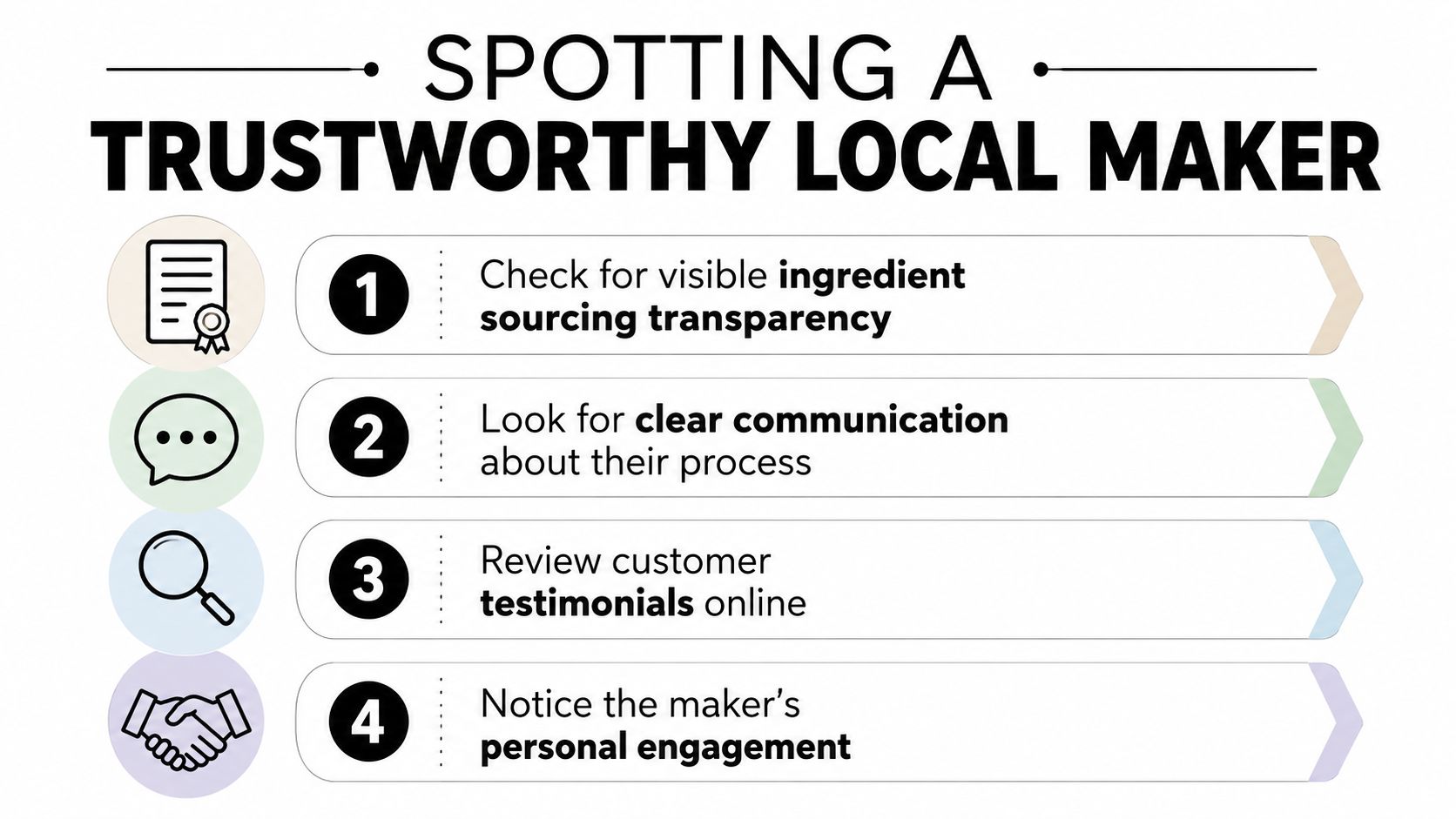
A trustworthy maker doesn't need a dramatic “all natural” story. They need a clear label, a reachable person, and answers that remain clear when you ask a specific question.
Compare evidence with presentation
| What you see | More reassuring | Needs a closer look |
|---|---|---|
| Ingredients | Complete list with recognizable function or explanation | “Proprietary blend” or no list |
| Sourcing | Specific details about oils, botanicals, and suppliers | Broad claims about purity without support |
| Process | Clear explanation of where and how products are made | Stock photos presented as a workshop |
| Customer support | A maker answers questions directly and precisely | Resistance, defensiveness, or silence |
| Product updates | Changes are explained on the product page | Formula shifts with no notice |
Ask, “Where do your main oils and botanicals come from?” Then ask, “How often do you change the formula?” You're not looking for a perfect supply chain. You're checking whether the person behind the product knows the formula and is willing to explain it.
Reviews help, but read them for useful detail. Comments about packaging, scent strength, texture, shipping, and customer service tell you more than repeated statements that a product is “amazing.” If someone reports irritation, don't assume that means the product is bad. Treat it as a reminder that suitability is personal and patch testing matters.
The red flags are easy to recognize: vague claims, missing ingredients, exaggerated promises, and a maker who can't explain basic product choices. If the label is attractive but the answers are evasive, leave it behind.
Here's a short video reference for evaluating maker communication and product presentation:
Using Loyaltie to Find and Buy From Makers Near You
Turn your search into a small, controlled shopping trip. Start by opening Loyaltie and searching for skincare makers or products available in your area. The point is to discover and buy directly from independent brands in the US, with product information close at hand instead of bouncing between social profiles and disconnected store pages.
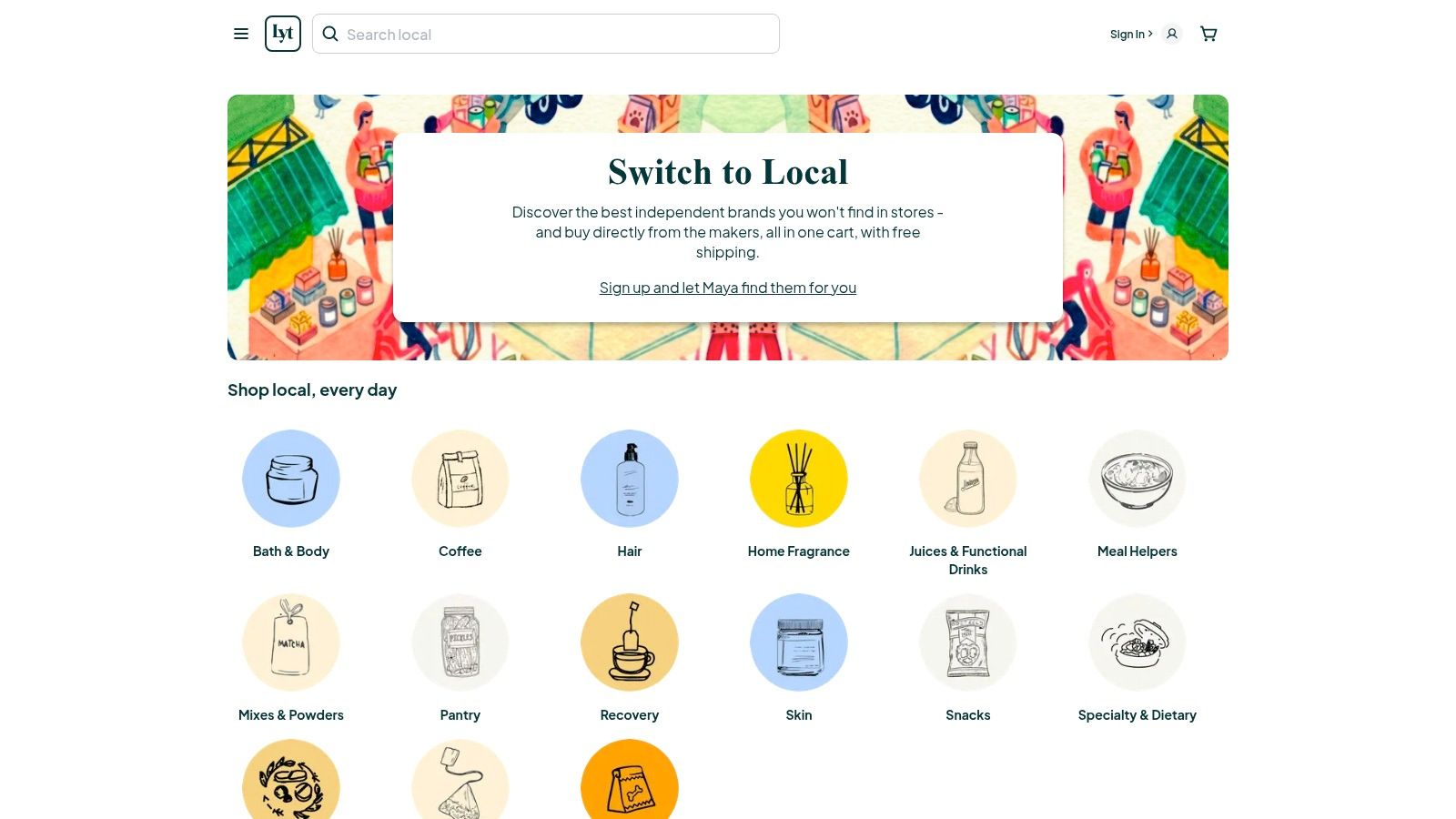
Use three filters before you compare products
First, filter by skin concern. Sensitive skin, acne-prone skin, and eczema-prone skin shouldn't be treated as interchangeable categories. If a maker doesn't provide useful skin-type information, move to the next listing rather than guessing.
Second, filter by ingredient concern. Look for full ingredient lists, then flag fragrance, essential oils, preservatives, and food-allergen derivatives that may matter to you. Don't assume an ingredient is harmless because it appears in a botanical product.
Third, filter by local connection. Check whether the listing identifies the maker, location, or direct purchasing relationship. You want to know who stands behind the formula and where questions should go.
Read the product page slowly enough to catch omissions. A good page should tell you what the product is, how it's intended to be used, and what ingredients are included. If you still have a question, message the maker before checkout. Their response is part of the product evaluation.
Place a small first order, patch test each new formula, and keep the packaging until you know your skin tolerates it. Loyaltie backs every order, which adds confidence to the transaction, while direct purchasing gives makers a chance to build a relationship with the people using their products. When a formula works, save it and reorder rather than constantly chasing the next launch. Regular delivery can also make repeat purchasing easier when the option is available.
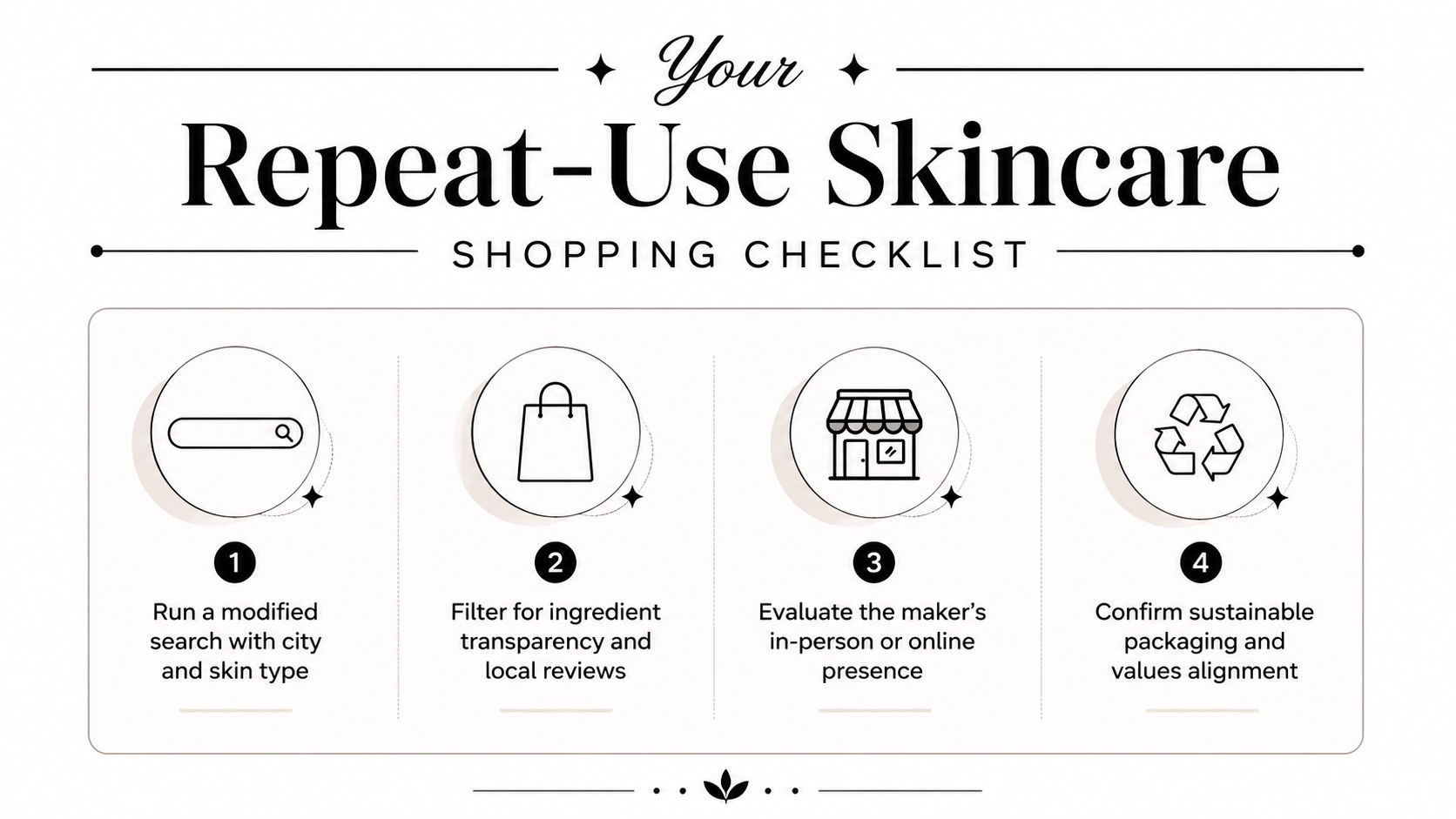
Your Repeat-Use Skincare Shopping Checklist
Save this checklist before your next local skincare search. It keeps the process focused on fit, safety, and accountability, not attractive packaging or the nearest map pin.
Search before you shop
- Modify the phrase: Add your city, product type, skin concern, and ingredient preference to “natural skincare near me.”
- Check the listing: Confirm that you can identify the maker, product, location, and complete ingredient list.
- Compare locally: Use map results, maker websites, markets, and curated marketplaces instead of trusting one search result.
Check the formula
- Scan fragrance first: “Natural scent” can still come from essential oils or botanicals that irritate or sensitize.
- Review preservatives: Water-based products often need preservation, so ask what system the maker uses rather than rejecting every preservative automatically.
- Flag known allergens: Look for food-allergen derivatives and ingredients you've reacted to before.
- Don't buy the giant bottle: Start with the smallest practical amount until your skin has passed a patch test.
Evaluate the routine
- Patch test for 48 hours: Test one new product at a time and watch the site after removal.
- Keep sunscreen in the routine: Oils and balms don't replace sun protection.
- Simplify during a flare: If your skin is burning, swollen, or developing a persistent rash, stop experimenting and get professional advice.
Evaluate the maker
- Ask direct questions: Find out where key ingredients come from and whether the formula changes.
- Read specific reviews: Look for comments about texture, scent, packaging, and customer service.
- Check values alignment: Consider packaging, sourcing, and whether the maker explains sustainability claims in concrete language.
Buying from independent brands is a quality upgrade when you protect it with a little homework. You get the chance to choose products made by real people, buy directly from the maker, and avoid the mystery that often comes with mass-produced everyday skincare.
Loyaltie gives you a place to discover and buy directly from independent brands and local makers across the US, with product details and order support in one shopping experience. Visit Loyaltie to find a nearby skincare maker, compare the ingredients, and start with one carefully chosen product.