
What does the word mineral guarantee you?
Less than the front of the bottle implies. It tells you which UV filters are inside. It doesn't tell you the SPF, whether the formula carries a broad spectrum claim, how it wears on your skin at 2pm, or whether you'll still be wearing it when the sun is at its worst. Most mineral vs chemical sunscreen comparisons pick a winner and move on. The label, the regulatory fine print and your own routine decide the choice, and they rarely line up neatly on one side.
So here's the version I'd give a friend who texted me a photo of two bottles in a store. Short answer first, then the parts of the panel that earn your attention.
Table of Contents
- Mineral vs Chemical Sunscreen at a Glance
- How to Tell Which Type Is on the Label
- How Each Type Actually Protects Your Skin
- What the FDA Review Means for Your Bottle
- Reef Safe Claims and Environmental Trade-offs
- Which Type Fits Your Skin and Your Days
- Pick Your Sunscreen Before Your Next Outdoor Day
Mineral vs Chemical Sunscreen at a Glance
Mineral sunscreens use zinc oxide, titanium dioxide, or both as their active UV filters. Chemical sunscreens use organic filters such as avobenzone, octocrylene and octisalate. That is the whole distinction. Safer, gentler, and better for the ocean are separate claims, and each one has to be checked on its own.
The shelf is lopsided. Chemical sunscreens accounted for 58.3% of the U.S. sunscreen market in 2025, according to Emergen Research. A typical store aisle is mostly chemical formulas. On the mineral side the field narrows again: zinc oxide sunscreens held 61.4% of the global mineral sunscreen market by product type in 2025, per Dataintelo, so zinc is the filter you will meet most often.
Mineral vs chemical sunscreen by key trait
| Trait | Mineral sunscreen | Chemical sunscreen |
|---|---|---|
| Active UV filters | Zinc oxide, titanium dioxide, or both | Organic filters such as avobenzone, octocrylene, octisalate |
| Texture and finish | Thicker, can feel heavy or drying | Lighter, usually spreads more evenly |
| Visible white cast | Common, more noticeable on deeper skin tones | Usually clear on the skin |
| Stinging on sensitive skin | Less common, often the first choice for reactive skin | Can sting irritated or compromised skin |
| Long-wave UVA coverage | Zinc oxide generally strong, titanium dioxide weaker | Depends on the filter combination |
Read the rows in the order they change a day outside. Active filters tell you which family the bottle belongs to, and that is a fact you can confirm on the active-ingredient line in a few seconds. Texture decides whether you put on a full coat or a thin smear you will hate by noon. White cast is the biggest single reason shoppers under-apply mineral sunscreen, especially on deeper skin tones, and a thin coat cancels a better filter. If white cast is the sticking point, this roundup of no-cast SPF picks for deeper skin is a faster route than guessing in the drugstore aisle.
Stinging is where chemical filters most often lose people with reactive skin. I would start those shoppers on a mineral formula, then switch only if the heavier feel makes them skip the second coat.
The table is a starting point, not a verdict. Which row matters most depends on your skin and on how long you are outside. Shade changes the math too. A breathable Mesh Back Trucker Cap keeps direct sun off your face and neck, so the sunscreen has less work to do on those areas.
How to Tell Which Type Is on the Label
Flip the bottle over. The front is a mood board; the back is a legal document. The American Academy of Dermatology's guide to reading sunscreen labels makes the same point: the active-ingredient panel, not the marketing copy, is where the answer sits.
Read it in this order.
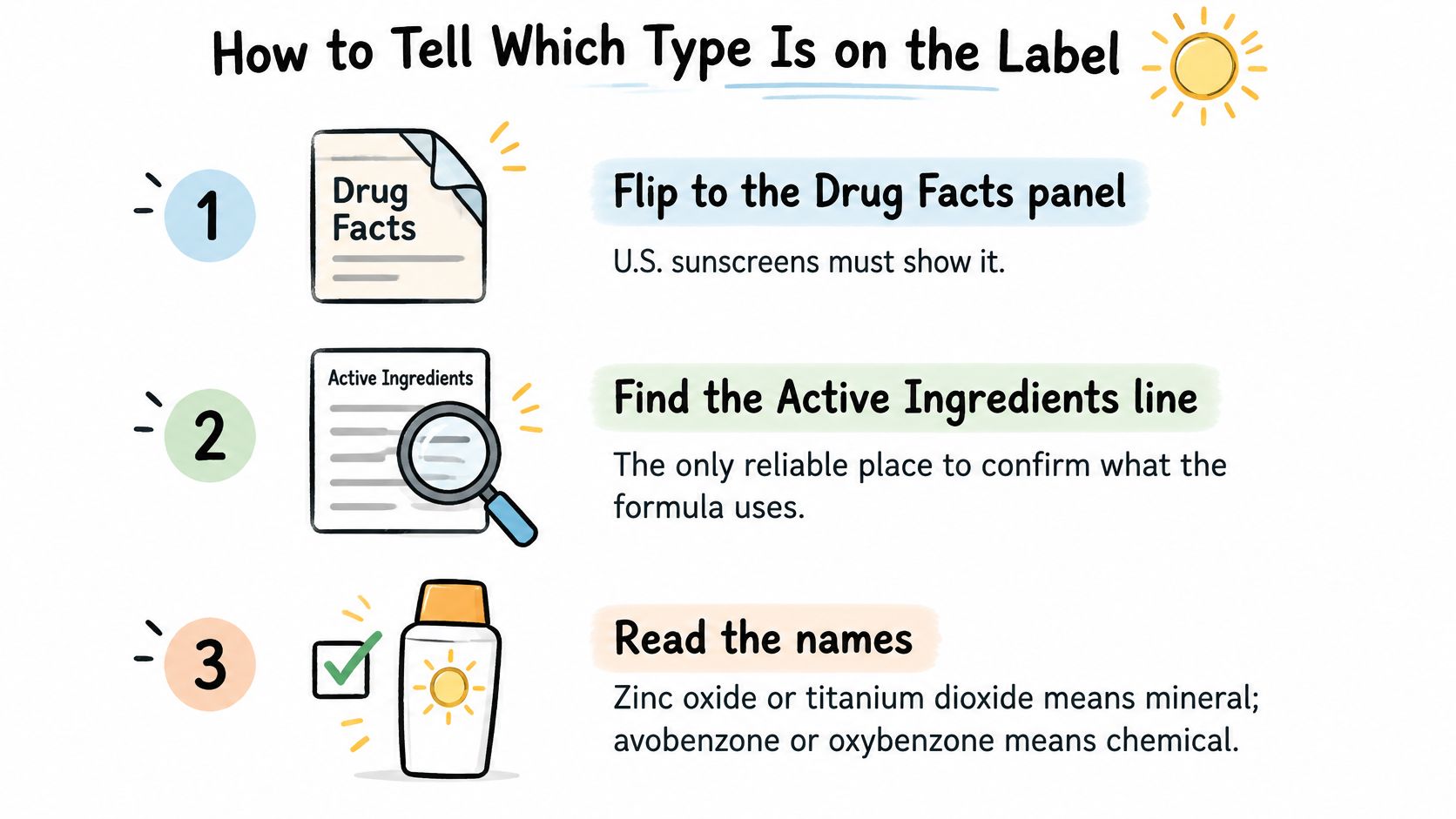
- Find the Drug Facts panel. U.S. sunscreens are regulated as over-the-counter drugs, so the panel is required. No panel, no verified claim.
- Go to the Active Ingredients line. It's the only reliable place to confirm which filters the formula uses, and it lists percentages that the front label never mentions.
- Look for zinc oxide, titanium dioxide, or both. If those are the only UV filters named, the product is mineral.
- Look for avobenzone, octocrylene, octisalate, homosalate, oxybenzone or octinoxate. Any one of those makes it chemical.
- See both families listed? That's a combination formula, and it's more common than the debate admits. Read every filter before deciding what you're holding.
Then check three things on the same panel: the Broad Spectrum statement, the SPF number, and the water resistance time. A mineral formula with no broad spectrum claim is not automatically a better buy than a chemical one that carries it.
Front-of-bottle words like natural, clean and reef safe tell you almost nothing about filter type. None of them is a legal shortcut to a mineral formula.
Independent makers tend to be better on this than the big brands. Many publish the full ingredient list with percentages on the product page, and when you buy directly from the maker you can ask what those numbers mean and get a real answer instead of a script. A jar like the Sunny Dayz Mineral Tallow Sun Balm from Ojas Glow blends grass-fed tallow with non-nano zinc oxide to moisturize, comfort and shield skin from daily sun, and it names its filter up front, which is the whole game.
Store test: read the active ingredients first, decide whether the bottle matches what you want, and only then glance at the front. If the front contradicts the panel, believe the panel.
How Each Type Actually Protects Your Skin
Mineral filters and chemical filters do not split the job as cleanly as the bottle copy implies.
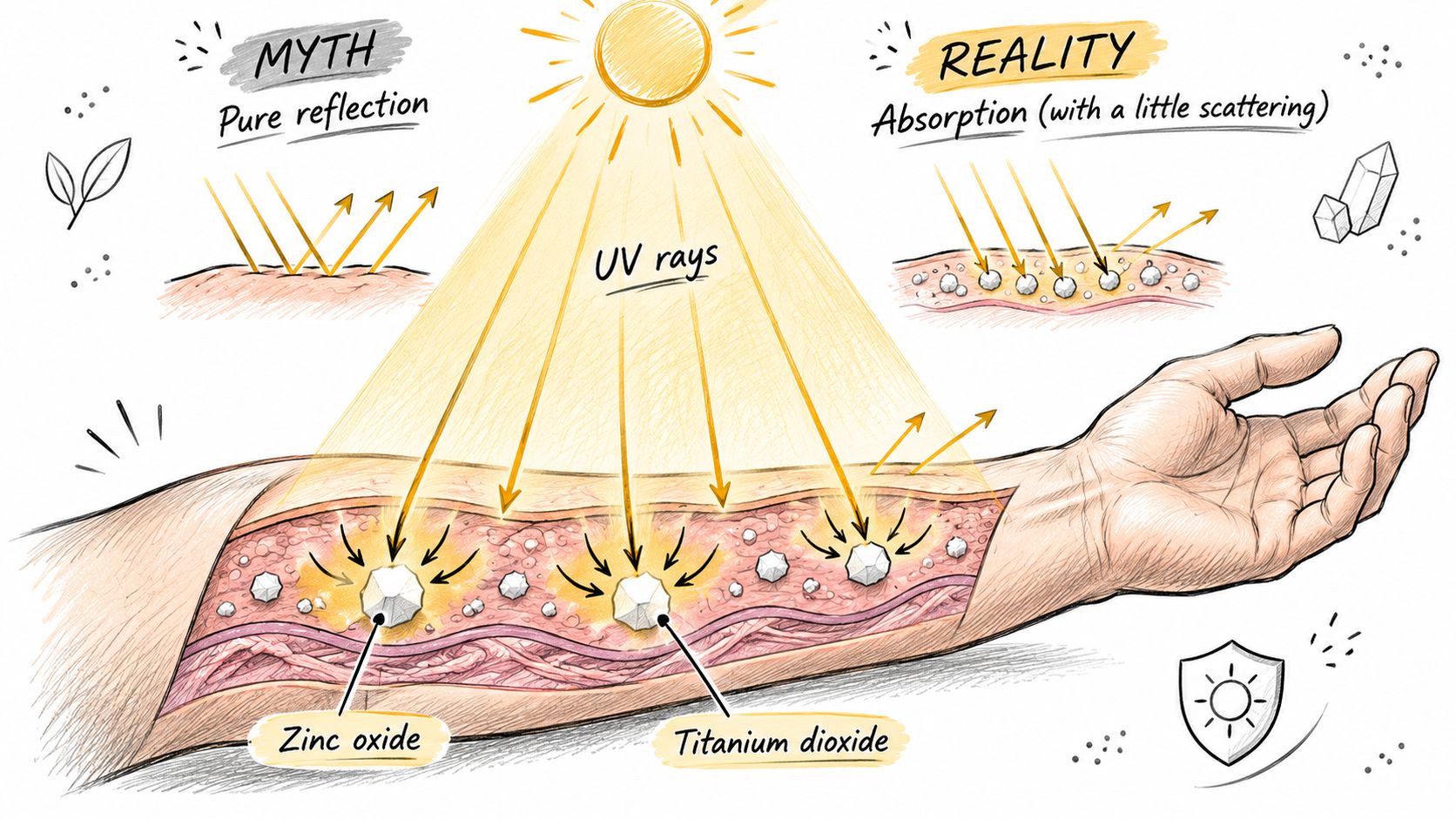
Zinc oxide and titanium dioxide absorb most of the UV that hits them. Scattering and reflection account for a smaller share of the protection. Chemical filters absorb UV energy and release it as a little heat. Those mechanisms overlap far more than marketing suggests, so the mineral-versus-chemical split explains less of your result than the film on your skin and the claims printed next to the SPF.
SPF mostly measures UVB, the burn side of the spectrum. A high number alone will not tell you how a formula handles UVA, the wavelengths tied to aging and pigmentation. The FDA's sunscreen guidance defines broad spectrum as coverage against both UVA and UVB.
If you want the visual walkthrough of how the two mechanisms differ, this is worth a few minutes.
Why the Percentages Don't Rank the Bottles
Active-ingredient percentages do not order products from weakest to strongest either. Two FDA-listed mineral sunscreens both carry SPF 30. One lists 7.75% titanium dioxide with 10% zinc oxide; the other lists 3.44% titanium dioxide with 4.88% zinc oxide, according to their DailyMed drug listings. Same claimed SPF, less than half the filter load.
Particle size, dispersion quality, film uniformity and the base the filters sit in decide how the finished product behaves. None of that shows up as a percentage. I would trust the tested claims on the finished formula before I ranked two bottles by the zinc printed on the panel.
What to trust instead:
- The tested claim over the ingredient count. SPF and broad spectrum are measured on the finished formula, not on the raw materials list.
- Wear over numbers. If a formula pills, streaks or stings, you'll apply less of it, and a thinner film protects worse.
- A film that stays put. Every filter type loses protection as that film thins, so how often you reapply belongs in the day's routine, not in the ingredient debate.
What the FDA Review Means for Your Bottle
The FDA's 2019 proposed rule reviewed 16 sunscreen active ingredients under its generally recognized as safe and effective (GRASE) framework. The American Academy of Dermatology's sunscreen statistics summary gives the proposal date, February 21, 2019. The FDA proposed GRASE status for zinc oxide and titanium dioxide at concentrations up to 25% for either filter, subject to other applicable conditions, as described in the FDA's Q&A on its sunscreen rule.
The FDA's proposed categories separate filters that met its standard from those needing more evidence or raising safety concerns. Its sunscreen rule Q&A identifies 12 ingredients for which the agency said more safety data were needed. PABA and trolamine salicylate were proposed as not GRASE because of safety concerns. For common filters, the proposed category for avobenzone, homosalate, octinoxate, octisalate, octocrylene and oxybenzone was “needs more data.”
| Active filter | FDA 2019 proposed category |
|---|---|
| Zinc oxide | GRASE up to 25 percent |
| Titanium dioxide | GRASE up to 25 percent |
| Avobenzone | Needs more safety data |
| Homosalate | Needs more safety data |
| Octinoxate | Needs more safety data |
| Octisalate | Needs more safety data |
| Octocrylene | Needs more safety data |
| Oxybenzone | Needs more safety data |
| PABA | Not GRASE, safety concerns |
| Trolamine salicylate | Not GRASE, safety concerns |
Needs more data means the evidence was insufficient for a final ruling. That category signals an evidence gap, while the proposal's separate safety-concern category reflects a different regulatory finding.
What Absorption Testing Actually Showed
In its sunscreen absorption testing, the FDA found that several organic filters enter the bloodstream after repeated application. Detection alone does not show harm. A 2025 scientific review found no evidence that commonly used filters such as avobenzone or homosalate damage human DNA or cause cancer, and reported measured concentrations far below levels expected to produce an effect, according to CNN's reporting on the review. Absorption is a reason to study exposure; it is not proof of danger. The regulatory category also does not tell you how well a finished sunscreen protects, so check its tested SPF and broad spectrum claim.
The 2019 document was a proposal. Check the FDA's current status rather than treating a decade-old headline as the final word. The US list also remains shorter than the filters available in European and Asian formulas, because some newer, more photostable filters have not cleared this framework.
Rule I'd follow: choose by tested SPF, a broad spectrum claim and a filter list you're comfortable using.
Reef Safe Claims and Environmental Trade-offs
Reef safe is a label brands write themselves, with no standard behind it. The research under that sticker is real, and it does not sort into mineral good, chemical bad.
The National Academies' interactive on sunscreen in the environment reports that UV filters have been detected in coastal waters, rivers, lakes, sediments and living organisms. Laboratory studies in that same work found that sufficiently high concentrations of some filters can be toxic to algae, invertebrates and fish.
Zinc oxide and titanium dioxide are inorganic particles that can aggregate in the water column and settle into sediments. A "natural" line on the front of the bottle does not change that.
The BBC's breakdown of which sunscreen to use makes the practical point. Environmental risk turns on concentration, formulation, exposure conditions, particle size and the specific filter. The mineral or chemical heading explains less than the sticker implies.
What the Data Can and Can't Tell You
Exposure and hazard data remain limited. There is no broad scientific agreement that every detected ingredient harms ecosystems. A brand that treats the question as closed is selling a claim, not a finding.
I'd read the active ingredients and ask what the formula is: which filter, how concentrated, what particle size. Those details decide more than which half of the sunscreen aisle the bottle came from.
Hawaii and the U.S. Virgin Islands have banned some sunscreen ingredients by name. Those rules list specific filters, not a whole category. Reading them as "mineral versus chemical" flattens the only part that is written down.
What I'd reach for: a bottle whose active list I can match against the filters I care about, not one that leads with a reef-safe line the brand wrote itself.
Which Type Fits Your Skin and Your Days
Start with the sunscreen failure you remember. That day tells you more than a mineral-versus-chemical ranking.
A bottle being sold is not the same as a formula worth wearing. The Environmental Working Group analyzed 1,700 chemical and mineral sunscreens in its 2024 guide and found one in four met its safety standards, as CNN reported. So read the panel and choose on purpose.
Which sunscreen type to lean toward by situation
| Situation | Lean toward | Why it matters |
|---|---|---|
| Reactive or stinging-prone skin | Mineral, zinc oxide based | Fewer chemical filters to irritate the skin |
| Deeper skin tones or dislike of white cast | Clear chemical or tinted mineral | A formula you will apply generously beats one you avoid |
| Daily face under makeup | Sheer, lightweight formula of either type | Texture decides whether you keep using it |
| Long beach or pool days | Water-resistant formula of either type, reapplied on schedule | Water resistance time and reapplication matter most |
| Babies and young children | Check the age guidance on the label first | Shade and clothing do more of the work than the filter type |
| Destination with sunscreen rules | Check local rules, then choose a lotion over a spray | Local bans may name specific filters |
Reactive skin is the clearest case. A shorter filter list gives the skin fewer chances to object, and zinc oxide sits on the surface rather than soaking in. Deeper skin tones flip the priority. A cast-free chemical formula, or a tinted mineral one, wins because you will put enough on. The split on the front label explains less than whether that texture survives your real day.
Daily wear under makeup is a texture problem. Anything that pills under foundation gets abandoned by Thursday.
The Part Nobody Plans For
Beach and pool days reward the water-resistance time printed on the panel, not loyalty to one filter type. Read that window, then reapply when it ends and after you swim or sweat hard.
Evening cleanup is the other half of a long day outside. A non-stripping oil-to-milk cleansing oil that lifts sunscreen takes the film off without leaving the face tight.
For babies and young children, the age line on the label comes before any preference for mineral or chemical. Shade and clothing still do the heavy lifting outdoors.
Pick Your Sunscreen Before Your Next Outdoor Day
The label, the Drug Facts fine print, and the day on your calendar decide the bottle. Mineral versus chemical explains less than that short list. You can run the check in about ten minutes, before you leave the house.
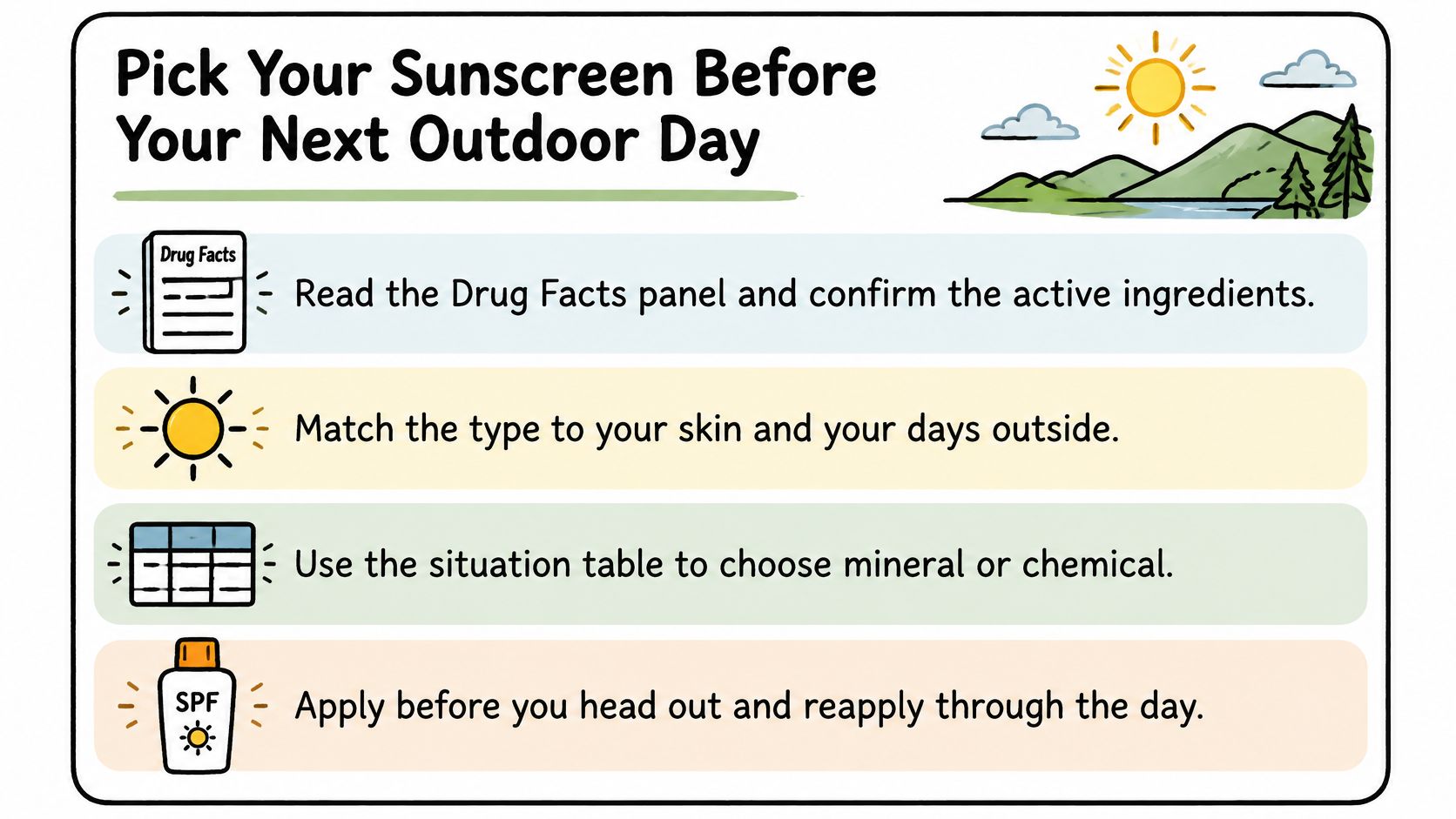
- Match the type to your skin and your days from the situation table, not from a slogan.
- Confirm broad spectrum and SPF 30 or higher on the Drug Facts panel.
- Patch test for a day or two on your inner arm or jaw. It tells you whether the formula stings, pills or leaves a cast you can't live with.
- Apply about an ounce for the body and a generous layer for the face, then reapply roughly every two hours and after swimming or heavy sweating.
- Check destination rules if reef protection matters where you're headed, and replace anything expired or left baking in a hot car.
I would reach for the formula you will put on again at hour two, mineral or chemical.
If a tinted mineral formula is where you're leaning, Skin Perfection's tinted zinc sunscreen guide is a useful comparison before you commit to a pigment.
Loyaltie is a marketplace for buying directly from nearby businesses, independent makers, growers, and producers. You browse sunscreen and the rest of an outdoor kit in one place, and every order is backed by Loyaltie, so you are not gambling on a shop you have never bought from. Buying direct gives you the maker behind the jar if you want a straight answer about the formula. An evening outside usually needs more than SPF, and a DEET-free insect repellent body oil covers the other half. Start at Loyaltie and pick a formula you will reapply.
Apply enough, and reapply. That one habit outweighs the filter argument.