
The most popular advice about low sugar salsa is also the least useful: chase zero sugar at all costs. That approach treats every gram the same, even though tomatoes, onions, and peppers naturally contain sugar while cane sugar, honey, syrups, and fruit concentrates are added during processing. The better question is simple: did the sugar come from the vegetables, or did someone sweeten the jar?
A good low sugar salsa should still taste bright, chunky, smoky, and generous on a chip. You can make one at home without refined sweeteners, or buy from an independent local maker that tells you exactly what went into the jar. The trick is knowing what to taste for, what to read, and which shortcuts create a salsa that's technically low in sugar but disappointing in every other way.
Table of Contents
- Why Zero Sugar Is the Wrong Goal
- Use the panel and ingredient list together
- Don't let sugar distract you from sodium
Why Zero Sugar Is the Wrong Goal
Tomatoes aren't sugar-free. Neither are onions or peppers. That's not a problem. Those vegetables bring the rounded flavor that keeps salsa from tasting like chopped acid and heat.
Total sugars include naturally occurring sugars and added sugars. The separate Added Sugars line tells you whether a manufacturer introduced sweeteners during processing, which is the distinction that matters most for a low sugar salsa. The FDA's nutrition label guidance explains how these two values answer different questions.
A salsa made from tomatoes, onions, peppers, lime, herbs, and spices can contain natural sugar without being sweetened. That's very different from a recipe padded with cane sugar, honey, corn syrup, agave, or concentrated fruit juice to soften sharp tomatoes or cover a flat spice profile.
The useful target: Skip unnecessary added sweeteners, not the natural flavor carried by fresh vegetables.
There's a practical reason to avoid the zero-sugar obsession. If you strip away every ingredient that contributes sweetness, you often end up compensating with more salt, more vinegar, or more heat. The salsa may show a tiny sugar number, but it can taste harsh and still fail to be a better everyday choice.
You also shouldn't judge a jar by sugar alone. FDA guidance identifies sodium and added sugars as nutrients Americans generally overconsume, so a low-sugar salsa can still be a poor pick if the sodium is high. The strongest choice balances clean ingredients, a sensible serving size, low added sugar, and flavor you'll enjoy eating.
At home, roasted peppers and onions supply depth without refined sweetener. At the store, a transparent label gives you enough information to separate vegetable sugars from added ones. That's how you get bold, scoopable salsa without turning dinner into a nutrition-label anxiety exercise.
Reading a Salsa Label Like a Pro
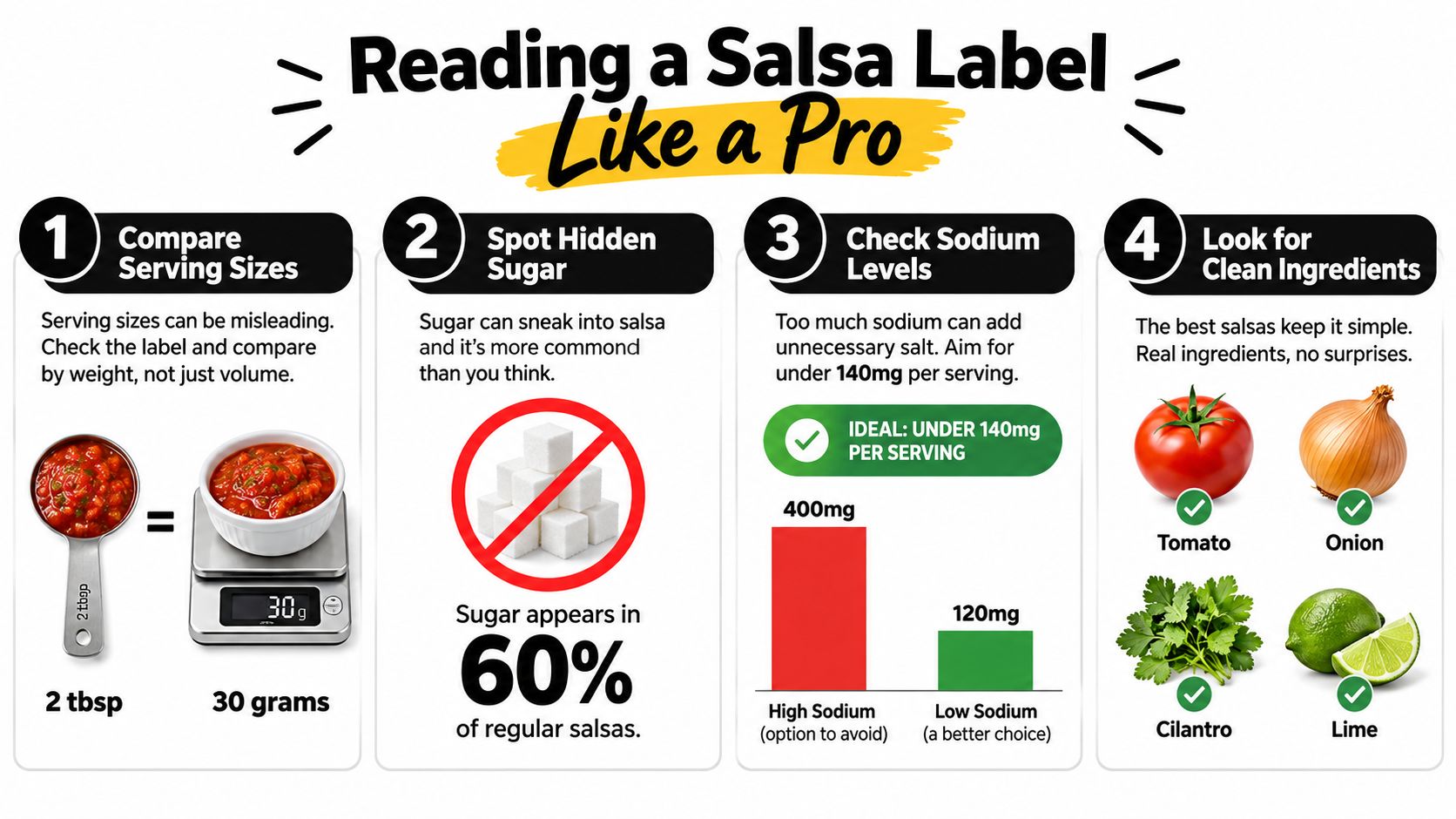
Start with the serving size. A label can list values per 30 grams, while another product uses a larger or smaller serving, so comparing the sugar line without checking the serving basis can mislead you. The FDA's updated Nutrition Facts framework requires packaged foods to distinguish Total Sugars from Added Sugars, and added sugar must appear in grams and as a percent Daily Value.
For added sugar, the FDA set a Daily Value of 50 grams per day based on a 2,000-calorie diet, equivalent to a recommended maximum of 10% of daily calories. A manufacturer may declare added sugars as 0 grams when a serving contains less than 0.5 grams, subject to applicable labeling rules. That means “0 grams added sugar” doesn't necessarily mean the product contains no trace amount.
Use the panel and ingredient list together
A salsa category dataset based on USDA branded-food records includes 2,837 products from 835 brands. It reports a median sugar content of 3.3 grams per 100 grams, with half of the listed products between 3.2 and 5.7 grams per 100 grams. The same dataset reports median calories of 33 per 100 grams and median sodium of roughly 500 milligrams per 100 grams. See the salsa category nutrition data for the full comparison context.
Those figures give you a useful category benchmark, not a universal pass or fail. At the median sugar level, a 30-gram serving would contain approximately 1.0 gram of sugar, although recipes and serving sizes vary by brand.
Then scan the ingredients. Look for sugar, corn syrup, honey, agave, cane juice, syrups, and concentrated fruit or vegetable juices. A short list built around tomatoes, onions, peppers, garlic, herbs, spices, and acid usually tells you more than a front label promising “healthy” or “natural.”
Don't let sugar distract you from sodium
A jar with no added sweetener can still be salty. Check the sodium line beside the sugar lines, especially if you eat salsa generously rather than treating it as a tiny garnish.
Your thirty-second routine is straightforward:
- Compare serving sizes: Put both jars on the same serving basis before judging them.
- Check added sugars: Use the separate line, not total sugars alone.
- Scan ingredients: Identify sweeteners and fruit concentrates hiding behind a wholesome-sounding front label.
- Review sodium: Low sugar doesn't automatically mean balanced nutrition.
Building Flavor Without Added Sugar at Home
The best homemade low sugar salsa starts with control, not deprivation. Weigh your tomatoes, peppers, onions, and acid so you know what you're changing. Use ripe, flavorful tomatoes, but don't rely on sugar to rescue bland produce.
Build the flavor in layers
For a chunky batch, roast some tomatoes, onion, garlic, and peppers until their edges deepen in color. Keep some tomatoes fresh so the finished salsa has contrast instead of tasting uniformly cooked. Chop everything to a similar size, then combine the roasted vegetables with the fresh ones.
Add acid gradually. Lime can give you a sharp, fresh finish, while bottled lemon juice or 5% vinegar brings a more predictable acidic edge. Salt makes the vegetables taste fuller, cilantro adds lift, and cumin, chili, or smoked spices bring warmth without sweetener. For a savory smoky note, try Chipotle Ranch Seasoning as part of your seasoning blend.
Taste after the mixture rests briefly. If it tastes flat, add a little salt. If it tastes heavy, add acid. If the heat feels aggressive, add more tomato or roasted pepper instead of sugar.
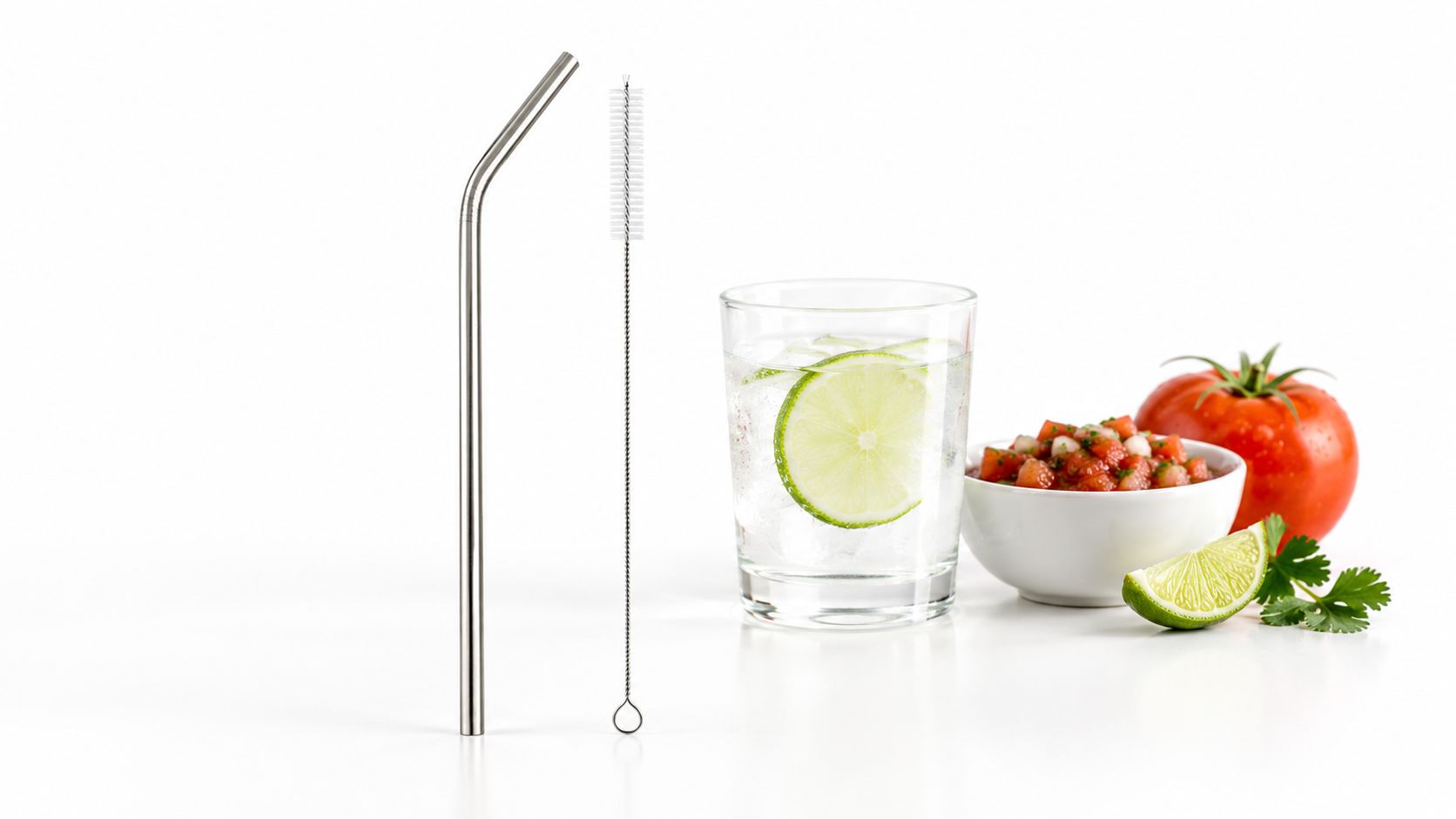
The Stainless Steel Reusable Drinking Straw + Cleaning Brush, Eco-Friendly, Dishwasher Safe, Rust-Resistant, 1 Set | Ube Superfood by Loyaltie is unrelated to salsa itself, but it's a practical example of the kind of everyday product you can find from an independent maker while you're building a more intentional kitchen routine.
Keep fresh salsa and shelf-stable salsa separate
Don't casually change the tomato-to-onion or tomato-to-pepper ratio if you're canning. Reducing bottled lemon juice or 5% vinegar, replacing standardized bottled juice with fresh juice, or adding more low-acid onions and peppers can alter the final acidity.
For acidified salsa, the finished equilibrium pH must be 4.6 or below. Products above that threshold may support growth of Clostridium botulinum and can't be validated through ordinary boiling-water processing. Penn State Extension's salsa safety guidance recommends measuring a representative chunky sample after blending, because testing only the liquid can miss higher-pH solids.
For a commercially sold product, record ingredient weights, batch temperature, fill temperature, container size, and pH readings for each lot, then validate the thermal process with a qualified process authority. Run at least three pilot batches while measuring °Brix, pH, titratable acidity, viscosity, and sensory acceptance, as outlined in Penn State Extension's guidance on acidifying canned products.
Smart Swaps That Keep the Taste
Sugar often performs a job in salsa, but it's rarely the only way to do that job. Roasting can create sweetness and depth. Acid can sharpen a dull batch. Smoke can make moderate heat feel more satisfying.
| Instead of | Try | What it protects |
|---|---|---|
| Concentrated fruit juice as a sweetener | Roasted red peppers or deeply roasted tomatoes | Roundness and gentle sweetness |
| Sweetened canned tomatoes | Fresh tomatoes or no-sugar-added canned tomatoes | Tomato flavor without an unnecessary sweetener |
| Sugar to balance aggressive heat | Smoked paprika, roasted garlic, or charred jalapeño | Smokiness and depth |
| Honey or agave in a “clean” recipe | Caramelized onions used carefully in a fresh batch | Savory richness |
| A sugary fruit salsa base | Fresh citrus zest, cilantro, and a small amount of fruit | Brightness without making the salsa dessert-like |
The swap I won't make casually is reducing the acid in a recipe intended for canning. Acid isn't there just to make salsa taste tangy. It's part of the preservation process, and changing the amount or type can invalidate a tested safety process.
A low °Brix reading doesn't prove a salsa is microbiologically safe. Sugar concentration and food safety are separate concerns. Low sweetness won't compensate for an unsafe pH or an unvalidated thermal process.
That distinction matters if you're developing a product for sale. Calculate total sugars from every ingredient, verify the calculation against laboratory nutrition analysis or an approved database, and express the result using the applicable market's regulated serving size. Keep the nutrition promise honest, then keep the safety process equally disciplined.
For a fiery option without added sugar, you can also compare the flavor profile of this salt-free, sugar-free Texas hot sauce trio alongside your salsa. Hot sauce won't replace salsa's texture, but it can add heat without reaching for a sweetener.
Buying Salsa From Local Makers
A local salsa maker often gives you a clearer look at the product than a mass-market shelf brand. That doesn't mean every local jar is automatically better. It means you can ask better questions, see a more direct ingredient story, and often buy directly from the maker with no middleman.
Run the label check before you buy
Look for a complete ingredient list, a clear serving size, total sugars, added sugars, and sodium. A maker who explains the tomato, onion, pepper, acid, and spice blend gives you more useful information than a front label built around vague health language.
Use this quick filter:
- Start with ingredients: Favor recognizable vegetables, herbs, spices, and clearly identified acid.
- Find added sugars: Make sure the product's sweetness isn't coming from sugar, honey, syrup, or concentrated juice.
- Check the sodium line: A no-added-sugar recipe still deserves a sodium review.
- Ask about storage: Especially if the salsa is home-canned or sold without a standard distribution chain.
- Inspect the container: Look for an intact seal, clean lid, and clear date or batch information.
Loyaltie is a marketplace where people discover and buy directly from independent brands in the US. That makes it a useful place to compare local makers by their actual ingredients and product details instead of settling for whichever jar happens to dominate the supermarket display.
For makers who want to be easier to find locally, these practical local pack strategies offer useful context on presenting local products where nearby shoppers are already searching.
Give the jar a careful look when it arrives. USDA guidance says a properly home-canned jar should be checked for a vacuum seal after cooling for 12 to 24 hours. An unsealed jar should be refrigerated and used within one week. Once opened, home-canned salsa should be refrigerated, and jars should be labeled and dated. The USDA's safe salsa guidance also says not to taste salsa with bulging or rusty lids, leaks, mold, unusual color, moving bubbles, spurting liquid, or off odors.
If you want a ready-made example to compare against your label checklist, look at Roasted Tomatillo Salsa Verde with tomatillos, onion, garlic, and mild heat. The point isn't to trust a product because it sounds fresh. Read the details, then decide whether the ingredients and storage information earn your confidence.
Your Low Sugar Salsa Game Plan
Make one batch at home with roasted tomatoes, peppers, onions, garlic, acid, salt, herbs, and spices. Skip refined sweetener, but don't chase a flavorless zero-sugar result. Let roasted vegetables provide depth and keep the salsa bright with controlled acidity.
When you buy a jar, use the quick check:
- Compare the serving size.
- Read the Added Sugars line.
- Scan the ingredients for sweeteners and concentrates.
- Check sodium before you put the jar in your cart.
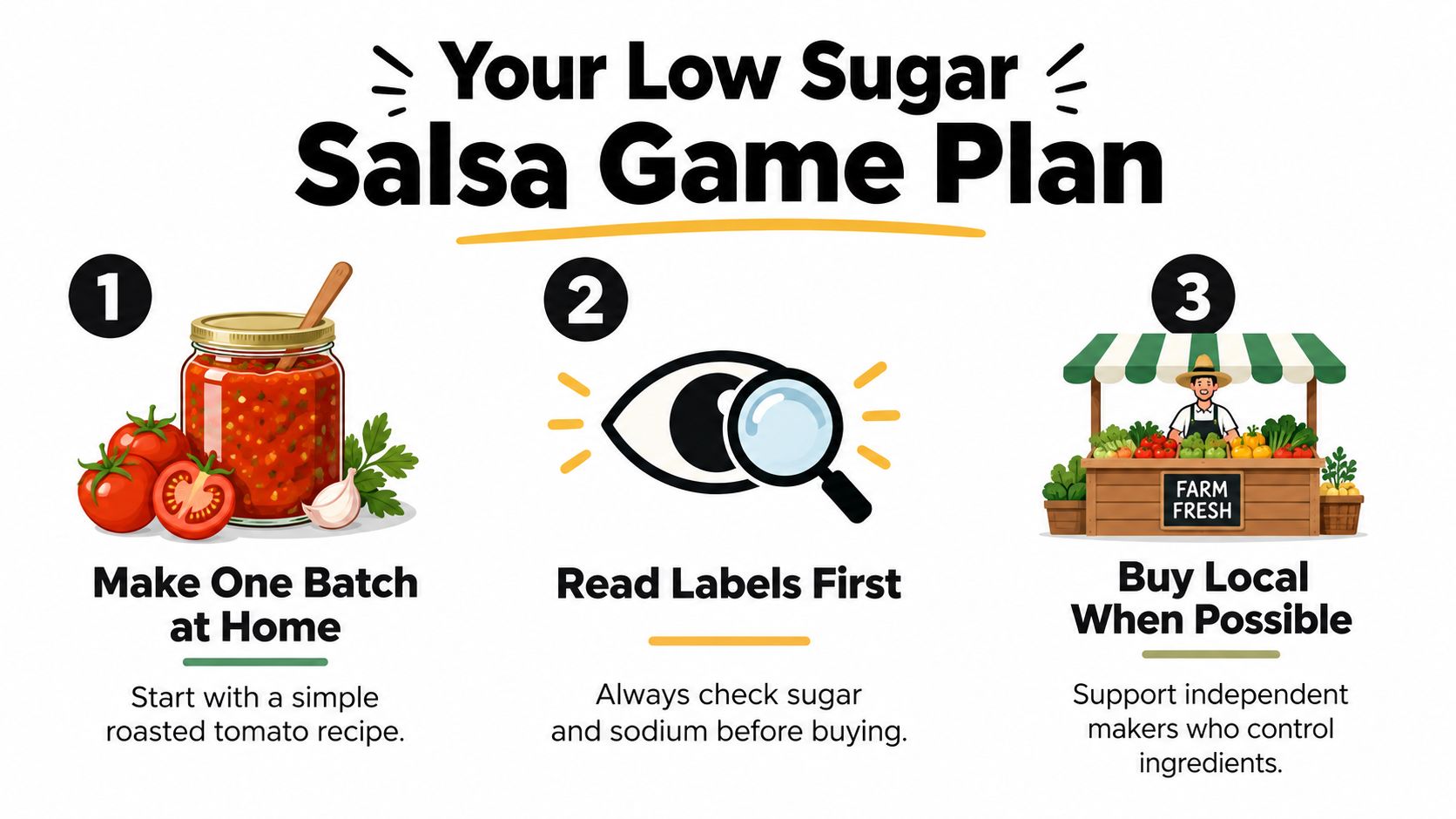
Then try one jar from an independent local maker. Buy it directly when you can, compare the ingredient list with a mass-market version, and pay attention to the difference fresh vegetables and careful roasting make. A good low sugar salsa should make food easier to enjoy, not turn every chip into a math problem.
Serve it with eggs, grilled chicken, fish, tacos, roasted vegetables, or crisp jicama sticks. Spoon it over beans, use it as a shortcut sauce for a grain bowl, or keep it beside grilled proteins when dinner needs brightness. The more useful the salsa is, the less temptation you'll have to buy a jar built around sugar and salt.
Local makers can offer a better product because they control the recipe more closely and can tell you what's inside. Loyaltie gives you a way to discover those independent brands and buy from them online, with the convenience of direct shopping rather than a crowded shelf.
Visit Loyaltie to discover independent US makers and compare local salsa products by their ingredients, serving information, and flavor style. Pick one direct-from-the-maker jar for your next taco night, then taste it beside your homemade batch and keep the one you'd happily buy again.