
The most popular advice about local skincare products is also the least useful: “Buy local because it's local.” Geography can tell you where a product was made, but it can't tell you whether the formula is stable, the label is complete, or the maker can explain what's inside. Treat locality as a starting point, then judge the product with the same curiosity you'd bring to a new coffee roaster: who made it, what went into it, how was it tested, and can you trace the result back to a real person?
The opportunity is worth exploring. The global natural skin care products market was estimated at USD 7.28 billion in 2022 and is projected to reach USD 11.87 billion by 2030, with a projected 6.3% compound annual growth rate from 2023 to 2030, according to Grand View Research's natural skin care market analysis. That growth reflects interest in transparent ingredients, gentler formulas, ethical sourcing, and products that feel closer to natural or small-batch production.
Table of Contents
- Ingredient transparency gives you something to inspect
- Smaller production can improve traceability
- Direct accountability changes the buying experience
- Start with pH
- Preservation is part of the formula
- Stability testing separates confidence from guesswork
- Check the label before you check out
- Look for a responsible contact
- Use compliance as a five-minute filter
What Local Skincare Products Really Mean in 2026
“Local” has become a flexible label. One maker may produce products in a city studio and sell at a farmers market. Another may source regionally, manufacture elsewhere, and ship through a national warehouse. A third may have started locally but now operates as a heritage independent brand with nationwide distribution.
For practical shopping, local skincare usually means a product made by an independent maker or regional studio, sold through the maker's own website, a farmers market, a local shop, or a curated marketplace rather than through a mass distributor. The same idea applies across local commerce, from city bakeries to regional wellness producers. The important distinction is not distance. It's the relationship between the maker, the formula, and the buyer.

Use locality as a filter, not a guarantee
A local maker may offer a shorter supply chain, more traceable sourcing, and a fresher production cycle. They may also be willing to answer questions that disappear inside a large corporate system. But those advantages only matter if the maker has built a sound formula and can show how they control quality.
The natural skincare category is now large enough to support specialized regional and direct-to-consumer sellers, not only multinational brands. One Business Research Company market report estimates the market at USD 22.8 billion in 2025 and projects USD 39.24 billion by 2030, roughly a 72% increase over that period at an 11.4% compound annual growth rate. Those figures are projections, not a guarantee for any individual maker, but they show why local skincare deserves more serious evaluation than a casual “buy handmade” label.
The quality questions matter more than the map
Before buying, ask:
- Who made it? Can you identify the responsible brand or maker?
- What's inside? Is there a complete ingredient declaration?
- Will it remain safe? Does the maker understand pH, preservation, packaging, and stability?
- Can you get help? Is there a real contact route for questions or adverse reactions?
That framework separates a meaningful local product from a product using locality as decoration. A regional ingredient or nearby studio can add value, but transparent formulation and accountable production are what make local skincare worth buying.
Why Independent Makers Can Be a Real Quality Upgrade
The strongest independent brands compete on details that mass-market packaging often hides. They can explain an ingredient's purpose, identify a batch, and discuss a reformulation without sending you through layers of customer service. That directness doesn't automatically make a product safer, but it gives you a better chance to evaluate the work before you buy.
Ingredient transparency gives you something to inspect
Look for a complete ingredient list rather than a vague “botanical complex” or “proprietary blend.” Recognizable ingredient names, clear product directions, and specific sourcing information help you compare formulas instead of judging them by words such as clean, pure, or natural.
A maker who lists rose hydrosol, glycerin, a preservative system, and the rest of the formula is giving you something concrete to assess. A brand that relies mostly on claims about purity is asking you to trust a story without showing enough of the formula.
Smaller production can improve traceability
A local studio may turn inventory more regularly than a national brand that needs products to sit through a long distribution cycle. That can matter for formulas containing oxidation-sensitive or easily degraded ingredients, but freshness is only useful when the maker controls storage, packaging, and testing.
A batch number and production date let you ask better questions. If the maker can connect your jar to a production record, ingredient lot, and release decision, you're not buying an anonymous product. You're buying something with a traceable history.
Direct accountability changes the buying experience
You can email an independent maker and ask whether the formula changed, whether a particular ingredient is present, or how to patch test the product. You can also observe how they handle a negative review, a damaged parcel, or a reported reaction.
Practical rule: A beautiful label is a pleasant extra. A complete formula, a traceable batch, and a reachable maker are quality signals.
| Signal | Independent Maker | Mass-Market Brand |
|---|---|---|
| Ingredient information | Often explains individual ingredients and sourcing | May emphasize a hero ingredient while giving less context |
| Batch visibility | May provide lot numbers, dates, or direct production details | Usually managed through a larger supply chain |
| Customer access | You may reach the maker or a close product team | You may communicate through standardized support |
| Formula changes | Can sometimes explain why a change occurred | Reformulation details may be harder to obtain |
| Quality evaluation | Personal accountability can make questions easier | Scale can provide consistency, but less personal visibility |
The right conclusion isn't that every independent formula beats every national formula. It's that buying directly can give you more evidence to work with. That evidence lets you choose based on formulation rather than packaging scale.
Reading a Skincare Formula Like a Formulator
A skincare label is a useful beginning, but it won't answer every technical question. The formula's pH, preservation system, water content, packaging, and stability history all influence whether the product remains effective and safe.
Start with pH
pH affects both skin compatibility and ingredient performance. Weak-acid preservatives such as sorbic acid and benzoic acid work best in acidic formulas because their antimicrobial activity depends on the undissociated form. Technical guidance from Safic-Alcan on natural preservatives notes that sorbic acid and potassium sorbate are most useful below about pH 5.5, with stronger performance closer to pH 4.0 to 5.0. Benzoic acid and sodium benzoate generally need an even lower pH for strong activity.
You don't need to become a cosmetic chemist. Ask whether the maker measures the finished product with a calibrated meter, what pH range they target, and whether they recheck it during stability testing.
Preservation is part of the formula
Any water-containing product needs a preservation strategy that can control microbial contamination. “Natural” doesn't mean self-preserving, and an attractive botanical ingredient list doesn't replace testing. Essential oils may contribute fragrance or some antimicrobial activity, but they shouldn't automatically be treated as a complete broad-spectrum preservation system.
A useful question is, “What protects this formula from mold and bacteria after opening?” The answer should connect the preservative to the product's pH, packaging, water activity, and ingredient interactions.
Stability testing separates confidence from guesswork
Finished-product challenge testing evaluates whether the actual packaged formula withstands microbiological stress. The independent review of cosmetic preservation and microbial protection explains that products face contamination during storage, transport, and consumer use, so protection needs to be demonstrated in the finished product rather than inferred from individual raw ingredients.
Look for signs of a disciplined process:
- Water phase present: The maker can explain the formula's water content and preservation approach.
- pH checked: The finished product has a measured target, not an assumption.
- Packaging considered: Airless packaging may reduce repeated exposure for suitable formulas.
- Expiration information: The package identifies a use-by date or relevant shelf-life guidance.
- Batch traceability: The maker can connect your product to a defined production lot.
For a practical formula example, you can inspect the Hydrating Face Serum with Rose Hydrosol, Hyaluronic Acid, Bakuchiol, and Glutathione and use the same questions before purchasing any local serum.
This video offers another visual way to think about reading skincare ingredients and product design:
How U.S. Labeling Rules Help You Judge a Maker
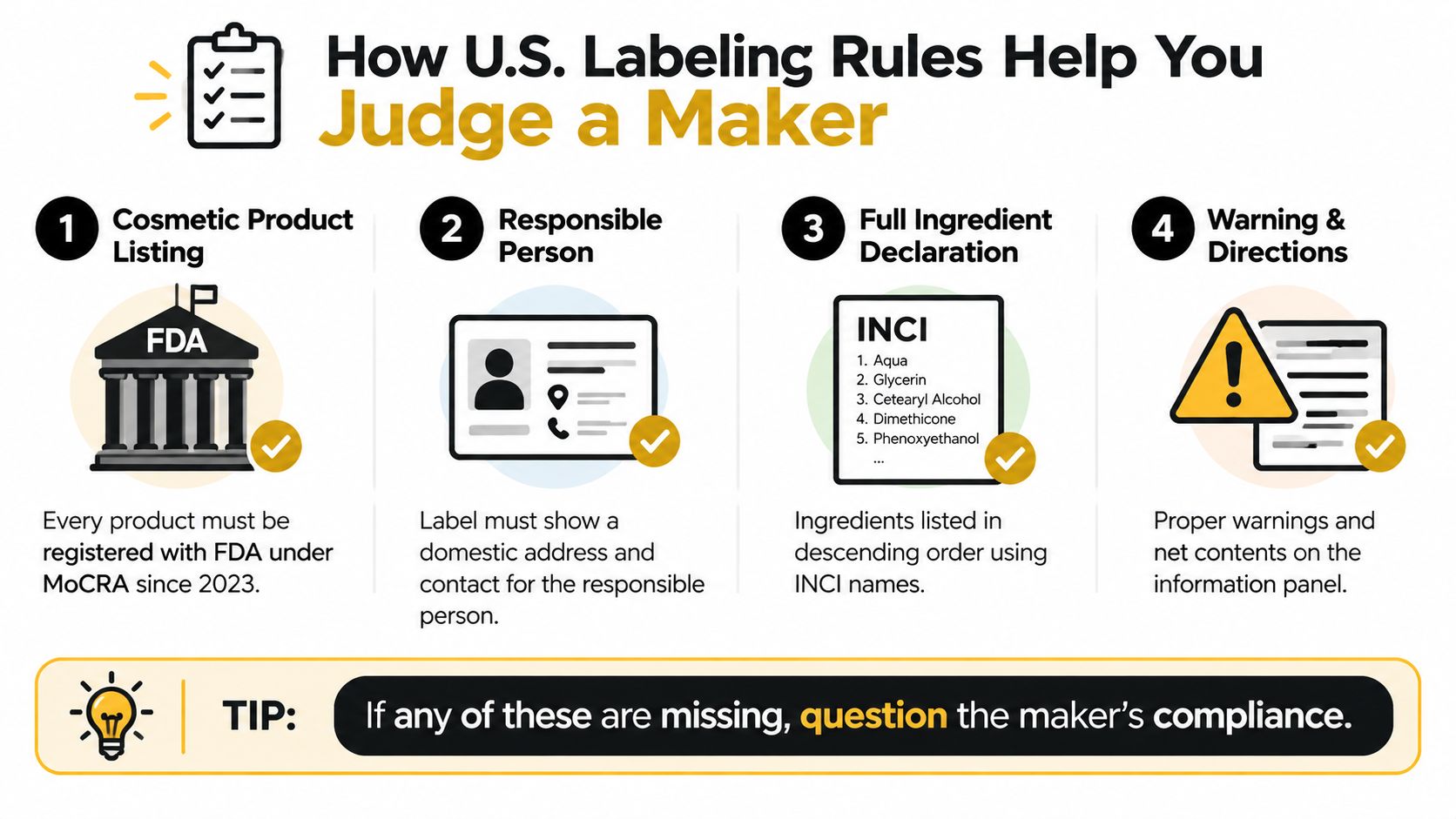
U.S. cosmetic rules give you a free screening tool. The FDA says cosmetics generally don't need premarket approval, except for color additives, but brands still must follow federal cosmetic and labeling requirements under the FD&C Act and FPLA. That means “made locally” doesn't excuse an incomplete label.
Check the label before you check out
A retail cosmetic should provide an identity statement, an accurate net quantity, and an ingredient declaration. The FDA summary of cosmetic labeling requirements explains that ingredients are listed in descending order of predominance, subject to the applicable rules for ingredients present at lower levels.
That order helps you test a marketing claim. If a product highlights a botanical but places it near the end of the ingredient list, the ingredient may be present mainly for label appeal rather than as a major part of the formula. The list won't tell you every concentration, but it gives you a more reliable starting point than the front label.
Look for a responsible contact
The Modernization of Cosmetics Regulation Act changed the compliance picture for U.S. brands. The FDA began enforcing facility registration and product listing requirements on July 1, 2024, and by December 29, 2024, cosmetic labels needed a U.S. address, phone number, or electronic contact route for adverse-event reports, as summarized in this MoCRA compliance overview.
A contact route matters because it connects the product to an accountable party. If a maker is difficult to identify, offers no usable contact information, or treats questions as an inconvenience, that's a reason to pause.
Use compliance as a five-minute filter
Check these items before buying:
- Ingredient declaration: Is the full list visible and readable?
- Identity and net quantity: Does the label clearly say what the product is and how much it contains?
- Responsible contact: Can you reach the business about safety or adverse events?
- Claims and directions: Does the maker explain use without making unsupported drug-like promises?
The FDA's small-business and homemade cosmetics guidance makes the central point clear: products sold directly by a maker still need to follow applicable cosmetic and labeling rules. Local production can make a brand easier to reach, but compliance is what makes that relationship meaningful.
Spotting a Trustworthy Local Skincare Brand
A trustworthy local skincare maker doesn't need a glossy origin story. They need a working system. You should be able to find a product batch, ask a technical question, understand the sourcing story, and learn what happens if the formula changes.
Start with the package. A batch number or lot code is more useful than a photograph of the studio. A production date, expiration guidance, storage instruction, and contact route show that the maker has thought about the product after it leaves the mixing room.
Ask questions that reveal process
Try questions such as:
- How do you test preservation in the finished product?
- What pH range does this formula target?
- How do you track ingredient lots and finished batches?
- Has the formula changed recently?
- What should I do if I experience irritation?
A serious maker might not publish every laboratory document, but they should answer clearly. “It's natural, so it doesn't need much testing” is not a reassuring explanation for a water-based product.
Sourcing stories should be specific too. “Locally sourced botanicals” tells you very little. A better explanation identifies the supplier or growing region, describes whether availability changes seasonally, and explains how the maker manages variation. Seasonal inputs can affect color, scent, texture, and even the amount of an active botanical, so consistency requires more than a warm relationship with a grower.
Watch how the maker handles friction
Read a few less-than-perfect reviews. Does the maker respond with useful information, or do they dismiss every concern? Check the return policy and look for an actual process for damaged, contaminated, or misidentified products.
A formula change deserves disclosure, especially when the ingredient list, scent, texture, or preservation system changes. The maker doesn't need to claim perfection. They do need to show that they notice problems, document decisions, and communicate with buyers.
That's the difference between a product made by someone practicing a careful formulation discipline and one assembled casually for resale. Locality may get the product onto your radar. Process determines whether it stays in your routine.
Matching Local Skincare to Your Skin Type
Your skin concern should guide the format you choose, not just the ingredient highlighted in large type. A thick balm can feel comforting but overwhelm oily skin, while a watery serum may leave dry skin searching for a second layer.
| Skin Type | Common Concerns | Formulation Features | Product Formats |
|---|---|---|---|
| Oily or acne-prone | Shine, clogged pores, uneven texture | Lightweight humectants, gel textures, carefully chosen niacinamide or zinc | Gel cleanser, light serum, non-greasy moisturizer |
| Dry or mature | Tightness, flaking, barrier discomfort | Occlusive structure, supportive lipids, stable emulsifier system | Cream, balm, richer moisturizer |
| Sensitive or reactive | Stinging, redness, fragrance intolerance | Shorter ingredient list, low fragrance, gentle preservation approach | Simple moisturizer, fragrance-free balm, mild toner |
| Combination | Oil in some areas, dryness in others | Layerable textures and targeted application | Lightweight serum plus selective cream |
For oily or acne-prone skin, a thinner humectant-led serum or gel often makes more sense than a heavy butter. Look for a maker who can explain why an ingredient is included, rather than placing “clarifying” on the front of the jar.
Dry or mature skin often benefits from a formula that combines water-binding ingredients with emollient and occlusive components. Ask how the emulsifier system supports the texture and whether the product remains stable under the storage conditions you'll use at home.
Sensitive skin requires restraint. Fragrance, essential oils, and a crowded botanical list can complicate patch testing. Ask for the complete INCI list, request patch-testing guidance, and find out whether the maker announces reformulations.
If you're evaluating products for an event or community program, practical resources such as sunscreen giveaways with logo can help you think about format, labeling, and portability without confusing promotional samples with a complete daily skincare routine.
For a richer, balm-style option, compare the ingredient approach and intended use of Whipped Grass-Fed Tallow Balm with Calendula and Jojoba. Whatever you choose, patch test first and introduce one new product at a time.
Your Starter Kit for Buying Direct from Local Makers
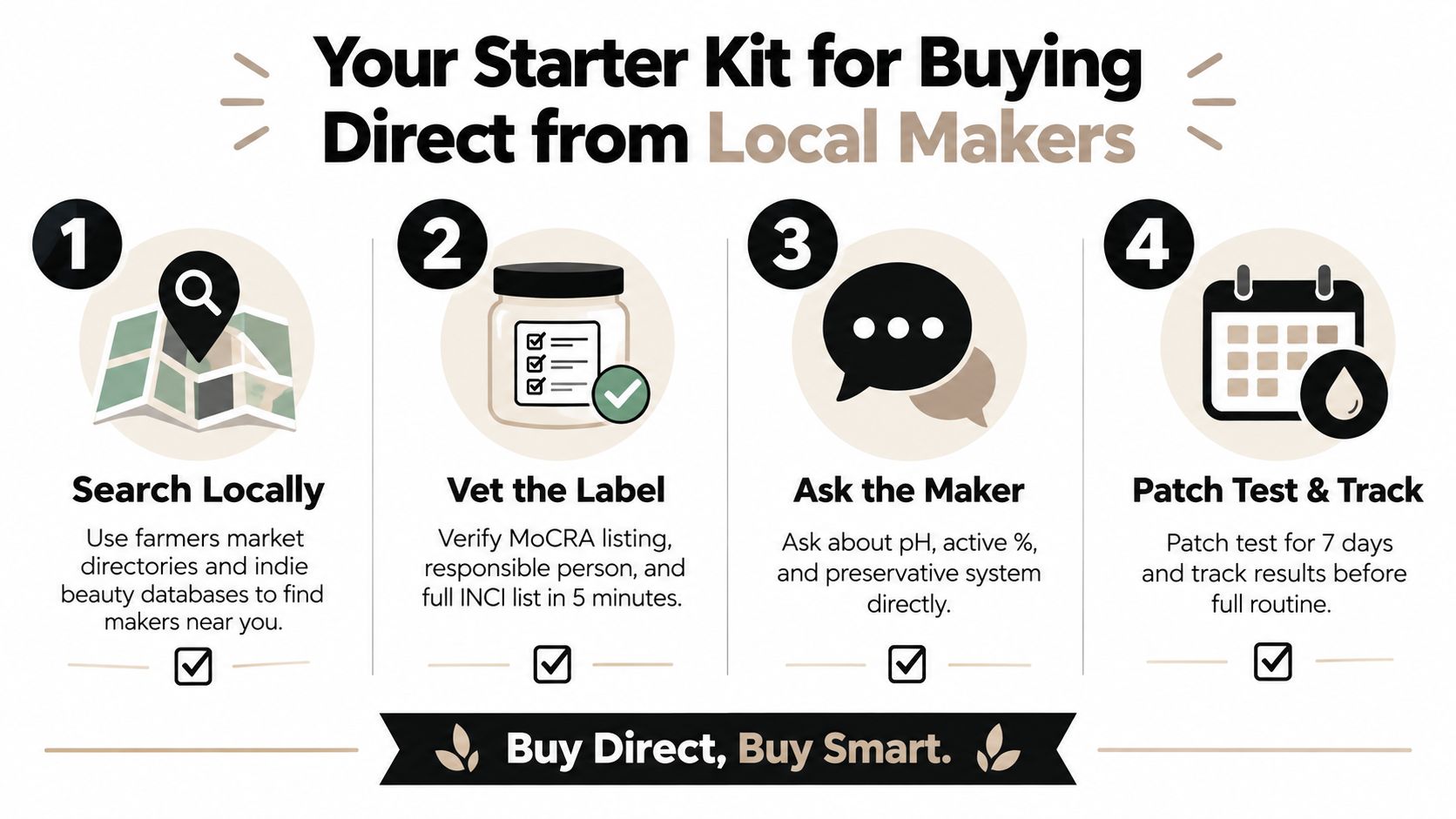
You don't need to replace your entire routine at once. A calmer approach is to build a short list, inspect each maker, and start with one product whose format matches your skin.
Search locally. Check farmers market directories, regional maker collectives, independent beauty databases, and direct websites. Look for brands that identify where they make products and how you can contact them.
Vet the label. Confirm the ingredient declaration, net quantity, responsible contact, batch information, directions, and storage guidance. Ask about pH and preservation when the product contains water.
Start with one or two products. A cleanser or moisturizer is easier to evaluate than a full routine with several new actives. Keep your other products steady so you can tell what changed.
Track the experience. Patch test cautiously, note the date you began, and record changes in comfort, dryness, redness, texture, or breakouts. Give yourself a consistent observation window rather than judging the product after one use.
A curated marketplace can reduce the discovery burden by bringing independent brands, product information, and direct purchasing into one place. If you're building a simple first routine, you can review a Skincare Starter Kit with Tsubaki, Camellia, and Jojoba while applying the same label and formulation questions.
Makers also need to be findable. If you run a local skincare site, resources covering essential local SEO plugins for your site can help you present your location, product categories, and contact details clearly to nearby shoppers.
Visit Loyaltie to discover and buy directly from independent brands across the United States, including local skincare makers you can evaluate without a middleman. Start with one clearly labeled product, ask the maker your technical questions, and build your routine around formulas that earn your trust through evidence.