
You know the feeling. You open the fridge, see a bag of tired greens, and realize your last grocery run was mostly a race through bright aisles, plastic clamshells, and produce that looked good enough but didn't taste like much. You wanted food that felt fresher and more alive. What you got was another week of “fine.”
Local organic food delivery changes that rhythm in a very practical way. Instead of buying whatever survived the longest trip and happened to be on the shelf, you get closer to food that was grown with more care and moved through fewer hands. That usually means better flavor, more seasonality, and a stronger sense that someone real grew or made what you're eating.
This isn't a niche habit anymore. In the U.S., certified organic product sales reached $76.6 billion in 2025, up 6.8% year over year, with organic food sales alone totaling $70.1 billion and representing a 6.1% penetration rate of the overall food market. The Organic Trade Association also projects organic sales will add another $24 billion over the next five years and cross the $100 billion threshold in 2030 (Organic Trade Association market update).
If you're already looking for a smoother way to eat well during busy weeks, something like Nourish Meal Delivery can make the idea of better food feel a lot more doable.
Table of Contents
- CSA for people who like seasonality and trust the farm
- Food hubs and market-style delivery for flexible weekly ordering
- Direct from a farm or maker for a closer relationship
- Make your first orders easy on yourself
- Store it well so you actually use it
- How local delivery can fit more budgets
More Than Just Groceries The Rise of Local Food Delivery
It often starts on a tired weeknight. You unload another grocery order, slice into a tomato that looks flawless, and get almost no flavor back. After a few rounds like that, local organic food delivery starts to feel less like a trend and more like a practical upgrade.
What changes is not only convenience. The whole chain gets shorter. Food can move from a nearby field, bakery, dairy, or kitchen to your door with fewer handoffs, which often means better texture, better flavor, and a clearer sense of who produced it. If you are comparing options and want a closer-to-home meal route, local meal delivery options with a direct sourcing focus can be one way into this broader local food system.
The appeal is easy to understand once you try it for a few weeks. A bunch of greens picked recently behaves differently in your fridge than produce that has spent more time in transit. Bread from a nearby baker has a story attached to it. Eggs from a regional farm stop feeling like a generic carton and start feeling like part of a place.
Why it feels like an upgrade
The first difference is sensory. Local produce often tastes fuller because it spends less time traveling and waiting. Seasonal eating helps, too. You stop forcing the same out-of-season routine every month and start building meals around what is good right now.
There is also a relationship piece that allows local delivery to stand apart from a standard grocery app. You may see the farm name on your box, a note from the baker, or a weekly message explaining why asparagus showed up and tomatoes did not. That small bit of context works like meeting the person behind the product instead of only seeing a label on a shelf.
Practical rule: If a service helps you understand where your food came from and why this week's selection looks the way it does, it usually offers a more thoughtful buying experience.
Another reason this category keeps growing is simple. It fits real life. People want food that tastes better, feels more trustworthy, and does not require a Saturday morning trip across three different markets to get it. Local food delivery brings those pieces together in a way that can feel more connected without making dinner harder.
What Local and Organic Really Mean for Your Food
“Local” and “organic” get tossed around so often that they can start to sound vague. They're not vague. They point to two different things, and when they come together, you usually get food with a shorter, clearer story.

Local is about distance and timing
Think of local food like a direct conversation. The fewer steps between the grower and you, the less gets lost. A nearby farm harvests, packs, and sends produce out fast. A longer supply chain works more like a message passed through a big group. It can still arrive, but it often arrives later and flatter.
Local doesn't always mean a fixed mileage rule in real life. It usually means the food is coming from your region, your state, or a nearby network of growers and makers. The important part is that the chain is shorter, the timing is tighter, and the food often reflects what's in season where you live.
Organic is a standard and a growing approach
Organic refers to a certified production system, and for many shoppers it also signals a broader growing philosophy. You're looking for food produced without synthetic pesticides, herbicides, or fertilizers that are disallowed under organic standards, along with rules around livestock feed, outdoor access, and ecological practices.
If you want a plain-English primer on how certification works on the land side, this overview of organic land certification from Farm & Country Insurance is useful because it helps decode the process without turning it into a legal document.
Here's where people get confused. Local and organic are not the same thing. Local tells you about proximity. Organic tells you about production standards. Some local farms are certified organic. Some follow similar methods but aren't certified. Some certified organic products travel far. You're often choosing how much each part matters to you.
Farm to People offers a good example of how this shorter chain can affect waste, too. It says it keeps waste under 1% by letting farmers harvest only what is needed (Farm to People). That's a helpful reminder that delivery doesn't automatically mean more spoilage.
A small practical detail can support this whole routine. An Organic Cotton Tote Bag, 100% Certified Cotton Twill, Heavy-Duty Grocery & Travel, 20×14×5 in, 6 Gallon, 2 Colors | JudyMakesJuices by Loyaltie is a useful carry option if you're picking up market orders or combining home delivery with a quick add-on shop. It's described as a spacious certified organic cotton twill tote with a flat bottom for easier packing and a 30 lb weight capacity.
Local organic food delivery works best when you stop treating it like a purity test and start treating it like a better way to source the food you buy most often.
Finding Your Perfect Food Delivery Model
There isn't one right model. There's the model that fits your week, your cooking habits, and how much surprise you enjoy.
A lot of people quit local delivery too quickly because they chose the wrong format, not because the food was bad. Start by matching the model to your actual life.

CSA for people who like seasonality and trust the farm
A CSA usually means you buy a share of a farm's harvest and receive regular boxes as the season moves along. This can be the most direct relationship with a farm, and often the most immersive one.
This model is great for you if you:
- Enjoy cooking around the season: You're happy to ask, “What do I make with this?” instead of “Why isn't this here all year?”
- Don't need perfect control: You can roll with surprise turnips or an extra bunch of greens.
- Want a closer farm connection: You like knowing one farm is filling most of the box.
The tradeoff is flexibility. CSAs can be less customizable, and the weekly contents may not line up with a picky household.
Here's a quick visual if you want a broader look at local food options before choosing one.
Food hubs and market-style delivery for flexible weekly ordering
This model feels more like a farmers market you shop from your couch. A delivery service gathers produce, dairy, bread, pantry goods, or prepared foods from several local producers and lets you build an order.
This is often the easiest entry point for busy households because you can choose what you'll use. You keep the local angle without committing to a surprise box every week.
A few signs this model fits you:
- You need control: You want to pick apples, skip beets, and add yogurt.
- You shop for a household: Different tastes are easier to handle when you can mix categories.
- You want regular delivery without feeling locked in: Many of these services make changes simpler.
USDA's Economic Research Service reports that the share of organic food sold to consumers via the internet rose from 2% in 2012 to 6.7% in 2024, while certified organic cropland increased 79% to 3.6 million acres and certified organic operations grew by more than 90% to 17,445 farms over 2011–2021 (USDA Economic Research Service organic agriculture overview). That helps explain why these online regional models keep getting easier to find.
If you also like buying prepared items directly from nearby food businesses, Complete Body Juice Bar is the kind of listing that shows how local online ordering can extend beyond raw produce.
Direct from a farm or maker for a closer relationship
Sometimes the simplest option is buying straight from one farm, orchard, bakery, dairy, or maker through its own site. This works well when you already know what you love.
Use this route when:
- you want the same eggs, bread, mushrooms, or produce every time
- you care more about source loyalty than browsing lots of vendors
- you want to buy directly from the maker with no middleman in the shopping experience
A short comparison makes the difference clearer:
| Model | Best fit | Main tradeoff |
|---|---|---|
| CSA | Adventurous cooks, seasonality lovers | Less control over contents |
| Market-style delivery | Busy households, flexible planners | Slightly less direct than a single-farm relationship |
| Direct from one farm or maker | People with favorites | Narrower selection |
How to Find and Choose a Local Delivery Service
Finding a good local organic food delivery service is partly search, partly detective work. The fastest route is usually a mix of online browsing and one offline question asked in the right place.
Where to look first
Start with the obvious local terms in search, but don't stop there. Farmers' markets are still one of the best discovery tools because growers will often tell you whether they deliver, offer pickup, or work with a neighborhood food hub. Farm stands, local co-ops, and community food groups can also point you toward services that don't spend much on marketing.
If you're comparing several options, make a short list with three columns: what they sell, how often they deliver, and how clearly they name their producers. That alone will remove a lot of fuzzy options.
Ask one simple question before ordering: “Who actually grew or made this?” The better services answer that quickly and clearly.
What to check before you place an order
Once you've found a few candidates, look beyond the homepage photos.
- Delivery zone and timing: Make sure they serve your address on days that match how you cook. A Wednesday afternoon drop-off sounds fine until you realize no one is home.
- Sourcing transparency: Strong services name the farms, makers, or regions involved. You shouldn't have to guess whether “local” means nearby or just domestic.
- Ordering flexibility: Look for the ability to skip a week, swap items, or adjust your order without friction.
- Packaging approach: You want sensible packaging, not overbuilt packaging. Reusable bins, returnable insulation, and simple recyclable materials are usually good signs.
- Product mix: Some services are produce-first. Others include dairy, bread, pantry goods, or prepared meals. Pick the one that matches what you typically buy.
- Customer feedback: Read reviews for the practical stuff. Was the produce fresh? Was delivery reliable? Did the service respond when something went wrong?
Cold handling is more critical than often appreciated. Industry analysis of organic logistics highlights cold chain management and cross-contamination as core challenges, which is why careful operators use temperature checks at pickup, insulated last-mile packaging, and route planning that keeps food from sitting around too long (Inbound Logistics on organic food logistics).
That sounds technical, but you can spot it in simple ways. If a service explains how perishables are packed, separated, and delivered quickly, that's a good sign. If it says almost nothing about handling, I'd be cautious with delicate greens, dairy, and prepared foods.
Ordering Storage and Making It Affordable
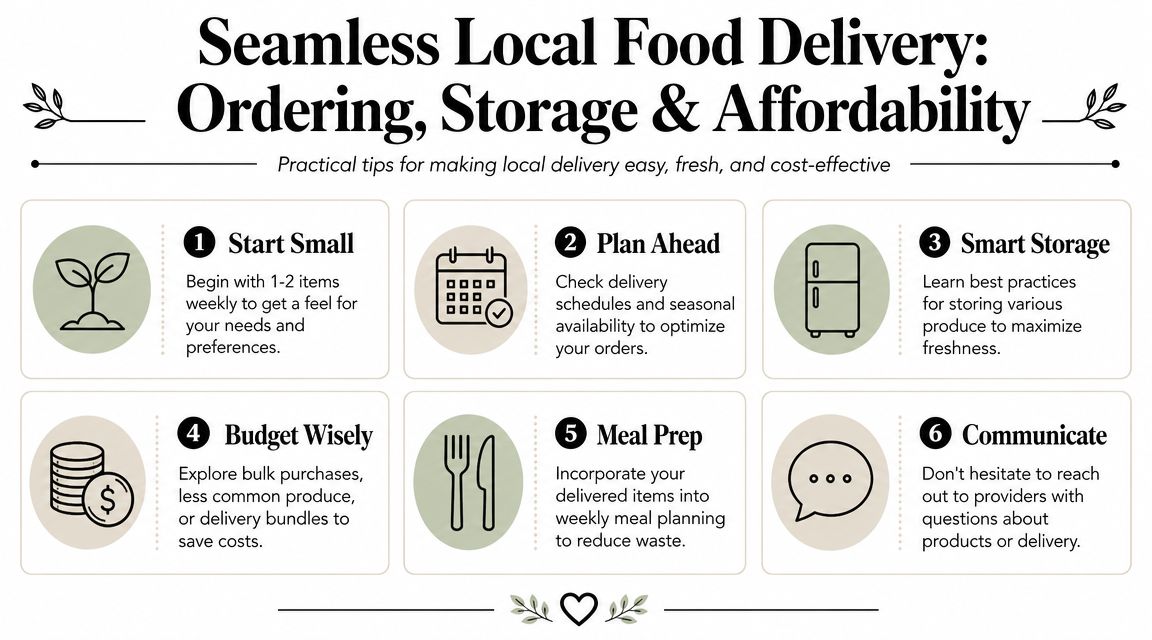
A good first order should make your week easier, not turn your kitchen into a guilt pile of produce you forgot to use. The smartest approach is to begin small and build a routine you can keep.
Make your first orders easy on yourself
Start with food you already know you eat. Salad greens, apples, eggs, bread, yogurt, carrots, or one prepared item usually work better than an ambitious “new season, new me” box full of unfamiliar vegetables.
A simple first-week strategy looks like this:
- Pick a few staples: Choose items you'll definitely finish.
- Plan two meals: Tie your order to actual dinners, not vague intentions.
- Leave room for one fun item: One surprise herb, fruit, or vegetable keeps it interesting without becoming homework.
Order for your real week, not your fantasy week.
Some services also help by letting you change delivery frequency or skip when life gets busy. That kind of flexibility matters a lot more than polished branding.
Store it well so you actually use it
Storage is where a lot of good intentions fall apart. If you learn a few basics, local organic food delivery becomes much easier to stick with.
- Leafy greens: Keep them cold and dry, and move them out of any soggy bag quickly.
- Herbs: Treat tender herbs gently and use them early in the week.
- Root vegetables: These are your patient ingredients. Save them for later meals.
- Fruit: Keep an eye on ripeness. Some fruit should stay out first, then move to the fridge.
The broad rule is simple. Eat the delicate things first and save the sturdy things for later.
How local delivery can fit more budgets
People often assume local organic delivery is only for households with a lot of room in the budget. That's not always true. The cost picture changes when you waste less, buy fewer random extras, and stop panic-ordering takeout because there's “nothing to make.”
Access programs matter here too. Fresh by 4Roots accepts SNAP EBT online, offers a dollar-for-dollar match on Florida-grown fruits and vegetables through Fresh Access Bucks, and provides free home delivery for SNAP recipients in Orange County (Fresh by 4Roots program details). That's a strong example of local delivery being designed around access, not just convenience.
A few budget-friendly habits help:
- Choose in-season produce: It usually gives you the easiest path to better flavor and value.
- Build meals around overlap: If cilantro goes into tacos, soup, and eggs, you'll use the whole bunch.
- Mix categories thoughtfully: Use local organic produce where you care most, then fill the rest of your cart strategically.
- Read labels calmly: “Certified Organic” means a defined standard. Other phrases may reflect growing philosophy, but they don't all mean the same thing.
A Simpler Way to Buy Directly From Local Makers
If the hard part for you isn't interest but discovery, a marketplace can remove a lot of friction. Instead of hunting across dozens of individual sites, you can browse products from independent brands in one place and buy directly from the maker.

That's where Loyaltie fits. It's a marketplace where people discover and buy directly from the best independent brands in the US. For shoppers trying to avoid mass-produced defaults, that means one account, a more direct buying path, and a clearer connection to who made the product.
Local food shopping often breaks down at the search stage. You know the kind of products you want, but finding reliable independent brands one by one takes time. A marketplace format keeps the no-middleman feel of buying directly from the maker while making the online experience simpler to use.
A good platform also helps with the part people don't talk about enough, which is confidence. You want to know what you're buying, who it comes from, and whether the ordering experience will feel smooth instead of improvised.
The sweet spot is simple: real products from real people, with less digging and less guesswork.
A Quick Guide for Local Growers and Makers
If you're a grower, baker, or food maker thinking about delivery, start tighter than you think you should. A small radius, a manageable menu, and a clear handoff process beat a wide service area with constant last-minute scrambling.
Organic operations have real constraints. One synthesis reports that organic arable yields are about 20–40% lower than conventional, horticultural yields about 50% lower, and labor needs 10–90% higher depending on farm type (Sustainable Nutrition Initiative summary). That means inventory swings and limited SKU depth aren't signs you're failing. They're part of the operating reality.
A practical starting approach looks like this:
- Keep the assortment focused: Sell what you can pack consistently and proudly.
- Batch deliveries carefully: Group orders by day and geography so food spends less time in transit.
- Write clear availability notes: Customers are usually understanding when expectations are honest.
- Use strong order communication: Pickup windows, substitutions, and product handling instructions should be easy to read.
- Improve the online buying flow: If you need help thinking through customer touchpoints, this guide to ecommerce customer experience strategies is a useful place to sharpen the basics.
You don't need to mimic a giant retailer. You need a system that protects product quality, respects your time, and makes it easy for buyers to reorder from you directly.
If you want a simpler way to discover and buy directly from independent brands and local makers across the US, take a look at Loyaltie. It brings the convenience of online shopping to products made by real people, so finding better food and everyday essentials feels straightforward instead of time-consuming.