
You know that moment in the aisle when you pick up a bag of coffee or a bottle of lotion and think, it's fine, but it's not exciting? That's usually the gap a local commerce marketplace fills. It helps you find the independent brand one neighborhood, town, or state away that made something better, without making you dig through a dozen tabs or give up the convenience of online shopping.
The appeal isn't charity, and it isn't a cute idea about “supporting small business.” It's getting everyday products that feel more alive, more specific, and more worth paying attention to. Coffee with a roast date that matters. Skincare with ingredient lists you can read. Food, pet care, supplements, and home goods made by people who know what they're making.
Table of Contents
- Discovery needs to be smarter than a social feed
- Trust needs to be visible, not implied
- Fulfillment has to respect small-batch reality
The Everyday Moment a Local Commerce Marketplace Solves
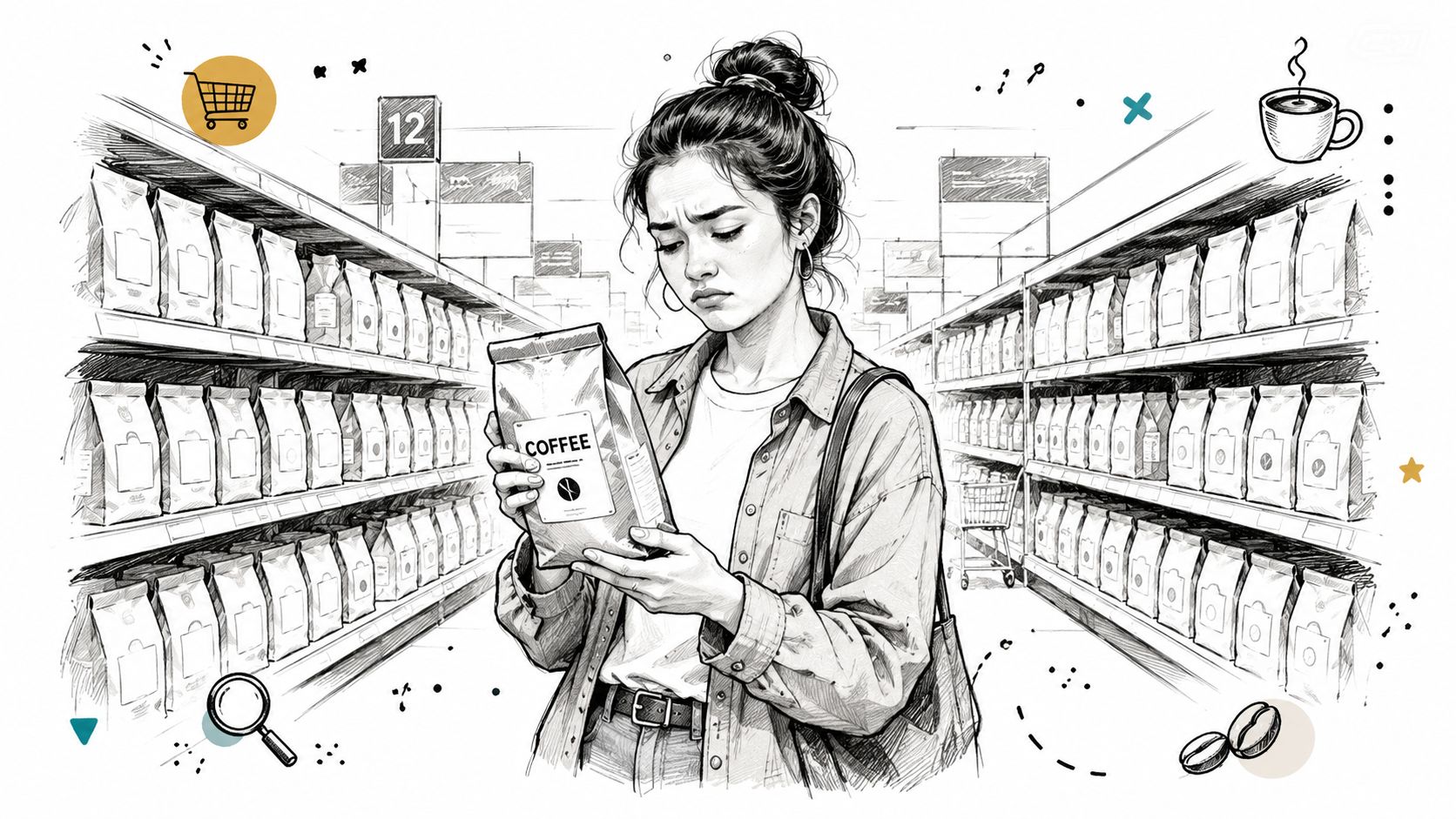
You're standing in a store aisle with two nearly identical products in your hands. One is the big brand you already know, the other is the generic version that looks slightly more thoughtful but still feels like it came off a conveyor belt. You scan the label, shrug, and grab the one that seems least annoying.
That is the exact moment a local commerce marketplace is useful. It doesn't ask you to become a detective or a loyalist to a logo. It gives you a better path to the stuff you already buy, but from independent brands and local makers whose products often have more care, better ingredients, and sharper ideas behind them.
Why that matters in real life
The problem is not that better products don't exist. The problem is discovery. A roaster across town, a skincare maker in another state, or a pet food brand with better sourcing can be almost impossible to find through normal online shopping, even when the product is exactly what you wanted.
A local commerce marketplace acts like the missing layer between your everyday need and the people making something better. Instead of forcing you to jump from search results to brand sites to social posts to a checkout page that may or may not feel safe, it brings everything into one place. That's the part shoppers feel immediately, even before they know the terminology.
Practical rule: if you're already buying the same kinds of products every week, the upgrade usually isn't a new category, it's a better version of the category you know.
For shoppers, that means less friction. For makers, it means a real chance to be found. And for the whole market, it means the products you use can be chosen with more confidence and less guesswork.
What a Local Commerce Marketplace Actually Is
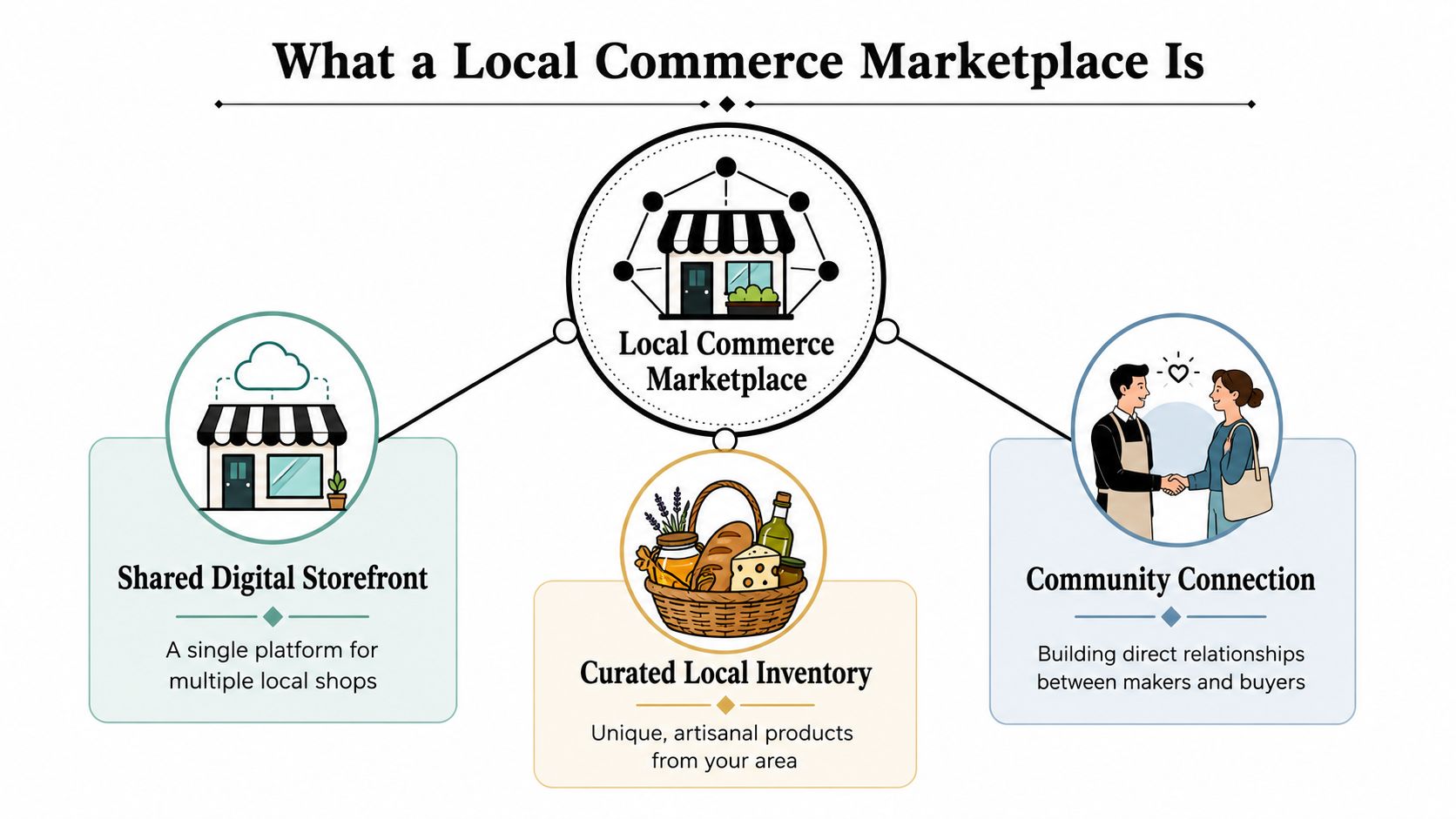
Think of a farmers market that learned how to load instantly on your phone, accept one checkout, and sort the stalls so you can find what you want fast. That's the simplest version of a local commerce marketplace. It's a shared digital place where multiple independent sellers show up under one roof, but the roof is software.
The three parts that make it work
The first part is shared storefront. You're not visiting fifty separate websites. You're entering one place where local makers and independent brands can be discovered side by side. The second part is curated inventory, which means the marketplace is organized around real products and real sellers, not just a generic catalog of anonymous third-party listings. The third part is single checkout, which gives you one payment flow, one order view, and one layer of protection rather than a patchwork of disconnected carts.
A good version also has logistics underneath it. That might mean delivery, pickup, or a shipping flow that gives you realistic timing and clear updates. The point is not to make everything instantaneous. The point is to make it reliable.
A generic marketplace usually optimizes for scale and randomness. A single brand's website optimizes for one seller only. A local commerce marketplace sits in the middle. It helps you discover a coffee roaster twenty miles away and a skincare maker across the state in the same session, because it organizes around maker identity and geography, not one retailer's stock.
If you want a parallel outside shopping, Bornbir's guide on how to get matched with care providers shows a similar idea in another category, a single place helps you match with the right option instead of making you search everywhere on your own.
For a shopper, that's the whole sentence: a local commerce marketplace is one place to discover, compare, and buy directly from independent local brands without losing the ease of online shopping. You can see the same kind of structure on Loyaltie, where the buying experience is built around that direct connection.
Why Shoppers Win When They Buy This Way
The shopper benefit is easy to feel once you try it. Everyday products can feel more specific, more cared for, and more worth your attention, while you still buy them through one place instead of chasing five separate brand sites. That is why this model fits coffee, skincare, pet products, wellness goods, and food so well.
The upgrade feels practical, not ideological
A fresh coffee roast often tastes different in the cup than something that has been sitting around for too long. Skincare from an independent maker can come with shorter ingredient lists and clearer sourcing language. Pet food, supplements, and pantry staples can feel less mysterious too, because the people making them are visible and the product page usually explains what is inside.
That is the value for shoppers. The marketplace layer keeps the better product experience convenient, so you can compare options in one place, keep one cart, and track delivery without jumping between separate checkouts. If you buy the same item again and again, reorder flows and regular delivery patterns make the whole thing even easier.
Shipping from a smaller-batch maker can take a little longer than warehouse-fast delivery. That part is normal. The product is often being made in smaller runs by real people who are paying attention to quality, instead of sitting in a giant fulfillment center waiting to move.
Good rule of thumb: if you want speed above all else, warehouse retail wins. If you want a better product with a calmer buying experience, a local marketplace usually wins.
You are not paying for romance. You are paying for a product that often feels more considered, plus a buying process that does not make you work for it. That is why shoppers come back.
For a grounded food example, the benefits of eating locally grown food are a helpful companion read, especially if you care about where your pantry staples come from and why that changes the eating experience.
A small scene makes it clearer. You order a bag of coffee from a roaster nearby, or a jar of pantry staples from a maker who chose the ingredients themselves. The package arrives, the label makes sense, and you know who to return to next time. That kind of trust is hard to build with anonymous retail.
The deeper win is trust. You know who made what is in your kitchen or on your shelf, and when you need more, you can reorder directly from the maker instead of going through a chain.
Why Independent Brands and Makers Win Too
Most independent makers are already strong at the part customers can taste, use, or wear. They know how to roast, formulate, bake, blend, design, package, or source. What usually drains them is everything wrapped around the craft, getting found, taking payment, answering repeat questions, and handling the messy parts of fulfillment.
Less operational drag, more time for the actual product
A local commerce marketplace takes on a lot of that load. A maker keeps control of the product while the marketplace handles the shared infrastructure that would otherwise have to be built piece by piece. That includes the storefront, payments, discovery, and customer support. Each one seems small on its own, but together they can swallow the hours that should go into making better goods.
The business upside is easy to see. Sellers get in front of buyers who are already looking for local alternatives and are already ready to buy. They also benefit from shared trust signals, like reviews and buyer protection, which are hard to build alone. Once a maker has a few products moving, the marketplace can also support repeat buying through reorder or regular delivery patterns, which often matters more than one-off traffic that disappears after a visit.
That is why selling through a platform like Loyaltie can make sense for independent brands that want to reach nearby buyers without running their own full storefront. The maker stays in charge of the product. The marketplace handles the machine around it.
What makers get back: time, cleaner operations, and a better shot at being discovered by the right buyer.
The economics shift too. Wholesale can hide the maker behind someone else's shelf. A standalone site can work, but it often puts the entire burden of discovery on the brand. A marketplace gives the maker a place where shoppers are already comparing options, which is a much better starting point for direct-to-buyer growth.
A small repeat-buy scene makes the advantage obvious. A buyer tries your coffee once, then comes back for a regular delivery. Someone buys skincare one month, then adds body care the next. That kind of relationship is easier to build when the marketplace keeps the door open and makes returning simple.
How Trust, Discovery, and Logistics Actually Work
The best local marketplace experiences don't feel magical because they're vague, they feel smooth because three systems work together. Discovery. Trust. Fulfillment. If one of those breaks, the whole thing feels off.
Discovery needs to be smarter than a social feed
Geospatial search is a big part of that discovery layer. The architecture in hyperlocal marketplace work uses MongoDB geospatial indexing, plus role-separated JWT authentication and a three-tier flow from React client to JWT middleware to Express router to MongoDB, because nearby search has to be fast and location-aware as listings grow. That's the technical side of a simple shopper promise: you can find what's close to you without waiting on a slow, brute-force search.
Trust needs to be visible, not implied
Trust comes from clear maker profiles, ingredient and sourcing details, secure payments, and reviews from real buyers. Buyers want to know who made the thing, where it came from, and what happens if something goes wrong. The marketplace has to make those answers easy to see before checkout, not after a problem shows up.
Fulfillment has to respect small-batch reality
Logistics is where a lot of platforms get sloppy. Handmade goods and small-batch products need careful packaging, realistic windows, and communication that doesn't oversell speed. A good marketplace absorbs a lot of that complexity so makers don't have to become shipping experts just to sell a loaf of granola or a bottle of lotion.
A marketplace is only as good as its boring parts. If payments, search, and order handling are clean, the buyer experiences the product, not the plumbing.
That's why marketplace architecture is usually layered. Guides on marketplace tech stacks point to separate storefront, business logic, data, and integration layers, with tools like Next.js or React for the storefront, Node.js, NestJS, or Express for logic, PostgreSQL for transactional records, Redis for caching and queues, Elasticsearch for search, and Stripe Connect for multi-seller payments. The reason is practical. Search should not slow checkout, and payouts should not depend on media loads or browsing spikes. Netguru's marketplace stack guide lays out that kind of separation clearly.
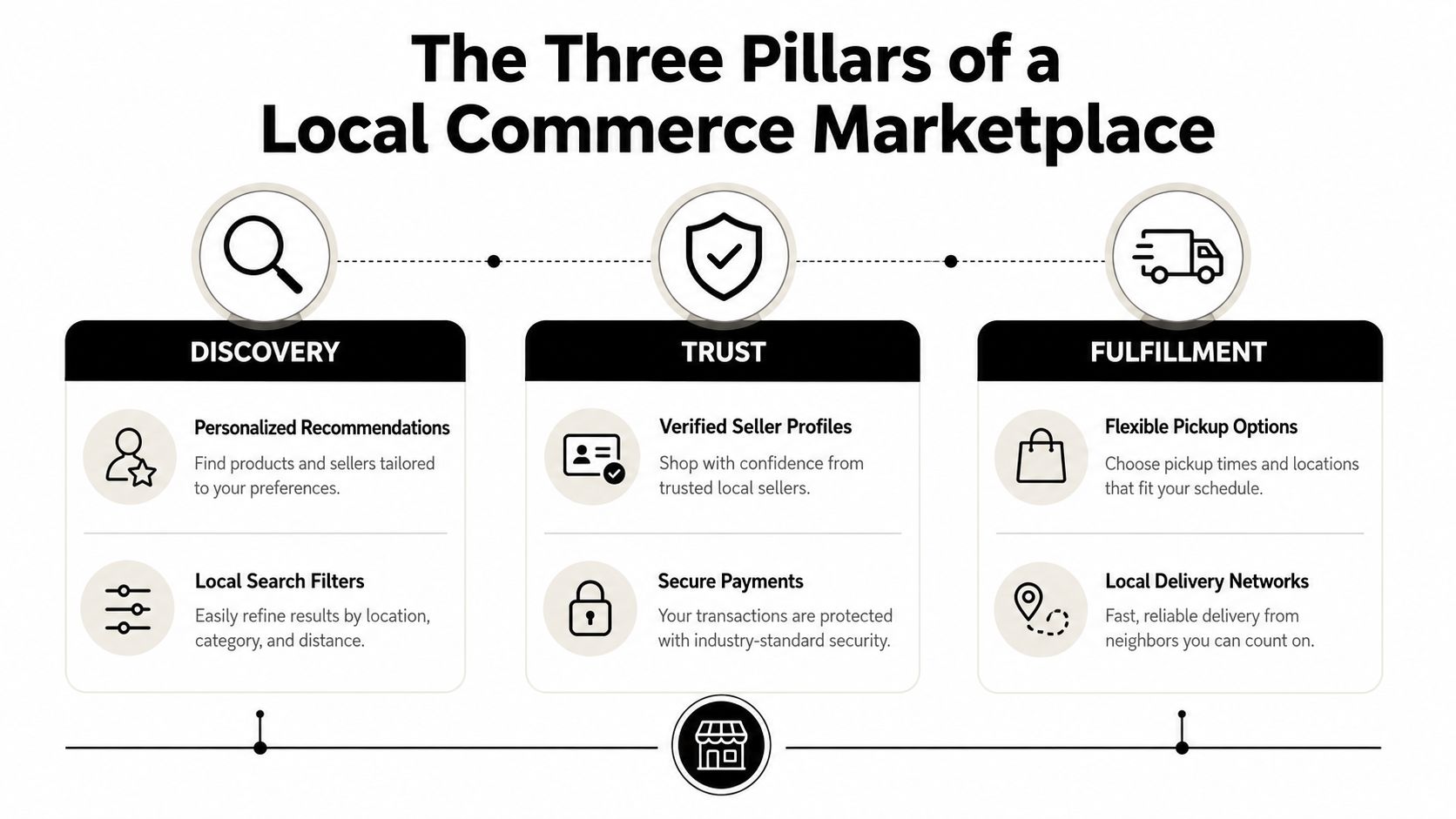
The magic, if you want to call it that, is a stack of ordinary decisions done well.
What Buying on a Local Commerce Marketplace Looks Like in Real Life
You're making coffee on a Tuesday night and realize the bag in your cupboard is uninspiring. So you search for a better one. A marketplace built for local brands surfaces a few independent roasters, each with tasting notes, roast dates, and enough detail to help you compare without opening ten browser tabs.
A normal search turns into a clearer decision
One roaster leans bright and citrusy. Another feels darker and more chocolate-forward. You compare them side by side, add one to the cart, and check out without leaving the platform. That's the difference between browsing and making a decision.
The same pattern works when you're stocking weekly staples. A jar of hot honey for pizza night, a granola for weekday breakfasts, and a wellness product you use in the evening can all live in the same account. If the products are the sort you reorder, you can keep them in a regular delivery rhythm instead of rebuilding the same order from scratch every time.
A concrete example helps here. Chile de Árbol Hot Honey is the kind of item that fits naturally into a local marketplace shopping habit, something you can use on dinner tonight and then reorder later without changing platforms. The same goes for a breakfast item like granola, where the point is not novelty, it's having something you want to keep around.
You can also discover products that aren't just edible or topical. The Triple Macrame Plant Hanger, Natural Cotton, Wall Mounted 3-Pot Display for Small Planters, 26x13 in | Evolve Botanica co by Loyaltie turns a blank wall into a mini plant gallery. It's handwoven from natural cotton and designed to hold three small planters in one compact display, which is the kind of object that feels more considered than a random mass-produced version.
After the order lands, the experience should stay simple. Reordering is easy. Direct communication with the maker is there when appropriate. And you can keep discovering new brands over time without giving up the checkout you already trust.
How Independent Makers and Brands Can Get Started on Loyaltie
A buyer usually meets your product before they meet your process. That means the first step is to make the product page do the talking. Choose one or two items that clearly show what you make, write listings in plain language, and use real photos that show the product the way it arrives.
A clean shop beats a crowded one
Open a shop through Sell on Loyaltie, then use the Help Center resources to get your listings reviewed and ready. A complete maker profile helps buyers see who is behind the product, which matters more than many sellers expect. Clear ingredient notes, sourcing details, and shipping timelines you can keep are part of that trust signal too.
If you already know which products people come back for, start there. Set up regular delivery or reorder options for those items first, then watch early reviews to see what should stay, what should change, and what belongs in the shop next. That pace is quieter than a splashy launch, and it usually gives you cleaner feedback. A small shop can work like a good corner shelf, a few strong items, easy to scan, easy to remember.
The marketplace handles discovery, checkout, and buyer protection, so your attention stays on the part customers pay for: the product itself. You keep making. Buyers get a simpler way to find you, try you, and come back when they want the same thing again.