You're standing in the kitchen on a Tuesday morning, and the coffee jar is lighter than you thought. The bag on the counter has a roast date, not a mystery expiration line, and the note inside came from a roaster a few miles away who remembers you like a medium roast, not a burnt one. That's the whole charm of a local coffee subscription, it feels less like an autopilot reorder and more like your neighborhood roaster keeping the good stuff coming. If you've been curious about how that works, on both the buyer side and the roaster side, this guide walks through it without the fluff.
Table of Contents
- A Box on Your Porch and a Roaster Who Knows Your Name
- What a Local Coffee Subscription Actually Is
- The four choices that matter most
A Box on Your Porch and a Roaster Who Knows Your Name
The first good sign is small. A bag lands on your porch, the roast date is fresh, and the coffee doesn't feel like it sat in some giant warehouse with a thousand other boxes. The second good sign is better. The roaster packed it, knows what you bought last time, and probably has an opinion about how you brew it.
That's the feeling people are after when they choose a local coffee subscription over an anonymous recurring box. You're not just getting coffee on a schedule, you're buying directly from the maker, which usually means clearer roast dates, better communication, and a real person behind the order. The experience is warmer because the process is simpler. Fewer hands, fewer delays, fewer surprises.
A national box can still be fine if you only care about convenience. But if you care about taste, freshness, and knowing where your beans came from, local usually wins on the details that matter every morning.
If you want to see how a local roaster presents this kind of offer in a real storefront, River Rising Coffee Roasters on Loyaltie is a useful place to start.
What a Local Coffee Subscription Actually Is
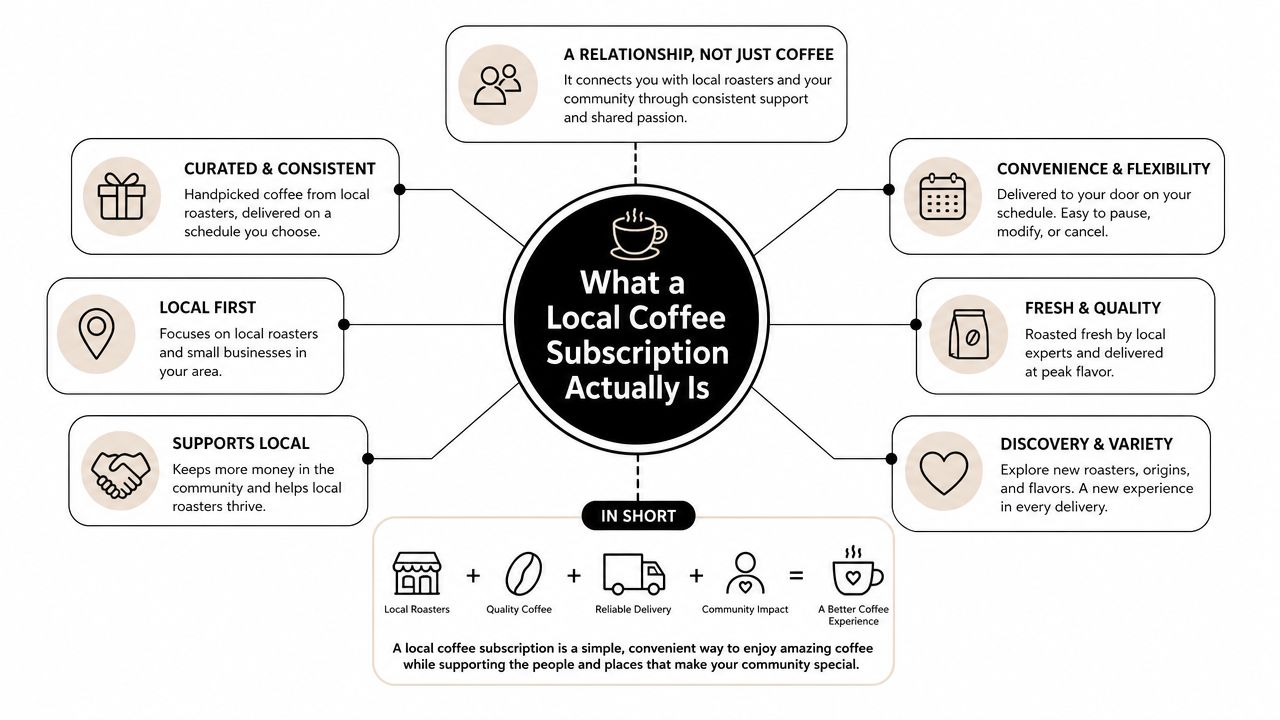
A local coffee subscription is a recurring delivery or pickup program run by a roaster in your area. You choose a schedule, the roaster packs beans close to the ship date, and the coffee comes from a business you can visit, call, or find at a farmers market. That direct relationship is the point. You're not buying from a warehouse that just happens to know your address.
Like a CSA share for vegetables, you commit to regular pickup or delivery, and the maker keeps the product flowing in a predictable way. The difference is that coffee is usually roasted to order, so freshness depends less on storage and more on timing. A bag roasted near shipping time almost always tells a better story than one that bounced through a long distribution chain.
What counts as local can shift depending on where you live. For some buyers, it means a roaster in the same city. For others, it means the same state or region. The tighter the radius, the easier it is to build repeat purchases and a relationship that feels personal, not transactional. That matters because coffee subscriptions are still a relatively small slice of global coffee spending, about 2% of global coffee spending, or roughly $685 million annually, and that share is projected to rise to 5%–7% by 2032 as recurring delivery and direct roaster-to-customer relationships expand, according to FreshCup.
Practical rule: if you can name the roaster, the roast date, and the pickup or ship rhythm without digging, you're looking at a real local program.
How the Mechanics Actually Work
Many overthink this part, then get annoyed by the wrong bag showing up at the wrong time. The fix is straightforward. Match the delivery rhythm to how fast you drink coffee, then choose the bag size and grind that fit your routine.
The four choices that matter most
- Cadence: weekly, biweekly, monthly, or “when I run out.”
- Bag size: a smaller bag for lighter drinkers, larger formats for households that go through coffee quickly.
- Grind style: whole bean if you grind at home, or a grind that fits your brewer.
- Fulfillment: delivery or pickup, depending on how close you live to the roaster.
A household that brews every morning will usually need a different setup than a remote worker who drinks two cups and likes variety. The first group cares about consistency and not running dry. The second group often wants rotation and surprise without waste.
Freshness here means three things, roast date, ship window, and how fast the bag gets to your door after roasting. A local setup usually does better on all three because the maker controls the rhythm.
For a good comparison point on how recurring purchases can be structured in another category, the craft spirits subscription service is useful reading, even though the product is different. The same basic question shows up in both places, how do you match what ships with what the customer uses?
| Common Subscription Cadence Options at a Glance | Typical Bag Size | Best For | Freshness Window |
|---|---|---|---|
| Weekly | Smaller bags | Fast drinkers, office routines, espresso homes | Very tight |
| Biweekly | Standard bags | Most regular home brewers | Tight |
| Monthly | Larger bags or multi-bag plans | Households with predictable usage | Depends on storage and roast timing |
| When I run out | Flexible bag size | People with variable routines | Best when the roaster reacts quickly |
If you want a concrete product example, this coffee bundle from Three Avocados on Loyaltie shows how a plan can be packaged around a repeatable home routine.
How to Choose a Local Coffee Subscription Worth Your Money
The easiest way to judge a plan is to look for the signals that serious roasters don't hide. A visible roast date, a short ship window, and clear origin information are the basics. If the bag or product page doesn't make those easy to find, you're doing guesswork instead of buying coffee.
A quick buyer checklist
- Freshness signals: roast date printed clearly, not buried.
- Transparency: origin, farm or co-op details, and roast notes you can understand.
- Flexibility: easy pause, skip, change, and cancel controls.
- Trust: real reviews, a plain refund or replacement policy, and a site that answers questions directly.
Price matters, but it shouldn't be the only thing you compare. The cheapest plan often looks good until stale coffee lands on your counter. I've watched buyers switch from a low-cost option to a slightly pricier roaster that ships within a short window after roasting, and the difference in cup quality usually shows up fast. Not because the higher price is magic, but because the coffee is arriving in better shape.
The research backs up that instinct. A specialty coffee subscription study found that brand information and trustworthiness had the strongest influence on subscription decisions, with β = 0.725, ahead of price and promotion (β = 0.680), consumer attitude (β = 0.635), service membership conditions (β = 0.608), and convenience (β = 0.256), according to this study. In plain language, people buy when the roaster feels clear and credible.
Watch for this red flag: if a roaster can't tell you where the beans came from, that's not a mystery, it's a gap.
Why a Local Roaster Should Run One in the First Place
A recurring-delivery program is not a side hobby. For a neighborhood roaster, it turns one-off bag sales into repeat revenue that is easier to plan around. That predictability matters because coffee roasting has real moving parts, green coffee purchases, packaging, labor, and equipment all need cash flow.
The bigger reason is retention. One-time buyers are always expensive to replace because you keep starting from zero. A regular delivery program gives a roaster a better shot at keeping the same customer long enough to learn what they like, then serve them again without paying to reintroduce the brand every month.
The churn math that decides survival
In coffee subscription operations, monthly churn is a core health metric. Benchmark guidance puts average churn at 5% to 10% per month, with 4% to 7% considered healthy and under 5% top-tier. Roughly 28% of subscribers cancel within the first 90 days, so the first few deliveries matter a lot, according to Eightx's churn benchmark.
That is why the problem usually is not price alone. It is whether the first bag matches expectations, whether the cadence fits real life, and whether the customer knows how to pause instead of quitting. Get onboarding wrong, and the cancellations pile up.
A cafe and a recurring-delivery program can live side by side. One brings people in the door, the other keeps the relationship going when they're not standing at the bar.
A practical revenue benchmark for subscription coffee is an LTV/CAC ratio of at least 3:1. One KPI guide notes that with a $45 CAC, lifetime value needs to exceed $135 to justify acquisition spend, and it recommends tracking MRR = active subscribers × average monthly fee, because retention changes hit lifetime value fast, as noted by Financial Modeling Lab. That is the math a roaster has to respect before the first box ever ships. A roaster that wants to optimize subscription retention has to watch those numbers while it is still small, because thin margins leave little room for guesswork.
Setting Up a Local Subscription Program That Works
Start with the promise you can keep most often. If your buyers drink coffee at a similar pace, choose one or two delivery cadences and make them easy to spot. If you try to offer every possible option on day one, you will spend more time fixing special cases than roasting, packing, and shipping coffee.
Build the offer around actual use
Pick a default bag size that matches normal household use, then decide whether whole bean alone is enough or whether a ground option belongs in the mix too. Whole bean keeps quality steadier for people who grind at home. A ground option helps the customer who does not own a grinder and does not want another morning step.
Packaging carries part of the promise. A valve bag signals freshness and careful roasting. A plain kraft bag suggests a lower-friction, utilitarian setup. A branded pouch says the roaster cares about presentation, but it still has to hold up in transit, because a nice-looking bag that arrives crushed does not build trust.
Make the policy boring in a good way
Pause, skip, cancel, and refund rules should be easy to read before checkout. If you offer a pause menu, give people a few practical choices instead of forcing a hard stop. That keeps a customer from canceling just because they are traveling for a month or want to slow down for a while.
The other part is the break-even math. A program should be designed so lifetime value is at least three times acquisition cost. If it costs $45 to acquire a subscriber, the relationship needs to bring in more than $135 before the marketing spend makes sense.
For roasters setting up the backend and trying to optimize subscription retention, the details matter. Small choices about reminders, pause settings, and renewal flow can keep people subscribed without making the program feel sticky.
If you need help shaping the storefront side, the Sell on Loyaltie resources page is a practical place to start. The same applies to the customer side. A subscription that is easy to understand, easy to pause, and easy to trust usually survives longer than one that looks clever on paper but feels annoying after the second box.
Promoting a Local Coffee Subscription on Loyaltie and Beyond
A lot of roasters start by trying to build a subscription page from scratch, then wonder why it feels separate from the rest of the store. A cleaner path is to sell the recurring delivery where shoppers are already browsing independent brands and makers. On Loyaltie, a roaster can put a regular-delivery option next to one-time bag purchases, so the offer feels like part of the shop instead of a side project. That helps when trust is still being earned.
If you are setting up the storefront side, the Sell on Loyaltie resources page is a practical place to start. A clear product name, a direct description, and a good photo usually do more work than a long pitch that takes effort to decode.
The launch message should be short and plain. Tell people what they get, when it ships, and why it tastes better when it comes straight from the maker. You do not need to push hard. You need an answer to a simple question, why reorder from you? If the roaster also offers a reusable add-on, something like the Organic Canvas Tote Bag from Kissing Rock Coffee can support the brand in a useful way, since it is described as a sturdy cotton canvas bag with reinforced web handles and a clean natural finish.
Outside the marketplace, keep the message human. Email works because it reaches people who already know the shop. Instagram works when the photos show the bag, the roast, and the counter, not just a generic graphic. For a practical guide to human-powered follower growth for local shops, that article is a useful place to look.
The Local Coffee Subscription Mindset
A local coffee subscription works best when both sides treat it like a regular habit, not a novelty. For the buyer, that means fresh coffee from a roaster you can talk to directly. For the roaster, it means repeat orders that do not depend on constantly chasing new attention.
That is why plain language helps. Say buy on a plan. Say regular delivery. Say reorder directly from the maker. Those phrases sound like real life because they are, and they help people understand what they are agreeing to before the first bag arrives.
If you are buying, pay attention to freshness, transparency, and how clearly the roaster answers questions. A good subscription should feel like a neighbor handing you coffee at the counter, not a box with a mystery attached. If you are roasting, build the program around churn, tracking, and the simple fact that some people will cancel when the coffee, the timing, or their budget stops fitting their life. The relationship lasts when the process is easy to follow and the coffee earns the next refill.
For a neighborhood roaster, the work is partly math and partly trust. The math is churn and lifetime value, because a subscription only survives when enough people stay long enough for the recurring orders to cover the cost of keeping the program running. The trust comes from doing the small things well, clear offers, reliable roast dates, honest expectations, and enough communication that a customer does not feel like they are being sold to every week.
If you want to discover independent coffee makers and buy directly from them with no distributor in the middle, start on Loyaltie.