
You're probably here because you've done that frozen little hover in front of a carton display. One hand on a dozen brown eggs, eyes bouncing to the blue-green ones beside them, then over to a hand-labeled carton that says pasture-raised, then another that says organic, then another that says jumbo Grade AA, and suddenly breakfast feels like a pop quiz.
That happened to me at a farmers market table packed with six different cartons from the same local flock. The seller was cheerful. The line behind me was not. I realized most of us aren't confused because eggs are complicated to cook. We're confused because eggs are sold like one simple product when they're several different kinds of eggs layered together. Species, production method, grade, size, freshness, and specialty claims all get stacked onto one carton.
If you buy eggs often, especially from independent brands and local makers, sorting that out matters. It helps you spend where the difference is real, skip labels that don't change much, and choose a carton that fits what you're cooking.
Table of Contents
- Standing at the Carton Aisle
- Start with the kitchen question
- When each one actually beats a chicken egg
Standing at the Carton Aisle
At the market, the table looked simple until I got close. Pale tan shells. Dark brown shells. A few blue-green eggs tucked into one carton like they knew they'd steal attention. Prices ran from $4 to $9 on handwritten tags. Some cartons had glossy printed sleeves. Others had a rubber-stamped farm name and the date scribbled in pen.
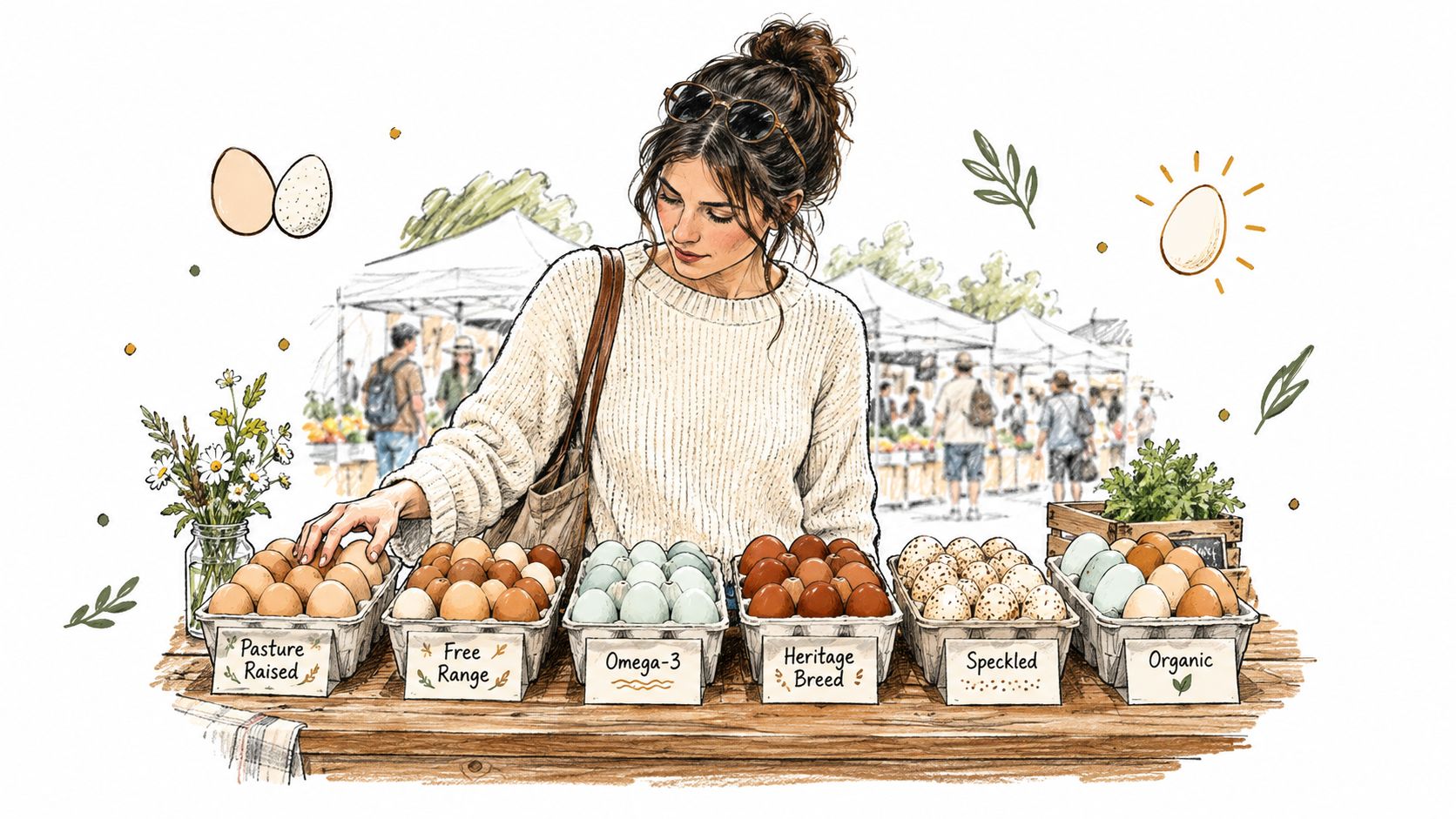
The part that trips people up is that all those cartons can be “eggs” while meaning completely different things.
One carton may differ by species, like duck instead of chicken. Another differs by how the hens were raised, like cage-free or organic. Another differs by quality grade, which has nothing to do with shell color. Another differs by size, which matters more in baking than you might realize. Then there are specialty cartons sold for a richer yolk, a feed-based nutrition tweak, or a specific cooking use.
Practical rule: When a carton seems expensive or confusing, ask one simple question first. “What am I actually paying for here?”
That question clears a lot of fog.
Sometimes you're paying for freshness. Sometimes you're paying for a production method. Sometimes you're paying for a duck egg that will make a custard silkier than a standard chicken egg. And sometimes you're paying for packaging language that sounds lovely and means almost nothing.
A little context helps. Global egg production reached 97 million tonnes in 2023, and hen eggs made up 94% of output at 91 million tonnes, which is one reason chicken eggs dominate how eggs are thought about in the first place. The FAO also notes that production should be tracked separately for hens, ducks, geese, and turkeys, which is why “kinds of eggs” is a meaningful category in food systems, not just a grocery-store curiosity (FAO egg production data).
Eggs Beyond the Chicken
Most of us use chicken eggs as the baseline. They're the all-purpose reference point. Mild flavor, familiar size, predictable behavior in recipes. But if you shop farmers markets or buy directly from local makers, you'll run into other species pretty quickly, and they're not just novelty buys.
Start with the kitchen question
If you're asking, “Which egg tastes closest to what I already use?” start with chicken.
If you're asking, “Which egg makes baked goods richer?” look at duck.
If you want garnish-worthy little eggs for canapés or lunch boxes, quail earns its spot.
If you find goose eggs in spring, think of them as a once-in-a-while cooking ingredient for especially rich scrambles or custards.
| Species | Shell Color | Avg. Weight | Flavor vs. Chicken | Best For |
|---|---|---|---|---|
| Chicken | White, tan, brown, blue-green | Medium and familiar | Baseline, mild | Everyday cooking, baking, frying |
| Duck | Usually white or pale tinted | Larger than chicken | Richer, fuller | Baking, custards, dramatic fried eggs |
| Quail | Cream with brown speckles | Tiny | Slightly richer, delicate | Appetizers, quick soft-boils, garnish |
| Goose | White | Much larger than chicken | Rich and dense | Custards, rich scrambles, special-occasion baking |
Those size descriptions are qualitative on purpose. For birds beyond chicken, familiar USDA size labels don't apply. Serious Eats notes there are no USDA size standards for duck, quail, or ostrich eggs, so you may see them sold loose, by count, or in specialty cartons without the Large or Jumbo shorthand you know from chicken eggs (guide to shopping for eggs from other birds).
When each one actually beats a chicken egg
Duck eggs stand out when structure and richness matter. Bakers like them because they bring a generous yolk and plenty of white, which can help with lift and richness at the same time. If you've ever bought duck eggs from a grower and wondered why availability shifts, this guide on troubleshooting duck egg laying gives useful context on seasonality, feed, and why supply can be uneven.
Quail eggs are less about replacing a chicken egg and more about changing the experience. They cook fast, look great halved on toast or salad, and make a regular brunch plate feel more intentional.
Goose eggs are the market-table conversation starter. They're not your everyday dozen. They shine when you want plush texture and don't mind adjusting a recipe around a much larger egg.
And if you want to turn a simple egg breakfast into something sharper and greener, a side of fresh shoots helps. I'd pair any of these with a microgreens variety box with arugula, broccoli, pea, and sunflower shoots, especially with softly scrambled eggs or duck-egg toast.
What the Labels Really Mean
Production labels cause more confusion than shell color ever will. People often treat them like a ladder of quality, but that's not quite right. Some labels describe animal housing. Some describe feed rules. Some are tightly regulated. Others are loose enough that two cartons can look similar and mean very different things.
Cage-free and free-range
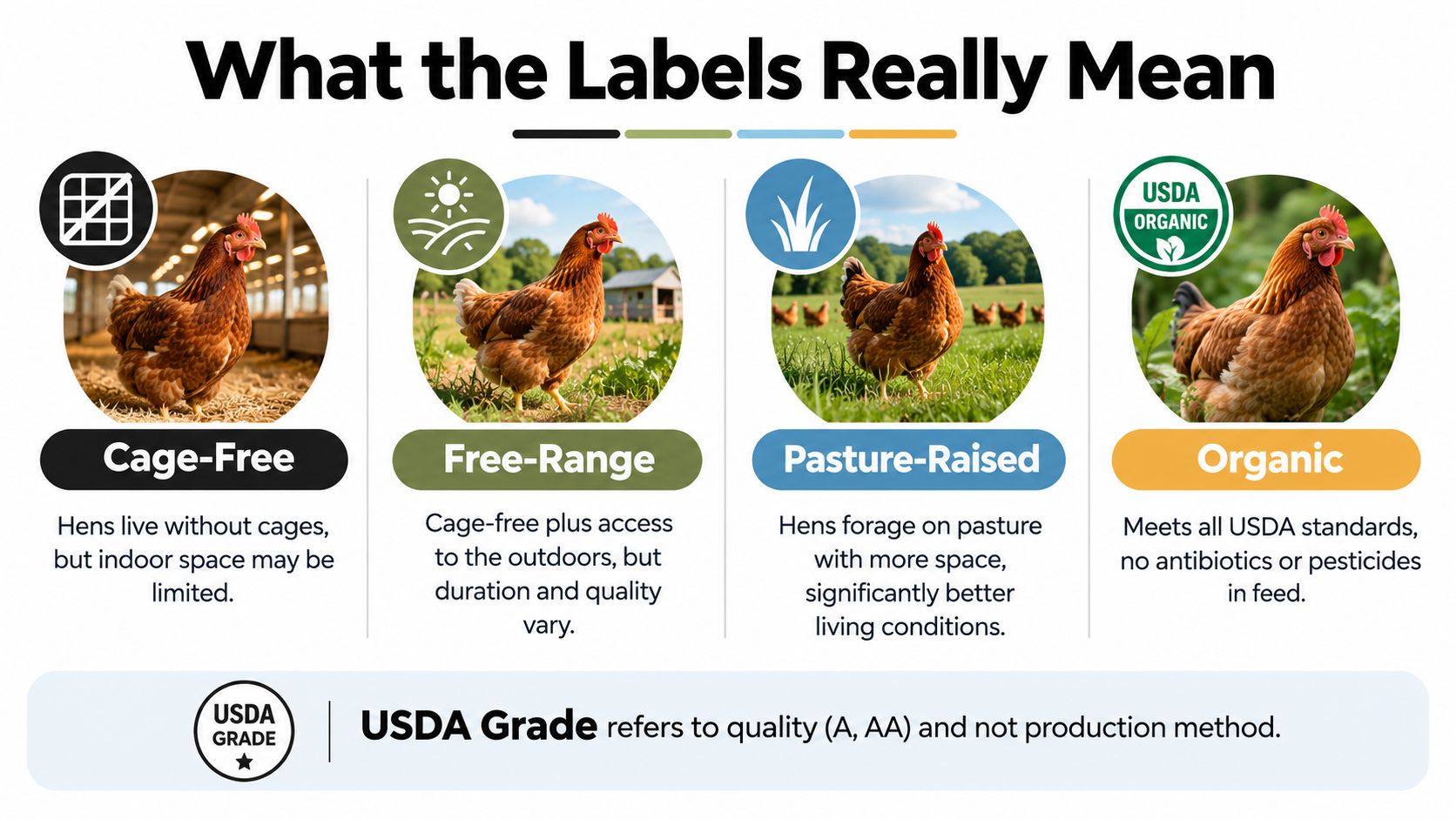
Cage-free means hens aren't kept in cages. It does not, by itself, tell you much about indoor crowding, layout, or outdoor access.
Free-range adds outdoor access, but that still leaves a lot unanswered. How much access? How often? What kind of outdoor area? A grassy field and a small pop door both technically count as “outdoor access” in everyday shopping language, even though they're not the same lived reality for the birds.
That's why these labels can help, but they don't finish the story.
Pasture-raised and organic
Pasture-raised is the phrase many shoppers reach for when they care most about how the birds live. The catch is that it doesn't have one simple federal legal definition the way people often assume. In practice, third-party standards matter a lot.
Organic is clearer. Organic eggs come with enforceable federal standards, and the label covers feed and production requirements in a way that terms like cage-free and free-range often do not. Neutral references also note that nutrient-enhanced eggs are produced by changing feed, not by changing the egg itself or the hen's species (label explainer with current market context).
Don't treat every egg label like a quality score. Ask whether it's describing welfare, feed, or marketing language.
That distinction matters more now because label-based buying is mainstream, not niche. In the U.S., cage-free eggs represented 39% of eggs processed in late February 2026, according to the same reference above.
Words that sound nice and say little
A few carton phrases deserve healthy skepticism:
- Farm-fresh means almost nothing on its own. It sounds good. It doesn't tell you about access, feed, or handling.
- All-natural isn't a reliable welfare or nutrition signal.
- Vegetarian-fed may matter to some shoppers, but it doesn't automatically mean better flavor, better welfare, or more natural behavior for the bird.
The easiest way through the clutter is to match the label to the question in your head. If your question is ethics, look at housing and certification. If it's nutrition, look for what changed in the feed. If it's flavor, freshness often matters more than the front of the carton.
Grade and Size Without the Guesswork
Grade and size get lumped together all the time, but they do different jobs. Grade tells you about quality. Size tells you about weight. You can have a Large Grade AA egg and a Large Grade B egg in the same store, and “Large” won't tell you which one will poach neatly.
What grade actually means
USDA shell egg grades are AA, A, and B, and they describe interior and exterior quality, not size (USDA egg grading manual).
Here's the plain-English kitchen version:
- Grade AA works well when appearance matters. Fried eggs with tidy whites. Poached eggs that hold themselves together better.
- Grade A is the everyday workhorse. Good for scrambling, baking, boiling, and most normal home cooking.
- Grade B is less about pretty presentation and more about use. If the egg is headed into batter or dough, appearance matters less.
If you care how the egg looks in the pan, pay attention to grade. If it's disappearing into banana bread, size usually matters more.
Size is a weight system
USDA weight classes are set by minimum net weight per dozen: Jumbo 30 oz, Extra Large 27 oz, Large 24 oz, Medium 21 oz, Small 18 oz, and Peewee 15 oz (USDA weight classes for shell eggs).
| Size | Oz per Dozen | Min Oz per Egg | Best For |
|---|---|---|---|
| Jumbo | 30 oz | 2.5 oz | Big breakfast plates, dramatic fried eggs |
| Extra Large | 27 oz | 2.25 oz | Recipes that can handle a little extra egg |
| Large | 24 oz | 2 oz | Standard recipe testing, most baking |
| Medium | 21 oz | 1.75 oz | Everyday scrambling, budget cartons |
| Small | 18 oz | 1.5 oz | Hard-boiling, kid portions, older recipes |
| Peewee | 15 oz | 1.25 oz | Rare retail find, specialty use |
If a cookie mix or cake recipe was built around Large eggs, moving up or down can change texture. That matters most in baking, less in scrambled eggs or frittatas. A product like this gluten-free banana cinnamon sugar cookie mix that tells you to just add eggs and butter will usually behave most predictably with the egg size the recipe developer had in mind, which is often Large unless stated otherwise.
One shortcut that helps
If the recipe is fussy, use Large eggs unless the package or author says something else.
If all you're making is breakfast, relax. Grade affects looks. Size affects recipe balance. Knowing which one matters to your dish is enough.
Specialty Eggs Worth the Splurge
Some specialty eggs are worth the extra money. Some just wear a nicer outfit. The trick is figuring out whether the claim changes what lands on your plate or only changes how the carton reads.
Omega-3 and feed-based eggs
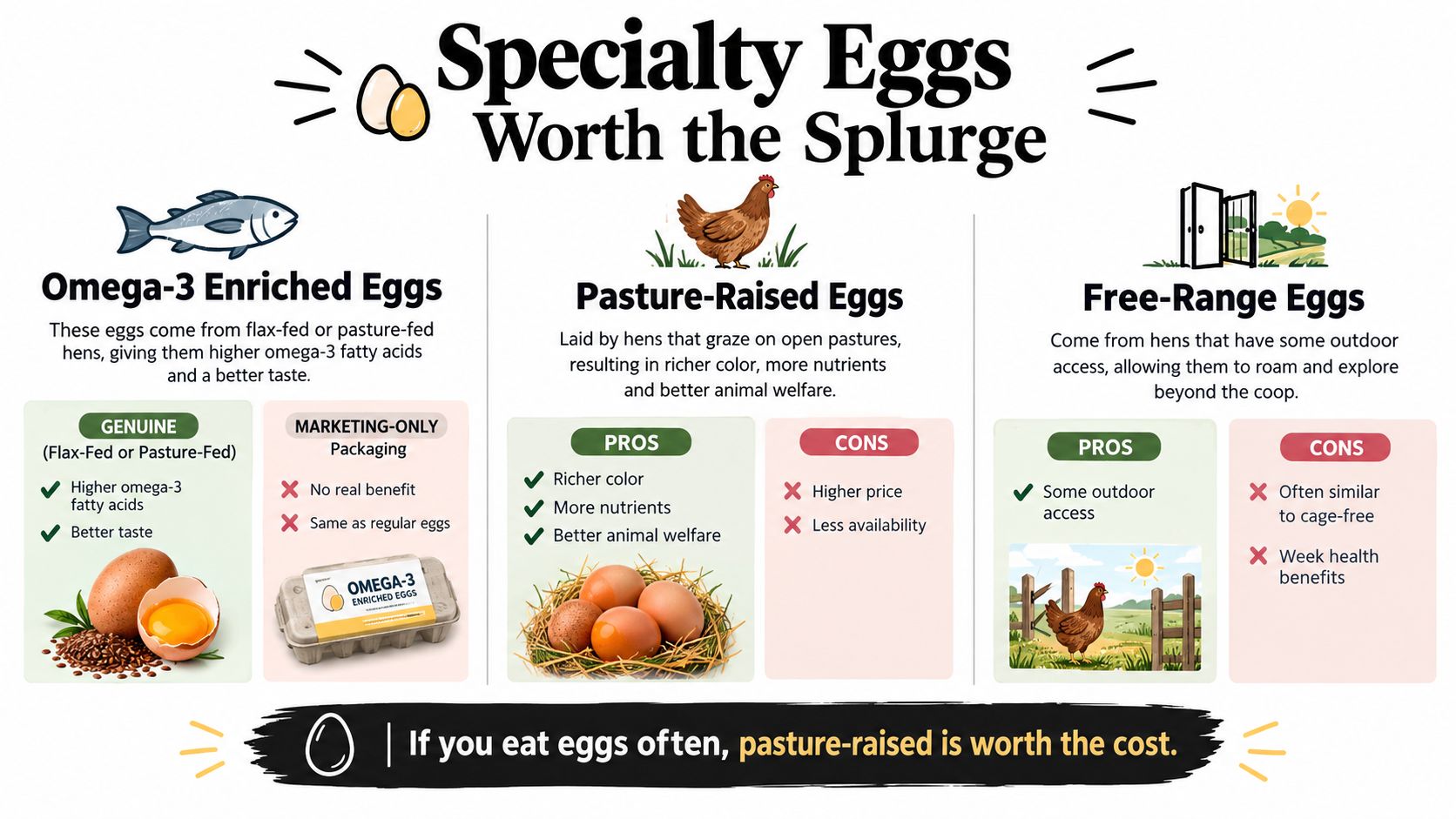
Nutrient-enhanced eggs are the clearest example of a specialty carton that comes from feed changes, not a different bird. If the hens were fed in a way that raises omega-3 content, that's a real production choice. The taste difference is often subtle, but the claim isn't magic. It's feed.
That's useful if you want that specific nutrition angle. It's less useful if you're hoping for a dramatic flavor leap.
Heritage breeds and unusual shells
Heritage breed eggs are fun because the difference often feels more tangible. You may notice darker yolks, slightly different shell shades, and a more distinct eating experience, especially when the eggs are very fresh and cooked. That doesn't make every blue shell better than every brown shell, though.
Research comparing white and brown eggs found white eggs had 0.70% higher total fat than brown eggs, while vitamin A was higher in white eggs and vitamin E was higher in brown eggs. The larger takeaway was that shell color differences exist at the margins, but feed, storage, and freshness have a bigger effect in real life (comparative analysis of white and brown eggs).
Here's a useful watch if you like seeing these tradeoffs talked through in a more visual way.
Fertilized eggs and the honest answer
Fertilized eggs carry a lot of mythology. For most home cooks, they're not a nutrition upgrade by default. If you seek them out, it should be because you specifically want them, not because you've been told they're automatically better.
Duck and quail eggs also live in this specialty zone, but for a simpler reason. They cost more because they're less common, often more seasonal, and used differently.
Buy the specialty carton when the claim changes flavor, cooking behavior, or a value you care about. Skip it when the carton only sounds fancier.
And if you're doing a breakfast-for-dinner night with those eggs, a jar of Everything Bagel egg seasoning blend makes a very convincing case for keeping dinner simple.
Storing Eggs So They Stay Fresh
Freshness isn't luck. It's mostly storage.
Egg quality starts dropping after lay, and expert guidance points to time, temperature, and relative humidity as the big three drivers. Preservation is best when eggs are cooled quickly and held around 40 to 65°F (about 4 to 18°C) at more than 80% relative humidity. In comparative storage data, eggs in a humidified room retained AA grade at 63.61%, compared with 34.07% in an unhumidified room and 23.43% in feed-room storage (egg storage and humidity data from Oregon State research).
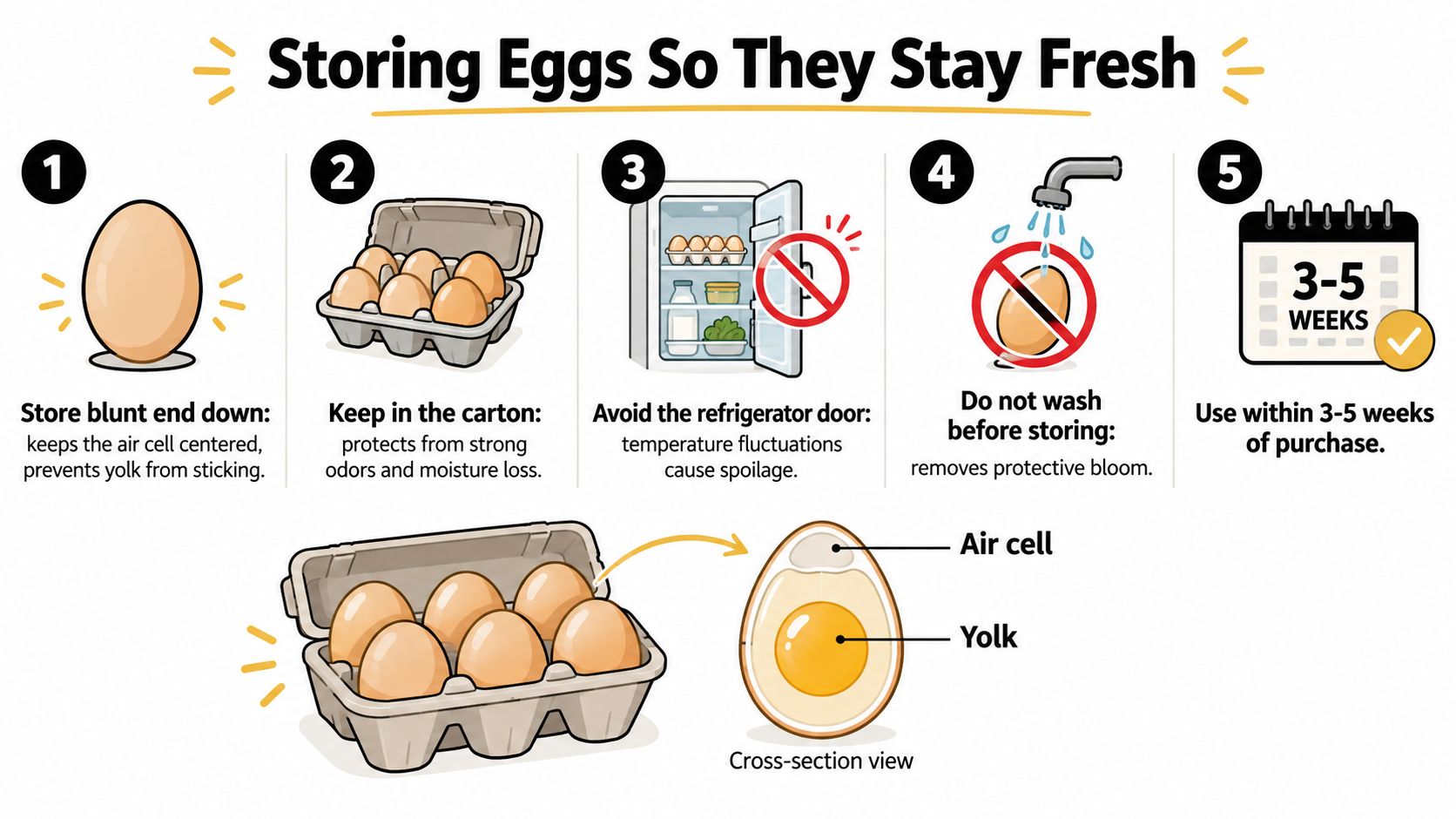
The habits that help most
A few habits do more than all the old folklore combined:
- Keep them in the carton. The carton slows moisture loss and protects the eggs from fridge odors.
- Store them blunt end down. That helps keep the air cell positioned well and supports better interior quality over time.
- Use a middle or back shelf. The refrigerator door is convenient, but the temperature swings more there.
Washed and unwashed eggs
Market shopping changes the conversation.
Most commercial American eggs are washed, which removes the natural outer coating often called the bloom. Once that coating is gone, refrigeration matters more.
Many farm-fresh eggs are sold unwashed. If the bloom is intact, they behave differently. You still want good handling and common sense, but they may keep well in a cool spot in a way washed supermarket eggs won't.
Hard-boiled eggs are their own category. Once cooked, plan to use them within about a week.
The float test can tell you an egg has aged. It can't tell you whether that egg is ideal for the recipe you're about to cook.
If you overbuy, freezing works better than people think. Crack the eggs first, freeze the contents rather than the shells, and label them so future-you knows what's in the container.
Buying Direct from Local Producers
Saturday morning market shopping answers a different question than the carton aisle does. Instead of decoding labels from six feet away, you can ask the person who gathered the eggs. For a shopper trying to sort out taste, bird welfare, price, or the right eggs for a specific recipe, that changes the whole math.
Freshness is usually the first difference you notice. Crack a very fresh egg into a skillet and it holds itself together better. The white stays tighter, the yolk sits higher, and poached eggs behave with less fuss. If your usual question is, “Will I taste or see the upgrade?” direct-from-farm eggs often make the clearest case in simple breakfasts where the egg is front and center.
You also get details a carton rarely explains well. A market seller can tell you the breed, what the birds eat, whether the eggs were washed, and how the flock is managed through the year. That helps you connect the price to something real. A blue or speckled shell may still be mostly a breed story, but feed, handling, and time since collection can matter more for cooking.
The best part is that your questions can be practical, not performative.
- If taste is your main question, ask which eggs they eat at home and what dishes show the difference best.
- If ethics matters most, ask where the birds spend their days and how that changes with weather or season.
- If budget matters, ask whether some weeks bring heavier laying and better value.
- If you are shopping for a recipe, ask which eggs they would save for soft boiling, frying, or custard, and which are perfectly fine for baking.
A little context helps here. USDA monthly egg production reports split table eggs from hatching eggs, which is a useful reminder that “kinds of eggs” in market data are not all headed for breakfast. In February 2026, U.S. production reached 8.36 billion eggs, including 7.17 billion table eggs and 1.19 billion hatching eggs. In May 2026, production reached 9.21 billion eggs, including 7.90 billion table eggs and 1.31 billion hatching eggs (USDA monthly egg production reporting).
That sounds far away from a farm stand, but it helps explain why local buying can feel different. Broad supply swings affect store prices and availability. Buying direct does not erase those pressures, yet it can give you better answers and a clearer sense of what you are paying for.
If you want to buy this way more often, start with places that make conversation easy:
- Farmers markets if you want to compare several producers in one trip.
- CSA programs if you already buy produce and want eggs added to the same routine.
- State farm directories if you prefer regular pickup.
- Online marketplaces for independent makers, such as Loyaltie, if you want to browse producers outside the usual grocery setup.
Buying direct works a bit like skipping the movie trailer and talking to the director. You get fewer slogans and more usable information. For shoppers confused by labels, that is often the fastest route to a carton that fits how you cook.
Your Next Carton Made Simple
If you want the short version, use five questions.
Ask these before you buy
What am I cooking?
Custard, poached eggs, and sunny-side-up breakfasts reward freshness. Baking can be more forgiving if the size matches the recipe.What matters most to me?
If ethics leads, look harder at how the birds are raised than at shell color. If taste leads, freshness and species often matter more.What's my budget today?
Save the pricier carton for dishes where the egg is the star. For muffins, scrambles, or pancake batter, you may not need the fanciest option.Do I want a specialty trait?
If you care about omega-3s, choose that on purpose. If not, don't pay extra for a claim you won't notice.Can I buy closer to the source?
A nearby local maker can answer questions a carton never will.
The simplest rule
The right carton isn't the one with the most labels. It's the one that fits your recipe, your standards, and the way you cook.
Once you start thinking about kinds of eggs this way, the whole display gets calmer. Brown versus white stops feeling like a moral decision. Grade and size stop blending together. And direct-from-the-maker eggs start making more sense because you can finally tell what kind of difference you're paying for.
If you like buying everyday food from real people instead of guessing your way through a big retail shelf, Loyaltie is a marketplace where people discover and buy directly from the best independent brands in the US. It's a useful place to find makers for pantry staples, seasonings, produce, and other kitchen upgrades that pair naturally with the kind of thoughtful egg shopping you just did.