

Kombucha is a reasonable fermented drink for most healthy adults and may offer small gut benefits, but only 8 human clinical trials informed a recent review, so the evidence is thin. It isn't a proven health treatment.
If a bottle contains live cultures, does that automatically make it good for you? That's the question health claims often skip.
The useful answer depends on the individual bottle and the individual drinker. A carefully managed drink from an independent local maker can offer a quality upgrade through clear ingredients and direct answers about production. But a fermentation story isn't a substitute for safety controls, and a wellness label doesn't override your medical needs.
Table of Contents
- What the Research Says About Kombucha's Benefits
- Sugar and Alcohol in Your Bottle
- Who Should Skip Kombucha Altogether
- Homemade Versus Store-Bought, and How to Judge a Brand
- How Much Kombucha Is Reasonable Each Day
- Decide Whether Kombucha Belongs in Your Routine
What the Research Says About Kombucha's Benefits
Kombucha may offer small benefits, but strong human evidence is still missing. A 2025 systematic review published in Fermentation identified 8 clinical trials, including 6 randomized controlled trials and 2 pre–post studies, with interventions lasting 10 days to 10 weeks; only 2 studies reported improvements in gastrointestinal symptoms, mainly constipation-related complaints.
The reviewers also found modest changes in gut and salivary microbiota and related metabolites. Those results weren't consistent: researchers tested different drinks, doses, populations, and outcomes. A finding about a particular formulation doesn't establish the same benefit for whatever bottle you buy.
Kombucha health claims graded by evidence
Mayo Clinic's kombucha guidance describes a small amount of research suggesting probiotic-like benefits, while emphasizing that few valid human medical studies establish clear health effects.
| Claim | What the research shows | Confidence |
|---|---|---|
| Probiotic-like effects | Small amount of research suggests benefits similar to probiotic supplements; few valid human studies | Limited |
| Digestive comfort and constipation | Only 2 of 8 trials reported symptom improvements, mostly constipation-related | Limited |
| Gut and salivary microbiota changes | Modest shifts, but inconsistent across studies | Low |
| Detoxification | No reliable clinical support | Not supported |
| Disease prevention or treatment | Goes beyond what current trials can establish | Not supported |
| Immune support | Not established in the reviewed trials | Not established |
A microbial change isn't automatically a health improvement. Researchers need to connect that change to a meaningful outcome, such as reliably improved symptoms, before it becomes useful treatment advice.
Likewise, limited evidence doesn't mean nobody benefits. It means you shouldn't expect predictable results or replace digestive, metabolic, or immune treatment with kombucha.
Enjoying a fermented food and proving a medical benefit are different things.
If you're comparing digestive-wellness options, NexiHerb plant-based digestive support picks from NexiHerb LLC offers another resource to discuss with your clinician, not proof that supplements or kombucha will treat your symptoms.
Keep the same distinction when browsing fermented foods such as Carolina Reaper fermented hot sauce: fermentation describes a process, not a guaranteed health outcome. Choose kombucha because you enjoy it and it fits your diet, not because you need it to function as medicine.
Sugar and Alcohol in Your Bottle
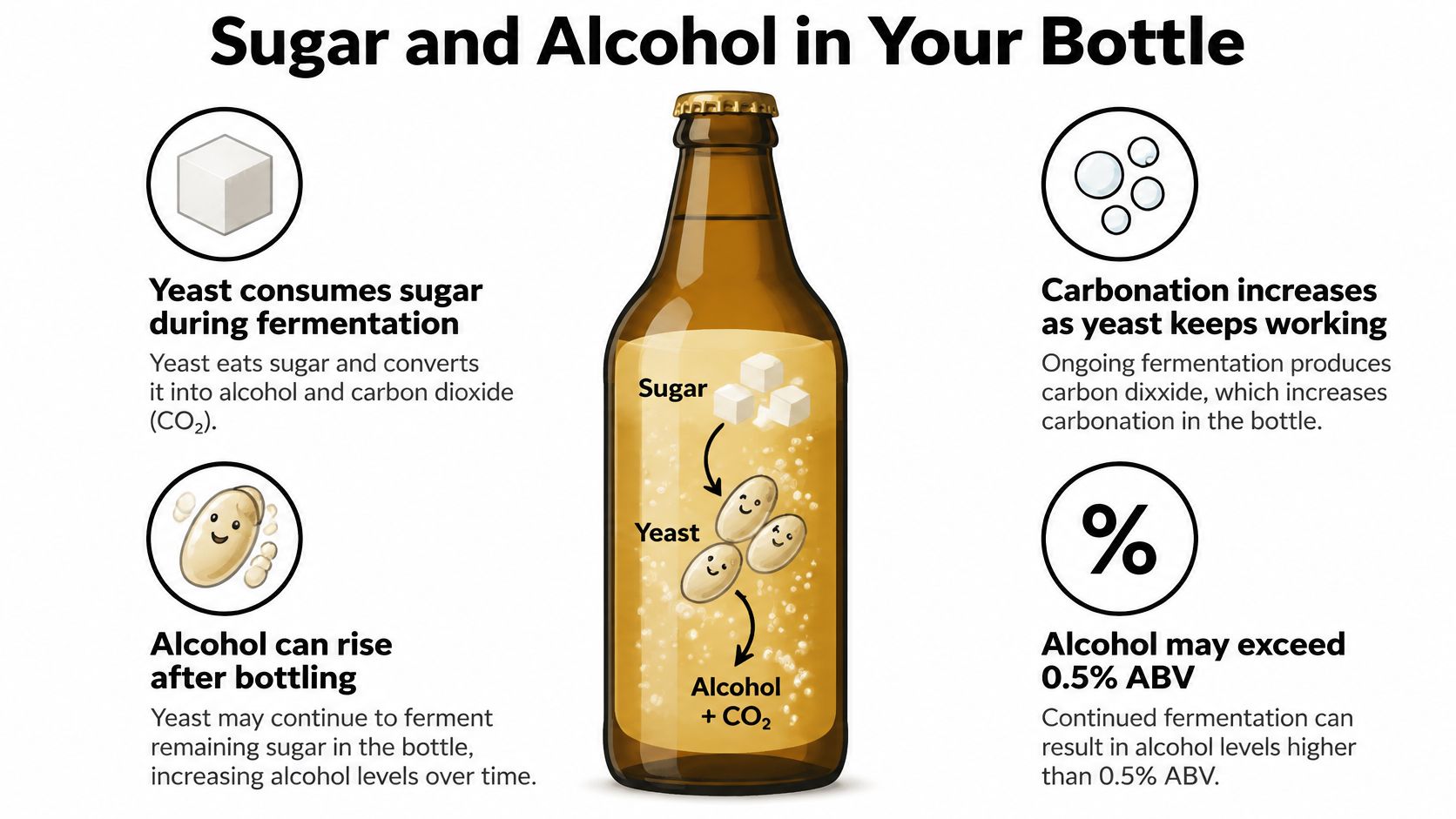
Fermented doesn't mean sugar-free, and non-alcoholic doesn't necessarily mean alcohol-free. Yeast consumes sugar during fermentation and produces alcohol and carbonation. If active yeast remains after bottling, it can keep working.
Colorado State University's food-safety guidance says refrigerated kombucha sold as non-alcoholic must remain below 0.5% alcohol by volume during production and after shipment; it also explains that continued fermentation can push alcohol above that threshold and that pasteurization at 180°F for 15 seconds can disable fermentative yeasts.
That makes storage part of the product, not an afterthought. A maker's refrigeration instructions tell you how to handle a drink whose composition may otherwise continue changing.
The bottle illustration shows why the finished drink needs ongoing control.
Alcohol levels and what the rules say
Federal alcohol rules apply at the threshold below. New York agricultural guidance also warns that a roughly month-long ferment can reach substantially higher alcohol concentrations.
| Situation | Alcohol by volume | What it means |
|---|---|---|
| Refrigerated non-alcoholic kombucha | Below 0.5% | Must stay under 0.5% through production and shipping |
| Kombucha at or above the threshold | 0.5% or more | Regulated as an alcoholic beverage under federal rules |
| Fermented about 30 days, New York guidance | About 3% | Alcohol and acidity can rise substantially |
| Uncontrolled homebrew | Unknown without measurement | No reliable control without measurement |
Don't treat fermentation time as a simple alcohol calculator. The ingredients, organisms, temperature, and storage conditions also matter, so an actual measurement is more useful than a confident guess.
For sugar, read the individual bottle's nutrition panel. Compare the stated grams per serving alongside the serving size, then consider how much you'll pour. Don't assume a tangy taste means all the sugar has disappeared.
Before buying, check these details:
- Alcohol statement: Look for an ABV statement, especially if alcohol matters to your health or personal choices.
- Sugar declaration: Use the brand's own grams-per-serving figure, not a supposed category average.
- Production approach: Check whether it's pasteurized and follow its storage instructions.
An independent maker who explains these details gives you something more useful than a vague promise of natural goodness.
Who Should Skip Kombucha Altogether
A drink can suit your friend and still be the wrong choice for you. Pregnancy, immune status, kidney health, stomach sensitivity, and alcohol avoidance all change the decision.
Acidity is part of that picture. The British Columbia Centre for Disease Control's kombucha guideline explains that fermentation typically lowers pH below 4.2, helping inhibit many bacterial pathogens, but advises avoiding values below 2.5 because excessive acidity may harm susceptible people, with rare concerns including metabolic acidosis.
That doesn't mean an ordinary sour taste signals a medical emergency. It means more acidity isn't automatically better, especially when your body has difficulty managing an acid load.
Who should skip kombucha or check first
| Reader situation | Why it matters | What to do |
|---|---|---|
| Pregnant or breastfeeding | Human safety data is limited, so caution is the default | Skip it or ask your doctor first |
| Immunocompromised | Live organisms and acid load carry more risk | Avoid unless a doctor clears it |
| Kidney disease or metabolic conditions | Acid load matters for these conditions | Ask a clinician before regular use |
| Avoiding alcohol or in recovery | At 0.5% ABV or more it counts as alcohol | Check the ABV on the label |
| Significant stomach sensitivity | Acidity and live cultures can aggravate symptoms | Start small or skip |
| Healthy adult | No identified special vulnerability doesn't guarantee zero risk | Enjoy a modest glass, 4 fluid ounces or less a day |
Mayo Clinic advises pregnant, breastfeeding, and immunocompromised people to avoid kombucha. For these readers, a raw or live-culture label isn't a reason to make an exception.
Alcohol avoidance deserves an equally personal standard. EBSCO's kombucha overview highlights fermentation-related alcohol and the importance of considering pregnancy, recovery, medication interactions, and other reasons for avoiding it. If you need complete abstinence, a non-alcoholic category label alone may not answer your question.
Personal safety comes first: You don't need to try kombucha to have a healthy diet.
If your stomach is already sensitive, don't interpret discomfort as evidence that the drink is working. Skip it, or discuss a cautious trial with your clinician rather than pushing through symptoms.
Homemade Versus Store-Bought, and How to Judge a Brand
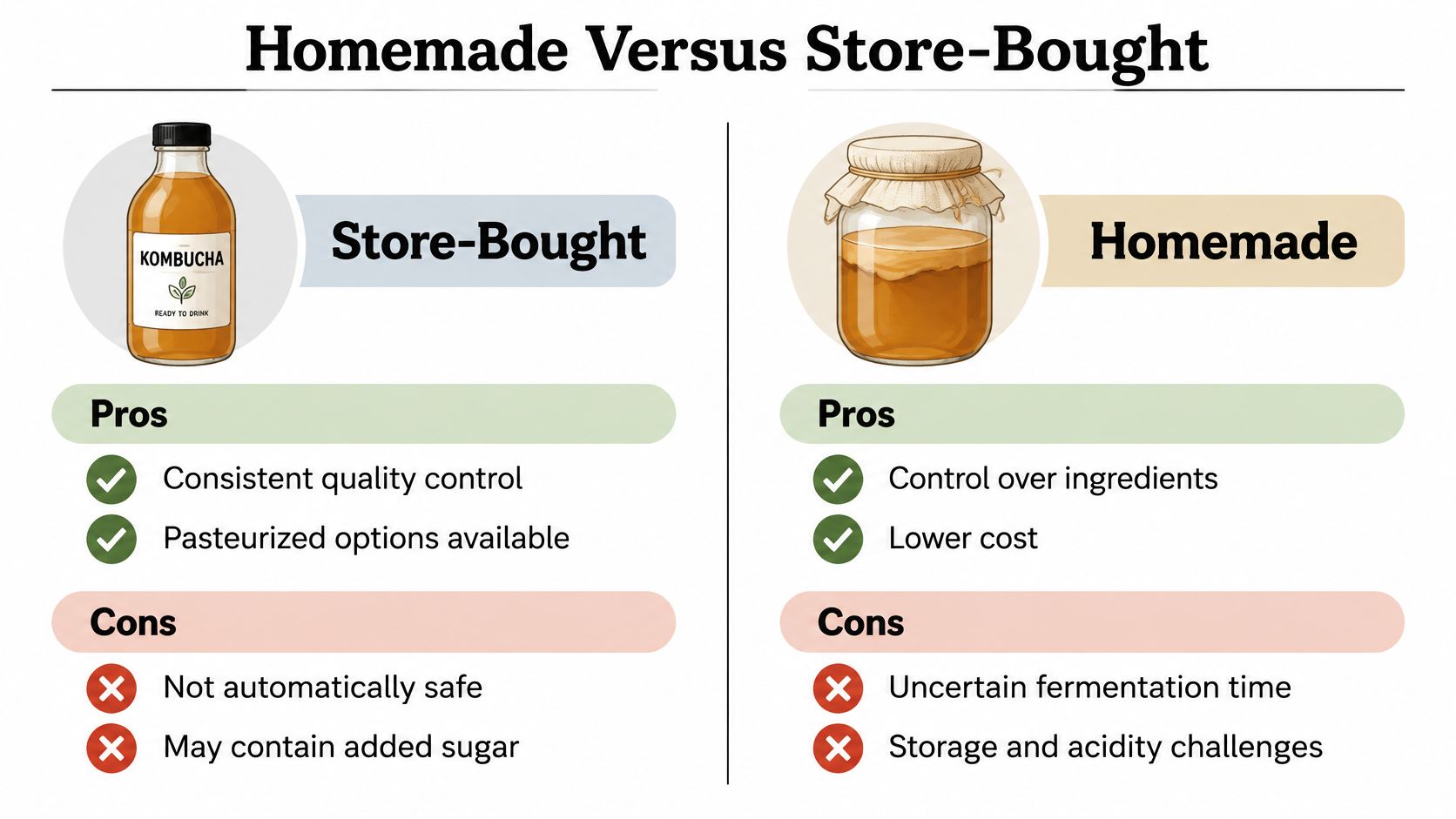
A store bottle isn't automatically safe, and a homemade batch isn't automatically dangerous. The meaningful difference is documented control, not whether the maker works in a home kitchen or sells through a shop.
Homebrewing adds uncertainty around fermentation, sanitation, storage, acidity, and vessel choice. Commercial production can offer more consistent testing and handling, but you still need to evaluate the particular producer.
The comparison below shows why access to ingredients isn't the same thing as control over the finished drink.
Homemade versus store-bought kombucha
Read the store-bought column as standards to verify, not promises every commercial producer fulfills.
| Factor | Homemade | Store-bought from a maker |
|---|---|---|
| Fermentation time | Brewer chooses the schedule | Documented process, commonly about 7 to 10 days |
| Acidity | Unknown if it isn't measured | Checked against the pH 2.5 to 4.2 range |
| Alcohol | Unknown without testing; can exceed the non-alcoholic threshold | Tested and appropriately labeled |
| Sanitation | Determined by the home setup | Documented cleaning; pasteurization in some products |
| Storage | Home storage may be inconsistent | Refrigeration instructions and freshness date |
| Main concern | Contamination and excessive acidity | Lower uncertainty when the process is documented |
The safety concerns aren't merely theoretical. In the CDC's 1995 Iowa investigation, two people became seriously ill after consuming kombucha daily for approximately two months, and one died; the investigation did not establish that kombucha caused the illnesses.
That distinction matters. The report supports caution and careful preparation, not a claim that every fermented tea is dangerous.
Questions that reveal a careful maker
New York's Department of Agriculture and Markets guidance recommends a finished pH of 2.5 to 4.2, describes fermentation of about 7 to 10 days, warns that going beyond 10 days can produce acidity comparable to undiluted vinegar, and advises steeping tea with water at least 165°F.
Use those benchmarks to make your questions specific:
- Is the finished pH within the recommended range? A good answer explains measurement and batch records, rather than judging acidity by taste alone.
- How long does it ferment? Ask how the maker decides a batch is ready. A calendar helps organize production, but testing should guide release.
- How hot is the water used to steep the tea? The maker should describe a controlled preparation step, not just say the tea gets brewed.
- Does production start with a commercially purchased culture? This is part of New York's recommended approach. Ask how the starter culture is sourced and maintained.
- How is equipment cleaned, and what happens if mold appears? The good answer includes sanitary equipment and discarding a moldy batch.
- How is the finished bottle stored? Look for refrigeration instructions, a freshness date, and a clear explanation of handling after purchase.
Buying directly from the maker, with no middleman, can make these conversations easier. Specific answers are the quality upgrade. Words such as raw, natural, and probiotic don't replace them.
You can use the same ingredient-first shopping habit when considering a non-fermented alternative such as hibiscus and rooibos herbal tea. The goal isn't to find the most elaborate wellness story. It's to choose something you enjoy whose ingredients and preparation you understand.
How Much Kombucha Is Reasonable Each Day
Start with the smallest serving that still feels enjoyable, then let the bottle and your body set the ceiling. A cautious limit for healthy adults is a small daily glass rather than the whole container; that is consumer caution, not a clinically proven dose. The right amount also changes with the product: alcohol level, sweetness, acidity and how clearly the maker controls fermentation all matter, and so do your own health conditions.
The Iowa investigation is a reminder to take persistent symptoms seriously, not proof that a particular amount caused those illnesses. This illustration reflects that historical safety context.

A cautious routine for healthy adults
- Pour a measured serving. Use a glass instead of drinking from a large bottle, and stop before the package becomes the portion.
- Read the bottle like a label, not a promise. Note sugar, the alcohol statement, refrigeration and dates so the serving fits this kombucha rather than kombucha in general.
- Keep one variable steady. Stay with the same product for a few tries so stomach comfort, sleep and energy are easier to interpret; those signals guide preference, not diagnosis.
- Rotate for pleasure later. Try other makers for flavor once you know your baseline, without treating variety as protection from side effects.
- Stop if symptoms persist. Ongoing discomfort calls for a clinician and a pause, not a bigger pour or a detox explanation.
A video can help you discuss the habit, but your medical situation and the label in front of you carry more weight.
More kombucha isn't a shortcut to better gut health.
You do not need a streak, a rising dose or a special sensation. If a small refrigerated serving sits well and fits your reasons for drinking it, that can be enough; skipping it is just as reasonable.
Decide Whether Kombucha Belongs in Your Routine
So, is kombucha good for you? The honest answer is personal: the same bottle can be a reasonable treat for one adult and a poor fit for another. Start with the drinker, then inspect the drink.
If you are a healthy adult who does not need to avoid alcohol, a modest serving that tastes good and sits well can have a place in your routine. If you are pregnant, breastfeeding, immunocompromised, managing kidney or metabolic conditions, or avoiding alcohol, skip it or get individualized medical advice first. Choosing water, tea, or another drink does not leave a nutritional gap that kombucha must fill.
Make your next purchase a deliberate one
Judge the bottle in front of you rather than the category. Pick a refrigerated product with clear storage directions, an alcohol statement, and a sugar declaration you can read before checkout. Favor a maker who can explain acidity testing, fermentation time, filtration or pasteurization, and whether live cultures remain, without turning every answer into a health promise.
- For your palate: choose flavors you enjoy, not ingredients you feel obliged to tolerate.
- For product quality: look for clear ingredient lists and documented preparation.
- For your health: keep medical decisions separate from beverage marketing.
Independent makers can be easier to question than anonymous mass-produced labels, and that access is the clear advantage. A local address does not prove lower sugar, lower alcohol, or safer fermentation; a direct answer about process control tells you more.
If kombucha does not fit, apply the same label and serving-size checks to alternatives such as Pressed Sunshine cold-pressed juice. Another beverage is not automatically gentler just because it is not fermented.
This week, contact one maker and ask how the finished drink is tested and stored before you buy. A clear reply can earn fridge space; a vague one is an answer too. Kombucha works best as a drink you enjoy, measured by your body and your bottle.
Loyaltie is a marketplace where shoppers can discover and buy directly from nearby independent makers and producers, making it easier to find thoughtfully made everyday drinks and foods. Visit Loyaltie to explore local makers, compare ingredients, and start a conversation about the process behind your next purchase.