
Agave isn't better than sugar in any simple health sense. Agave syrup has a glycemic index of about 10–27, compared with roughly 65 for sucrose, but it can contain up to 90% fructose, while both remain calorie-dense added sugars.
The popular advice usually stops at the glycemic index and declares agave the winner. That's too shallow for a label reader or a home cook. A slower blood-glucose response can be useful in a narrow context, but it doesn't erase the sugar, calories, or the metabolic tradeoff created by agave's unusually high fructose content.
If you're choosing between the two, think less about which bottle looks more natural and more about what you're cooking, how much you're using, and what your overall added-sugar intake looks like.
Table of Contents
The Short Answer Most Comparisons Skip
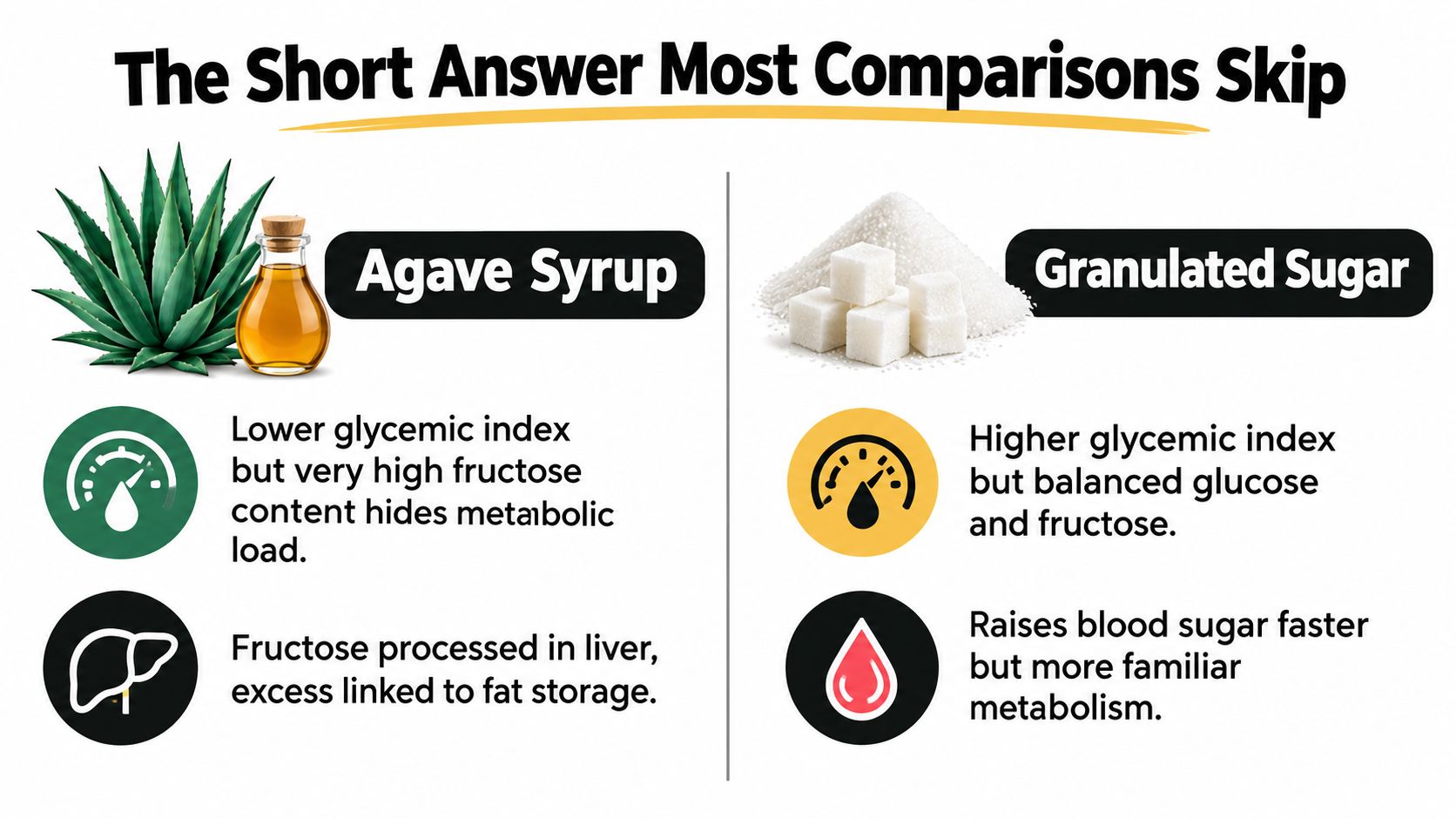
Agave syrup has a real advantage over table sugar, but it's a limited one. Its lower glycemic index can produce a smaller short-term rise in blood glucose, largely because commercial agave products can contain up to 90% fructose. A 2022 peer-reviewed review reports an agave glycemic index of about 10–27, compared with roughly 65 for sucrose (peer-reviewed review on agave syrup and glycemic impact).
That number is useful, but it's not a health verdict. Fructose is handled differently from glucose, and the body sends much of it through the liver. Excessive intake is associated with concerns involving liver fat, triglycerides, and insulin sensitivity, which is why a low glucose reading alone can give you an incomplete picture (BBC Good Food's discussion of agave and fructose).
The natural-sweetener trap
Agave is often marketed as a clean, plant-based alternative to refined sugar. The plant origin is true, but it doesn't make the finished syrup nutritionally exceptional. Agave is still an added sugar, and its lower GI comes from its composition rather than from a lower total sugar burden.
Table sugar contains sucrose, which is made from glucose and fructose. Agave shifts the balance heavily toward fructose. That can make it look better on a blood-glucose chart while moving the concern toward the liver and total fructose exposure.
Practical rule: A lower glycemic index can help you choose a sweetener for a specific meal, but it isn't permission to use more of it.
The blunt answer to is agave better than sugar is therefore no, not as an everyday health upgrade. Agave can be the better tool for an iced drink or a recipe that needs a smooth liquid sweetener. It isn't a free pass, and it isn't a reason to replace every granulated sweetener in your pantry.
How Agave and Sugar Are Made
Sugar and agave may look different in the jar, but neither reaches it straight from nature. Both require extraction, concentration, and processing before they become convenient kitchen sweeteners.
From cane or beets to crystals
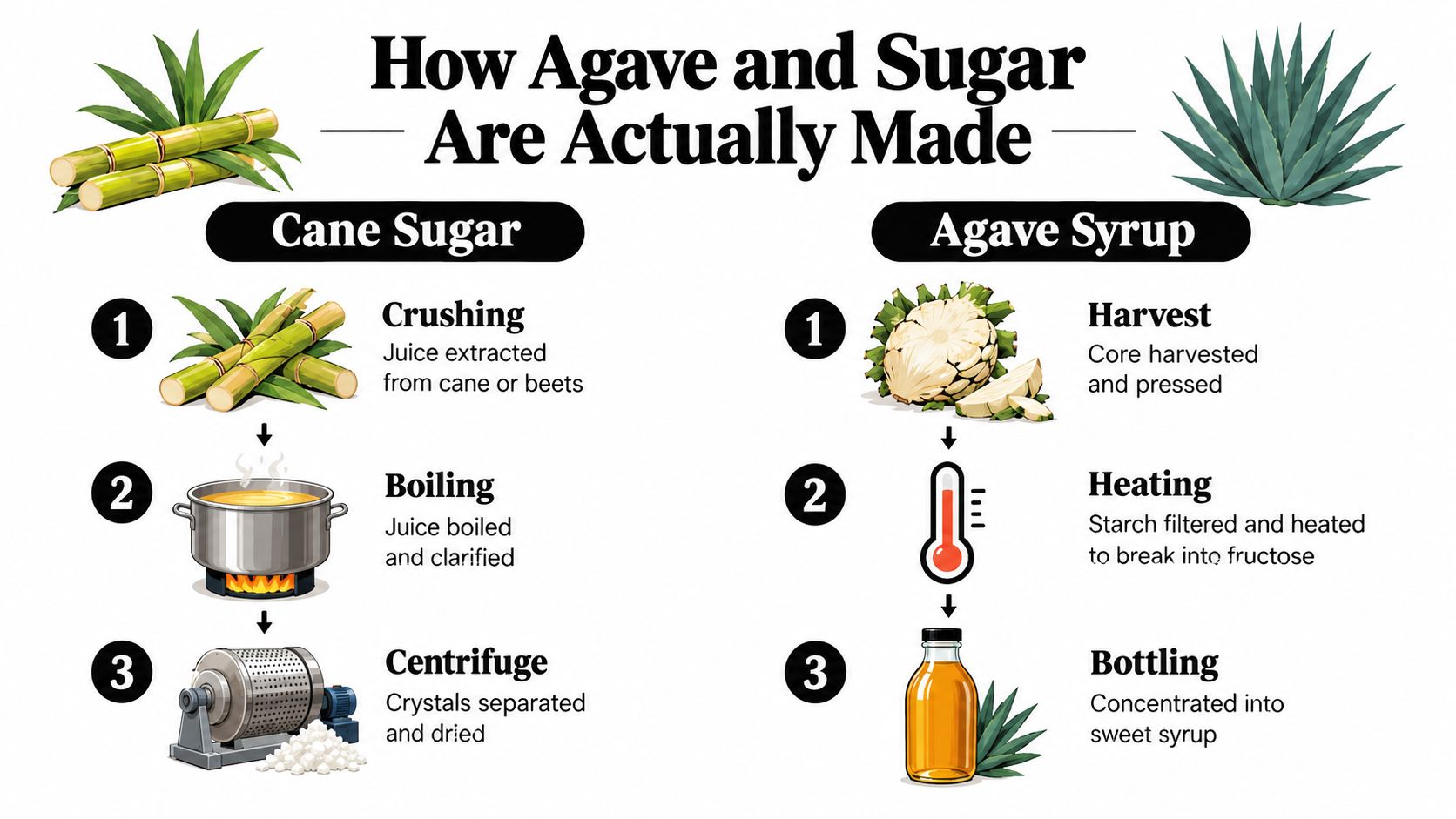
Granulated sugar starts with sugarcane or sugar beets. Producers extract the plant juice, clarify it, boil it down, and separate sugar crystals from the remaining liquid using centrifuges. The crystals are dried and packaged.
Turbinado, muscovado, and demerara sugars retain some molasses, giving them darker color and a stronger flavor. That makes them useful in baking and sauces, but the underlying sucrose molecule remains the same. Dark color does not place sugar in a meaningfully different health category.
White sugar remains popular because it behaves predictably. It dissolves, creams with butter, helps create structure, and supports browning. Those are useful cooking properties, not evidence that it is healthy.
From agave heart to syrup
Agave syrup begins with the plant's central core, often called the piña. Producers harvest and press or roast the core, then use heat and enzymes to break its complex carbohydrates into simpler sugars, especially fructose. The liquid is filtered, concentrated, and bottled.
Light agave usually receives more filtering than darker varieties. Mass-market products may also undergo ultrafiltration, producing a thin, uniform syrup with mild flavor. Darker agave can retain more color and flavor, but “dark” does not guarantee minimal processing or a better nutritional profile.
What the label can and can't tell you
The word natural says little by itself. A product can start as a plant and end as a concentrated sweetener with no meaningful fiber or protein. Check the ingredient list, nutrition panel, country of origin, and sourcing information instead of trusting the front-label story.
Local makers may provide clearer information when they explain ingredient origins and processing methods. Transparency is a quality signal, and the label is where you verify it. Choose a bottle whose contents and production story match what you want to buy.
Calories and Sugar Load by Serving
Serving size changes the comparison. Agave is sweeter than sugar, so you may need less of it, but a teaspoon of agave still isn't automatically lighter.
A product-style nutrition summary lists 1 tablespoon of light agave nectar at about 60 calories, 16 grams of total carbohydrate, and 14 grams of sugars, with 0 grams of fiber and 0 grams of protein (agave syrup nutrition and serving comparison). The same source reports about 21 calories per teaspoon of agave, compared with 16 calories for table sugar.
USDA-linked nutrition data lists 1 teaspoon of table sugar as 4 grams and about 15 calories (USDA-linked table sugar serving data). The small difference between sources reflects ordinary product and measurement variation, so use the figures as a practical comparison rather than a laboratory promise.
| Serving | Agave syrup | Table sugar |
|---|---|---|
| 1 teaspoon | About 21 calories, about 4.8 g sugars | About 15 to 16 calories, 4 g sugar |
| 1 tablespoon | About 60 calories, 14 g sugars, 16 g carbohydrate | About 45 to 48 calories, about 12 g sugar |
Why sweetness changes the math
Agave tastes sweeter than table sugar. In a real recipe, you may use less syrup to reach the same perceived sweetness, which can narrow the calorie difference. But that advantage depends on measuring rather than pouring freely.
Agave also contains water, so its nutrition panel doesn't map perfectly onto a spoonful of dry sugar. A teaspoon of agave is listed at about 6.3 grams total weight and 4.8 grams of total sugars in a peer-reviewed nutrition table (PubMed Central agave nectar composition table). That “small drizzle” can add up quickly in coffee, oatmeal, smoothies, dressings, and baked goods.
The practical question isn't whether one spoonful wins. It's how often you add that spoonful and whether it joins other sweetened foods during the day. Replacing sugar with agave while keeping the same overall sweetness habit rarely changes the bigger picture.
Glycemic Index and What It Really Means
Glycemic index, or GI, measures how quickly a carbohydrate raises blood glucose. Agave generally produces a much lower GI reading than table sugar because its carbohydrate is mostly fructose rather than glucose. The reported comparison places agave around 10–27, while sucrose is roughly 65.
That result makes agave look like the obvious winner. It is only one part of the comparison, though. Fructose is handled primarily by the liver instead of entering the bloodstream in the same way as glucose, which can produce a flatter immediate blood-sugar response. A lower reading does not mean the syrup has little sugar or carries no metabolic tradeoff.
The number has a blind spot
GI measures the rise in blood glucose. It does not capture the entire route fructose takes through the body, the calories in the serving, or the effect of regularly adding concentrated sweeteners to meals.
The composition data above show why agave can post a low GI while remaining heavily fructose-based. The cited table uses an assumption of about 90% fructose, 8% glucose, and 2% other carbohydrates for agave nectar (agave nectar composition data). Sucrose is digested into roughly equal parts glucose and fructose. Agave's low GI is therefore a compositional result, not proof that it is a light or metabolically neutral sweetener.
| Sweetener | Glycemic index | Fructose share | Glucose share | Primary metabolic route |
|---|---|---|---|---|
| Agave syrup | About 10–27 | Up to about 90% | About 8% in the cited composition assumption | Fructose is processed primarily through the liver |
| Table sugar | Roughly 65 | About 50% after digestion | About 50% after digestion | Sucrose is split into glucose and fructose |
GI testing also uses a standardized carbohydrate amount, not necessarily the amount in your coffee, oatmeal, or dressing. A mixed meal changes the result. Protein, fat, and fiber can slow digestion, blunt the overall glucose rise, and shrink the practical difference between sweeteners.
That meal context matters more than a bottle's front label. Agave may suit someone monitoring post-meal glucose under clinical guidance, but portion control still applies. It does not erase calories or make concentrated fructose a health food.
If blood-sugar management drives your choice, discuss sweetener portions with a qualified clinician. A blood sugar support herbal tea with bitter melon and cinnamon can sit within a broader routine, but it should not replace medical advice or prescribed care.
How They Behave in the Kitchen
The kitchen often gives you a clearer answer than the nutrition label. Agave is a liquid syrup with quick-dissolving sweetness. Sugar is a dry crystal that brings texture, bulk, and browning along with sweetness.
Drinks and no-grit sweetness
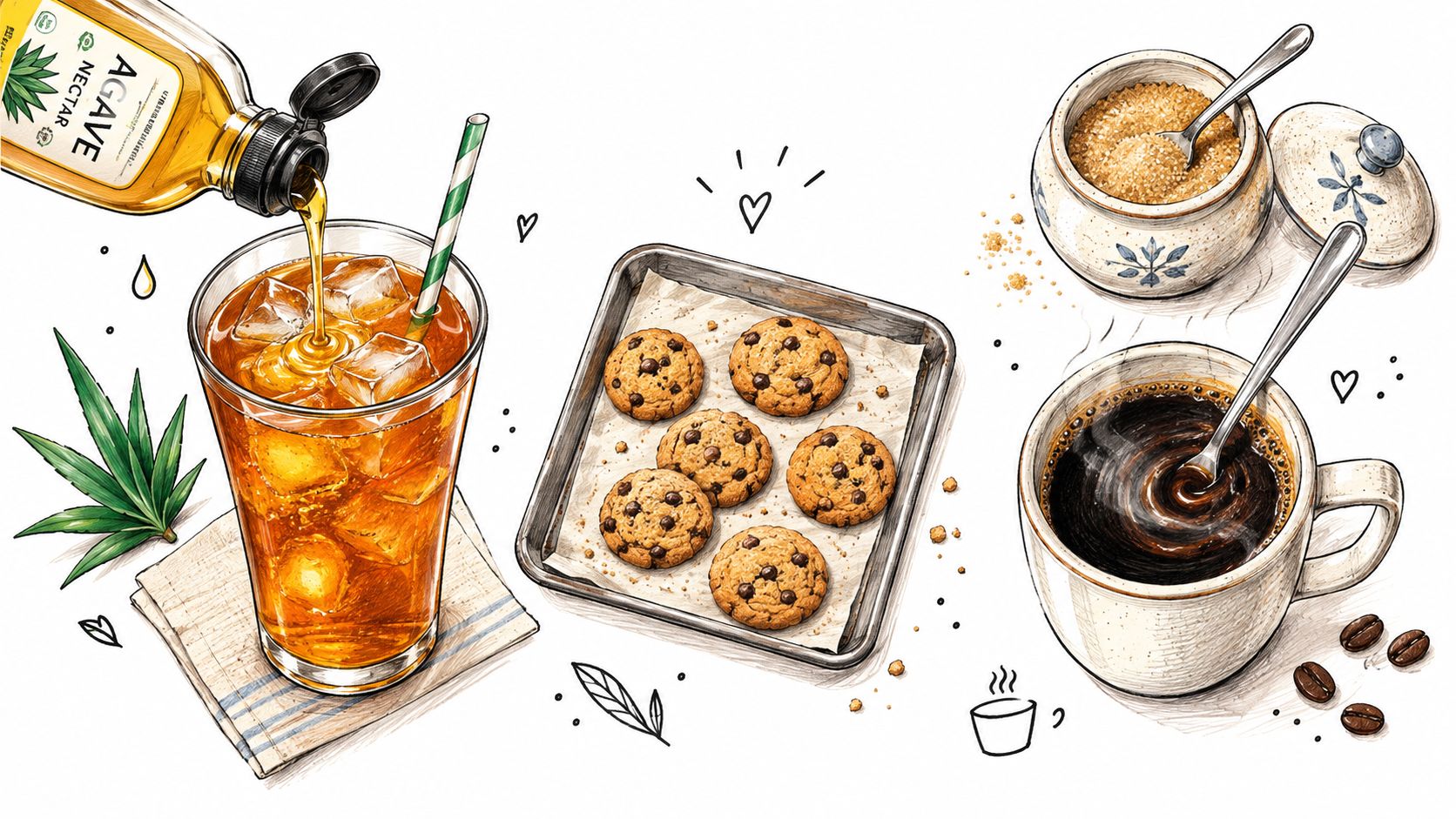
Agave shines in iced tea, cold brew, lemonade, and cocktails because it blends into cold liquid without leaving crystals at the bottom. Sugar can do the same job, but you'll need more stirring or a warm simple syrup.
In hot coffee and tea, both work well. Agave gives you a smooth pour and a soft flavor, while sugar lets you adjust sweetness by the spoonful with familiar precision. Start with less agave than sugar, taste, and stop before the drink becomes syrupy.
Baking needs adjustment
Agave adds moisture as well as sweetness. That can help create tender muffins, chewy bars, and soft cakes, but it can also make a recipe spread, brown too quickly, or lose structure. Reduce other liquid cautiously and watch the oven closely when adapting a recipe written for granulated sugar.
Agave's high fructose content also changes browning behavior. It can darken quickly on the surface, while sugar remains the more dependable choice for crisp edges, caramel, meringue structure, brittle, and hard-crack candy.
Sauces, glazes, and cocktails
For salad dressings, barbecue sauces, marinades, and glazes, agave keeps the mixture smooth. Its syrup texture helps it disperse through oil, vinegar, mustard, and citrus without the graininess that can come from undissolved sugar.
A cocktail made with agave can blend quickly because the sweetener is already liquid. Use a measured amount, though. “A splash” is how a modestly sweet drink turns into a dessert.
For candying or caramelization, sugar wins. It gives you a predictable granular structure and the behavior needed for crisp, glassy, browned results. Agave is the convenient syrup, not the all-purpose replacement.
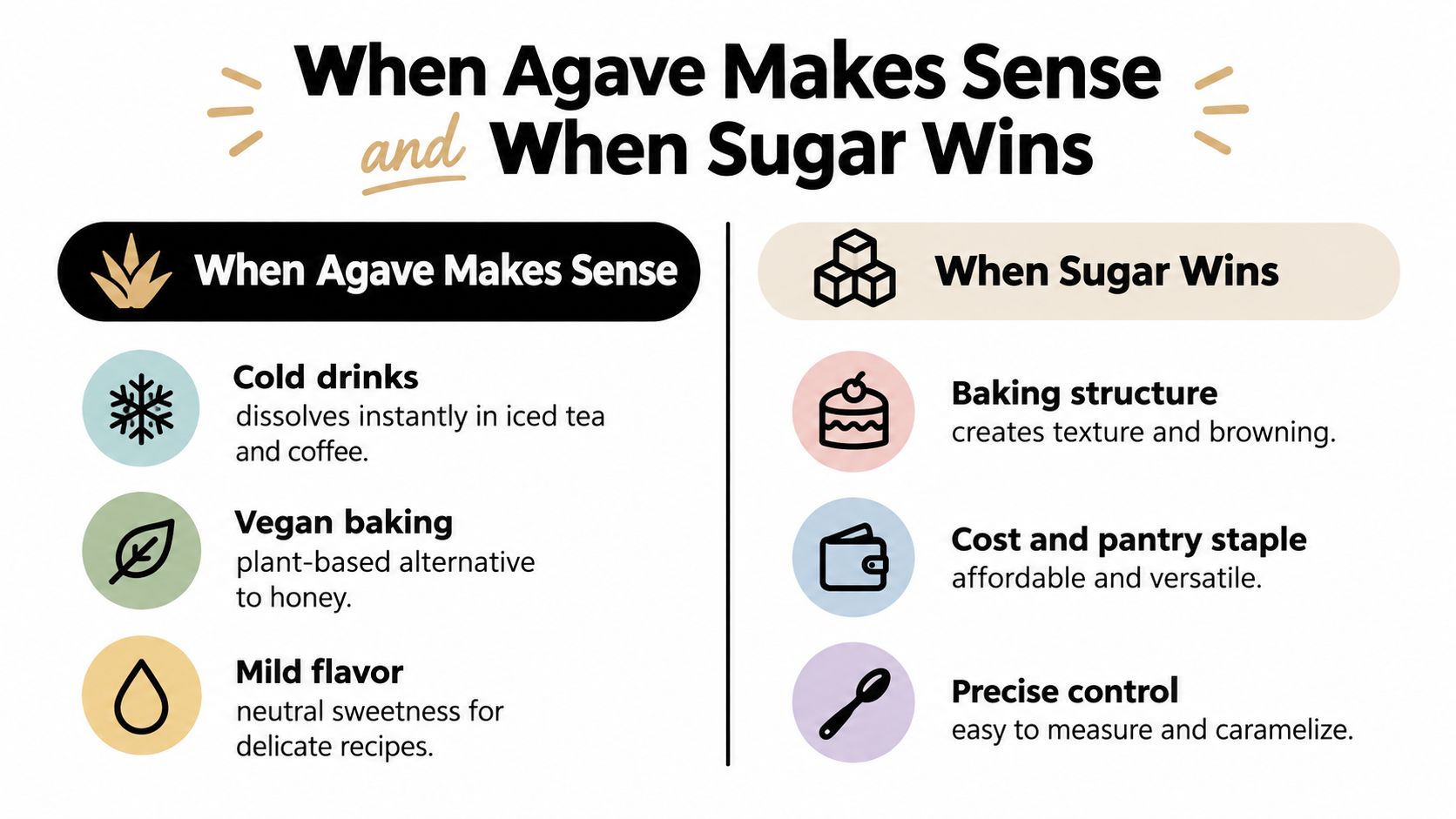
When Agave Makes Sense and When Sugar Wins
You don't need to choose one sweetener for every job. Keep the decision tied to the result you want.
Reach for agave when the recipe needs liquid sweetness
Agave is a sensible pick in three situations:
- Cold drinks: It dissolves quickly in iced tea, cold brew, and lemonade, so you won't be left with grit at the bottom of the glass.
- Moist, tender recipes: A liquid sweetener can suit soft cakes, breakfast bars, glazes, and dressings where crisp browning isn't the target.
- A specific glucose-management goal: Its lower GI may be useful when immediate post-meal glucose response matters, especially alongside a high-fiber meal and with professional guidance.
Agave also works when you want a mild, neutral sweetness that won't compete with citrus, vanilla, berries, or delicate spices. Buy a bottle for the jobs it performs well, not because the label calls it healthy.
Choose sugar when crystals do the work
Sugar is the honest winner for:
- Structure and browning: Cookies, cakes, caramel, brittle, meringue, and crisp toppings depend on sugar's physical and chemical behavior.
- Granular texture: Shortbread and crumb toppings need dry crystals, not a pourable syrup.
- Simple pantry economics: Granulated sugar is widely available and usually costs less than agave, so it makes sense for recipes that use a substantial amount.
Sugar also gives you cleaner control when a recipe was written and tested with sugar. Substituting agave without adjusting moisture and baking conditions can produce a flat, dense, or overly dark result.
Kitchen rule: Choose agave for smoothness and fast dissolving. Choose sugar for structure, crunch, and caramelization.
The choice doesn't need to be ideological. Many practical home cooks keep both: agave for cold drinks and sauces, sugar for baking and candy. That's not inconsistency. It's using the right ingredient for the job.
The Bigger Picture Beyond the Sweetener
The useful question is not which sweetener sounds healthiest. Ask how much added sweetness you use, then read what the product contains.
Replacing table sugar with agave may change the glycemic response without lowering the amount of concentrated sweetener in your diet. Syrup in breakfast, sweetened drinks, packaged snacks, and dessert can add up quickly. A different bottle does not fix a high-sweetness routine.
Agave deserves careful label reading because its low GI can distract from its fructose load and calories. The practical takeaway is simple: a lower GI does not make a concentrated sweetener nutritionally free.
Read the panel, not the promise
Check the serving size first, then total sugars and added sugars. A compliant label can list the sweetener under Added Sugars, with its contribution included in the daily value. If the ingredient list begins with agave syrup, cane sugar, honey, or another syrup, the product is built around concentrated sweetness, whatever the front label suggests.
Look for a short ingredient list, clear flavor descriptions, and sourcing information you can understand. Organic, raw, and natural describe aspects of a product, but they do not erase its calories or make generous portions a good habit. Flavorings and colorants also matter when you want a straightforward pantry ingredient.
Use taste as part of the decision. A more distinctive sweetener may let you use less because it contributes flavor as well as sweetness. A pure raw wildflower honey from an independent maker on Loyaltie offers a different texture and flavor profile, but it remains an added sweetener.
Label-reader's test: If the bottle makes a health promise while the panel lists concentrated added sugar, trust the panel.
The strongest improvement usually comes from reducing the total amount you pour. Choose the sweetener that suits the recipe, measure it deliberately, and let less sweetness become the default.
Smarter Swaps and Better-For-You Alternatives
Different goals call for different tools. If you want fewer glucose swings, a non-nutritive sweetener may suit a drink. If you want a rich flavor in a sauce, maple syrup or honey may be more satisfying in a smaller amount. If you want a clean label, choose the product whose ingredients and sourcing you can understand.
| Sweetener | Calories per tablespoon | Glycemic index | Fructose share | Best use |
|---|---|---|---|---|
| Agave syrup | About 60 | About 10–27 | Up to about 90% | Cold drinks, smooth sauces, moist recipes |
| Table sugar | About 45–48 | Roughly 65 | About 50% | Baking structure, caramel, everyday measuring |
| Pure maple syrup | Not specified in the verified data | Not specified in the verified data | Not specified in the verified data | Flavor-forward drizzling and sauces |
| Honey | Not specified in the verified data | Not specified in the verified data | Not specified in the verified data | Drizzling, tea, marinades |
| Coconut sugar | Not specified in the verified data | Not specified in the verified data | Not specified in the verified data | Recipes where a deeper flavor is welcome |
| Date sugar | Not specified in the verified data | Not specified in the verified data | Not specified in the verified data | Sauces, dressings, and fruit-forward baking |
| Monk fruit | Not specified in the verified data | Not specified in the verified data | Not specified in the verified data | Drinks and low-calorie sweetening |
| Stevia | Not specified in the verified data | Not specified in the verified data | Not specified in the verified data | Drinks and recipes that don't need sugar bulk |
The table includes alternatives, not health halos. Pure maple syrup and honey still provide sugar and calories. Coconut sugar and date sugar can bring different flavors and textures, but they aren't permission to use unlimited amounts. Monk fruit and stevia can reduce calorie intake where you only need sweetness, though they won't provide the bulk, browning, or structure that sugar contributes to baking.
Match the swap to the goal
- Managing blood sugar: Focus on portion size, meal composition, and clinical guidance. Agave may reduce immediate glucose response, but its fructose content still matters.
- Reducing fructose: Table sugar is not fructose-free, but agave is the more concentrated fructose choice. Use less sweetener overall and avoid treating low GI as the deciding factor.
- Cutting calories: Monk fruit or stevia may help in beverages where you don't need sugar's bulk. Agave isn't the obvious choice because its teaspoon calorie count can exceed sugar's.
- Improving flavor: A well-sourced maple syrup, honey, or date-based product may let you use less because the flavor is more distinct. Try a small amount first.
- Reducing added sugar habits: Build meals around unsweetened foods and use a practical resource such as this weekly meal plan without sugar for ideas that don't depend on a syrup swap.
Ingredient quality still matters. Buy directly from makers who explain sourcing and processing rather than choosing a bottle only because its label says “natural.” Loyaltie is a marketplace where people discover and buy directly from independent brands in the US, including products such as a date-sweetened balsamic vinaigrette and date syrup bundle.
The three honest takeaways are simple. Agave has a lower GI, that advantage comes with a high fructose load, and reducing the amount of any concentrated sweetener matters more than chasing a perfect substitute.
Visit Loyaltie to discover independent US brands and buy directly from makers whose ingredients and sourcing are easier to evaluate. Start with sweeteners, dressings, coffee, wellness products, or other everyday goods, then choose the products that deliver better flavor and clearer information without relying on the “natural means better” story.