
You're standing in a grocery aisle, holding a snack bar or skincare bottle, and the front label looks reassuring. Turn it around, though, and you may find a dense list of unfamiliar terms with no explanation of what they do, where they came from, or why they belong in the formula. You're not asking for a chemistry degree. You're asking whether the product deserves a place in your home.
That question creates a clear opening for independent brands and local makers. A large company can print a compliant label, but a maker who knows the supplier, the recipe, and the production process can explain those choices like a real person. That human explanation is the quality upgrade buyers are looking for.
Table of Contents
Why Shoppers Are Demanding to Know What Is Inside
A shopper may accept an unfamiliar ingredient name. They will hesitate when the brand offers no explanation. Ingredient transparency is now a broad buying expectation, not a niche concern limited to natural food, wellness, or skincare. NielsenIQ and FMI found that the share of shoppers who considered transparent product information important rose from 69% in 2018 to 72% in 2021 and 76% in 2023 (NielsenIQ and FMI transparency research). More than three-quarters of surveyed grocery shoppers said information about ingredients and how food is made matters.
The global finding is equally direct. Eighty-six percent of consumers worldwide considered ingredient transparency extremely important or very important, including 88% in emerging markets and 84% in developed markets, according to the global ingredient transparency findings. Buyers carry that expectation into coffee, supplements, pet products, everyday food, and household goods.
Technical names become a problem when the maker leaves the buyer to interpret them. “Tocopherol” may mean vitamin E used to protect a formula from oxidation. “Emulsifier” may describe an ingredient that keeps oil and water blended. A short explanation can replace suspicion with understanding.
The trust advantage independent makers can own
Mass-market brands usually communicate through packaging panels, legal reviews, and tightly controlled claims. Those systems may reduce risk, but they often leave ordinary buyer questions unanswered:
- What does this ingredient do?
- Why did you choose it instead of another option?
- Where did it come from?
- Would you still use it if you didn't need it?
Independent makers can answer in a human voice, without expensive certifications or compliance language doing all the work. A coffee roaster can explain the bean's origin and the reason for a particular roast. A skincare maker can describe how an oil affects texture or why a preservative protects a water-based product. A pet-food producer can explain the role of each protein, fiber, or supplement.
Practical rule: Don't make buyers decode your formula. Translate it for them.
That explanation also shapes perceived quality. Clear ingredient reasoning shows that the maker understands the product, has nothing useful to conceal, and respects the buyer's ability to decide. It gives specific meaning to claims such as “pure,” “clean,” or “natural,” instead of asking shoppers to trust vague labels.
Use simple platform tools to make those answers easy to find. Add short ingredient notes to product pages, link technical terms to plain-language explanations, and use email or social posts to show the people and choices behind the formula. You do not need to publish every manufacturing document. Show the decisions that matter.
When buyers can see what is inside, understand why it is there, and connect those choices to a real maker, a small brand can look more trustworthy than a mass-market alternative. That is the advantage transparency gives independent products.
What Ingredient Transparency Means to Buyers
A full ingredient list earns attention, but it does not answer every buyer's question. A large U.S. shopper survey found that 89% of respondents defined transparency as a complete list of ingredients, while 86% expected a plain-English description and 85% expected in-depth nutritional information (consumer expectations for ingredient transparency).
Buyers want disclosure first, interpretation second, and enough context to judge whether the product fits their needs. They need useful explanations, not a longer wall of technical text. Independent makers can deliver that context in their own voice, using product-page sections, expandable details, and short posts instead of expensive certifications or compliance jargon.
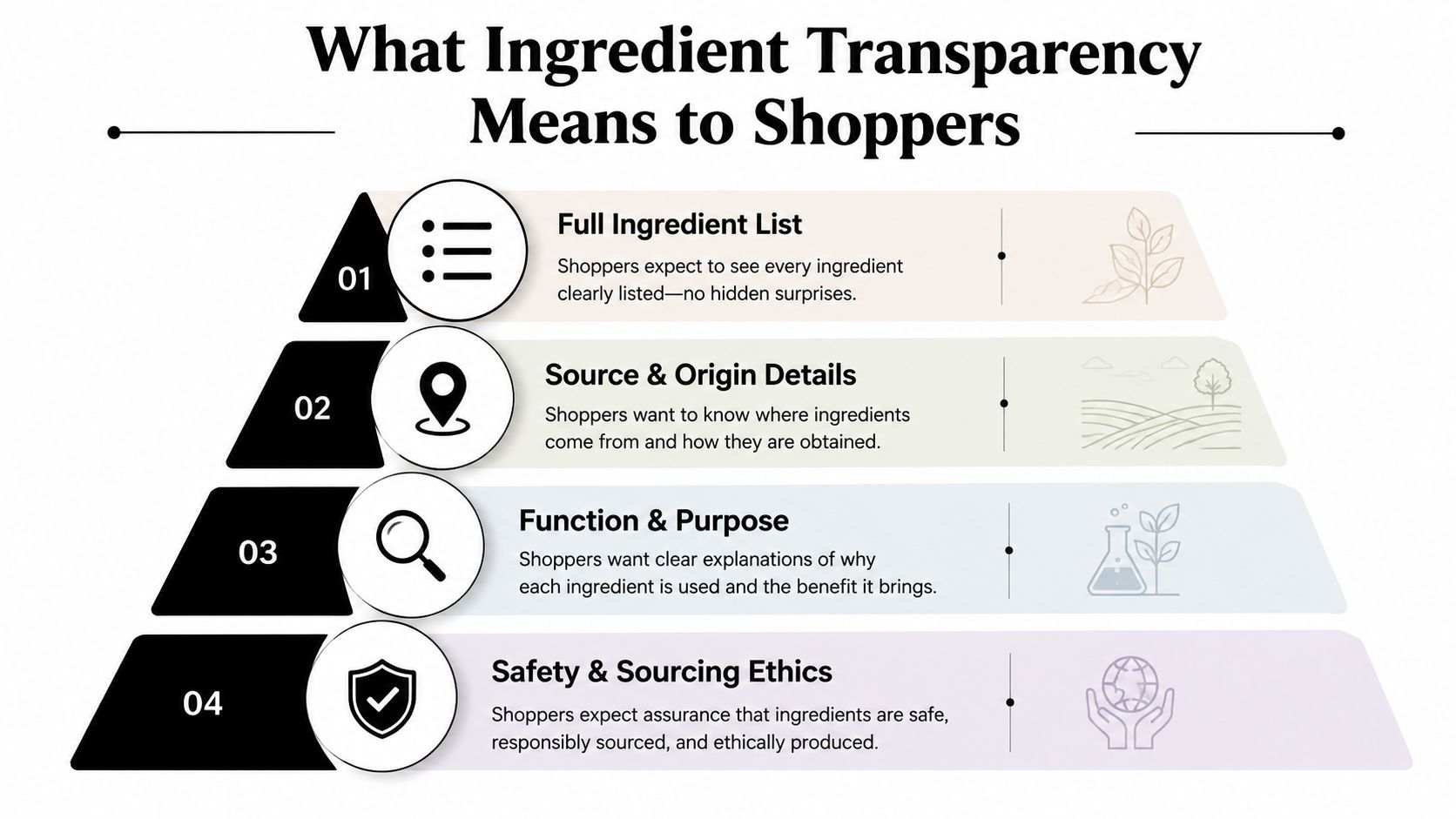
Four layers of a trustworthy explanation
Full ingredient identity comes first. Use the required ingredient names on the package and make the complete list easy to find online. Keep it on the product page or link to it directly. Buyers should not search unrelated pages or download a document to confirm what is inside.
Function and purpose turns disclosure into comprehension. Explain whether an ingredient provides structure, preserves freshness, adds flavor, supports texture, or supplies a nutrient. Plain language means giving a useful answer before introducing technical detail.
Source and origin addresses the next question. Buyers want to know where key ingredients come from, whether you buy directly from a grower or use a specialized supplier, and why that source meets your standards. State only what you can document.
Safety and sourcing ethics require careful wording. Share relevant testing, allergen handling, certifications, or supplier standards when evidence supports them. Treat “free from” language narrowly, and pair any badge with an explanation rather than relying on the symbol alone.
More disclosure can still create overload. Laboratory terms, supplier codes, and unexplained certifications may reveal information while leaving shoppers less able to judge the product. Put the complete list first, then let buyers expand supporting details as needed.
For pet-product shoppers, reading dog supplement labels shows why the task involves more than spotting ingredients. Buyers need to understand what the label communicates. The same principle applies to human wellness products, food, and skincare. A small brand that explains its choices clearly can make a stronger trust case than a mass-market competitor.
The Regulatory Baseline and Common Standards
Ingredient transparency starts with compliance, but compliance is only the floor. Your product page should make the legal label easier to understand, not replace it with marketing language.
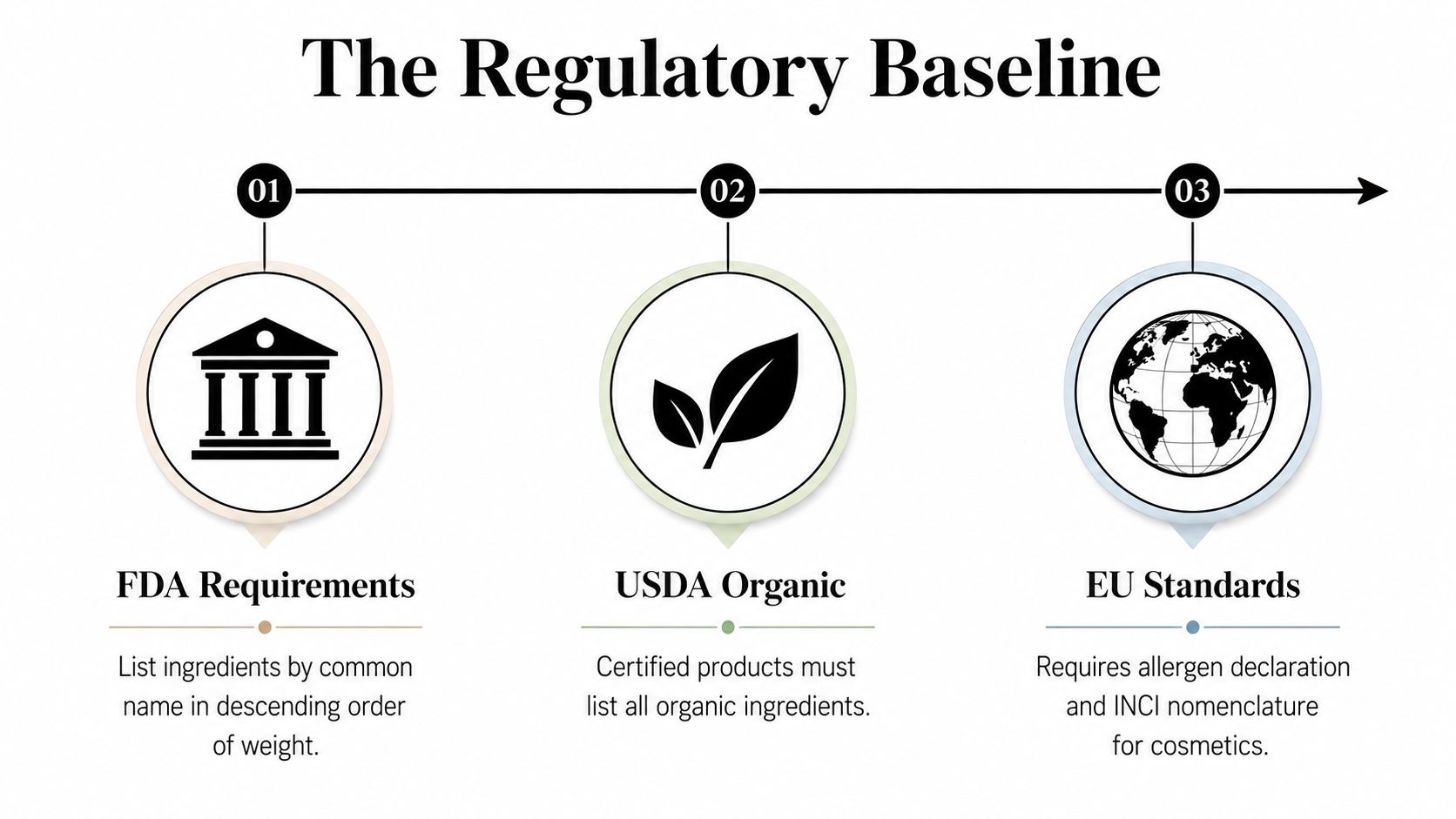
For U.S. food products made with two or more ingredients, FDA food-labeling rules generally require each ingredient to appear by its common or usual name, listed in descending order of predominance by weight, with limited grouping exceptions for spices, flavors, and colors (FDA food-labeling requirements). Ingredient order isn't decorative. It tells buyers and regulators which components make up the greatest share of the product.
That means transparency belongs in formulation decisions. If a functional ingredient moves lower in the list after a recipe change, the product's composition and the shopper's interpretation both change. Review the actual formula, the label, and the product-page copy together before you publish.
What cosmetics makers should check
For cosmetics sold at retail in the United States, the FDA requires an ingredient declaration under 21 CFR 701.3 (FDA cosmetics labeling requirements). Treat that declaration as the fixed reference point for your online product page. A plain-English guide can sit beside it, but it shouldn't contradict the official list or disguise an ingredient behind a friendlier nickname.
Historical regulation helps explain why buyers now expect this information. The U.S. Fair Packaging and Labeling Act of 1967 required cosmetic ingredient disclosure on consumer packaging, while the Nutrition Labeling and Education Act of 1990 made standardized nutrition labeling mandatory for food, with later allergen-focused updates tied to 2004 onward (history of food and cosmetic labels). Disclosure moved from a voluntary advantage toward a consumer-protection baseline.
Separate required information from trust-building detail
Your required label may not tell buyers where a botanical was grown, why you selected a particular oil, or how you interpret a test result. Those details are where independent makers can stand apart.
Share documentation you hold. Explain certifications accurately, and distinguish a formal certification from an internal sourcing standard. If cruelty-free claims matter to your audience, help buyers understand cruelty-free skincare standards you can trust rather than displaying a vague ethical statement.
The safest communication is specific, current, and supported. Don't promise that a product is universally safe, and don't use regulatory language as a shield against ordinary questions.
How to Show Transparency on Your Product Pages
A transparent product page should answer the buyer's questions before they need to email you. Build the page in layers so a quick shopper can scan it and a careful shopper can investigate further.
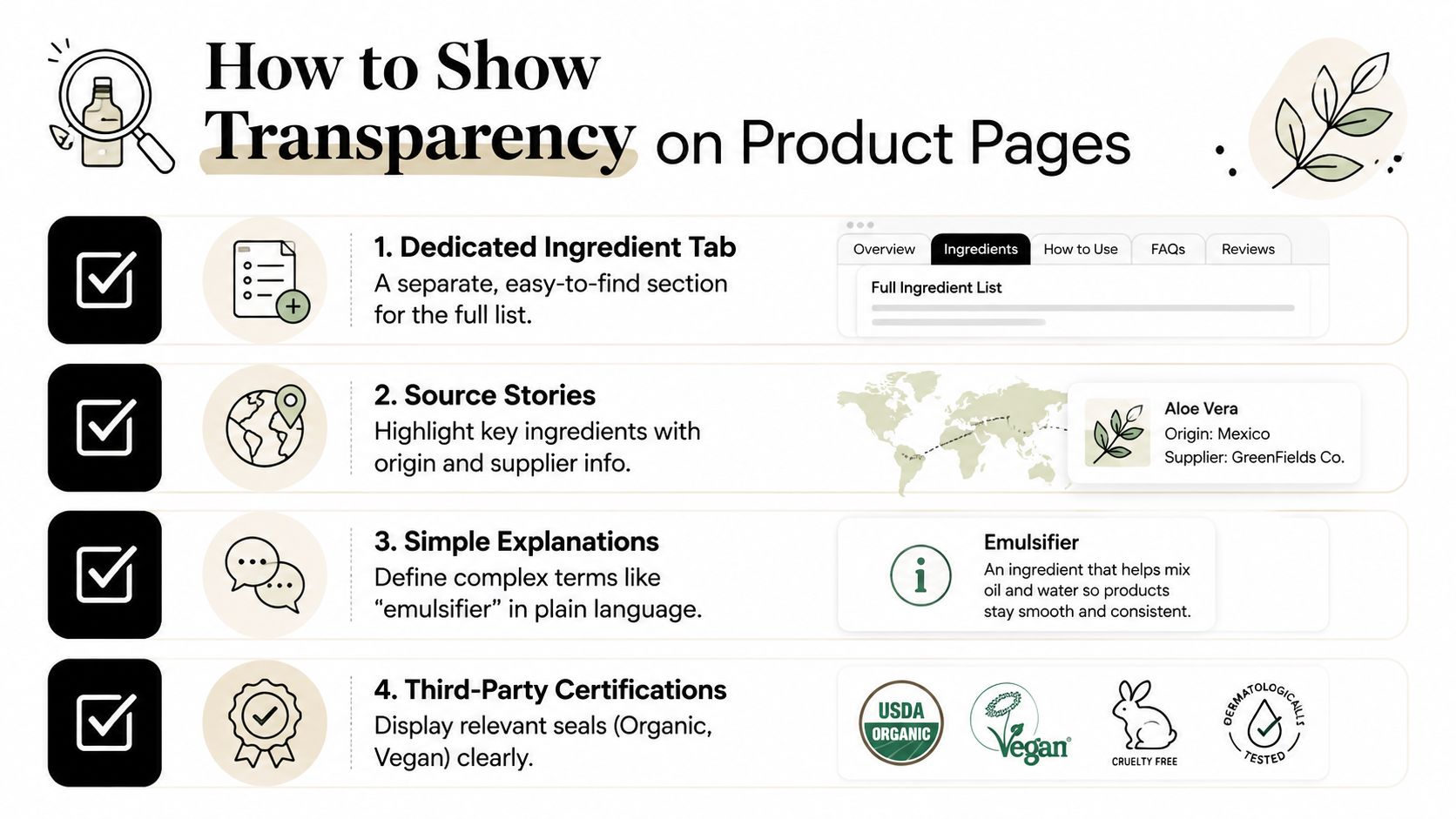
Start with a dedicated ingredient section near the product description. Put the complete list in the same order as the package, then add a short explanation for important ingredients. For a laundry product, “coco glucoside, a plant-derived cleanser that helps lift soil” is more useful than leaving the shopper with a technical term alone.
Add evidence around the formula
Use a short sourcing statement for ingredients that carry the product's identity. Name the region, supplier relationship, or production method when you can verify it. If an ingredient has multiple sources depending on availability, say so clearly instead of presenting a single origin as permanent.
Photos help because they give buyers something concrete to inspect. Show raw materials, the workspace, packaging, or the maker preparing a batch. These images don't prove safety on their own, but they make the product feel connected to a real process rather than an anonymous factory.
Testing information should be readable. If you publish a third-party result, explain what was tested, when the test applies, and what the result does and doesn't establish. A downloadable certificate without context creates work for the shopper. A brief summary beside the document creates confidence without pretending that one test answers every safety question.
Make traceability understandable
Batch details can be simple. Tell buyers where they'll find the batch or lot identifier, what it connects to in your records, and how they can contact you if they have a question. You don't need to expose private supplier paperwork. You do need an internal process that lets you investigate a concern without guessing.
On Loyaltie, a maker can use the product page as the central place for this information, then keep the same ingredient language across product listings, reorder messages, and customer support. For a concrete example of how ingredient names can appear in an everyday-product title, review the plant-based liquid laundry detergent listing.
A practical update for this week looks like this:
- Rewrite the introduction: Explain what the product does before discussing technical features.
- Publish the complete list: Match the package and include an update date when the formula changes.
- Clarify key terms: Define unfamiliar ingredients in one sentence each.
- Add source context: Identify the origin or selection reason for the ingredients customers care about most.
- Show the maker: Include a process image or a short note from the person responsible for the formula.
For additional visual guidance, this video can help makers think about how product information is presented online.
Choosing the Right Transparency Tactics for Your Brand
You don't need every possible trust signal on every product page. Choose the tactic that answers the main concern in your category, then add detail where customers keep asking questions.
| Tactic | Best For | Effort Level | Trust Impact |
|---|---|---|---|
| Complete ingredient list | Every food, wellness, skincare, and pet product | Low | Foundational |
| Plain-English function guide | Skincare, supplements, household products | Moderate | High when terms are unfamiliar |
| Sourcing story | Coffee, food, botanicals, oils, pet ingredients | Moderate | Strong when origin affects quality |
| Nutritional detail | Food, snacks, supplements, pet products | Moderate | High for comparison-focused buyers |
| Third-party testing | Supplements, skincare, food, and products with safety concerns | High | Strong when scope and results are clear |
| Certification badge | Products with relevant, current certifications | Moderate to high | Useful when the seal is recognizable and verified |
| Batch traceability | Products with changing ingredients or production batches | High | Strong for accountability and follow-up |
A food maker might begin with sourcing and nutrition. The buyer wants to know what they're eating, how the ingredients fit together, and why the recipe is worth choosing. A skincare maker should usually prioritize the full declaration, ingredient functions, usage guidance, and relevant testing or certification information.
Match the proof to the promise
Don't lead with a certification that has little connection to the shopper's concern. If buyers ask whether a supplement contains what the label promises, testing information has more value than a general values statement. If they're choosing coffee based on origin and freshness, a sourcing story and roast explanation may do more work than a wall of technical documentation.
Certification can still help, but only when it's current and relevant. Explain what the certification covers, and don't suggest it validates claims outside its scope. Makers who want a broader content framework can review guidance on marketing natural beauty products while keeping their own ingredient claims precise.
The right approach is cumulative, not maximal. Publish the information that reduces the biggest decision barrier first, then use customer questions, returns, and support messages to identify the next useful addition.
Real Examples of Transparency Done Well
The strongest ingredient stories don't sound like legal notices. They sound like a maker explaining a decision across a worktable.
A skincare maker might introduce a honey-infused balm by naming the base ingredients, describing the texture each one creates, and explaining why the balm is stored in a particular container. A photo of the jar, the raw honey, and the ingredient card gives the buyer a tangible sense of the product without making unsupported claims about what it can do.
Let simple formulas speak clearly
The Lupin Protein Rotini Pasta in the Loyaltie catalog offers a useful product-page model because its positioning centers on a short, recognizable ingredient story. The product highlights lupin and chocho lupins, protein, fiber, gluten-free ingredients, and the absence of gums or fillers. A buyer can understand the product's point without sorting through a complicated narrative.
That doesn't mean a short list automatically proves quality. It means the maker has a clean starting point for explaining the role of the core ingredients, how the pasta cooks, and what dietary questions the shopper should consider.
Organic Kids Snack Bars can use the same principle from a different angle. Parents need an ingredient list they can scan quickly, followed by plain explanations of the ingredients that may affect allergies, texture, sweetness, or nutrition. The page should make the buying decision easier, not force parents to interpret marketing phrases.
Show the work without staging a performance
A local cleaner can apply the same approach to an everyday household product. The plant-based all-purpose cleaner product page names ingredients such as decyl glucoside and cocamidopropyl betaine in the product itself. The opportunity is to add a concise explanation of their cleaning role, the intended surfaces, and any relevant fragrance or sensitivity information.
Good transparency doesn't require a large campaign. It requires consistent details:
- A real origin: Show where a notable ingredient comes from when you can substantiate it.
- A clear purpose: Explain why the formula includes each important component.
- Readable proof: Summarize testing or certification documents instead of merely displaying them.
- A human voice: Let the maker explain the tradeoff, such as choosing a preservative to protect a water-based product.
The buyer should finish the page thinking, “I understand what I'm getting and why it was made this way.” That reaction is more valuable than a dramatic claim the product can't support.
Your Transparency Action Plan and Common Questions
Build ingredient transparency in stages. Start with the information every shopper needs, then add proof and process details as your records improve.
Days one through seven: Audit every product page against the physical package. Correct ingredient names, order, allergen information, nutrition details, and outdated descriptions. Add one plain-English sentence for each ingredient that customers regularly ask about.
Days eight through fourteen: Add sourcing context and process photos. Identify the supplier, region, or selection reason for major ingredients where you have reliable information. Photograph the actual workspace or materials instead of using generic stock imagery.
Days fifteen through twenty-one: Organize your evidence. Gather current testing documents, certification details, supplier specifications, and batch records. Publish only what you can explain accurately, and state the scope of each document.
Days twenty-two through thirty: Create a change protocol. When a supplier or formula changes, update the product page, note the relevant change in clear language, and give customer support the same explanation. Consistency protects trust better than pretending a product never evolves.
Questions makers ask
How much detail is enough? Start with the complete list, purpose, sourcing context, and relevant safety information. Put technical documents behind expandable sections so curious buyers can explore without overwhelming everyone else.
Do I need expensive certifications? No. Certifications can be useful when they apply, but clear labels, honest sourcing statements, and accessible testing information can build trust without a badge. Never imply certification where none exists.
What happens after a reformulation? Don't leave old copy online. Explain what changed, why it changed, and which product version the information describes.
Keep your working documents organized, and use a consistent template for every product. Loyaltie's seller resources can sit alongside your own formulation and labeling process as you build product pages that help buyers compare independent goods with confidence.
Loyaltie is a marketplace where people discover and buy directly from the best independent brands in the US, with everyday products across food, wellness, skincare, household goods, and more. Visit Loyaltie to put clearer ingredient stories in front of shoppers who want better products made by real people.