


Independent beauty brands now hold 32% of the $125 billion U.S. beauty and personal care market, and they're doing it with real momentum, not cute branding. If you've been assuming indie beauty is mostly a feel-good alternative to mass retail, the numbers say otherwise, and they make the case for a simple truth, you can often buy better products directly from the maker.
The shift matters because beauty shoppers don't just want novelty. You want formulas that work, ingredient lists that make sense, and brands that respond when something is off. That's where independent makers keep winning, especially online, where discovery is faster and the feedback loop is tighter.
Table of Contents
- Read the formula like a buyer, not a fan
- Verify claims the hard way
- Read reviews for signal, not applause
- Make the listing do the selling
- Build trust where buyers already browse
- Design for repurchase, not just launch day
Why Independent Beauty Brands Are Taking Over
Independent beauty brands controlled about 32% of the $125 billion U.S. beauty and personal care market in the 52 weeks ending Nov. 1, 2025, and that's the part people should stop treating like a niche footnote. Those brands generated roughly $40.0 billion in sales and grew 22.3% year over year, while conglomerate-owned brands grew 6.1%. That's not a branding story, it's a performance story, and the market is voting with actual purchases.
The numbers point to a real shift in consumer behavior
The cleanest takeaway is simple. Independent brands are no longer winning only in the “beauty nerd” corner of the internet, they're winning in the mainstream basket. In facial skincare, indies hold the largest share at 41%, and they're also posting strong growth in fragrance, facial skincare, and cosmetics and nails. If you want a practical place to start browsing, the find skincare DTC examples resource from Landra is a useful way to see how direct-to-consumer skincare brands present products without retail gloss getting in the way.
Practical rule: if a brand keeps showing up in a category where shoppers buy repeatedly, not just impulsively, that's a sign the product is solving a real problem.
The other thing worth paying attention to is where the sales happen. About 70% of indie beauty sales happen online, which tells you the growth isn't coming from legacy shelf space, it's coming from digitally native discovery, repeat ordering, and social commerce. That's exactly why independent brands feel more responsive than giant labels. They live closer to the customer, and when they get the formula right, shoppers notice fast.
What Actually Qualifies as an Independent Beauty Brand

An independent beauty brand is an independently owned and operated company with under $300 million in annual revenue. NielsenIQ expanded that threshold from $200 million to $300 million to better capture the segment's growth, which matters because the definition shapes how you read the market and compare brands accurately. If you blur that line, you can end up treating a still-independent maker like a conglomerate player, or the other way around.
Ownership matters more than the label on the box
The word independent is about control, not aesthetic. A brand can look minimalist, natural, or clinical and still be owned by a large corporation. It can also have broad distribution and still be independently run if the ownership structure fits the category. For shoppers, that matters because the person making formula decisions is often closer to the customer problem, not a giant retail committee trying to smooth everything into a safe middle.
Revenue isn't a vibe, it's a boundary
That revenue threshold also gives you a cleaner way to evaluate claims. Some brands market themselves like scrappy newcomers long after they've outgrown the indie tier, while others stay small but independent. The threshold helps you avoid confusing “has a polished website” with “is corporate.” It also keeps the conversation on what really changes product experience, such as speed of reformulation, ingredient transparency, and direct accountability.
A brand doesn't become more trustworthy because it says the right words. Trust comes from who owns it, how clearly it explains the formula, and whether it can stand behind what it sells.
The one misconception I'd drop immediately is that all indie brands are automatically clean, gentle, or better. They're not. What they are, when they're good, is more accountable and easier to evaluate than faceless mass-market lines. That's a better starting point for your money.
The Quality Advantage of Buying Directly from Makers
Independent brands usually win when the product has a clear job to do. That's why they do so well in facial skincare, where shoppers care about ingredients, texture, and whether a formula fits their routine. They're not trying to please every department store buyer at once, which often means the product has sharper intent and fewer compromises.
Direct-to-maker means fewer compromises
When you buy directly from the maker, you're closer to the person who chose the texture, the active ingredients, and the final packaging. That matters because a formula built for direct feedback can evolve faster than one built to satisfy broad retail expectations. The result is often a product that feels more specific, whether that's a serum for crepey skin, a fragrance with a clear identity, or a nail product that lasts.
The category data backs up that instinct. Independent brands hold the largest share in facial skincare at 41%, and they're also growing strongly in fragrance, skincare, and cosmetics and nails. That lines up with how shoppers use beauty products, they buy what solves a daily issue, then they reorder what works.
Specificity beats generic beauty branding
If a brand is trying to serve a precise need, you can usually feel it in the formula. Ingredient transparency gets tighter. Claims get easier to test. Customer service tends to be more direct because the maker has fewer layers between the complaint and the answer. That's why I'd rather buy from a brand that knows exactly who it's for than from one trying to be vaguely appealing to everyone.
One clean example on the marketplace side is Finally All Natural, which sits in the kind of direct-to-maker ecosystem that makes comparison shopping easier. I like seeing brands presented as actual products with a clear formula story, not just a mood board and a promise.
My rule: if the brand can't explain who the product is for in one plain sentence, it probably isn't focused enough for repeat use.
That focus is the true upgrade. You're not buying charity, and you're not buying a logo. You're buying a formula built by someone who has to answer for it directly.
How to Vet Independent Beauty Products Before You Buy

Start with the ingredient list, not the brand story. If a product reads like a vague promise, I'm already skeptical, because skincare and beauty work is built on formulas, not vibes. The product page should make it easy for you to understand what's inside, what the texture is like, and why the formula exists.
Read the formula like a buyer, not a fan
Look for clarity first. You want to see the full ingredient list, visible variant details when relevant, and a description that tells you what the product is meant to do. Beauty ecommerce data is most useful when it captures shade or variant detail, size, ingredients, stock status, images, star ratings, and review text, because those are the fields that help you judge whether a product matches your need before you order.
If a serum claims hydration, check whether the formula centers on ingredients that match that role. If a nail product claims wear, see whether the brand explains the finish and use case. If a listing buries the useful part, that's a signal the brand may be leaning on marketing more than product clarity.
Verify claims the hard way
Don't let a certification icon do all the work for you. Read the exact claim, then ask whether the brand gives any evidence, context, or process detail. A good independent brand can usually tell you what the product is meant to do without sounding defensive. A weak one hides behind buzzwords.
For example, the Multi-Peptide Copper Serum, Copper Tripeptide-1 + Hyaluronic Acid, Firming & Smoothing, 1 fl oz (30 mL) | Equanimist by Loyaltie is described as a lightweight serum that pairs Copper Tripeptide-1 with a multi-peptide blend and hyaluronic acid to support elasticity and give tired, crepey-looking skin a firmer, smoother feel without harsh actives. That's the kind of plain-language formula description I trust more than a wall of trend words.
Read reviews for signal, not applause
Reviews matter, but only if you read them carefully. Ignore the ones that sound copied and pasted. Look for repeated comments about texture, absorption, scent, irritation, wear time, and whether the product matches its claim. That pattern tells you more than a single five-star rating.
Practical rule: one detailed review is worth more than ten vague compliments.
If you want to compare skin-forward listings that are easy to inspect, the Ojas Glow product page is the kind of page where the formula details do the heavy lifting. That's the standard you should expect.
Where to Discover Local Independent Beauty Makers
Some of the best finds still come from the world around you. Farmers markets, maker fairs, pop-up beauty events, and neighborhood stores let you talk to the person who made the product, which is useful when you want to know why a serum feels the way it does or why a balm uses one ingredient over another. You get context that a flat product grid can't always give you.
Start close to home, then go digital
Local discovery is great for sampling, but the buying often moves online. That fits the category. About 70% of indie beauty sales happen online, so even if you discover a maker at a market, the ongoing relationship usually happens through digital ordering and regular reorder habits. That's where marketplaces help, because they make it easier to come back to the products that worked for you.
Loyaltie fits that use case as a marketplace where people discover and buy directly from the best independent brands in the U.S. It gives you a clean way to move from browsing to ordering without the usual friction of hunting down a maker's site, then trying to remember which serum, balm, or body product you meant to repurchase.
Use social proof, but keep it grounded
If you want a second opinion before buying, check out creator-led reviews that focus on how a product performs, not just how pretty it looks on camera. A Lander dupe review can be useful for that kind of comparison shopping, especially when you're trying to decide whether a formula is just trend-adjacent or worth using every day. I care more about real wear tests than polished unboxings.
If a maker shows how the product is used, who it's for, and what problem it solves, you're already ahead of the average beauty shopper.
The smart move is to build a short list of products that earn a place in your routine, then reorder those directly. That keeps your shelf less crowded and your standards higher.
Tips for Independent Makers to Reach Local Buyers
If you're a maker, stop trying to sound like everyone else. Buyers don't need another brand that says “clean,” “glowy,” and “luxury” in the same sentence. They need to know what problem you solve, who the product is for, and why your formula deserves a spot in their routine.
Make the listing do the selling
Your product page should carry the weight. Put the full ingredient list near the top, explain the variant clearly, and name the use case without hedging. If the product is a serum for dry skin, say that. If it's a facial oil that works best at night, say that. Shoppers buy faster when they don't have to decode the listing.
The technical details matter more than founders like to admit. Beauty data needs accurate shade, size, ingredient, stock, image, and review fields because those are the things that drive confidence. If you manage those well, you're helping the right shopper find the right product faster.
Build trust where buyers already browse
Selling through a marketplace can remove a lot of friction, especially when shoppers are already comparing makers. Loyaltie gives independent brands a direct path to local audiences, and that matters when your goal is repeat buying rather than one-off discovery. You're not just chasing traffic, you're making it easier for someone to reorder when the first bottle runs out.
Keep your assortment tight at first. Offer products that solve one clear problem well, then make the buying path obvious. The best independent brands don't try to be everything. They become the default choice for a specific need.
Design for repurchase, not just launch day
If your product works, make it easy to buy again. That means clear sizing, stable formulation, and communication that reminds people when the product is worth restocking. You don't need gimmicks to create loyalty. You need a formula that earns it, plus a storefront that doesn't get in the way.
For makers, the goal is simple. Be easy to understand, easy to trust, and easy to buy from again.
Your Independent Beauty Shopping Checklist
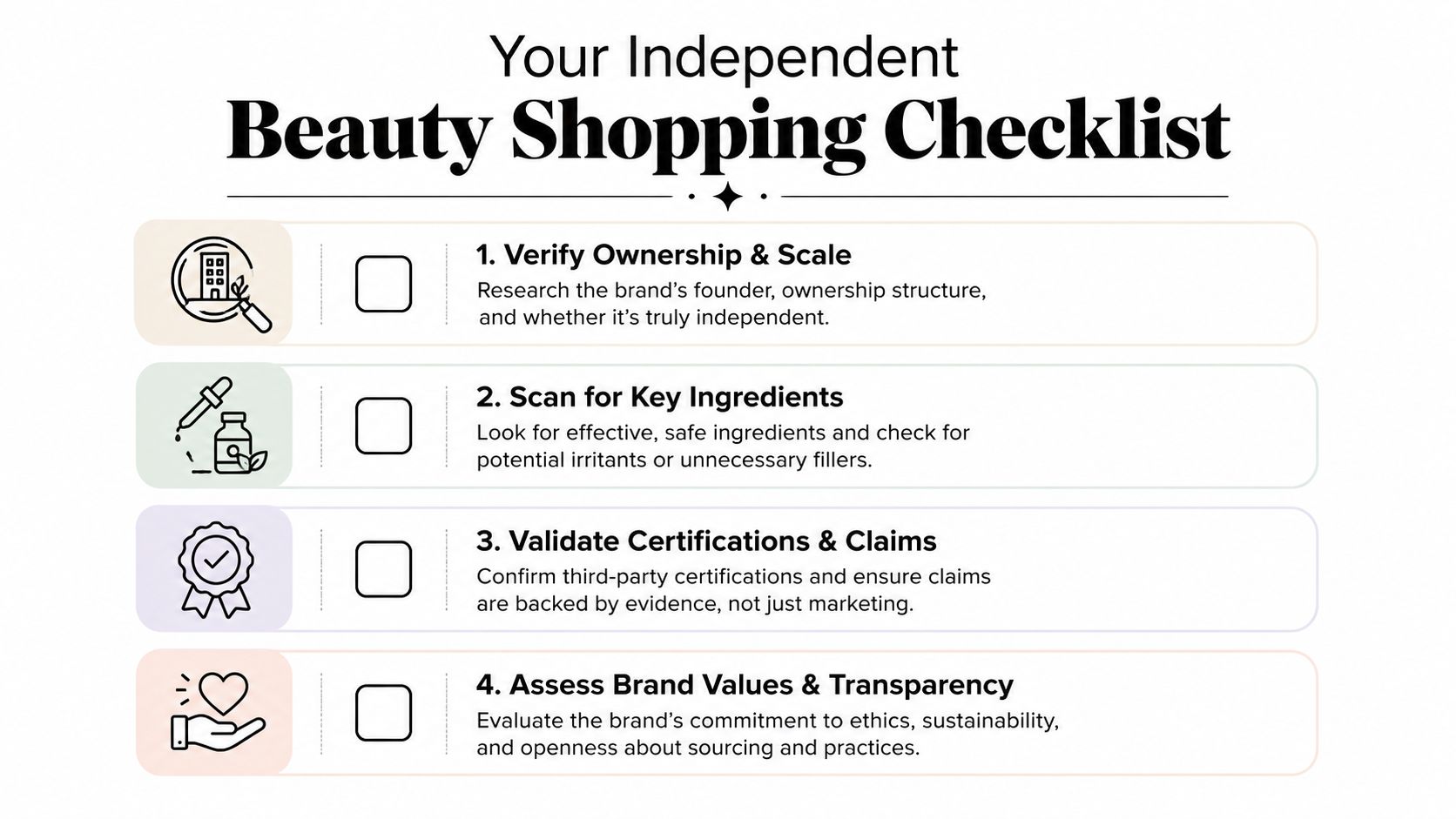
Use this when a new brand catches your eye and you want to know whether it deserves a spot on your shelf.
- Verify Ownership and Scale: Check whether the brand is independently owned and whether it fits the indie category instead of relying on aesthetic cues alone.
- Scan for Key Ingredients: Read the formula, not just the claims. Look for ingredients that match the problem you're trying to solve.
- Validate Certifications and Claims: Don't assume a badge tells the full story. Check whether the brand explains what the product does.
- Assess Brand Values and Transparency: Look for clear product pages, straightforward usage guidance, and evidence that the maker can answer questions directly.
If you're shopping, buy from brands that make the formula easy to judge and the reorder path easy to use. If you're making products, focus on the data fields and trust signals that help the right buyer say yes faster.
Loyaltie makes it easier to discover independent beauty brands, compare real product details, and buy directly from makers without the usual retail clutter. If you want better beauty buys and a simpler way to reorder the products that work, visit Loyaltie and start browsing the independent brands worth keeping in your routine.