
You've packed the mug carefully, added a generous layer of filler, and still feel that small doubt when the box leaves your hands. A customer opens it to find a cracked handle, spilled product, or a carton full of pieces. Now you're replacing the order, paying for another shipment, and trying to preserve the buyer's confidence.
Learning how to ship fragile items isn't really about adding more bubble wrap. It's about understanding what can damage the product, building protection around that specific risk, and creating a packing routine you can repeat from a home workspace. That matters for independent brands selling ceramics, candles, skincare, supplements, specialty food, and other everyday products made by real people.
Table of Contents
- Why Most Fragile Shipping Advice Falls Short
- Match the force to the weak point
- Ask three questions before packing
Why Most Fragile Shipping Advice Falls Short
A handmade soap bar can reach the customer intact while its delicate top snaps from the base. A ceramic mug may survive a single drop yet crack after hours of vibration in a delivery vehicle. A glass bottle can have generous padding and still fail if it rattles against the carton wall.
Most basic guides recommend bubble wrap and a fragile sticker, yet those measures leave the main packing decision unanswered: which force is this product unable to withstand? A sticker may signal caution, but it cannot stop movement inside an oversized box.
Packages pass through sorting hubs, trucks, conveyors, and delivery vehicles. Along the way, they may be dropped, compressed, rubbed against neighboring parcels, or shaken continuously. Each failure calls for a different response. Impact needs cushioning and support at weak points. Vibration needs controlled movement. Crushing needs a rigid outer carton and enough clearance to keep pressure off the product.
Practical rule: More filler isn't automatically more protection. Protection works when it controls movement and absorbs the force threatening the product.
Industry guidance evaluates the complete packaging system rather than judging a carton by appearance. The International Safe Transit Association describes a “reduce to damage” approach: after a package passes testing, redesign it with less packaging and test it again until protection and material use reach a practical balance. ISTA's package engineering guidelines present test-based design as a repeatable way to improve transit performance.
For an independent brand packing orders at home, this approach stays manageable. A maker shipping ceramic pieces, glass tincture bottles, or candle vessels in small batches can test one product and carton combination at a time. Record the weak point, the material used, and the result. That record turns trial and error into a packing routine that protects the product without filling every box with unnecessary material.
Diagnosing What Actually Breaks Your Product
Before choosing packing material, handle the product as if you're trying to predict its worst day in transit. Look for the part that fails first, the direction in which it bends, and the kind of movement that would cause damage.
Match the force to the weak point
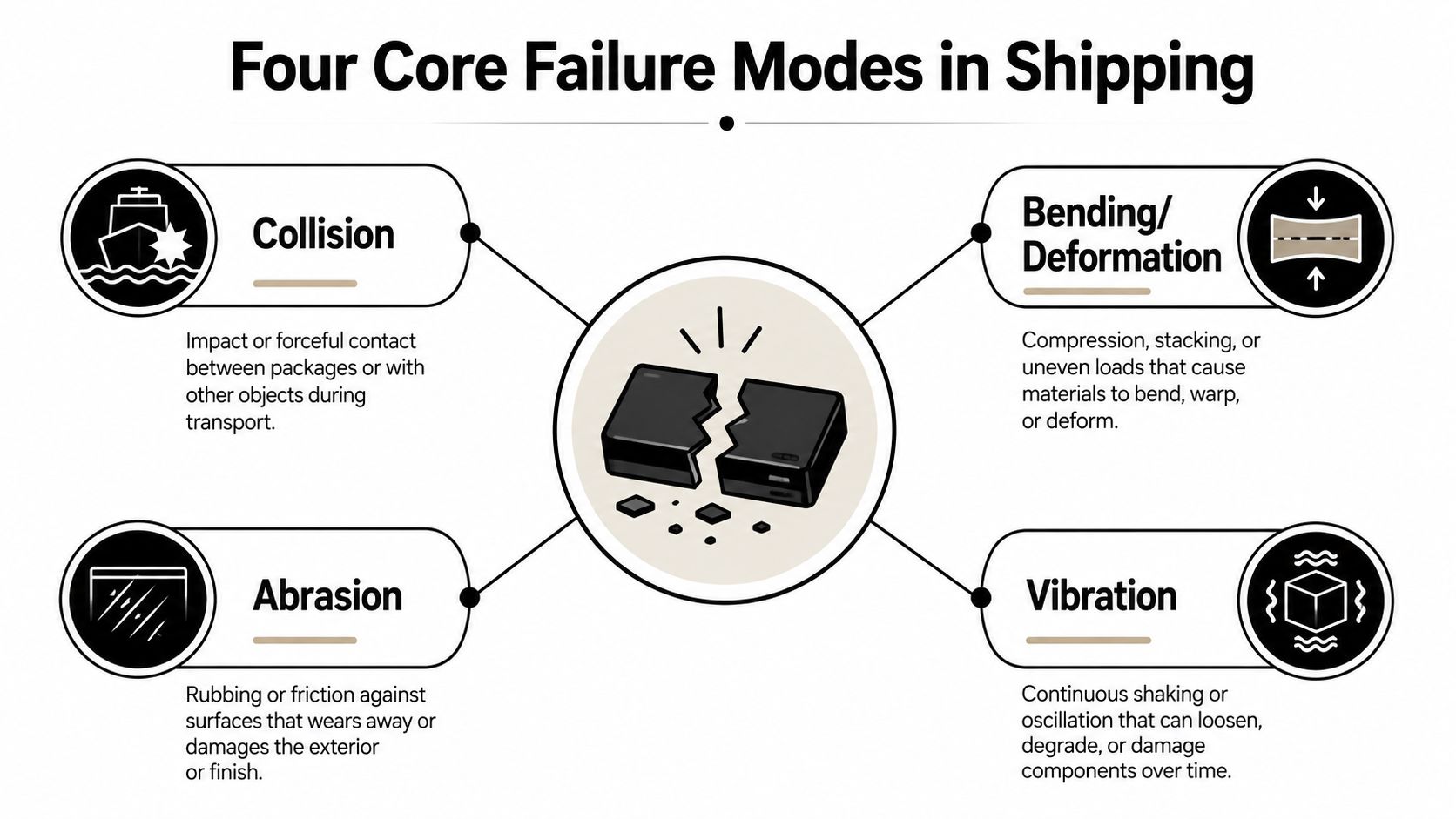
Collision is the obvious one. A glass tincture bottle, ceramic mug, or clay planter may crack when a corner or bottom hits a hard surface. These products need a rigid outer layer, cushioning that absorbs impact, and protection around concentrated weak points such as handles, rims, and narrow necks. A snug inner mount or brace can work better than just wrapping the entire object in additional soft material. For a ceramic coffee mug, inspect the handle separately. A black-gloss ceramic coffee mug has a broad body and a projecting handle, so the handle needs space and support rather than pressure from a tight wrap.
Bending or deformation affects objects that flex, buckle, or collapse under pressure. A lightweight clay planter can deform when a heavier parcel is stacked on it. A soap box with a raised top can crush even if the soap itself doesn't shatter. Use a stronger carton, protect the item with rigid panels, and keep vulnerable surfaces away from direct load.
Abrasion happens when surfaces rub together. Glazed ceramics can scratch, candle labels can scuff, and skincare jars can lose their finish when they move against dividers or filler. Wrap each item in a soft, clean layer before adding structural protection. Don't let glass touch glass, and don't place rough corrugated edges directly against a finished product.
Vibration is slower and less dramatic than a drop, but it can loosen closures, wear through surfaces, and make separate items collide repeatedly. Three essential oil bottles may survive a single impact yet damage one another during a long vibrating journey if they share an open cavity. Individual sleeves, partitions, and a firm block that prevents movement address that risk.
Ask three questions before packing
- What moves? Shake the product gently in its retail container. If a lid, cap, handle, or insert moves, secure that part first.
- What carries the weight? Identify the base, corners, neck, or lid that will receive pressure if the parcel is stacked.
- What must stay apart? Separate glass, projecting parts, decorated surfaces, and anything that can scratch or collide.
ISTA guidance also treats fragile products as a distribution-system problem. Its overview notes that products containing 25% or more fragile materials may be classified as fragile, and one validation procedure uses five samples for testing. ISTA's fragile-item testing overview also highlights environmental conditioning and handling hazards. For liquids or temperature-sensitive contents, the fragility assessment can change when contents become liquid above 70°F. The useful lesson isn't to memorize a category. It's to test representative products under realistic conditions before committing to a packaging design.
Building a Packing System That Protects
A repeatable pack specification beats improvisation. For every fragile product, record the carton size, inner wrap, inserts, cushioning, sealing method, and final checks. A written standard saves time at home and makes failures easier to trace when an order arrives damaged.
Start with the outer box
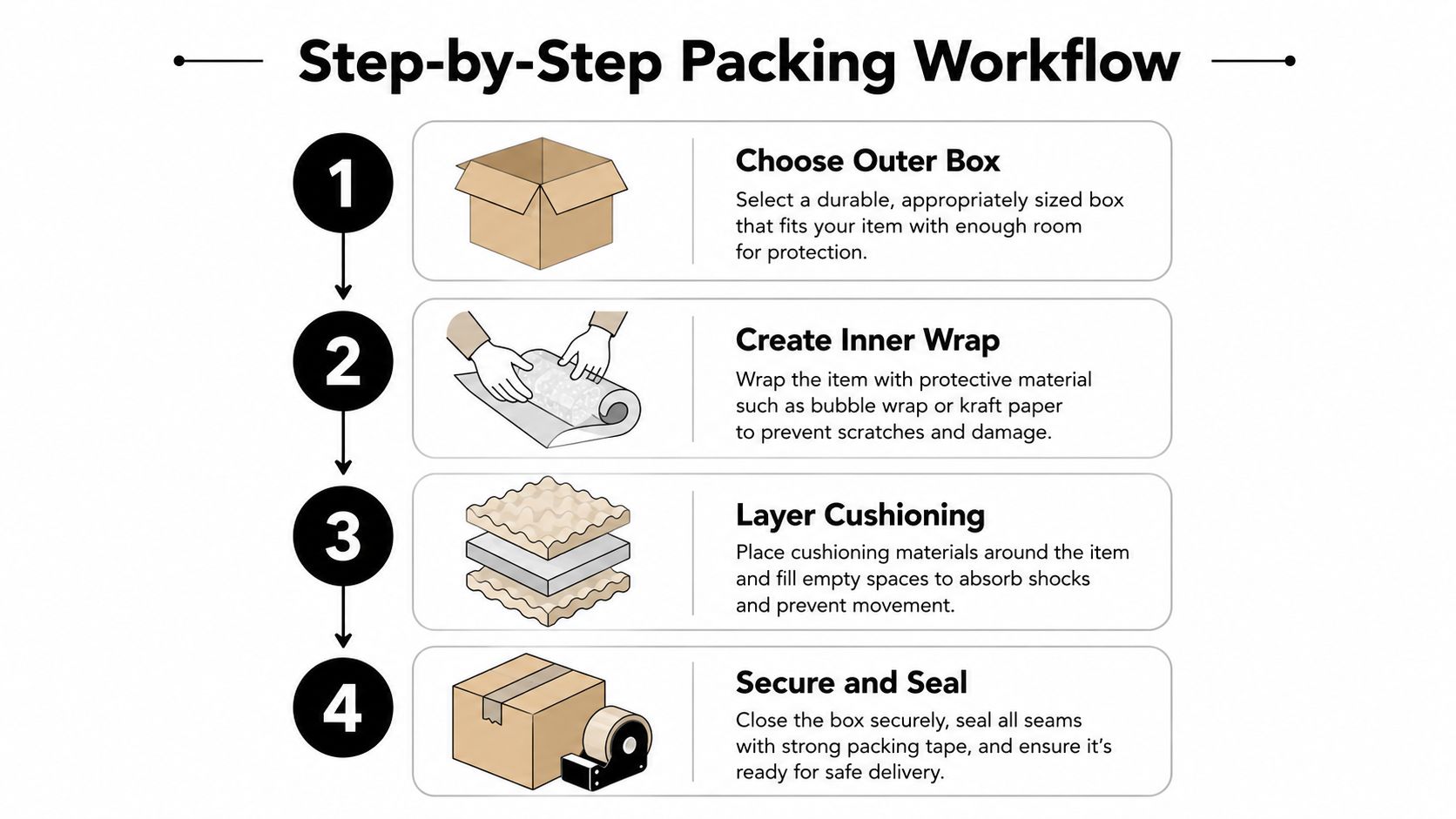
Choose a carton that leaves room for protection without creating a large empty cavity. An oversized box lets a mug or jar build speed before impact. A carton that barely fits leaves no cushioning space and can transfer force directly to the product. The right box is a controlled fit, not the smallest one available.
Match the structure to the failure mode. A six-pack of ceramic mugs needs individual separation and rigid partitions that stop repeated contact. A single large planter needs protection at the rim and base, with support that keeps its walls from deforming. For three essential oil bottles, keep them upright only if that orientation has been tested. Otherwise, block movement in every direction.
Wrap, cushion, and block
Wrap each item individually. Choose bubble wrap, honeycomb wrap, a foam sleeve, or clean kraft paper according to the surface and the risk. Bubble wrap suits many glass jars and bottles. A foam sleeve works efficiently for uniform candle vessels. Kraft paper can fill controlled voids, but crumpled paper alone will not provide reliable impact protection.
Add cushioning between the wrapped product and every box wall. Corrugated pads increase rigidity around a planter or a stack of ceramics. Air pillows can fill space in a light parcel, but they may shift or compress and do not fully protect heavy glass. Reused packing peanuts can fill voids, yet they may migrate during transit and leave the product against a wall. Use them only after the inner pack already controls movement.
A molded insert pays off when the same shape ships repeatedly. It speeds packing and gives each item a defined position, which helps with impact and vibration. For varied product shapes, adjustable partitions or folded corrugated bracing may cost less and adapt better.
Seal and test the finished parcel
Seal every seam with strong packing tape, including the center seam and the edges where flaps meet. Press the tape firmly onto the carton rather than trusting a single narrow strip.
Run a controlled home check before sending a batch. Shake the sealed parcel gently and listen for movement. Then place it on a stable surface and perform a cautious drop test that matches the packaging standard you intend to use. Open the box, inspect the product and inserts, and note what shifted. If a vulnerable corner fails, reinforce that corner, improve the brace, or change the carton. Loose filler may hide movement, but it does not correct a weak structure.
For custom inserts and packaging structures, MSP Packaging's custom packaging guide explains how to design packaging around a product instead of forcing every item into one box. Sellers building a home-based operation can also consult Loyaltie's seller resources for marketplace information that supports the fulfillment process.
Dry goods need the same discipline, even when impact is not the main concern. The High-Protein Lupin Pasta Bundle, Lupin Flour & Psyllium, Gut-Friendly Fiber, Gluten-Free, 5 Boxes (2 Spaghetti, 3 Rotini) | Chef's Kiss by Loyaltie is described as a five-box bundle made with lupin flour and psyllium husk. Its boxes need to stay dry, contained, and protected from crushing. That calls for moisture control and compression resistance rather than the same wrapping used for glass.
A visual demonstration can help a small team standardize the packing sequence:
Choosing the Right Carrier and Service Level
Packing protects the product, but the service you choose affects how long the parcel spends moving and how many handoffs it receives. No major carrier can promise that a parcel will never be dropped, so choose a service based on product risk, destination, dimensions, and replacement cost.
| Carrier | Best For | Handling Notes | Insurance Limit |
|---|---|---|---|
| USPS | Smaller parcels and residential destinations | Convenient access and broad coverage, but parcels still move through automated sorting and carrier handoffs | Check the service terms and declared-value rules for the exact shipment |
| UPS | Heavier cartons and established business shipping | Useful for structured pickup routines and larger parcels, though size and weight affect the service choice | Confirm the applicable declared-value limit before purchase |
| FedEx | Time-sensitive or heavier shipments | Service options vary by destination and package profile, so compare handling requirements carefully | Verify coverage, exclusions, and documentation requirements |
| Regional parcel services | Nearby delivery zones | Can reduce distance and handoffs when the service area fits your customer base | Confirm terms directly with the regional provider |
Ground service is often reasonable when the item is well tested, the buyer doesn't need a quick arrival, and the package can tolerate a longer journey. Faster service may make sense for a time-sensitive gift, temperature-sensitive product, or high-value order, but speed doesn't replace cushioning or movement control.
Compare the full shipping cost, not only the label. Dimensional weight, oversize handling, pickup arrangements, declared value, and return logistics can change the practical choice. Monopack ltd's shipping-cost guide is useful when you're building a cost model that includes packaging and carrier charges rather than treating postage as an isolated expense.
Don't pay for a fragile add-on that only creates the appearance of care. A visible mark may help a person notice the parcel, but automated systems still handle packages mechanically. Hand the parcel directly to a driver or counter employee when possible, keep it out of rain, and avoid leaving it unattended at a drop-off point.
For recurring shipments, compare actual outcomes by product and route. Record the carrier, service, carton, and damage result. That gives you a practical basis for choosing service levels instead of relying on reputation or a single bad delivery.
Labels, Marks, and Insurance That Actually Pay Out
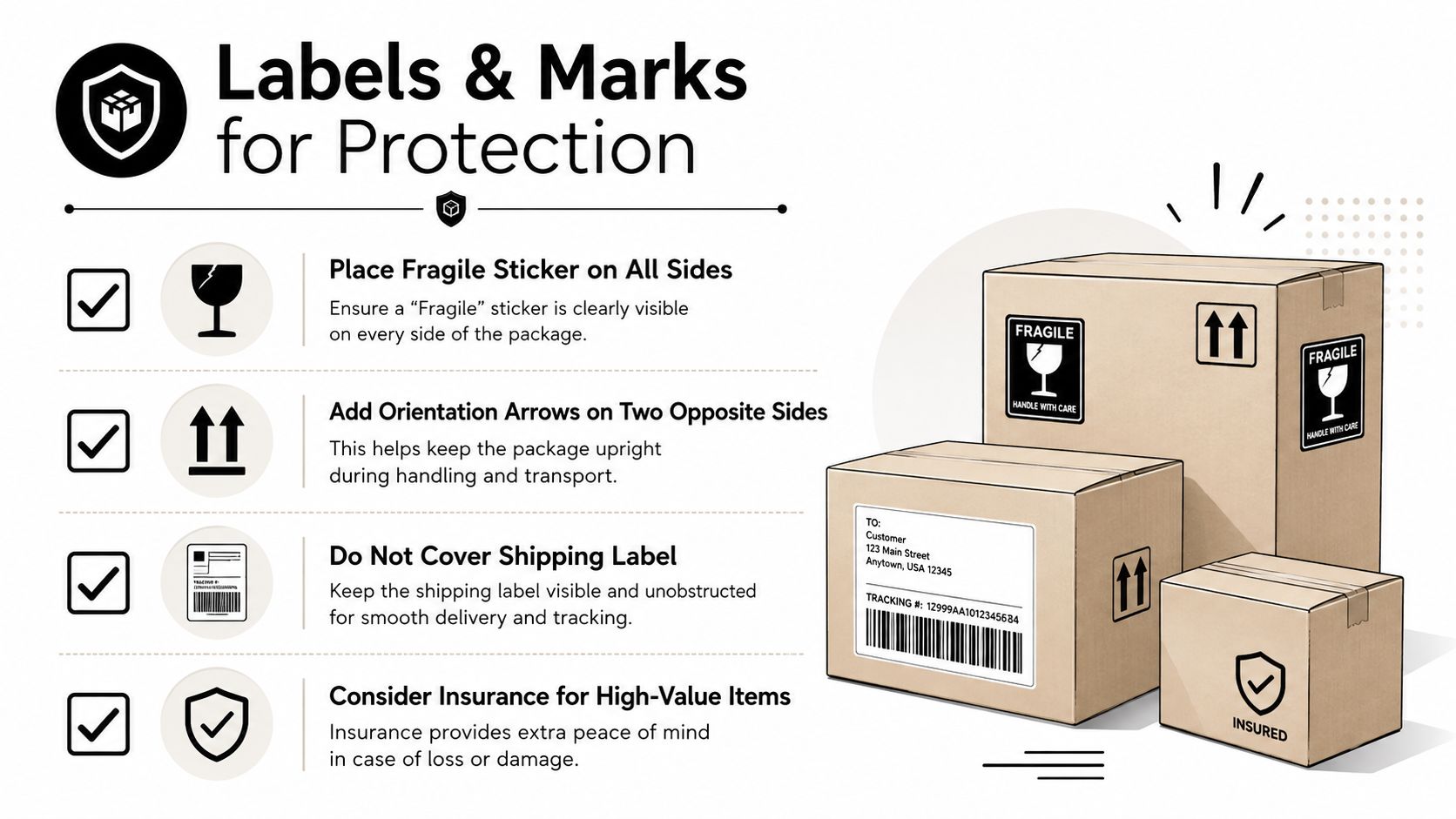
A fragile sticker is a signal, not a protective structure. Place handling marks where they can be seen without covering the shipping label, and use orientation arrows on two opposite sides when the contents depend on orientation. Don't design a package that fails if someone ignores the mark.
Make the claim record before there's a claim
Insurance and declared value can matter when the item is costly to replace, difficult to remake, or tied to a substantial customer promise. They won't make a weak package defensible. Carriers and insurers may ask for proof of value, shipment details, packaging quality, and the condition of the item.
Photograph the finished package before sealing it, then photograph the sealed carton with the label visible. Keep the order record, product description, carrier receipt, tracking details, package weight, dimensions, and packing specification together. If the customer reports damage, ask for photographs of the outer carton, inner protection, and product before anything is discarded.
Claim-ready habit: Photograph the package while your packing choices are visible, not after the buyer has thrown the materials away.
Write a damage policy that tells the buyer what to do, when to contact you, and which photos help you resolve the issue. Keep the language calm and specific. A replacement or refund decision should follow your stated policy, not a rushed reaction to an upsetting message.
Useful records to retain for at least 90 days include:
- Order evidence: The order number, product description, buyer communication, and fulfillment date.
- Shipment evidence: Carrier, service, tracking number, receipt, weight, and dimensions.
- Packing evidence: Photos of the inner protection, carton, seal, and label.
- Damage evidence: Customer photos showing the carton, cushioning, product, and any leakage or breakage.
For valuable or historically delicate objects, these safe antique moving tips from TLC Moving & Storage provide helpful context on documenting condition and controlling handling risk. Sellers should also publish their fulfillment and resolution terms clearly, including through Loyaltie's seller terms and conditions, so buyers aren't left guessing after a damaged delivery.
When Local Pickup Beats Shipping Entirely
If your buyers live nearby, local pickup often removes sorting, line-haul vibration, and repeated parcel transfers from the journey. For a small independent seller packing orders at home, that can eliminate several failure points before the product leaves your hands.
Set pickup windows and give buyers clear instructions: where to go, how the order will be identified, and how long you'll hold it. Pack for a short car ride with a stable base and enough cushioning to stop sliding. You may not need the same outer-carton system used for a multi-day parcel journey, but upright positioning still matters. A large planter or delicate gift box may travel safely in a buyer's vehicle when it is secured and protected from tipping.
Pickup works especially well when the product is awkward to box, vulnerable to vibration, or costly to replace. It also lets you explain handling directly and check that the customer can carry the item safely.
Local pickup fits how buyers find independent products. The handworker economy report identifies local markets as the most common way buyers purchase locally made goods, cited at 65%, while online sales remain a major channel. The Nest State of the Handworker Economy Report supports combining online discovery with an in-person exchange.
Loyaltie is a marketplace for discovering and buying directly from independent brands in the US. For a local maker, it offers a way to reach nearby buyers who may prefer pickup while keeping online browsing available.
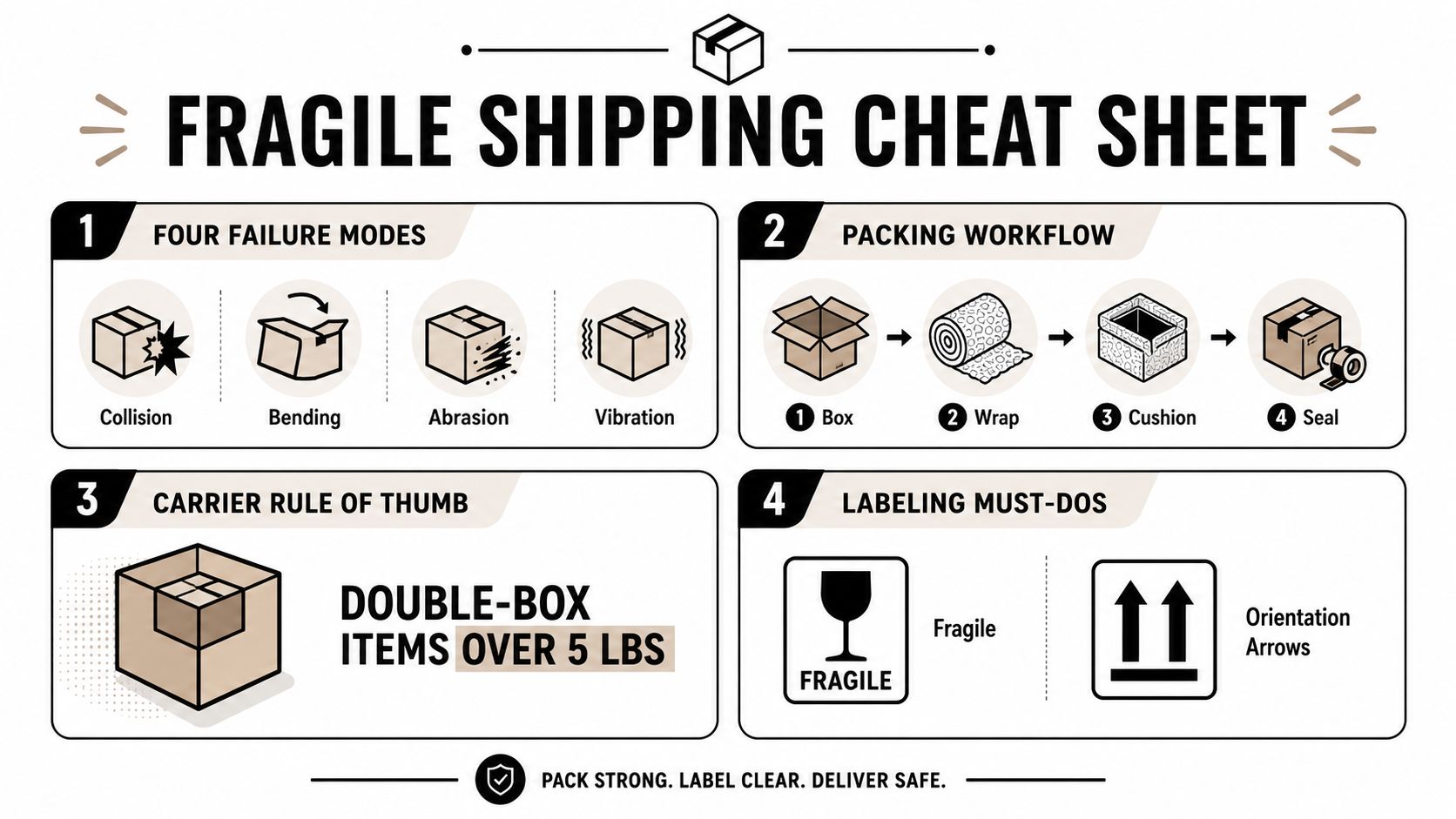
Your Fragile Shipping Cheat Sheet
Start with the failure mode, then choose the protection.
- Collision: Brace corners, handles, rims, and projecting parts.
- Bending: Add rigid panels and use a stronger outer carton.
- Abrasion: Wrap finished surfaces and separate neighboring pieces.
- Vibration: Remove movement with sleeves, partitions, and blocking.
- Pack: Select the box, wrap each item, cushion every side, and seal firmly.
- Carrier: Use ground service only after testing the pack for the journey. Choose faster service when timing or product conditions justify it.
- Records: Photograph the finished pack and keep shipment and damage evidence for at least 90 days.
- Labels: Add visible fragile marks and orientation arrows. Treat them as handling guidance, not as protection.
Small sellers can apply the same standard when buying or selling through Loyaltie, a marketplace for products from independent US brands. Review the maker's packing and fulfillment practices, then choose local pickup when a fragile order is safer in a short vehicle trip.
Before listing a breakable product, write down your packing standard. Use it at the packing table every time, and document exceptions before the parcel leaves home.