

You've got the bottle, the label artwork, and a draft listing open on your laptop. Then you reach the benefit statement and pause. Can you say it supports sleep? What needs to appear beside the ingredient list? And will shoppers understand why your formula is a better choice than the familiar bottle they already buy?
Learning how to sell supplements online starts with those questions, not an ad campaign. For an independent maker, the strongest advantage is a product buyers can understand and check for themselves. Give people clear serving information, specific quality evidence, and a real business behind the bottle, and you give them a reason to choose you beyond the packaging.
Table of Contents
- Choose Where You Sell Before You Build
- Build a Listing Shoppers Can Verify
- Claim Wording That Stays Within the Rules
- Proof of Quality Shoppers Can Check Themselves
- Launch One Product and Keep Repeat Buyers
Choose Where You Sell Before You Build
You have two practical routes: sell from your own website, or open a store on a marketplace built for independent brands. Choose before you commission a complete storefront. The route changes how you prepare your listing, manage checkout, and bring buyers back.
Your own website gives you control. You decide how the page looks, where documentation appears, and how customers move from education to checkout. You also have to attract the traffic and manage the tools behind the sale.
A marketplace puts you where people are already shopping. On a marketplace focused on independent brands, buyers arrive looking for alternatives to mass-produced everyday products. The trade-off is that your listing must fit the platform's fields, review process, and selling policies.
Compare the work behind each route
| Decision | Your own website | Marketplace |
|---|---|---|
| Product presentation | You build and maintain the page | You work within the platform's listing structure |
| Finding shoppers | You're responsible for bringing visitors | Buyers can discover you while browsing |
| Listing review | You manage compliance and service-provider rules | Platform review adds another approval step |
| Buyer relationship | You control your customer tools and records | Communication and reorder options follow platform rules |
| Operational work | You connect checkout, shipping, and support tools | Confirm which tasks the platform handles and which remain yours |
Check restricted-category requirements before uploading anything. Walmart's dietary-supplement policy, for example, identifies supplements as restricted and specifies labeling information sellers must provide.
Ask what happens if a listing is unpublished, including whether reviews return when it's restored. Losing a marketplace listing can interrupt your main sales route. Your own website keeps your pages and review records under your control, but it doesn't remove your responsibility for compliant selling.
Before committing, map out:
- Required fields: List the label images, business details, and supporting documents you'll maintain for every product.
- Order responsibilities: Establish who handles checkout, shipping promises, refunds, and customer questions.
- Repeat purchases: Decide where buyers will reorder and how they'll recognize the same maker.
You can explore selling on Loyaltie while making that comparison. Choose the route that fits your first product, then build for its requirements rather than retrofitting later.
Build a Listing Shoppers Can Verify
Your label and listing are the sales page. A shopper can't turn the bottle around, inspect the small print, or ask you what a serving contains. Your page has to make those answers easy to find.
The FDA's dietary-supplement labeling guide identifies five core label elements: product identity, net quantity, nutrition labeling, an ingredient list, and the name and place of business of the manufacturer, packer, or distributor. Treat those as your starting checklist, not information to hide beneath the sales copy.
Required label elements and where shoppers look
| Element | What to include | Where shoppers look | Common slip |
|---|---|---|---|
| Product identity | Front-panel term such as dietary supplement or herbal supplement | Top of the main image | Vague names like daily wellness with no product type |
| Net quantity | Count or weight of the contents | Front label and listing title | Capsule count listed as servings |
| Supplement Facts panel | Serving size, servings per container, amount of each dietary ingredient per serving | Image and listing text | Facts panel cropped out of the photo |
| Other ingredients | Fillers, capsule materials, and flavorings listed outside the facts panel | Below the facts panel | Missing from the listing text |
| Manufacturer or distributor | Name and place of business | Back label and page footer | Brand name only, no business location |
| Directions and warnings | Use instructions, warnings, and the disclaimer for applicable structure/function claims | Label and product page | Disclaimer left off the website |
Build from the label outward
Identify the product clearly. Put its supplement category on the front panel. A descriptive brand name doesn't replace the product type.
Separate quantity from servings. For example, a hypothetical bottle containing 60 capsules, taken two capsules per serving, provides 30 servings. Don't make buyers do that calculation, and don't describe capsule count as the number of servings.
Photograph the complete label. Keep the Supplement Facts panel visible in the main image set, with a dedicated readable close-up. Repeat its information in searchable text so buyers aren't dependent on an image.
Include the less glamorous details. Other ingredients, directions, warnings, responsible-business information, and storage instructions belong beside the appealing product description. These details help someone decide whether the formula fits their routine.
Serving-level comparisons are particularly useful for energy products. Optimal Native's guide can help readers compare caffeine doses per serving, a more concrete comparison than judging products by an energy-focused name.
For a page-layout exercise, open an electrolyte listing on Loyaltie and identify where you'd look for serving size, ingredient amounts, and directions. Use that shopper's perspective when arranging your own information, rather than treating any existing listing as a compliance template.
Create a repeatable publishing gate
Build a standard page template with fields for intended use, allergen information, storage conditions, lot identification, and customer contact details. Maintain supplier records at lot level so a batch question doesn't turn into an inbox search.
Before publishing, confirm the product's classification and have its label and promotional wording reviewed. The FDA's supplement overview explains that marketing claims can affect whether a product is regulated as a supplement or a drug.
Keep an evidence file for each benefit statement, then ask someone unfamiliar with your brand to use the page. If they ask how much magnesium is in a capsule, your information hierarchy needs work.
Practical rule: A shopper shouldn't need a customer-service conversation to understand the serving size.
Finish with a five-minute phone check. Make essential information readable without zooming, enlarge label images when tapped, and re-audit the page whenever your formula, packaging, or claims change.
Claim Wording That Stays Within the Rules
Say a customer writes that your gummy cured their anxiety. You're delighted and repost the review to Instagram. You haven't written the sentence yourself, but you've now used it to advertise your product.
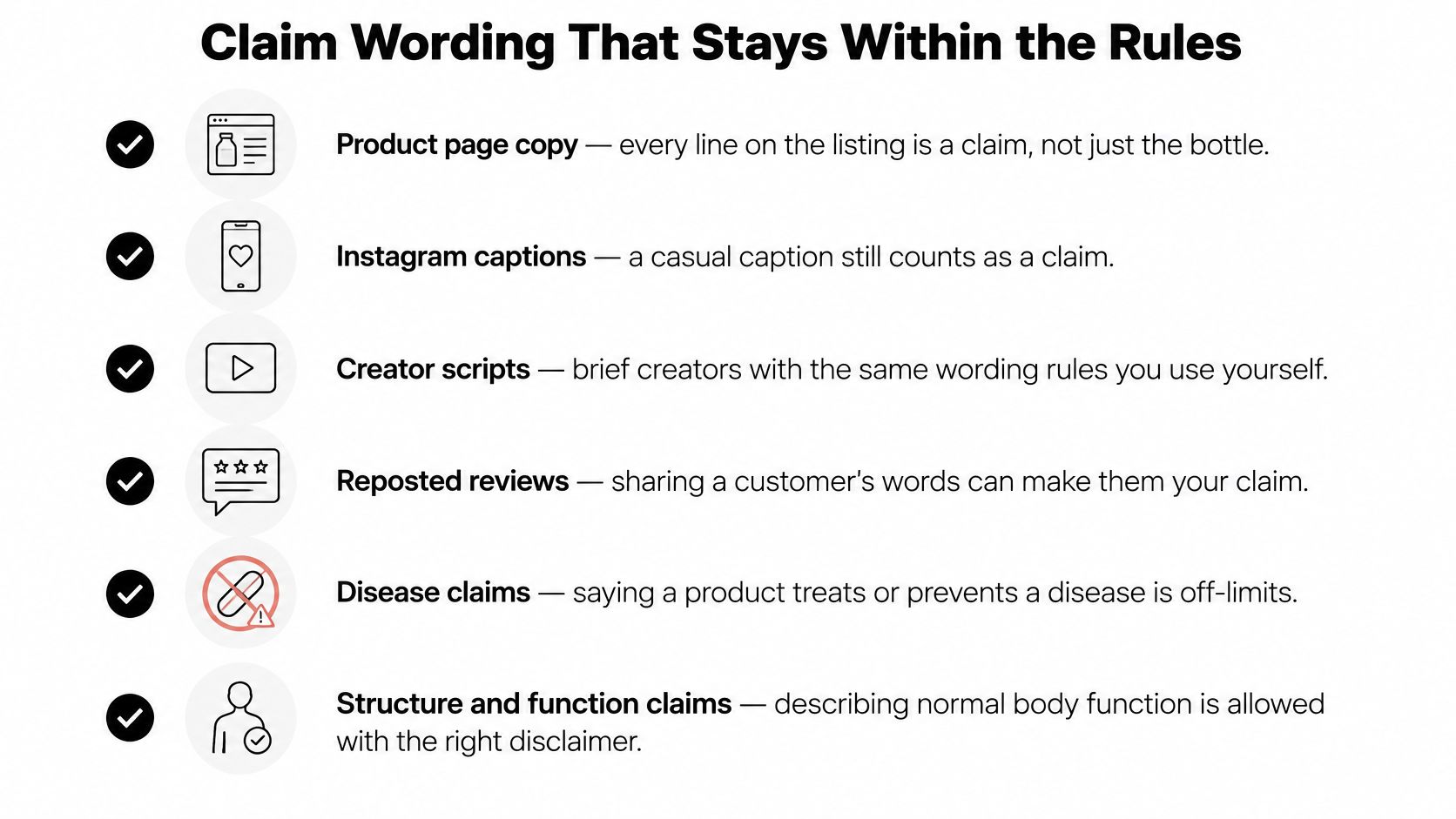
That's the trap: claims aren't confined to the bottle. Product descriptions, captions, creator scripts, ads, and selected testimonials can all communicate a benefit. The FTC's Health Products Compliance Guidance says advertisers need adequate substantiation before distributing objective claims, including claims conveyed by implication.
Use this checklist when reviewing everything a buyer might see.
Distinguish normal function from disease treatment
A structure/function claim describes support for normal body function. A disease claim says or implies that a product diagnoses, treats, cures, or prevents disease. Changing a verb doesn't necessarily change the overall message, especially if surrounding images or testimonials still imply treatment.
The FDA's claims labeling guide explains the substantiation and disclaimer requirements for structure/function claims and related statements. A disclaimer doesn't rescue a disease claim.
Claim wording by risk level
| Claim you want to make | Risk level | Safer wording | What you need before publishing |
|---|---|---|---|
| Treats or cures insomnia | Disease claim, not allowed for a supplement | Supports restful sleep as part of a routine | Original wording must not be published; alternative needs evidence and review |
| Supports healthy sleep | Structure/function claim | Supports healthy sleep as part of a daily routine | Evidence file plus the applicable FDA disclaimer on label and page |
| Clinically proven to reduce stress | Requires competent and reliable scientific evidence | Ingredient studied in trials for stress support | Study citations matching the exact claim, ingredient, and context |
| Natural and pure | Needs substantiation | Made with a named ingredient, if batch records confirm it | Supplier documentation and evidence for each claim |
| Customer says it cured their anxiety | Disease claim when adopted in your advertising | Don't repost disease language | Remove disease language; have any proposed alternative reviewed |
The alternatives aren't automatic approvals. An ingredient study doesn't necessarily substantiate a finished formula, and a traditional-use description can still mislead if you present it as established clinical evidence.
For drafting practice, SEMEX's structure function claim examples and templates offer wording examples to assess against your own evidence. A template is a starting point, not permission to publish.
Make sign-off part of publishing
Create a claim matrix with the proposed phrase, supporting evidence, approved wording, permitted channel, and reviewer. Keep creator briefs and paid ads in that same workflow.
For an additional visual reference, you can view this video.
The FDA's online advisory-letter guidance describes a 30-day response period for companies notified about online disease-related promotion. Don't treat that as a review process you can postpone until someone complains.
Use a four-step routine: write the claim, attach the evidence, choose supportable wording, and get sign-off. Nothing goes live before the last step.
Proof of Quality Shoppers Can Check Themselves
A listing that stops at third-party tested or clean ingredients leaves the buyer with another question: tested for what? A certificate only helps when someone can tell which product it covers and what the laboratory examined.
The FDA's dietary-supplement inspection guidance identifies accurate labeling and product quality as core inspection objectives. Your shopper-facing documentation should make those ideas understandable without asking buyers to interpret a laboratory report from scratch.
A certificate should be something shoppers can inspect, not just a badge beside the buy button.

What each type of testing proves
| Test type | What it proves | What it does not prove |
|---|---|---|
| Identity testing | The tested ingredient matches its stated identity | Dose, purity, or clinical effect |
| Potency testing | Tested dietary ingredients meet the amount specifications assessed | Safety or a health benefit |
| Contaminant screening | Tested contaminants fall within the limits used in the test | Coverage of every possible contaminant |
| Finished-product certification | Compliance with the certification program's stated product or manufacturing criteria | That the product works for a health goal |
Explain the scope, not just the result
Read the certification program's actual scope. A facility certification and a finished-product certification aren't interchangeable. If your document covers manufacturing standards at a facility, describe it that way rather than implying every bottle received independent finished-product testing.
The same care applies to ingredient testing. A supplier's raw-material certificate shouldn't be presented as proof that your complete formula was tested after manufacture.
More certificates don't automatically mean more trust. Relevant, matching documents are more useful than a page full of unexplained logos.
Publish the manufacturer, country of manufacture, expiration information, and allergen controls alongside a plain-language explanation of testing. State whether results apply to the current batch, selected batches, or another clearly defined scope.
Say you display a certificate for hypothetical batch 0412, but the bottle being shipped is batch 0519. Even if both batches meet your specifications, shoppers can't tell whether the document applies. Replace the certificate or explain the coverage before selling that inventory.
Give every product a proof sheet
Create a short, downloadable proof sheet that includes:
- Matching identification: Product name and the lot or batch identifier shown on the bottle.
- Testing details: Test type, test date, and scope in ordinary language.
- Manufacturing information: Responsible manufacturer and country of manufacture.
- Use-related details: Expiration information and documented allergen controls.
- Certificate coverage: A clear statement identifying the batches covered.
Keep the technical report available, but make the summary useful on its own. That lets shoppers compare independent brands on specifics, rather than guessing whether clean or natural means anything meaningful.
Launch One Product and Keep Repeat Buyers
A shopper who lands on a supplement page is rarely deciding in the abstract. They are asking whether this one bottle fits a routine they can follow. That is why I would launch one product first. You will have fewer moving parts when you need to work out whether buyers misunderstand the serving size, dislike the flavor, or abandon checkout over shipping.
There is a substantial market to enter. U.S. dietary-supplement sales reached $69.3 billion in 2024, with e-commerce accounting for 23.2% of sales, according to Nutrition Business Journal figures published by Nutraceuticals World. Online selling is not a side experiment, but category size does not tell you whether your particular listing is ready.
Run a contained pilot for about a month before expanding. That is a planning window, not a performance benchmark. If you have not collected enough orders to spot useful patterns, keep learning rather than adding products to make the storefront look fuller. One focused product gives you a cleaner read on the label, the claim wording, the page, and the purchase path.
Sell a dependable routine
Supplements can be replenishment purchases. Make reordering straightforward, and offer regular delivery or buy on a plan where available and appropriate. The customer benefit is continuity: they do not have to remember to replace a product they have chosen to use.
Do not assume every buyer wants automatic delivery. Explain timing, payment, and cancellation terms clearly wherever you offer it, and keep a straightforward one-time purchase option if your selling setup allows one. The clearer the routine, the less your buyer has to infer from vague benefit language.
For positioning practice, examine how a focused product page such as SleepHabits' overnight recovery supplement for athletes addresses a particular audience. Study the clarity of the intended routine, not just the benefit language, and do not borrow claims without checking their relevance and evidence.
The same merchandising question applies across everyday categories. Browse a coffee regular-delivery listing on Loyaltie as an exercise in identifying what a buyer needs to understand before reordering. Your supplement page needs equally clear expectations about what arrives and how long the contents are intended to last.
Loyaltie lets buyers purchase directly from independent makers and brands across the country, all in one cart. That structure makes the listing itself more important: the buyer still needs facts they can verify before choosing you.
Metrics to check each month
| Metric | What it tells you | Warning sign | First place to look |
|---|---|---|---|
| Add-to-cart rate | Whether the product page persuades shoppers to proceed | Low on one product only | Product facts and images |
| Checkout completion | Whether shipping, price, or trust stalls the buyer | Drop-off after the cart | Shipping terms and guarantee wording |
| Repeat purchase rate | Whether buyers replenish | Few second orders over time | Flavor, serving size, and delivery timing |
| Refund rate | Whether the product matches the page | Spike after a label or formula change | Label versus listing mismatch |
| Complaint rate | Trust and clarity problems | The same complaint appearing repeatedly | Claims and directions |
| Claim-related takedowns | Whether claims trigger platform or regulatory concerns | Any takedown | Claim matrix for that product |
Fix the cause before buying more traffic
Use consistent definitions when calculating these metrics. For example, distinguish refunded orders from refunded units, and choose a repeat-purchase window that makes sense for the product's labeled serving schedule. Otherwise, you can mistake a reporting change for a product problem.
Consider a hypothetical refund spike after a packaging update. The new bottle has a revised serving size, but the listing text still describes the old version. Buyers receive something different from what they understood they ordered.
The first fix is not a discount or another campaign. Correct the page, check the images and order emails, identify affected customers, and make sure the inventory being shipped matches the information buyers see.
Keep creator scripts, ads, and social posts within your approved claim workflow as you grow. More traffic should mean more consistency in what the page, label, and proof sheet say, not more versions of your product promise.
Keep the weekly routine manageable
Set aside fifteen minutes each week for a focused review:
- Check the purchase path: Look for the largest change in add-to-cart behavior or checkout completion.
- Read customer language: Review recent questions, complaints, and refund reasons for repeated confusion.
- Fix the weakest page: Choose the clearest problem, make a specific correction, and record the change.
Makers start selling on Loyaltie by opening a Loyaltie store. That is useful only when the listing gives buyers enough specific information to judge the product for themselves.
The label and the claim wording are your sales page. Get those right before you spend a dollar on traffic.
Loyaltie helps shoppers discover and buy directly from independent brands across the US, including makers offering everyday wellness products. Visit Loyaltie to explore the marketplace and open a store when your supplement label, evidence files, and first listing are ready.