
You've probably had the same experience as many independent makers. A farmers market sells out, a stranger from across town sends a product question, or a wholesale order slows down, and suddenly your next move is obvious: you need a way to sell online without turning your business into a national shipping operation.
The hard part isn't putting products on the internet. It's deciding who can buy, where they'll collect or receive an order, how quickly you'll answer questions, and how you'll keep inventory accurate. That's the answer to how to sell locally online. Discovery matters, but reliability closes the sale.
Independent brands are well positioned for this shift. In the United States, small businesses represent 99.9% of all businesses, employ 45.9% of American workers, or about 59 million people, and account for 43.5% of GDP, according to the U.S. Small Business Administration's 2024 small-business FAQ. Buyers already shop online. Your job is to make buying from a real maker feel easier, clearer, and more trustworthy than buying another anonymous mass-produced product.
Table of Contents
- Why Selling Locally Online Changes the Game for Independent Makers
- Picking the Right Platform to Sell Locally Online
- The fields nearby buyers scan first
- A first-ten-listing checklist
Why Selling Locally Online Changes the Game for Independent Makers
The best time to start selling locally online is usually right after demand becomes inconvenient. You've sold through your coffee beans at a market, received a direct message asking whether you deliver, or noticed that customers want your skincare, food, supplements, pet products, or home goods between market days.
That moment creates three practical decisions:
- Reach: Which buyers are close enough for pickup or short-hop delivery?
- Fulfillment: Can you offer a dependable pickup window, delivery route, or limited shipping option?
- Cash flow: Can you keep orders moving without spending heavily on ads before the process works?
Your advantage isn't unlimited reach. It's trust, margin, and product quality. A nearby buyer may accept a smaller catalogue when the product feels personal and the buying experience is dependable. They'll come back for coffee, wellness goods, skincare, pantry staples, or pet products when they know what they're getting and when they'll receive it.
Practical rule: Treat local online selling as an operations system with a storefront attached.
The trade-offs are real. Your audience ceiling is smaller than a national marketplace, customers may expect fast replies, and handmade production can collide with fulfillment when an order spike arrives. You'll need to choose product quantities carefully, publish honest lead times, and stop accepting orders when inventory runs out.
That trade-off is often healthier than chasing volume. A broad audience can create shipping work, customer-service pressure, and ad costs that overwhelm a solo maker. Local buyers give you a tighter feedback loop. You can learn which products people reorder, which pickup times work, and which questions appear before nearly every purchase.
The shift from offline selling to online selling is no longer unusual for independent producers. A global SME review reports that an overwhelming majority of SMEs operated a website or home page in 2022, with 80% to 90% of SMEs in Finland and Denmark having one, and says 65% of American SMEs expected e-commerce sales to grow in a 2024 business survey, according to Statista's SME e-commerce overview. If you're weighing a physical storefront against a digital one, this practical comparison of brick and mortar vs online for solopreneurs can help clarify the workload and control involved.
Picking the Right Platform to Sell Locally Online
Your platform determines more than where a product appears. It affects how much control you have over the brand, how buyers discover nearby products, and whether pickup coordination stays simple or becomes another spreadsheet.
| Platform type | Best for | Main trade-off |
|---|---|---|
| Personal website | Makers with steady demand and an audience to bring | You own the experience, but you must create local discovery and manage more tools |
| General marketplace | Reach beyond your existing followers | Large audiences often provide weak local signals and crowded search results |
| Facebook Marketplace or Etsy | Testing demand and meeting buyers where they already browse | Listing management, messaging, and local coordination can become fragmented |
| Local-first marketplace | Solo makers who need discovery, pickup, and order handling together | You give up some storefront control in exchange for simpler operations |
A personal website makes sense when orders are steady and you want direct ownership of customer email relationships. It gives you room to explain ingredients, sourcing, production, and your maker story. It also makes you responsible for traffic, local search, checkout, inventory, and fulfillment.
General marketplaces can provide reach, but they're built for broad browsing. A buyer searching for a product may find sellers from anywhere, not just within driving distance. If you use eBay, review practical guidance on eBay listing fees and shipping tips before adding shipping-heavy products to your mix.
For a solo maker with under twenty SKUs and limited time, I'd start with a local-first platform. Sell on Loyaltie is one option built around helping people discover and buy directly from independent brands in the United States, while keeping the selling process focused on local audiences. Review the seller path at Sell on Loyaltie and pay attention to what you'd still need to manage yourself.
Choose a standalone site when you need deeper customer ownership. Use a general marketplace when you need broader reach. Start local-first when your priority is nearby discovery, pickup coordination, and straightforward order handling.
Setting Up Listings That Convert Nearby Buyers
A local listing has to answer practical questions before it tries to sound persuasive. Buyers want to know what the product is, when they can get it, and where the handoff happens.
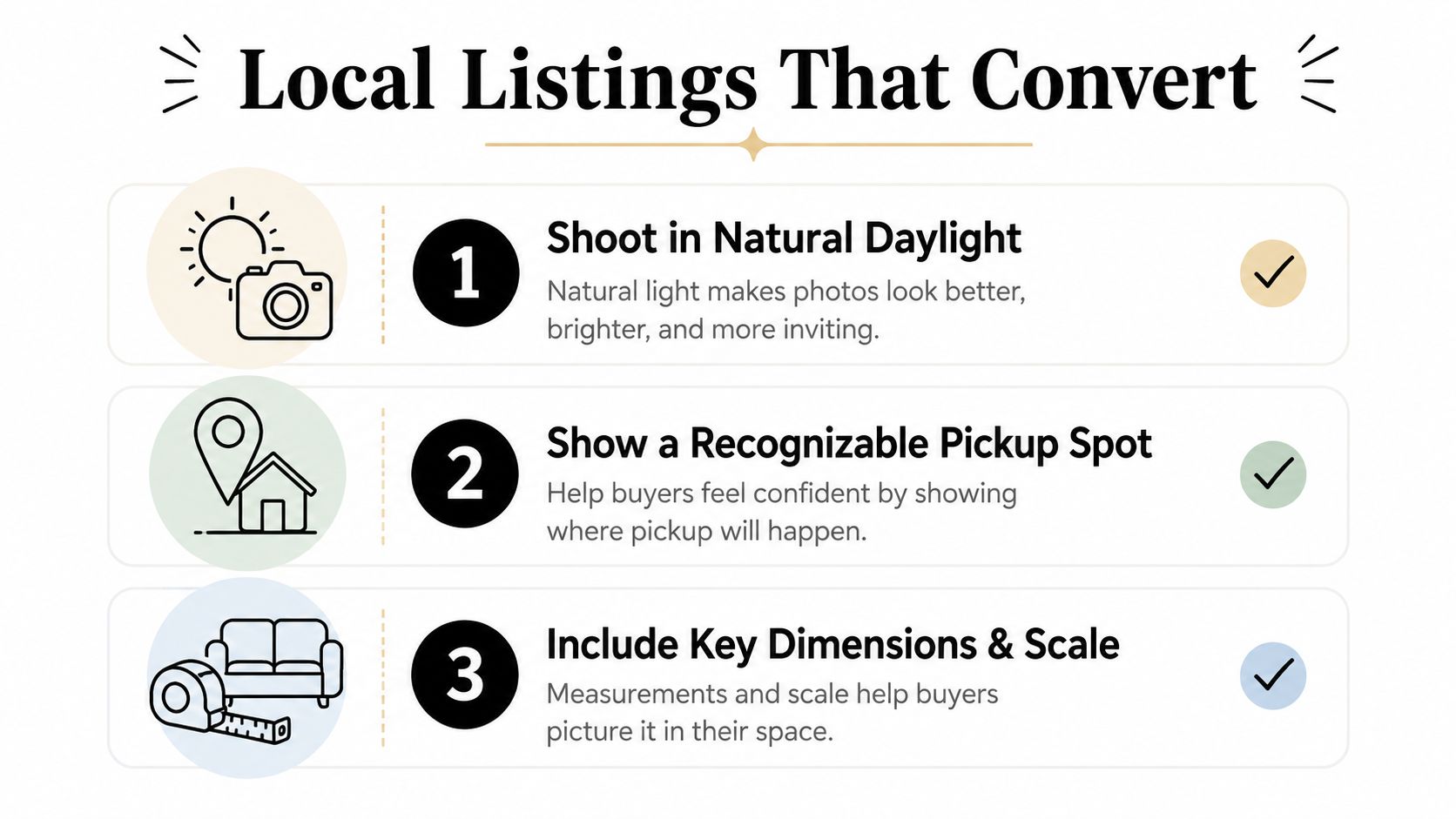
Start with photos that feel real but still make the product easy to understand. Use daylight, show the product from useful angles, and include close-ups of texture, finish, ingredients, or the small irregularities buyers expect from handmade goods. A recognizable pickup location in the background can also reassure people that there's a real local operation behind the listing.
The fields nearby buyers scan first
Put the information people need near the top of the listing, not buried below a long brand story.
- Pickup window: State the days and time range clearly.
- Location reference: Use a neighborhood, cross street, or approved public meeting point.
- Materials and ingredients: Name the paper, oils, wax, food ingredients, or other relevant components accurately.
- Lead time: Say whether the item is ready now or made after purchase.
- Maker bio: Use two or three sentences to explain who makes it and where.
Your description should sound like a helpful answer, not a slogan. “Hand-drawn A2 card made from 100% recycled paper, blank inside, with a kraft envelope” gives a buyer more confidence than a vague promise about meaningful gifting. The A2 Celebration Greeting Card, 100% Recycled Paper, Blank Inside, Hand-Drawn Congrats Card, Includes Kraft Envelope | Chika Paper Studio by Loyaltie is a useful example of factual listing language.
Response speed matters because local buyers often message before purchasing. Set a notification routine and create short saved replies for pickup timing, ingredients, delivery boundaries, and stock questions. Don't promise instant replies if you can't provide them. Promise a realistic service window and meet it.
A first-ten-listing checklist
Before publishing your first group of products, confirm that every listing includes:
- One clear primary image
- A useful close-up
- Product dimensions or quantity
- Materials or ingredients
- Pickup location details
- Pickup or delivery timing
- Lead time for made-to-order items
- Accurate inventory
- A short maker introduction
- A direct answer to common buyer questions
That checklist keeps you from rebuilding the shop after the first week of orders.
Getting Found with Local SEO and On-Platform Discovery
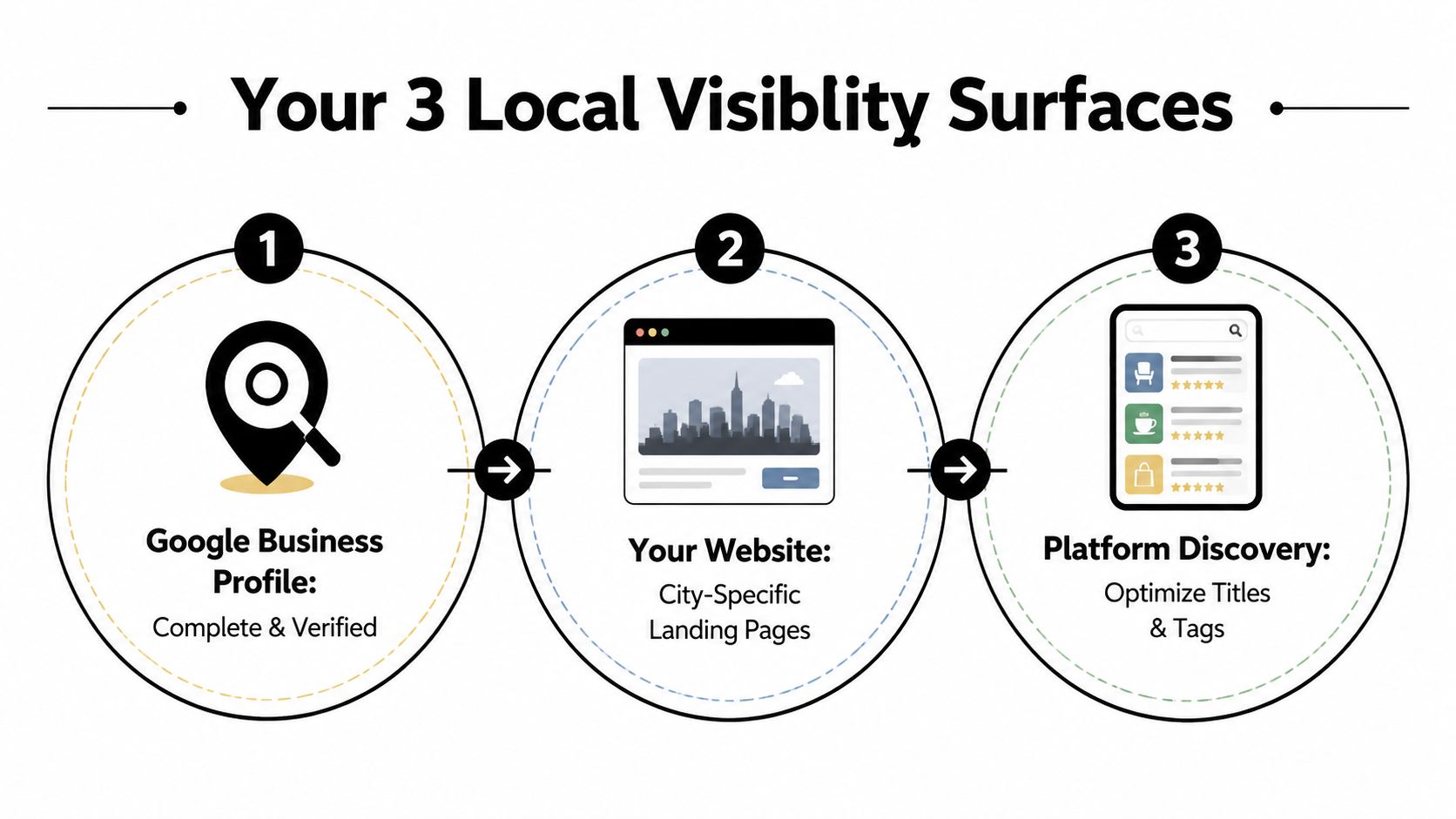
Local visibility comes from three places, and each needs different work. Your Google Business Profile captures nearby search intent. City-specific pages on your website explain where you serve. Marketplace discovery puts products in front of people already browsing.
Claim and complete your Google Business Profile with accurate hours, service areas, photos, and regular posts. If you sell from home, don't publish a private address unless you're comfortable doing so. Use a service area or public pickup point where appropriate, and make sure the information matches your listings.
Build pages around real local searches
Create a useful page for each city or neighborhood you serve. “Handmade candles in Brooklyn” is more useful as a page title and opening phrase than a generic “Shop our collection.” Explain pickup, delivery boundaries, product categories, and what makes buying directly from the maker worthwhile.
Don't create empty location pages that swap one city name for another. Each page should include local fulfillment details, relevant products, and clear contact or purchase paths. You can use the Nuwtonic AI SEO Platform to organize keyword opportunities and content tasks, but don't let software replace firsthand information about your service area.
On the platforms where you list, complete every profile field. Use product names buyers search for, include the location naturally, and keep availability current. Refresh stale listings when products change, but don't alter details merely to appear active. A buyer who sees an unavailable product has a trust problem, not a discovery problem.
Track inquiries, completed purchases, and repeat orders by surface, rather than celebrating clicks alone. The Loyaltie seller resources can support the practical work of building a clearer selling process. Your strongest channel is the one that sends buyers who understand where you are, what you sell, and how they'll receive it.
Fulfillment, Pickup, and Local Delivery Without the Headaches
Choose fulfillment according to margin and buyer expectation, not personal convenience. Pickup is often the cleanest option for fragile goods, low-priced items, and made-to-order products because it removes shipping costs and gives buyers a direct connection to the maker.
Local delivery works when orders cluster inside a manageable route. Set a defined radius, batch deliveries on specific days, and charge by zone rather than inventing a separate delivery price for every order. Shipping becomes necessary when your buyers live outside your delivery area, but it shouldn't be your default if the product is bulky, fragile, or expensive to send.
| Method | Best for | Main cost | When to use |
|---|---|---|---|
| Pickup | Fragile, low-priced, or made-to-order goods | Coordination time | When buyers live nearby and can follow a clear window |
| Local delivery | Higher-value orders in a concentrated area | Driving time and fuel | When you can batch routes on set days |
| Shipping | Buyers beyond your local zone | Packaging, postage, and returns | When demand consistently extends past your delivery boundary |
Use two-hour pickup windows. Send a confirmation message the morning of collection, include the meeting instructions again, and state what happens if someone misses the window. A simple policy prevents awkward conversations and stops one late buyer from disrupting the rest of your day.
Keep the handoff safe and predictable. Public locations, staffed partner businesses, or clearly defined porch pickup arrangements can work, depending on the product and your comfort level. Don't publish a vague “message me to arrange pickup” note and expect a smooth process.
Write a short standard operating procedure covering order confirmation, packing, pickup notifications, delivery batching, missed pickups, refunds, and inventory updates. If someone else ever helps you fulfill orders, that document should let them run the process without calling you for every decision.
For a concrete example of how local product delivery can be organized around makers and scheduled order days, review Rose of Eden Home and Scents on Loyaltie as a reference point for browsing locally made goods.
Pricing, Payments, and Customer Service That Builds Trust
Price for the buyer in your city, not for an abstract national average. Start with materials, pay yourself a real hourly rate for production and packing, add your margin, then compare the result with two or three nearby sellers offering similar products.
Your price has to fund the work. Underpricing may create attention, but it leaves you unable to replace supplies, handle customer service, or produce the next batch. If your product costs more than a mass-produced alternative, explain the difference through ingredients, materials, process, provenance, and direct access to the maker.
Offer a card-based payment option for delivery and shipped orders, such as Stripe or Square. For pickup, you can add tap-to-pay or cash if that suits your process. Decide in advance whether you'll accept Venmo or Zelle, then state the accepted methods in the listing and confirmation message.
Customer service should be simple enough to repeat:
- Reply within four business hours: Even a short confirmation reassures the buyer that the order is active.
- Confirm the next step within 48 hours: Tell the customer when to expect shipping, delivery, or pickup.
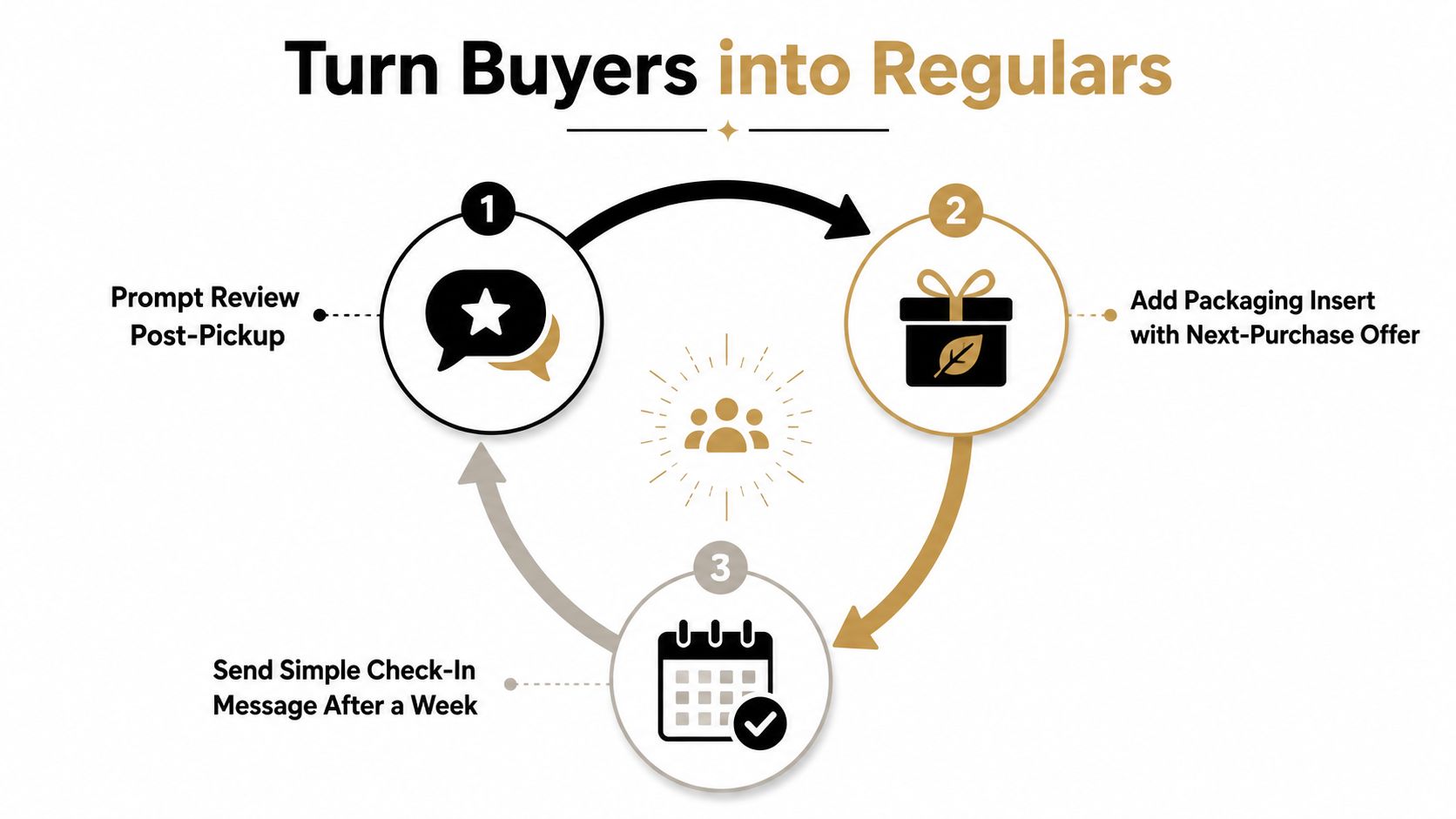
- Follow up once: Ask whether the product arrived safely and invite a review or question.
The follow-up isn't busywork. It gives you a chance to fix a damaged package, clarify product use, or learn why a buyer might reorder. A reliable response often protects trust more effectively than another polished brand post.
Turning First Orders Into Repeat Local Buyers
A first order proves that someone will buy. A second order proves that your operation works.
Ask for a review after pickup or delivery, while the experience is still fresh. Keep the request direct and make it easy. If the customer had a problem, invite them to contact you before asking for public feedback so you have a fair chance to resolve it.
Add a small packaging insert with the next useful action. That might be a restock reminder, care instructions, a referral invitation, or an offer tied to the next purchase. Don't turn the package into a flyer. One clear message is more useful than a stack of promotions.
A basic spreadsheet is enough to start your loyalty loop. Record the buyer's name, product, purchase date, location, permission for email or SMS, review status, and next likely reorder. For food, coffee, wellness, skincare, supplements, and pet products, organize messages around restocks and usage cycles rather than sending broad promotional blasts.
The numbers worth watching
Track three measures:
- Repeat purchase rate: How many buyers return for another order?
- Average order value: Do returning buyers add another product?
- Time between orders: When do customers typically need a reorder?
Use those signals to adjust inventory and communication. If people reorder one product but ignore another, improve the bundle or stop carrying the weak item. If buyers want regular delivery, offer a buy-on-a-plan option only when your production and fulfillment can support it consistently.
A focused 90-day plan
During the first month, make listings accurate, establish pickup or delivery routines, and collect honest feedback. During the second, improve follow-up messages, restock notifications, and referral prompts. During the third, review repeat behavior before expanding into adjacent neighborhoods or wholesale.
Don't chase a larger audience until current buyers can find products, receive orders, and reorder without confusion. The strongest local sellers grow by making reliability visible, then turning that reliability into a habit.
Loyaltie is a marketplace where people discover and buy directly from the best independent brands in the US, with local products and real maker relationships in one place. Visit Loyaltie to explore better everyday alternatives in categories like food, wellness, skincare, paper goods, and home products, or start building your own local selling presence.