

Your curing shelf is full, a few friends have asked to buy a bar, and you're trying to turn a good recipe into something you can confidently sell. The tricky part isn't choosing a ribbon. It's knowing what you can promise, what each bar really costs, and how you'll trace a problem after it leaves your hands.
Learning how to sell homemade soap starts with those decisions. Get them right, and you can offer buyers a meaningful upgrade from mass-produced everyday products: a well-made bar, clear ingredients, and a real person who can answer for what's inside.
Table of Contents
- Six Steps From Cured Bar to First Sale
- Word Your Labels So Your Bar Stays Soap
- Keep Batch Records Buyers Can Trust
- Price Each Bar From Its Full Cost
- Pick the Channel Where Your Bars Sell
- Fix Melting, Cracking and Slow Repeat Orders
- Confirm Your Claims Before Your First Listing
Six Steps From Cured Bar to First Sale
During your first week, set aside a few cured bars and write down the decisions each one requires before it goes on sale. Your first listing depends on those choices: what the bar is, how you describe it, and what you need to track after a buyer takes it home.
The global handmade soap market estimate points to an established category, but a market-wide projection cannot tell you whether your particular bar will sell. Use early orders and buyer responses to make that call.
- Set the product's legal category: decide what you can call the bar and which claims fit.
- Align the label and listing: make sure buyers see the same accurate description in both places.
- Make each batch traceable: keep records that connect the finished bars to their production details.
- Know your break-even price: account for the full cost of making and selling each bar.
- Choose where to sell first: match the channel to how you plan to reach buyers.
- Check the pilot before expanding: use sales, costs, and feedback to decide what to adjust.
Keep the physical preparation steps visible beside your workspace.
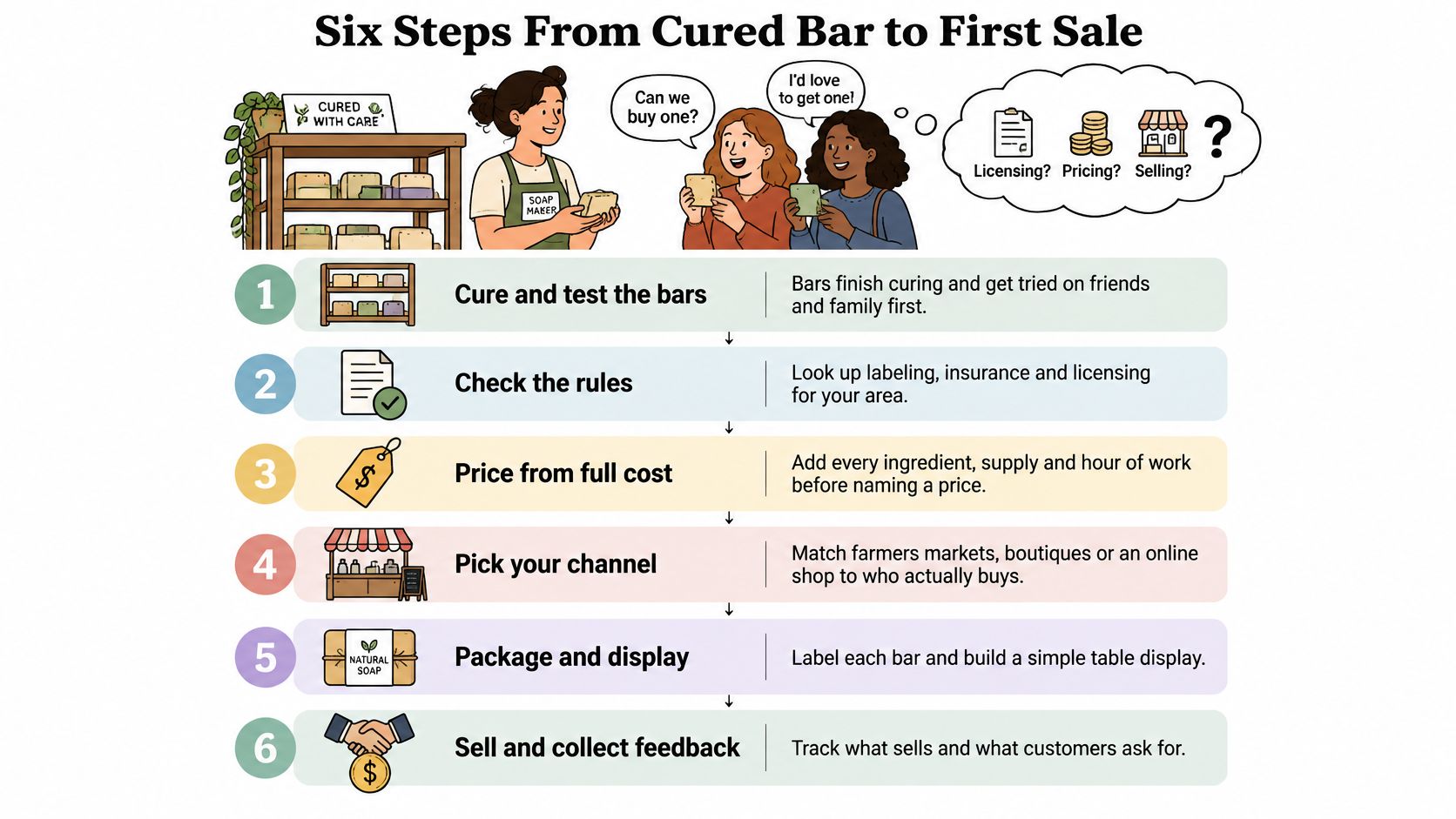
Use Loyaltie's seller resources to organize your launch work. Start by checking your product claims, since that decision shapes the language on both the packaging and the listing.
Word Your Labels So Your Bar Stays Soap
Under the FDA's soap, cosmetic, and drug classification guidance, traditional soap must consist mainly of alkali salts of fatty acids in its nonvolatile material, those salts must provide the cleaning action, and the product must be labeled and marketed only as soap. Qualifying products fall under Consumer Product Safety Commission oversight, while cosmetic promises can trigger cosmetic regulation and disease-treatment or germ-killing promises can make a product a drug, sometimes alongside cosmetic classification.
Your product page is part of that decision. A restrained wrapper won't resolve a listing that promises eczema relief.
Risky claims and safer wording
| Claim on label or listing | Why it creates risk | Safer way to describe it |
|---|---|---|
| Moisturizing or deodorizing | Can move the bar into cosmetic rules | Describe the lather and the scent instead |
| Makes skin smell nice | Cosmetic purpose claim | Sweet lavender scent with a clean finish |
| Heals dry skin | Therapeutic promise, drug territory | Feels rich and creamy in the lather |
| Treats acne or eczema | Medical claim under the FDA intended-use framework | Gentle everyday bar for body washing |
| Antibacterial or kills germs | Drug-type claim | Washes away dirt, oil and sweat |
| Natural or handmade | Not a legal shield and raises safety expectations | Lists each ingredient by its standard name |
These alternatives aren't automatic legal clearance. “Gentle” still needs support, and “clean finish” should describe the scent, not promise an effect on skin. Keep descriptions attached to observable attributes, such as the bar's aroma, texture, appearance, and cleansing use.
The FDA's cosmetics labeling summary is a useful starting point for category-specific labeling checks. Before printing, review:
- Identity and quantity: Product identity and accurate cured net weight in metric and US units.
- Ingredients: Standard names and the declaration format appropriate to your category.
- Business details: Your business name and city, plus the full address and contact information applicable rules require.
- Warnings: Any warning text your product type requires.
For physical label layout, the labeling advice from Jackpot Candles offers a neighboring-category resource. Use it for presentation ideas, not as a substitute for soap rules.
Before you print: Read the name, wrapper, listing, and photo text as a buyer would. Mark every promised result.
Give yourself two minutes to identify your top three claims, then rewrite them. Handmade, natural, and small-batch positioning doesn't remove your responsibility for safety or truthful descriptions.
Keep Batch Records Buyers Can Trust
How do you prove the bar you sold is the same one you described? You connect it to a documented recipe and production run, rather than relying on the scent name or your memory.
The FDA's homemade cosmetics fact sheet explains that home-based cosmetic manufacturers remain responsible for safety and labeling, with safety substantiation potentially involving testing, research, analyses, or other qualified evidence. A batch sheet supports that work, but it doesn't replace evidence that the formula is safe.
Batch sheet fields
| Field | What to record | Why it matters |
|---|---|---|
| Formula version | Recipe revision with weights by mass | Ties every bar to one recipe |
| Batch number | Unique code marked on the reference bar | Lets you trace a complaint back to one run |
| Production and cure dates | Mixing, molding, cutting, curing and packaging dates | Shows how long the bar actually cured |
| Supplier lots | Lot number for each oil, fragrance and colorant | Helps investigate whether an ingredient lot contributed to irritation |
| Claim review date | Date the label and listing were last checked | Catches drift after edits |
| Complaint log | Buyer report, batch code and action taken | Helps identify which batches to hold or pull |
Make the record part of production
Weigh oils, lye, fragrance, colorants, and finished bars by mass, using a suitable digital scale. Record substitutions immediately, including changes that seem minor, such as a different fragrance supplier or colorant blend.
Keep a reference bar from every batch in a labeled box under consistent storage conditions. Save supplier documents alongside the formula, including fragrance usage information and relevant ingredient specifications.
If a complaint or unexpected supplier change raises a safety question, hold the affected inventory while you investigate. Don't use a reference bar's normal appearance as proof that nothing's wrong.
Set up a one-page batch index tonight, with a row per batch and links to the detailed recipe, supplier records, release check, and complaint log. Aim for an index you can update in two minutes, while capturing production details as you work rather than reconstructing them later.
Price Each Bar From Its Full Cost
Pricing from ingredients alone is how you sell plenty of soap and still pay yourself nothing. Your oil invoice is only the beginning.
Include oils and lye, fragrance, colorants, labels, wrap, labor, payment processing, marketplace or market fees, shipping materials, damaged units, and a share of overhead. Count cleanup, packing, customer messages, and selling time, not just the minutes spent pouring batter.
Fully loaded cost per bar
Consider this hypothetical example, not a recommended selling price or an industry benchmark.
| Cost line | Note |
|---|---|
| Ingredients and packaging | Assume $2.50 for oils, lye, fragrance, colorant and wrap |
| Labor | Assume 20 minutes at $18 an hour, adding $6 |
| Cost before fees | $8.50, the total of the two lines above |
| Retail price | Assume $9, what the buyer pays |
| Market table fee | Spread the actual fee across sales, leaving almost no margin at this hypothetical price |
That example leaves just $0.50 before fees and overhead. The fix isn't necessarily charging more. You might need simpler packaging, more efficient batch production, or a channel that requires less selling time.
Use this cost stack when building your worksheet.
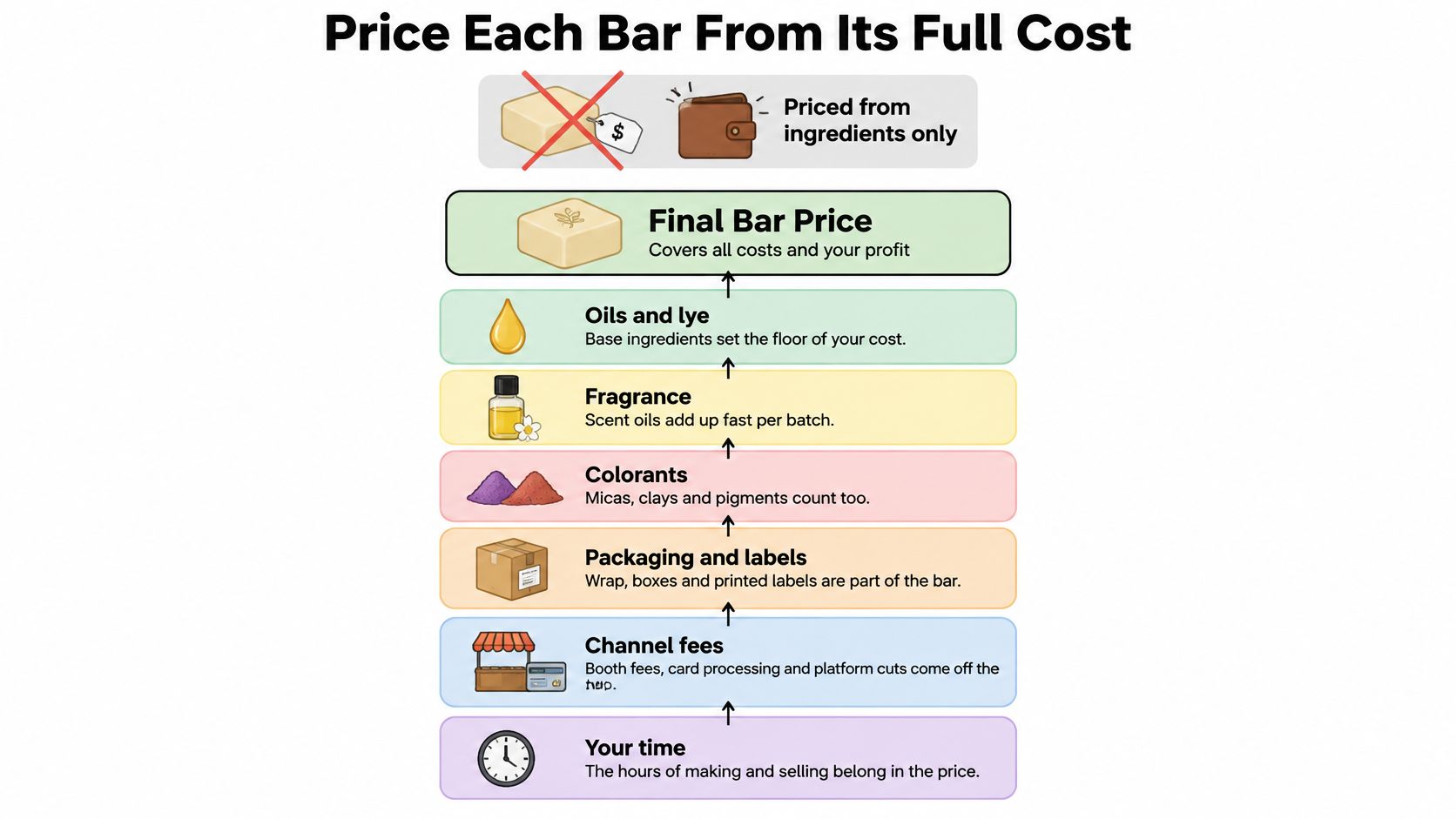
The Aroma Warehouse product costing walkthrough is another resource for organizing the calculation. Use your own invoices and measured labor time, rather than copying someone else's costs.
Test the offer before expanding it
Launch three to five differentiated bars, with a small batch of each. Track sell-through, contribution margin, repeat purchases, complaints, and cracked, softened, or otherwise damaged units.
Keep contribution margin separate from final profit: subtract variable costs from sales, then account for fixed overhead when judging the business. Don't count unpaid labor as profit because you haven't transferred yourself money.
A popular scent isn't a successful product if every reorder creates more unpaid work.
Review the numbers weekly against the price buyers accepted. Change a single variable at a time, such as the wrap or batch size, so you can tell whether the adjustment improved earnings without weakening the product.
Pick the Channel Where Your Bars Sell
A shopper at a market can smell a bar before buying it. Online, your listing has to do that work with clear descriptions, accurate photos, and dependable fulfillment. Choose the channel based on how buyers prefer to decide and what each route costs you in time and fees.

Sales channels compared for homemade soap
| Channel | Who Buys | What It Costs You | Best For |
|---|---|---|---|
| Local farmers market or craft fair | Neighbors who want to smell and touch before buying | Booth or table fee plus your weekend time | Testing scents and prices face to face |
| Holiday craft sale or boutique consignment | Gift shoppers | Booth fee or a consignment cut of each sale | Seasonal volume |
| Your own website | Repeat buyers and people who found you online | Hosting, payment fees and your marketing time | Full control of labels and pricing |
| Independent marketplace such as Loyaltie | Shoppers looking for independent makers | Listing and sales fees set by the marketplace, check current seller terms | Reaching buyers who want to shop online |
| Large general marketplace | Broad search traffic | Listing, transaction and payment fees | Reaching strangers who search for soap |
Loyaltie helps shoppers discover and purchase from local businesses and independent makers. Its sellers include Roost Roastery in Matthews, NC and Dudley's Toffee in Beech Grove, IN. Check the current terms on Sell on Loyaltie before listing.
If you're building your own storefront, Carti's step-by-step plan for Shopify DTC brands offers a separate planning resource. Running your own site gives you control over the storefront, while also making you responsible for attracting shoppers.
For another selling perspective, watch this video.
Be precise about where it's made
Under the FTC's Made in USA standard, an unqualified claim requires US final assembly or processing, all significant processing in the US, and all or virtually all ingredients or components made and sourced domestically. Mixing imported oils locally doesn't establish that claim.
A truthful town- or state-specific production description can be more precise, provided it doesn't misleadingly imply domestic ingredient sourcing. Choose one channel for a test period, then compare sales, fees, and the time required to run it before adding another.
Fix Melting, Cracking and Slow Repeat Orders
A bar can look fine on the curing rack and arrive soft, sweaty, or dented. Diagnose the failure before changing the formula: moisture on a melt-and-pour bar may have a different cause than a cold-process bar packed before it is ready.
Match the fix to the failure
| Problem | Likely causes to investigate | What to change | When to judge it |
|---|---|---|---|
| Soft or sweating bars in transit | Humidity, unsuitable wrap, incomplete cure, or a formula poorly suited to shipping conditions | Test heat and humidity exposure; keep labels off damp surfaces; extend cure where appropriate | One packaging trial for wrap changes, a full cure cycle for cure changes |
| Cracking or denting | Cutting too late, handling too early, stacking, or formula and processing issues | Adjust cutting timing; cure in a single layer with airflow; add protective packing | One batch for cutting changes, then its full cure cycle before release |
| Slow repeat orders | Product mismatch, unclear reorder route, or disappointing use experience | Check photos, scent, weight, and customer feedback; make reordering straightforward | One revised batch and the buyer's actual use cycle |
| Irritation complaints | Possible ingredient sensitivity, formulation error, contamination, or another cause | Follow the complaint procedure in your batch-record process | Act immediately |
A longer cure won't correct a wrongly calculated formula. For cold-process soap, independently verify the recipe and each oil's saponification requirements, and use appropriate chemical handling controls. A lye calculator output alone does not prove the finished bar is safe.
For repeat orders, compare the product with what the listing led the buyer to expect. A heavily styled photo that obscures bar size can leave buyers disappointed, even when the soap performs well.
Describe bar longevity only from documented use conditions. Shower storage, household use, and whether the bar dries between uses all matter.
Routine troubleshooting works best when you change one variable at a time, as covered in the pricing section. Safety concerns call for a different response: don't treat buyers as the next test.
Confirm Your Claims Before Your First Listing
A bar's legal category shapes both its label and its product page. Settle what you can claim before publishing, then keep batch records that support the product details buyers rely on.
Use this final checklist:
- Apply the label rules. Confirm that your product name, label, and listing use claims appropriate to the category you intend to sell.
- Show the actual bar. Use an accurate photo and state the cured weight in grams and ounces. Check that any weight shown in photo text matches the listing.
- Make ingredients readable. Describe the scent plainly and use standard ingredient names, not decorative substitutes.
- Keep production evidence organized. Record the batch code and cure date. Keep required physical tracking information with the product.
- Approve the economics. Check that the price covers packaging, fees, labor, and an allowance for damaged stock.
- Test fulfillment. Pack a bar in your actual mailer and check how it handles heat, humidity, abrasion, and label contact.
Publish deliberately
Use a live listing, such as this activated charcoal tallow soap product page, to see how a seller presents a bar. Treat it as an example of product-page layout, not a compliance template. Separate ingredient and product facts from claims that imply an effect on the buyer's skin.
Choose a sales channel and review its current seller terms. On Loyaltie, made-to-order products ship directly from the seller to the buyer's door, so packing and dispatch are part of the customer's experience.
You can start with one well-described bar rather than preparing every possible scent. Before taking orders, book a test shipment and check the package and label on arrival.
Loyaltie lets shoppers discover and buy directly from independent businesses, makers, growers, and producers. Visit Loyaltie to browse listed products and review the selling path for your soap.