

You've got a recipe people love, a few product photos, and a half-finished online shop. Then the less glamorous questions arrive. Can you legally make it in your kitchen? What has to appear on the label? Will it survive a summer delivery? How much does each order cost after packaging, payment fees, shipping, waste, and your own time?
That middle ground is where many food businesses lose money. Learning how to sell food online starts with compliance and unit economics, not branding. Independent brands can offer a genuine quality upgrade over mass-produced everyday products, but buyers need clear information and reliable delivery before they reorder. The global opportunity is already mainstream, with one estimate placing food and beverage e-commerce at USD 863.1 billion in 2024, projected to reach USD 947.4 billion in 2025 and USD 1.3 trillion by 2029 (industry market overview).
Table of Contents
Get the Legal and Food Safety Basics Right First
Before you think like a creator, think like an operator. A recipe can be excellent and still be impossible to sell legally if your kitchen, label, or product category doesn't meet local rules.
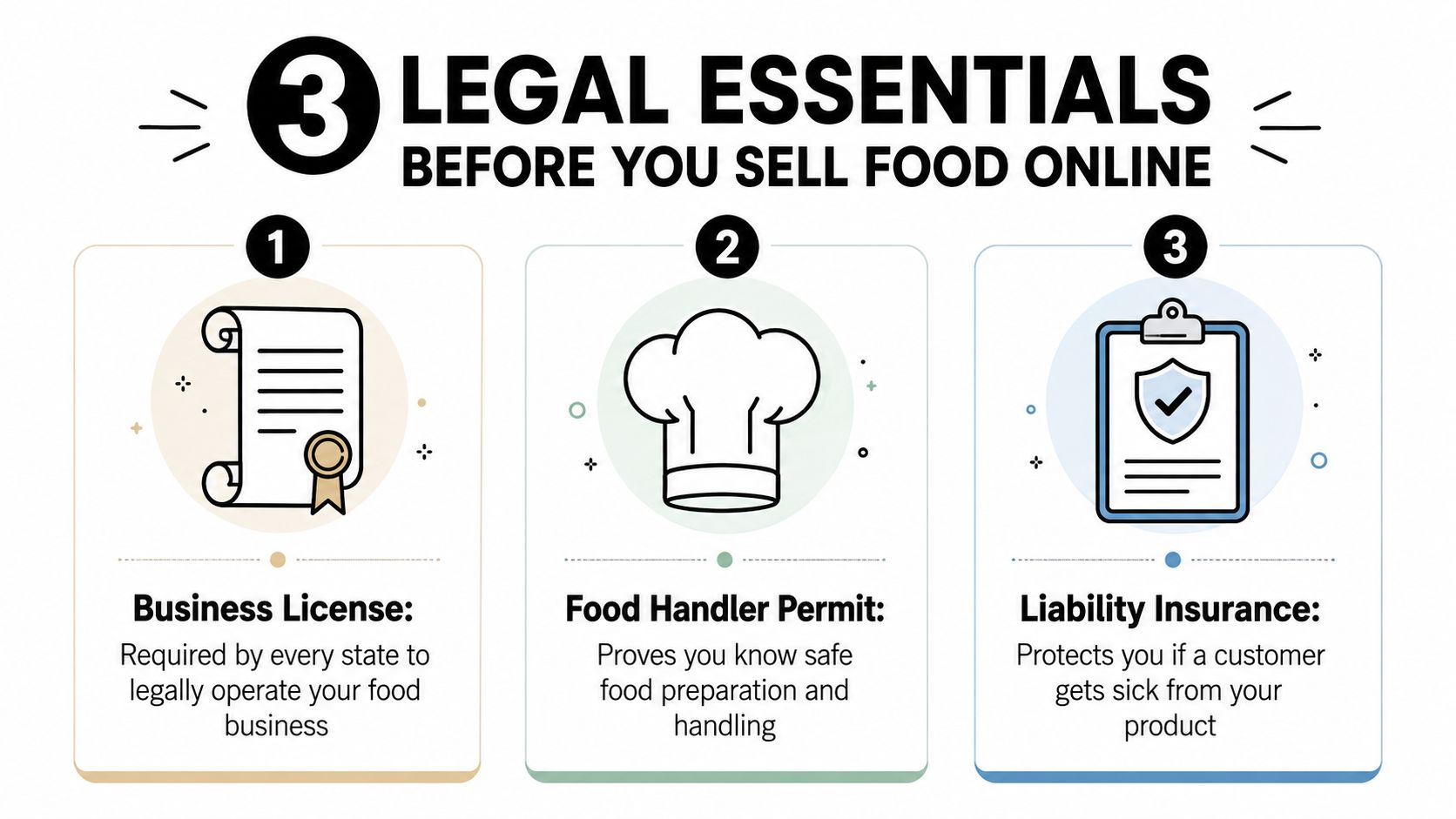
The exact requirements vary by state and product, but most first-time sellers should confirm three foundations before accepting an order:
- Business registration. Check whether your city, county, or state requires a business license, registration, or sales-tax account.
- Food-safety training. Complete the food-handler or food-manager certification required for your operation.
- Approved production space. Confirm that your product qualifies under your state's cottage-food rules, or secure an agreement with a registered commercial kitchen.
Cottage-food programs commonly focus on low-risk, shelf-stable products such as certain baked goods, jams, and acidified foods. Meat, dairy, and fresh-prepared meals are often excluded or subject to stricter licensing. Don't assume an online marketplace has checked this for you. In the UK, official guidance says food sold by distance selling must meet the same legal requirements as food sold in physical shops, and online advertising faces the same standards as offline sales (Food Standards Agency guidance). Similar food-safety principles apply across major markets.
Build the label before the listing
Your package and product page need to agree. Prepare an ingredient list in descending order by weight, allergen declarations, net weight, your business name and address, and any required statutory disclaimer. For products with short shelf life, retain the documentation that supports the labeled date.
Before listing, verify every disclosure. Then publish mandatory label information on the product page, show the actual label panel, and block inventory that won't meet the delivery threshold. In India, FSSAI-linked rules require delivered food to retain at least 30% of total shelf life or 45 days before expiry at delivery, and FSSAI guidance requires a principal-display-panel image and shelf-life details before purchase (FSSAI notice).
A practical safety framework can help you map hazards, controls, and records. This plain-language HACCP food safety guide is useful when you're turning a recipe into a repeatable process.
Protect the business you're building
Product liability insurance matters because a customer complaint can become a costly claim even when you followed your process. Many food sellers look for policies with USD 1 million minimums, but confirm the appropriate coverage with an insurance professional rather than copying another maker's policy.
Keep permits, kitchen agreements, batch records, invoices, and temperature logs together. A registered kitchen photo, a clean production setup, and visible compliance details can also become some of the least expensive trust-building content you create.
For example, a pantry listing such as Lupin Protein Rotini Pasta (4pack), Chocho Lupins, High Protein & High Fiber, Gluten-Free Ingredients, 2/4/6-Box Pack | Chef's Kiss by Loyaltie still needs accurate ingredients, allergen information, storage guidance, and any required label disclosures before sale.
Pick the Sales Channel That Fits Your Product
The right channel depends on what you're shipping, how often buyers reorder, and how much customer acquisition work you can handle. A shelf-stable sauce and a chilled prepared meal shouldn't use the same route to market.
| Factor | Marketplace (Etsy, Amazon) | Your Own Site (Shopify, WooCommerce) | Social Selling (IG, TikTok, Email) |
|---|---|---|---|
| Audience access | Built-in search and buyer traffic | You create and fund discovery | Fast access to your existing audience |
| Fees | Often includes marketplace fees and advertising costs | Lower platform dependence, but payment and app costs remain | Can be low at checkout, but content and selling take time |
| Control | Limited control over presentation and customer relationship | Highest control over brand, data, and checkout | Strong conversational selling, weaker operational structure |
| Compliance cushion | Platform checks may catch some issues, but seller remains responsible | You own the catalog and disclosure system | Fast publishing can make omissions easier |
| Best fit | Shelf-stable, searchable products | Repeat-purchase goods and a focused product line | Custom, made-to-order, local, or launch-based products |
Marketplaces can help a jarred or packaged product reach buyers who are already searching. The trade-off is margin pressure from platform fees, advertising, fulfillment requirements, and competition that can push sellers toward underpricing.
Your own site gives you the cleanest customer journey. You control the product page, checkout, reorder prompts, and email capture, but you're also responsible for traffic, analytics, tax settings, compliance, and support. Regular delivery or buy-on-a-plan options may be available through apps, but the payment and retention setup is yours to manage.
Social selling works well when the product has a strong visual or personal story. A local baker can announce a weekly drop, take paid orders, and coordinate pickup without building a large catalog. The weakness is that social posts don't replace inventory controls, label disclosures, refund policies, or buyer records.
For a ready-made example of a food-focused shopping destination, you can browse Nourish Meal Delivery. Choose one channel first, prove that one product line makes money there, and expand only when the process is stable.
Build Listings That Buyers Trust
Your product page has a short window to answer the buyer's silent questions. What is it? What does it taste like? What's inside? How much arrives? Will it reach me intact?
Start with four images that remove uncertainty:
- Hero shot: Put the food on a clean, neutral surface with enough detail to show texture.
- Scale shot: Place the item beside a coin, hand, plate, or familiar object so the size isn't ambiguous.
- Ingredient shot: Show the key ingredients or a close-up of the product's texture.
- Packaging shot: Photograph the actual sealed package and the unboxing experience, not a decorative mockup.

Put the important facts above the fold
Ingredient transparency and allergen callouts shouldn't be buried beneath a long origin story. Show the harvest, bake, best-by, or use-by information where relevant, then add storage instructions and a clear refund or replacement policy for damaged shipments.
The product page should mirror the physical label. EU-style distance-selling rules require mandatory food information to be available before purchase, and the same principle is a useful standard wherever you sell. Buyers should be able to understand the product without opening a separate PDF or sending you a message.
Food-and-drink conversion benchmarks vary by source and methodology. One benchmark reports 1.47% conversion in July 2026, while another 2026 benchmark places food products at an average of 3.4%, with top performers at 5.8% (IRP Commerce benchmark). Treat those figures as directional, not a promise. The practical lesson is simpler: incomplete listings create avoidable hesitation.
Write copy in this order:
- Use case and flavor: Tell buyers when they'll use it and what it tastes or feels like.
- Origin: Explain where ingredients come from or who makes the product.
- Dietary claims: State only claims you can substantiate, such as gluten-free or vegan, and keep them consistent with the label.
A short texture video, photo reviews, and a concise maker story can add confidence. The video below shows the kind of visual demonstration that can make a product easier to understand.
Price for Margin, Not Vibes
A food price has to pay for more than ingredients. Calculate the batch yield, direct labor, packaging, labels, payment processing, platform costs, shipping, breakage, spoilage, and the time spent answering delivery questions.
Use this formula as a starting point:
Required selling price = (fixed costs + variable costs) ÷ (1 − target margin)
Then add a buffer for waste, damage, and unsold inventory. The exact buffer depends on the product and process, but ignoring those losses guarantees that your spreadsheet looks healthier than your bank account.
| Cost Line | Shelf-Stable Jar (Hot Sauce) | Baked Good (Cookies, 12-pack) | Frozen Perishable (Broth/Meal) |
|---|---|---|---|
| Ingredients | Batch ingredients divided by sellable jars | Recipe ingredients divided by sellable packs | Ingredients divided by frozen portions |
| Direct labor | Cooking, filling, cooling, and cleanup | Mixing, baking, cooling, and packing | Cooking, portioning, freezing, and packing |
| Packaging | Jar, lid, seal, label, and carton | Inner wrap, tray, box, and label | Leak-resistant container, insulation, coolant, and outer carton |
| Selling costs | Payment and channel fees | Payment and channel fees | Payment, channel, and temperature-sensitive shipping costs |
| Loss risk | Broken seals, leakage, aging stock | Breakage, staleness, and weather damage | Thawing, carrier delays, and failed delivery |
| Pricing priority | Protect contribution per jar | Charge for labor, not just flour | Treat shipping and coolant as part of the product economics |
A marketplace or payment stack may take a meaningful share of the transaction. The plan notes many channels combine platform and payment costs around 8% to 12%, while marketplace fees can be higher once advertising is included. Confirm the current rate for your exact channel before setting a price.
The common mistakes are predictable. Sellers round down to match a competitor who may also be underpriced. They value their labor at zero. They list shipping as a separate customer expense even though the buyer evaluates the total delivered price.
Raise prices gradually, watch repeat purchasing and refund behavior, and never discount below your calculated floor. If bookkeeping is becoming the bottleneck, review the typical pricing for accounting hires before deciding whether outside help fits your operation.
Pack and Ship Food Without the Disasters
Shipping food isn't a packing task. It's a controlled system that connects product stability, packaging, weather, carrier service, and delivery timing.
Start with the package touching the food. Use food-safe liners where needed, vacuum sealing for suitable products, and oxygen scavengers for shelf-stable items when the package and process call for them. Then add secondary protection. Rigid mailers help protect baked goods, while cold products need an insulated shipper with enough wall thickness for the route and temperature risk.
Match insulation to the product
Expanded polystyrene foam, expanded polypropylene, and reflective liners each have different costs, durability, and performance characteristics. A shelf-stable product may need only cushioning and leak containment. Frozen broth, cheese, or prepared meals may require insulated packaging, gel packs, dry ice, and a delivery service that fits the product's validated temperature window.
Dry ice creates a separate compliance issue. UPS and FedEx Ground limit dry ice packages to 5.5 pounds per box, and carriers require UN1845 marking and ventilation because dry ice is classified as hazardous material. Verify current carrier rules before shipping, especially if your packaging or route changes.
For planning, a commonly used operational rule is one pound of dry ice per five pounds of payload for next-day transit, or two gel packs per quart of cold product for two-day transit. Treat those as starting points for testing, not guarantees. Your product, insulation, weather, pack density, and carrier handling can change the result.
Calculate both actual and dimensional weight. The carrier may charge based on whichever is higher, so a light product in a large insulated carton can cost more than its scale weight suggests. For practical packaging ideas, this shipping store guide offers useful context on protecting fragile shipments.
Test the ugly scenarios
Run shipments to the farthest realistic zone, test hot and cold conditions, and record arrival temperature or product condition. Chocolate can sweat and bloom in summer. Oils can leak through a primary container and breach an inner box. Saturday delivery surcharges can erase the margin on an otherwise profitable order.
A charcuterie product such as Charcuterie Gift Kit Fino Salami Rojizo Chorizo Wagyu Bresaola Summer Entertaining Cheese Preserves 2 Buckeyes illustrates why the product page, packaging plan, and delivery promise need to match. Don't promise a transit window your packaging hasn't survived in testing.
Set Up Local Pickup and Local Delivery
Local fulfillment deserves its own operating system. Pickup avoids much of the national shipping cost but demands precise handoffs. Delivery creates route economics, temperature obligations, and driver coordination that don't apply to a customer collecting an order at a market stall.
For pickup, publish a cutoff and a window. A maker might close orders Tuesday evening for Thursday pickup, then prepare every order together and release it at a defined location and time. The location could be a home kitchen approved for that product, a shared commercial kitchen, a farmers market stall, or a pickup locker.
The checkout should stay simple:
- Choose pickup only: Don't let a local customer accidentally select national shipping.
- Pay online: Payment before collection reduces no-shows and awkward handoffs.
- Show the time clearly: Include the date, window, location, and what the customer should bring.
- Mark every container: Use the customer's name, order identifier, product date, and storage guidance.
Local delivery needs a different calculation. Define a radius in miles, set a minimum order that makes the route worthwhile, and choose either a flat delivery fee or a tiered fee that decreases as the order grows. A single low-value drop can consume as much driving time as a larger order, so the minimum protects your production margin.
Choose the driver model
You have three practical options:
- Your own vehicle: Best control and lowest added coordination, but you absorb fuel, time, vehicle wear, and scheduling risk. Use a cooler bag or insulated container suitable for the food.
- A gig driver: Services such as Roadie or GoShare can provide flexible capacity, but availability, handling, and customer communication may vary by market.
- A local courier: More consistent for a regular route, though the contract price may require enough order density to work.
Cold delivery needs a temperature log. Record the product temperature when it leaves controlled storage, when it enters the vehicle, and when the customer receives it if your process requires that level of control. Date every container, and confirm that your state allows the relevant food category to be delivered under its cottage-food or retail-food rules.
Keep tax and payment records clean
Prepared foods and grocery items can carry different sales-tax treatment by state. Some whole grocery staples may be exempt, while a prepared version of a similar item may be taxable. The same SKU can therefore produce a different tax line depending on the destination.
Use a tax tool such as TaxJar, Avalara, or Shopify Tax to track origin and destination rules instead of guessing. Register for a resale certificate when buying eligible wholesale inputs, file state-specific food-tax forms where required, and reconcile processor payouts against gross sales every week.
Keep ingredient COGS and packaging costs separate from shipping. That lets you see whether pickup, local delivery, and national shipping each make money. The first surprise is often not the tax bill. It's the unmatched processor deposit that doesn't reconcile to your order report.
Payment gateways also behave differently around split tender, tipping, refunds, local pickup, and buy-on-a-plan orders. Stripe, Square, and Shopify Payments can each fit a different setup, so test the exact checkout flow before launch. Batch deliveries into a few predictable windows each week, and use a separate local order form so national orders never slip into a local route.
Turn First-Time Buyers Into Repeat Buyers
Food has a natural reorder cycle, but buyers won't automatically remember you when the jar runs out or the coffee bag gets low. Your retention system should make the next purchase easy without training customers to wait for a discount.
Start with three useful levers.
Regular delivery for consumables works for coffee, sauces, broth, pantry staples, and other products buyers use repeatedly. A 10% discount can be attractive, but only if the remaining contribution still covers fulfillment, payment costs, packaging, and support. Call it regular delivery or buy on a plan if that fits your offer. Make skipping, changing, or canceling straightforward.
Curated bundles can move slower items alongside a proven favorite. A bundle may carry an effective discount of 15% to 20%, but calculate that against actual gross margin rather than the individual list prices. The purpose isn't to make every product cheaper. It's to increase the usefulness of the order and raise the number of items moving through one fulfillment event.
Seasonal drops give people a reason to return without constant promotional noise. A rotating calendar can feature a new flavor, harvest, bake, or limited batch while keeping the core catalog stable. Announce the drop through email and SMS, but make those channels useful rather than turning them into daily discount blasts.
A referral program can use store credit instead of a cash discount. Credit keeps the reward inside your catalog and gives the referred customer a reason to complete another order. Set the reward only after the referred purchase is paid and outside your refund window.
Measure retention by cohort
Monthly revenue can rise while customer quality falls. Track buyers by the month of their first order and ask whether that cohort continues ordering later. Repeat-purchase rate by cohort tells you more about compounding demand than a single month's sales total.
Keep an eye on these measures:
- Repeat-purchase rate by cohort: Shows whether first orders become habits.
- Gross margin after shipping and platform fees: Reveals whether growth is financially useful.
- Average order value from bundles: Shows whether bundling improves the basket.
- Refund and damage rate: Connects packaging and fulfillment to retention.
- Customer acquisition cost by channel: Tells you where new buyers are affordable.
A pantry product like Coffee Subscription Bundle Uganda Nicaragua Bold Smooth Daily Brew 2 x 12oz Bags Whole Bean or Ground demonstrates the kind of repeat-use category where the reorder experience matters as much as the first product page.
Use a focused launch plan
Week 1: Lock permits, kitchen access, insurance, and one sales channel. Don't launch on three channels before you know whether one channel works.
Weeks 2 and 3: Photograph five products properly, write complete listings, include mandatory label and allergen information, and run three test shipments. Send one to the farthest realistic zone and one through summer heat conditions.
Week 4: Soft-launch to a 50-person email list, collect feedback through a survey, and then open publicly with a clear reorder prompt in the confirmation email.
For the following ninety days, improve the product line only after the unit economics work on one channel. The most common stall is adding channels before the first one is profitable. Another is delaying a price increase until shipping, packaging, or labor has already eaten the margin.
Independent brands win when the product earns its place in a buyer's routine. Better ingredients, a clear maker story, accurate labels, dependable fulfillment, and an easy reorder path matter more than adding another flavor before the existing one works.
Loyaltie is a marketplace where people discover and buy directly from the best independent brands in the US, including food, coffee, wellness, skincare, supplements, and pet products. Visit Loyaltie to find products made by real makers and give your own catalog another direct path to local buyers.