
You've got bags cooling, labels waiting, and a phone full of coffee photos. Say you roasted twenty bags on Tuesday. By afternoon, you're wondering whether to build a website, list on a marketplace, offer porch pickup, or call the cafe down the street.
Your buyer has a simpler question: will this coffee taste good when I brew it? Learning how to sell coffee online starts with answering that clearly, then making the bag, checkout, and delivery match. You don't need a sprawling catalog. You need a cup worth coming back for and a dependable way to get it into someone's kitchen.
Table of Contents
- Pick Where the First Bags Sell
- Build a Small Line People Can Finish
- Label Pack and Clear the Coffee First
- Ship for the Day They Brew
- Find Drinkers Who Want a Better Cup
- Open Your Store and Send the First Bag
Pick Where the First Bags Sell
Where to sell coffee online and what you still own
| Channel | Best when | You still handle | Main risk |
|---|---|---|---|
| Your own online shop | You want the buyer list and a reorder link | Site, payments, packing, shipping | Slow traffic until people already know you |
| Loyaltie | You want buyers to find independent makers and buy directly | Roast, label, pack, ship from your door | You fulfill every order yourself |
| Large online marketplaces | You want existing search traffic fast | Fees, listing rules, pack specs | Price sorting and slow parcels hurt freshness |
| Local pickup or neighborhood delivery | Drinkers live close enough for roast-week coffee | Roast calendar and handoff windows | Reach stays local unless you also ship |
| Wholesale to cafes | You can commit to cases on a schedule | Minimums, invoices, cafe timing | You lose the direct cup-by-cup relationship |
Choose one primary channel for your first month. If you can pack this week, pair a direct channel with a local handoff. Set a clear launch checkpoint, such as ten orders arriving in good shape, before adding another place to manage stock and messages.
Pick the work you can sustain
Your own shop gives you control over the buyer list and reorder experience. You also pay for the site, card processing, and the work of bringing every visitor through the door.
Loyaltie lets buyers purchase directly from independent makers across the country, all in one cart. You still roast, label, pack, and ship, so marketplace discovery doesn't replace your fulfillment work.
Large marketplaces put your listing beside existing searches. They also put your coffee beside cheaper bags, under listing rules that can make a careful freshness promise harder to explain.
Local pickup lets you coordinate handoff around your roast calendar. A short neighborhood route can protect the promise that coffee arrives in time for brew day, without rushing a parcel out the door the hour after roasting.
Wholesale suits a roaster ready to supply cases consistently. The cafe owns the conversation with the person drinking your coffee, while you manage purchasing schedules and invoices.
Make checkout answer the buyer's questions
Online shopping is established across retail categories. The U.S. Census Bureau's retail e-commerce report estimated seasonally adjusted US retail e-commerce sales at $304.2 billion in the second quarter of 2025. That figure is not specific to coffee, so make your own product details do the work.
Put origin, roast profile, whole bean or ground, bag size, and dispatch timing beside the buying button. Tell buyers when the bag leaves: after the next roast, or on another stated schedule. Freshness is a promise about when someone can brew a good cup, not a race to ship within hours of roasting.
Before offering delivery incentives, use Chicago Brandstarters' guide to protecting margin on shipped food orders. Add the cost of the bag, packing materials, and postage before deciding what you can afford to promise. A free-shipping offer only works if the order still covers its shipping costs.
Build a Small Line People Can Finish
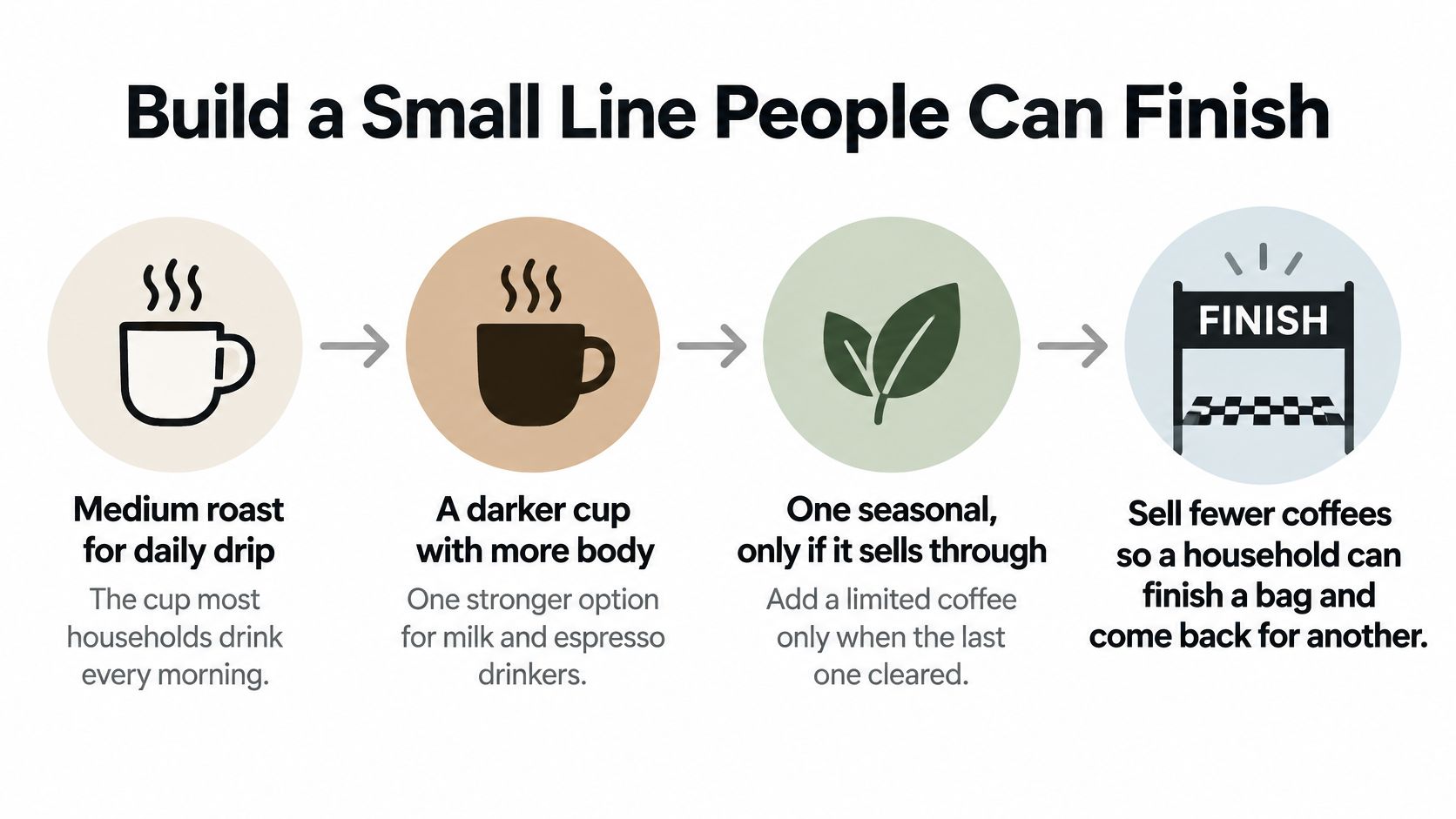
Give buyers a manageable choice, not a wall of tasting notes. A household that finishes a bag happily has a clear reason to reorder; a household juggling too many unfamiliar coffees doesn't.
Use a short lineup with distinct jobs.
Choose the coffee and the format
Start with a daily cup and a clear alternative. Offer a medium roast for everyday drip and a darker coffee with more body. Add a seasonal coffee only when you can keep the advertised offer consistent and sell through the batch without leaving old stock behind.
Make whole bean the default, with useful ground options. A coffee-plan market release published by openPR reported that whole-bean orders represented 47% of recurring coffee plans in 2025, while monthly plans represented 56%. Offer ground coffee by brew method, rather than just as ground, and connect grinding to your packing schedule because it loses freshness faster.
Choose a bag a household can finish. For example, build your launch around a 12-ounce or 1-pound format rather than several overlapping sizes. If you publish a cup count, calculate it from your own recipe, state the coffee dose and serving size, and label the result as an estimate.
A sampler can help an undecided buyer compare before choosing their everyday bag. The build-your-own whole-bean trio listing is a useful format reference, without making your main catalog larger.
Make the next purchase easy
Name what's in the cup. Put origin, roast level, and suitable brew methods in plain language. A hypothetical Honduras medium roast with clean acidity gives someone a clearer reference than an unexplained house blend.
Flavored coffee needs equally direct wording. Pops Coffee Company's Maple Cinnamon Vanilla medium-roast coffee describes maple, cinnamon, and vanilla notes with a smooth finish that isn't overly sweet. Keep flavor description separate from the ingredient declaration.
Let households choose their rhythm. For your own offer, consider reorder intervals such as every two, four, or six weeks, with straightforward skip, hold, and cancellation controls. Ask how quickly the last bag disappeared instead of assuming everyone drinks at the same pace.
Price the finished order, not just the beans. Include the bag, label, payment fee, packing time, and an actual parcel quote. Track second-order conversion, reorder rate, monthly drop-off, and money left after shipping, then use brew method, roast preference, caffeine preference, and drinking frequency to recommend a specific bag.
Practical rule: Don't add another coffee until you can explain which buyer needs it and why the current lineup doesn't meet that need.
Label Pack and Clear the Coffee First
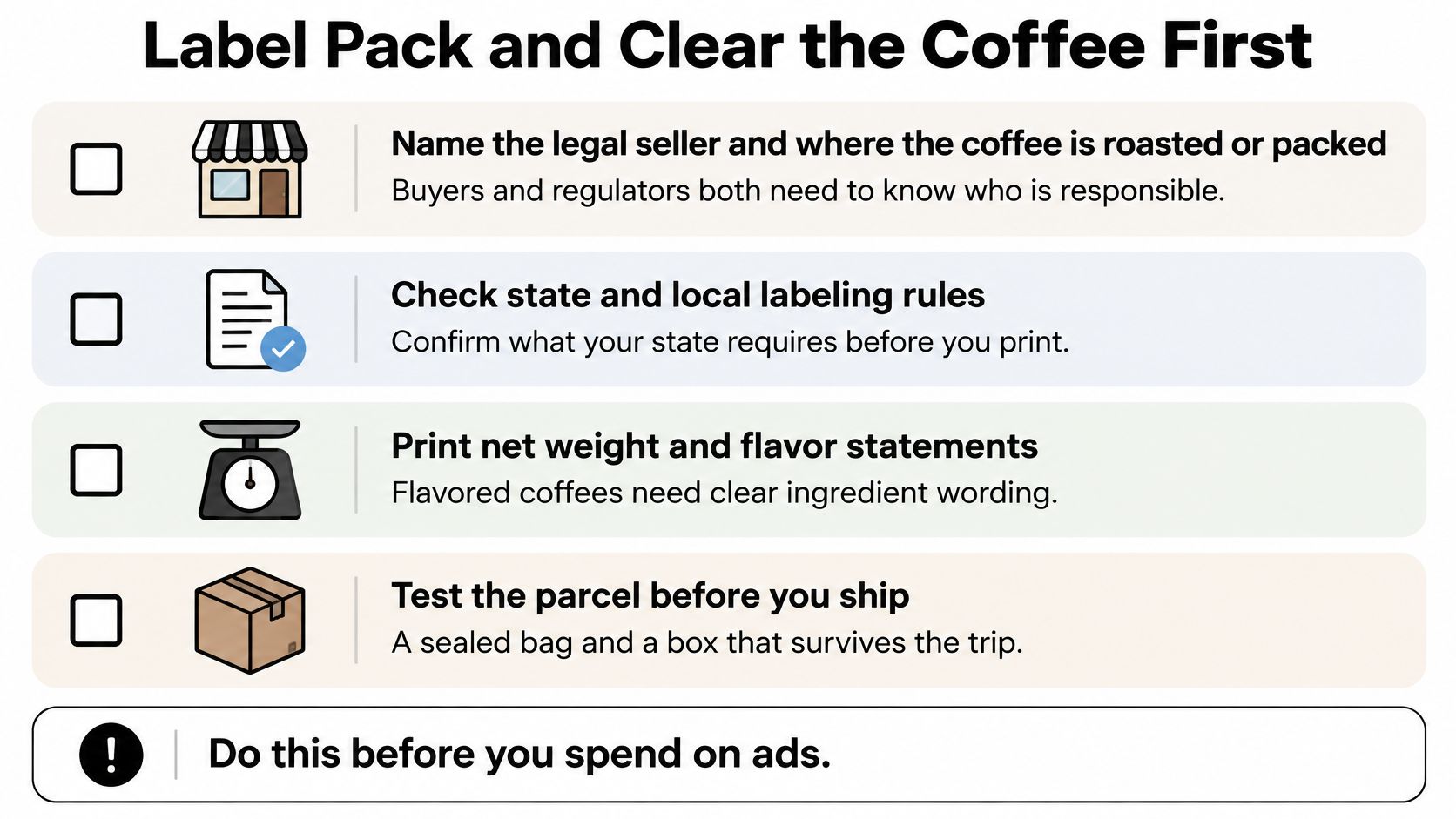
Don't buy ads for a bag you haven't cleared or a parcel you haven't tested. A beautiful product page won't fix a missing label detail or a split seal.
Start with the legal seller, then work outward to the parcel.
Clear the bag before photographing it
Identify who's responsible. Record the legal seller and where the coffee is roasted or packed. Verify state and local food permits, approved premises, and applicable shipping rules with the relevant authorities before printing a production run of labels.
Confirm the required label information. The Dura-Pack coffee packaging requirements guide identifies food identity, net quantity in US customary and metric units, and the manufacturer's, packer's, or distributor's name and address as core US packaged-coffee label details. Treat a packaging guide as a checklist, not a substitute for confirming the requirements that apply to your operation.
Handle additions and nutrition wording carefully. Add an ingredient list whenever the product contains more than coffee, including added flavors or mix-ins. Plain whole-bean or ground coffee can generally qualify for the insignificant-nutrient Nutrition Facts exemption, but nutrition claims or nutrition information on packaging or in advertising can affect that exemption.
What to print on a US coffee bag
| Item | When it is required | What to show |
|---|---|---|
| Identity of the food | Every bag | Coffee, or an accurate flavored-coffee identity |
| Net quantity | Every bag | Weight in both US customary and metric units |
| Seller name and address | Every bag | Manufacturer, packer, or distributor |
| Ingredient list | Anything beyond coffee | Coffee and added ingredients, including applicable flavor declarations |
| Nutrition Facts | When the exemption doesn't apply, including when claims or nutrition information affect eligibility | A compliant panel; confirm eligibility before omitting it |
| Roast date and lot | Your traceability workflow and freshness promise | Roast date, batch, origin, roast level, grind, and best-use note in product data, with appropriate bag markings |
The traceability row is an operational recommendation, not a claim that every listed detail is a universal federal label requirement.
Test what the buyer will open
Keep searchable production records. Put batch details in a spreadsheet or order system, not only on a sticky note beside the roaster. You should be able to connect a complaint to the coffee and packaging used.
Photograph the actual bag. Show a readable label and accurate package size. State your delivery area and dispatch timing alongside the listing.
Test the complete parcel. Check the heat seal, one-way valve, crush resistance, and shipping quote using the packed box's actual dimensions. Bulky protective packaging can make an inexpensive bag costly to deliver.
Run a small batch through real conditions. Send test parcels to hot and cold destinations, arrange arrival inspections, and calculate landed cost before expanding paid acquisition. Watch for unsupported health claims, vague origins, missing weight units, stale inventory, and delivery promises your carrier hasn't earned.
Ship for the Day They Brew
The fastest dispatch isn't automatically the best coffee. Your buyer wants a predictable cup on their brew date, not proof that you printed a shipping label while the beans were still warm.
Make the roast date visible enough to guide the whole order.
Publish a freshness policy you can keep
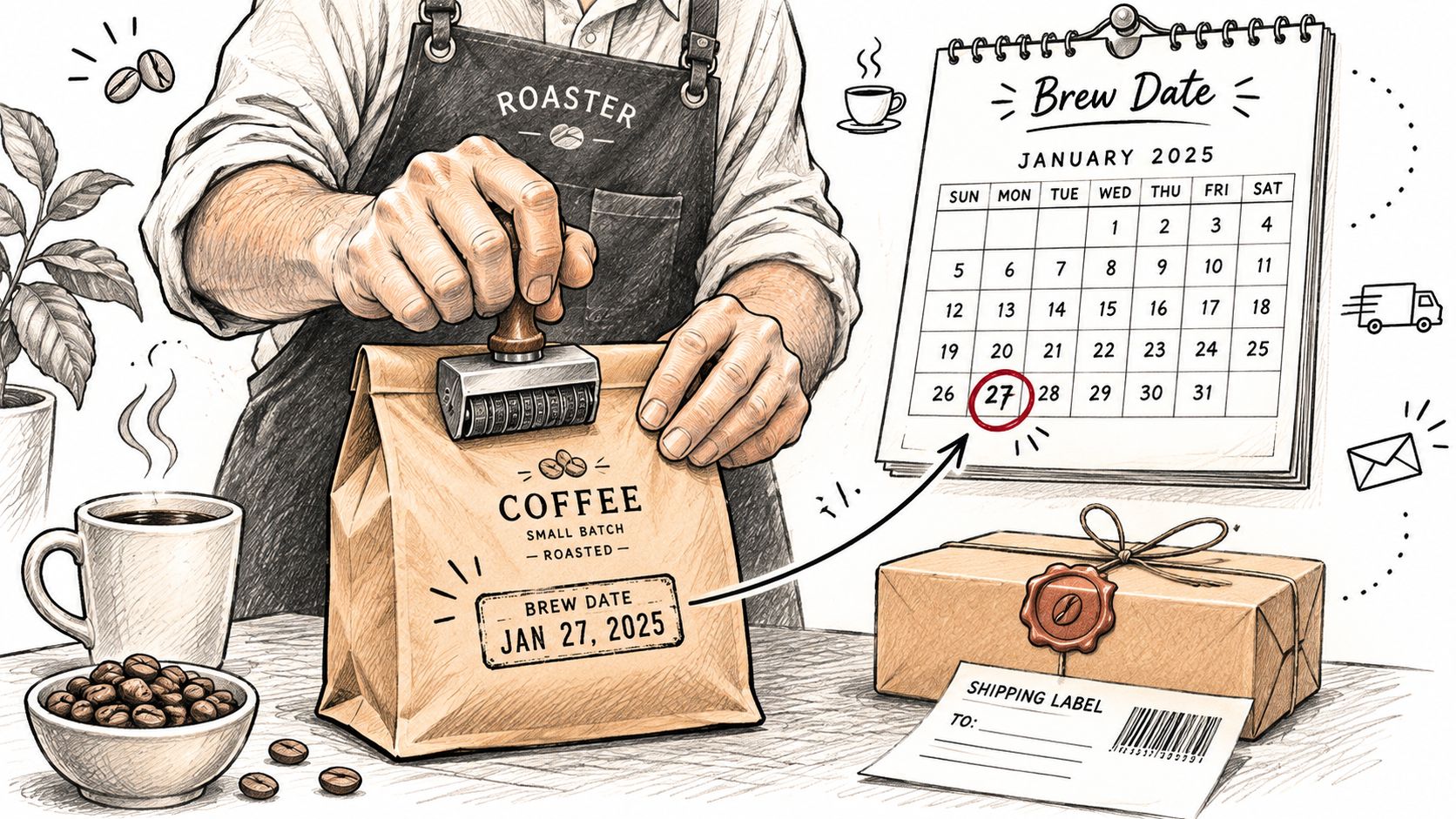
Show the roast date. Print it on the bag and display the relevant batch date on the product page. If you're taking orders for an upcoming roast, identify that clearly rather than presenting a future batch as ready stock.
Allow the coffee to rest. Degassing matters, and espresso often benefits from more rest than drip. Bellwether Coffee's online-selling guide provides a starting point for roast-to-order operations, but your actual roast, grind, and brew tests should determine the promise you make.
Set a dispatch window. For example, you might test packing and dispatching two to four days after roasting. That's a proposed operating window to validate with your coffee, not a universal freshness standard.
Account for weekends. Don't send a Friday parcel merely to clear your packing bench if it'll sit until the next carrier movement. Compare the actual collection and transit schedule with the buyer's likely brew day.
A calendar beats vague freshness language. Record roast, rest, pack, carrier collection, expected arrival, and intended first brew so you can see where a delay changes the experience.
Use the video alongside your own tasting and dispatch notes.
Use proximity as a quality advantage
Offer a local handoff when it improves the cup. A neighborhood delivery window or roast-day pickup lets nearby customers plan ahead. Include resting guidance when they collect freshly roasted coffee, rather than treating immediate pickup as a command to brew immediately.
Explain storage plainly. Keep whole beans sealed, cool, dry, and away from sunlight. Recommend using ground coffee sooner because grinding exposes more surface area, and don't assign every roast and format the same peak window.
Put dispatch timing beside the delivery area. Separate when you send the order from when the carrier expects to deliver it. If weather disrupts collection, tell the buyer what changed and what you're doing about it.
For a recurring-offer layout reference, look at the Fumi Coffee Roasters regular-delivery listing, then write timing around your own production capacity.
On Loyaltie, made-to-order products ship directly from the seller to the buyer's door. That direct route gives you responsibility for the promise, not permission to leave it vague.
Promise the cup on their brew date, then build the calendar backward from that date.
Find Drinkers Who Want a Better Cup
Lead with quality, not a plea to keep a shop open. In a January 2025 Bizrate Insights survey of 515 US consumers, 56% believed local brands offered higher-quality products, while 6% believed they were lower quality; the survey also found that 50% trusted local brands more, 44% preferred buying from them, and 53% were willing to pay more.
Access still gets in the way: in that same survey, 45% cited limited store locations and 39% cited limited product availability as barriers to shopping local. Your online listing should remove the extra trip while giving buyers enough detail to choose confidently.

Give people reasons to choose your bag
Replace vague praise with useful proof. Show origin, roast date, brewing guidance, and a photo of the actual coffee bag. Describe the cup in words someone can recognize, such as cocoa, toasted nuts, or citrus, only when those descriptions match your tasting.
Time the reorder note to the household. Ask early buyers when they expect to finish their bag, then send a short reminder around that answer. Offer a direct route back to the same coffee and an easy way to hold off if they still have plenty.
Recommend by brew method. Someone using a moka pot needs a more relevant answer than your newest release. Ask what equipment they use and what they wish their current coffee did better, then recommend the matching roast and grind.
The same quality-first approach helps people compare independent food, wellness, skincare, supplement, and pet-product brands across the US. Clear ingredients, format, maker identity, and honest product descriptions are more useful than asking buyers to assume a familiar national label is the better choice.
Earn the audience before buying more traffic
Meet neighbors where they already taste your coffee. At a Saturday handoff or a cafe pouring your beans, put a reorder card beside the bag. A QR code should open that exact coffee, not a homepage that makes someone hunt again.
Hold ads until fulfillment and repeat orders work. Check whether returning customers still leave a contribution after packing, shipping, payment fees, and any offer. A busy checkout isn't evidence of a healthy operation if every parcel loses money.
Ask for feedback that helps you fix something: Was the grind right? Did the coffee match the description? Was it ready when they wanted to brew? Those answers are more useful than a general request for praise.
People reorder coffee that tasted like the page promised, on the day they wanted to brew it.
Open Your Store and Send the First Bag
Give yourself a short launch schedule with a clear finish: a buyer opens an intact bag and makes the cup you described. Treat the following as a five-day working plan, not a reason to rush permits or skip testing.
Make the offer ready to buy
Day one, lock the channel. Makers start selling with us by opening a Loyaltie store. Use our seller resources to prepare your storefront, and keep the opening offer narrow enough to fulfill confidently.
Day two, photograph the launch coffees. Write the origin, roast level, bag size, and your tested serving estimate beside each image. Put the dispatch window next to the delivery area, then preview the page on a phone with someone who hasn't heard your sales pitch.
Day three, apply your cleared label checklist. Match the printed bag to the approved product information and production record. Check that the checkout description, packed weight, and actual contents agree before sealing anything.
Don't turn this into a branding marathon. A readable label, accurate description, and working checkout matter more than another afternoon choosing background colors.
Prove the order before widening the audience
Day four, run the handoff and parcel test. Arrange a neighborhood collection and a shipment to a different climate, with someone ready to inspect arrival condition. If transit takes longer, let the test extend beyond the launch schedule rather than declaring success early.
Compare services using the packed dimensions and destination, not a headline delivery price. Sendaparcel's fee-free courier comparison for online retailers is a useful comparison resource where its services apply; confirm coverage before relying on a quote.
Day five, open only the offer that passed. Activate checkout after the arrival inspection and brew test. Make the confirmation useful by identifying the batch and dispatch expectation, and provide a clear route for questions.
You're joining a marketplace that includes makers such as Roost Roastery in Matthews, NC, and Dudley's Toffee in Beech Grove, IN. Buyers can purchase directly from independent makers and brands across the country, all in one cart.
Start with the coffee you can stand behind today. Get that bag right before paying to put it in front of a bigger audience.
Loyaltie is a marketplace where people discover and buy directly from the best independent brands in the US, with no middleman. Visit Loyaltie to open your store and put your first coffee offer in front of buyers who want a better cup from the person who roasted it.