
You're standing in the cereal aisle with two boxes in your hands. One says “wholesome” in oversized lettering, the other shows a bowl overflowing with berries, and both promise a better start to the day. The louder claim is tempting, especially when you're shopping quickly, but the useful information is usually on the side or back of the package.
Learning how to read ingredient labels gives you a practical way to compare coffee, snacks, skincare, supplements, pet products, and everyday foods without relying on packaging designed to persuade you. You don't need to memorize every chemical name. You need a repeatable decoding habit that shows what a product contains, what it's meant to do, and whether its claims match the formula.
Table of Contents
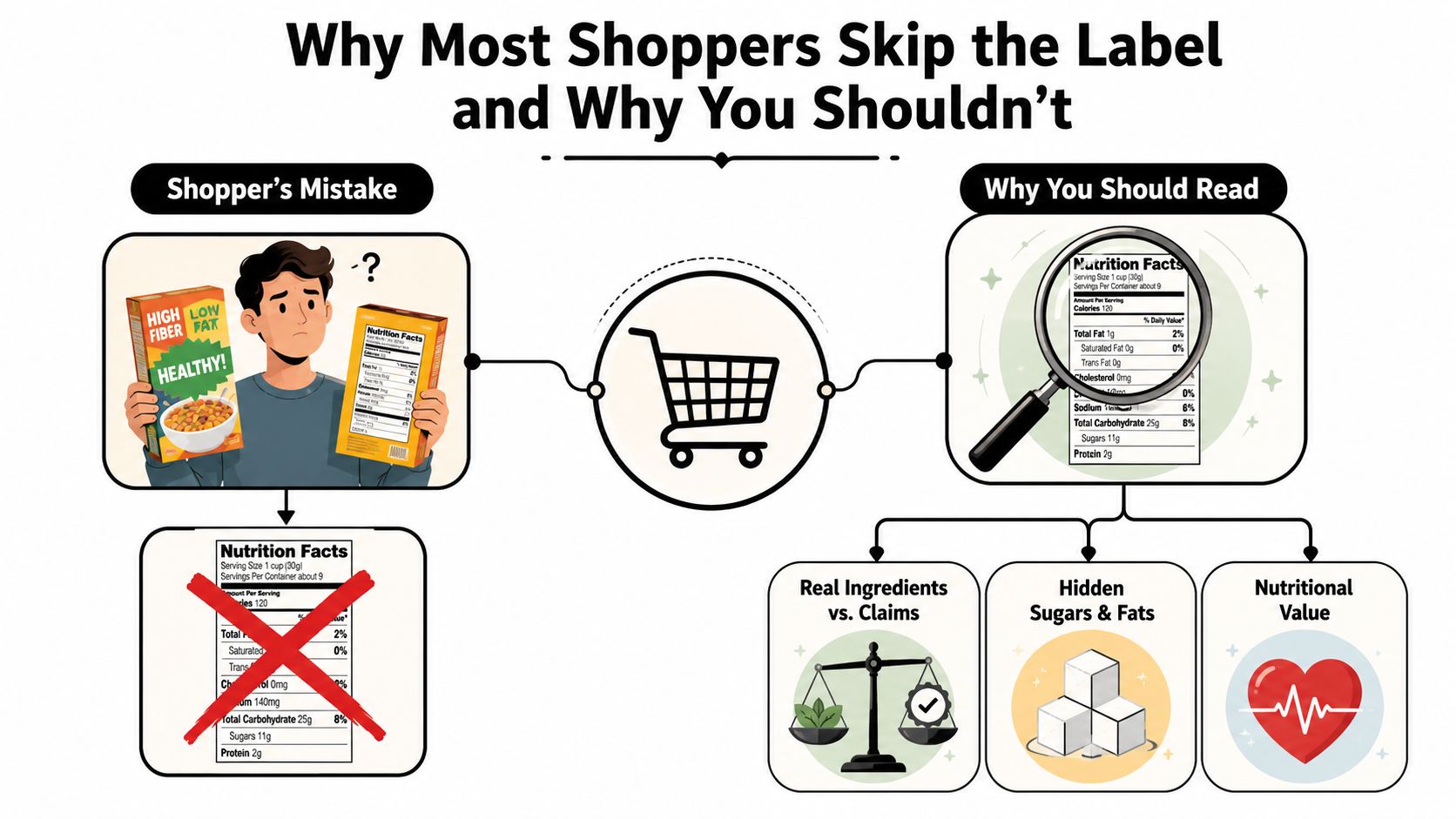
Why Most Shoppers Skip the Label and Why You Shouldn't
The cereal aisle creates a perfect shortcut. You see “whole grain,” “natural,” or “high fiber,” decide the product sounds sensible, and move on. Time pressure makes the shortcut feel reasonable. Bright colors, familiar logos, and wellness language compete for your attention, while the ingredient panel uses smaller type and unfamiliar words.
That habit is common. An Australian rapid evidence assessment found that up to 52% of consumers report routinely using ingredient lists, while a separate survey found 52.5% do not read them according to the evidence assessment. In the UK, 9% always read ingredients and 32% often do, while 21% rarely or never do according to the same assessment. The split tells you something important. Label information matters, but shoppers often don't have a fast method for interpreting it.
The three panels to find first
When you pick up a packaged product, locate three areas before you judge the front:
- Ingredient statement: This tells you what's in the product and lists ingredients from greatest to least predominance by weight.
- Nutrition Facts panel: This shows calories, nutrient amounts, and percent Daily Values, all tied to a stated serving size.
- Allergen callouts: A “Contains” statement identifies major allergens present in the product. A “may contain” disclosure can flag possible cross-contact, but it doesn't replace careful allergen guidance for your situation.
The ingredient list answers, “What is this made from?” The Nutrition Facts panel answers, “How much of each listed nutrient is in the stated serving?” The allergen statement answers, “Does this package identify a major allergen that matters to me?”
Boxes often place all three on the side panel. Pouches may wrap the information around a seam. Cans usually use the information panel beside the main display. Small bottles can shrink the type or place the ingredient statement on the bottom, beneath a peel-back label, or under a flap. If you can't find it immediately, rotate the package instead of assuming the front tells the full story.
Practical rule: The front of the package makes a promise. The back gives you material for checking it.
The reason to spend an extra moment is control. You can compare two products with similar claims, notice when added sweeteners appear under several names, and check an allergen before the product reaches your cart. A 2025 U.S. shopper study reported that 58% read labels all or most of the time before buying a new item and 79% first look at the ingredients list, yet only 16% found health claims very trustworthy as reported by Novonesis. That gap is exactly why the ingredient panel deserves more attention than the marketing badge.
Ingredient-label language can be difficult even when you're motivated. A 2022 peer-reviewed review of branded food products found that ingredient lists are often written at or above a middle-school to high-school reading level. Across four readability methods, median readability ranged from sixth-grade to college level, and the study found results ranging from 25.1% to 83.5% of lists at or below an eighth-grade reading level, depending on the formula used in the peer-reviewed review. In plain English, a long list isn't automatically bad, but it may require more decoding than the front panel suggests.
How Ingredient Order Tells You What the Product Really Is
Ingredient order is your first real decoding skill because it reveals the formula's foundation. For conventional packaged foods, ingredients must be listed by their common or usual name in descending order of predominance by weight, as explained in the FDA Food Labeling Guide.pdf). The first ingredient weighs more than the second, the second more than the third, and so on.
Suppose a loaf is marketed as “whole grain,” but the list begins with enriched wheat flour, water, sugar, and whole wheat flour. The claim may still refer to the presence of whole grain, but the first positions tell you refined flour and sugar appear before whole wheat flour. A fruit yogurt might begin with cultured pasteurized skim milk, sugar, and modified corn starch, with fruit in the fourth position. The front image shows fruit. The order tells you how much the formula depends on it.
Sweeteners deserve a second scan because manufacturers can distribute them across several ingredient names. Look for sugar, high fructose corn syrup, cane juice, maltodextrin, brown rice syrup, agave nectar, and fruit juice concentrate. You can't calculate the exact total from the ingredient list alone, but you can recognize when several sweetening ingredients appear throughout the formula.
| Ingredient Name on Label | What It Really Is |
|---|---|
| Sugar, sucrose, cane juice | Added sweetening ingredients |
| High fructose corn syrup | Corn-based sweetener |
| Maltodextrin | Processed carbohydrate used for sweetness, bulk, or texture |
| Brown rice syrup, agave nectar | Syrup-style sweeteners |
| Fruit juice concentrate | Concentrated fruit-derived sweetener |
| Disodium phosphate, sodium benzoate | Sodium-containing additives with different functions |
The same principle applies to pet products. If you're comparing limited ingredient cat treats, read the list from the top rather than stopping at the product name. For pet food and animal food, federal rules also require ingredients to appear by common or usual name in descending order by weight under FDA animal-food labeling guidance.
If the first few ingredients don't resemble the product you thought you were buying, pause before trusting the front label.
Serving Size and Percent Daily Values Explained
Start with the serving size before reading the calorie number. Every figure on the Nutrition Facts panel applies to that stated amount. A package with about three servings can turn a modest-looking snack into a much larger intake if you finish the bag.
A chip serving listed at 150 calories adds up to 450 calories when you eat the entire package. The arithmetic is easy. The misleading part is often the portion itself, because a serving may be smaller than the amount you would naturally pour, spread, or eat at one sitting.
Percent Daily Value provides a common reference point based on a 2,000-calorie reference diet, not a personal prescription. A listed 20% Daily Value of sodium is high, while 5% is modest, according to the FDA's label framework in its Food Labeling Guide.pdf). Use the percentage to compare products, then account for your own needs and the amount you will eat.
Align the portions before comparing
Two vanilla yogurts can use different serving sizes. Brand A lists one 170-gram container as a serving. Brand B lists 100 grams, even though its container holds 170 grams. Brand B may appear lower across the panel until both products are converted to the same amount.
| Nutrient | Brand A, serving: 1 container, 170g | Brand B, serving: 100g, 1.7 containers | Aligned to 170g |
|---|---|---|---|
| Calories | Read the listed amount | Read the listed amount | Brand B value multiplied by 1.7 |
| Total sugar | Read the listed amount | Read the listed amount | Brand B value multiplied by 1.7 |
| Added sugar | Read the listed amount | Read the listed amount | Brand B value multiplied by 1.7 |
| Protein | Read the listed amount | Read the listed amount | Brand B value multiplied by 1.7 |
The table demonstrates the method without inventing product values. If Brand B lists 12 grams of added sugar per 150 grams, compare 170 grams by multiplying 12 by 170, then dividing by 150. A plain yogurt with 9 grams of naturally occurring sugar may look different after you separate natural sugar from added sugar and align the portions.
For another explanation of serving sizes, see this nutrition label guide from Gym Snack. The practical habit is straightforward: multiply each listed amount by the number of servings you eat. That calculation turns the label from a small printout into a closer estimate of what reaches your plate.
Common Additives Grouped Into Easy-to-Spot Categories
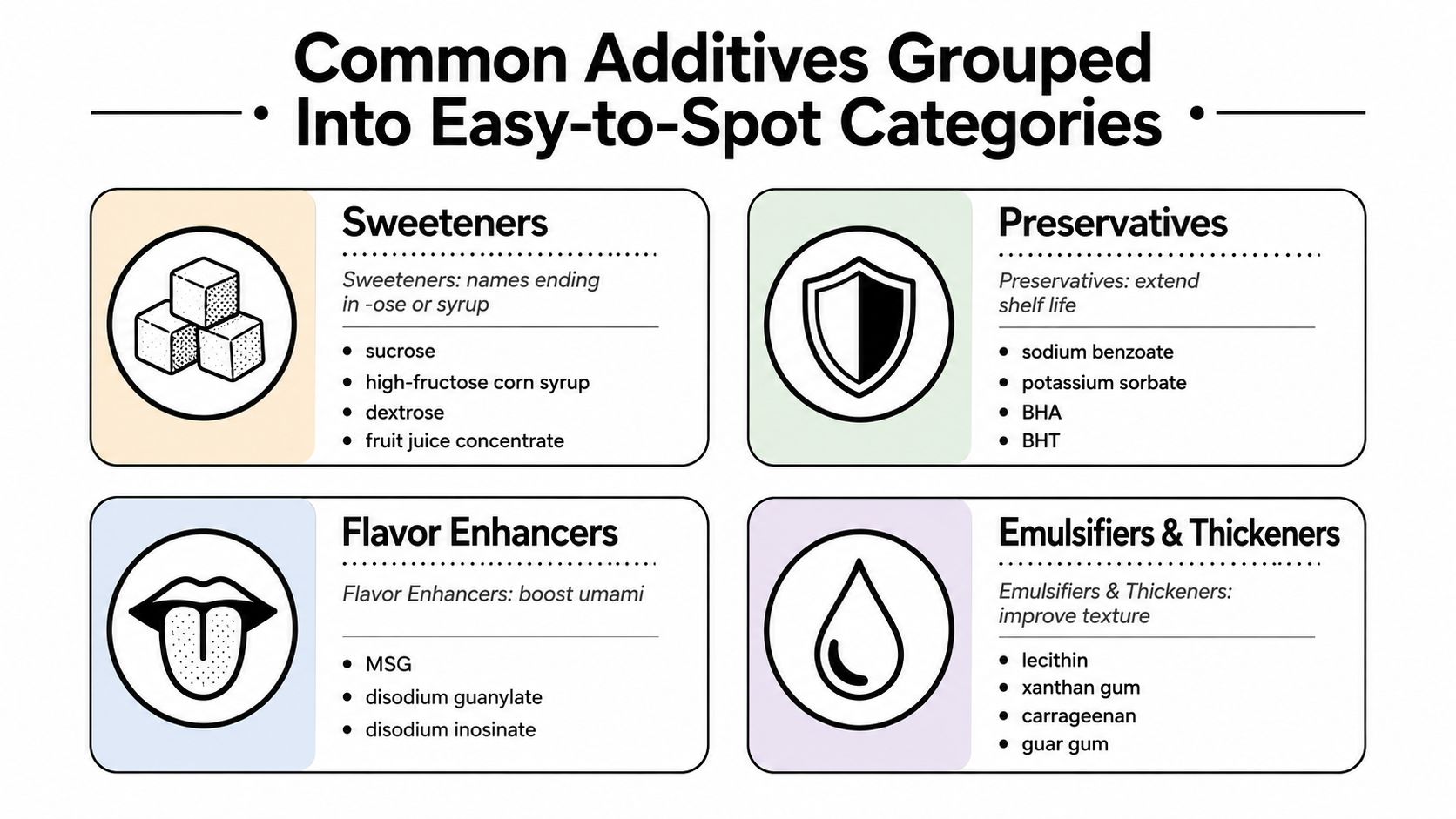
走進雜貨店,看到一串陌生成分名稱時,不必先背下一整本百科全書。先找出它們在配方中的家族與功能。添加物可能用來延長保存期限、讓油與水保持混合、改善口感,或讓味道更明顯。某個成分的存在,能提示產品如何製作,卻不能單獨判定整體品質。
四類值得先掃描的成分
甜味劑包括蔗糖、高果糖玉米糖漿、葡萄糖、果汁濃縮物與糙米糖漿。名稱以 「-ose」 結尾的字,以及 syrup、nectar、concentrate 等字眼,都值得多看一眼。同一配方可能同時放入幾種甜味來源。
工業油脂包括大豆油、棉籽油、芥花油、氫化油與酯交換脂肪。它們可以增加濃郁感、防止沾黏、承載香氣,或製造特定質地。看到這些名稱時,重點是理解它們在產品中負責什麼。
防腐劑與穩定劑包括 BHA、BHT、苯甲酸鈉、TBHQ、卡拉膠與聚山梨醇酯 80。製造商使用這類成分,協助產品在儲存期間維持穩定、安全或一致的狀態。
增味劑包括天然香料、味精、自溶酵母萃取物與水解蛋白。它們可以提升適口性或加深鹹味。「天然香料」仍是寬泛的描述,不能完整說明實際使用的香味系統。
掃描成分表的後段也很有用。開頭通常列出產品的主要組成,後方則可能集中出現色素、穩定劑、防腐劑與香味成分。這不是判決,而是提醒你在哪裡放慢速度,逐項確認功能。
同一套解碼方法也適用於個人護理用品。挑選 safe toothpaste for sensitive teeth 時,別只接受「不含化學物」的說法,還要查看實際成分與預定用途。家用產品也可以用同樣方式比較,例如這款 植物基多用途清潔劑,逐一詢問清潔劑、溶劑或穩定劑各自帶來什麼作用。
目標不是拒絕每個陌生字,而是弄清楚成分的角色,再判斷這個角色是否符合你對產品的期待。
What Front-of-Pack Claims Are Hiding From You
Treat front-of-pack language as a hypothesis, not proof. “Natural,” “clean,” “simple,” “wholesome,” and “made with whole grains” can guide your attention, but they don't tell you which ingredients dominate the formula.
A product labeled “made with whole grains” may contain whole grain while still placing refined flour and sugar before it. “No artificial flavors” can coexist with a highly processed flavor system built from natural isolates. “Light” may describe a reduction achieved by changing fat, sweetness, serving size, or texture, so the word alone doesn't explain what replaced what.
Run the ten-second buyer test
Read the claim, turn the package around, and inspect the first three ingredients. If the front says “wholesome” but the back begins with sugar or refined starch, the back gives you the stronger evidence about the product's base.
The same test works for supplements. A supplement label has different requirements from a conventional food label. The FDA requires a Supplement Facts panel to show serving size, servings per container, dietary ingredients, and amounts per serving under 21 CFR 101.36, as described in the FDA Dietary Supplement Labeling Guide. Ingredients not included in the Supplement Facts panel belong in an Other Ingredients list, and the panel must provide the applicable serving-size information and amounts per serving under FDA consumer guidance.
Third-party certifications can add useful information, but check the certifying organization rather than treating a seal as self-explanatory. A logo matters because someone defines and verifies its standard, not because the package uses a polished symbol.
Buying From Independent US Brands Makes Labels Easier
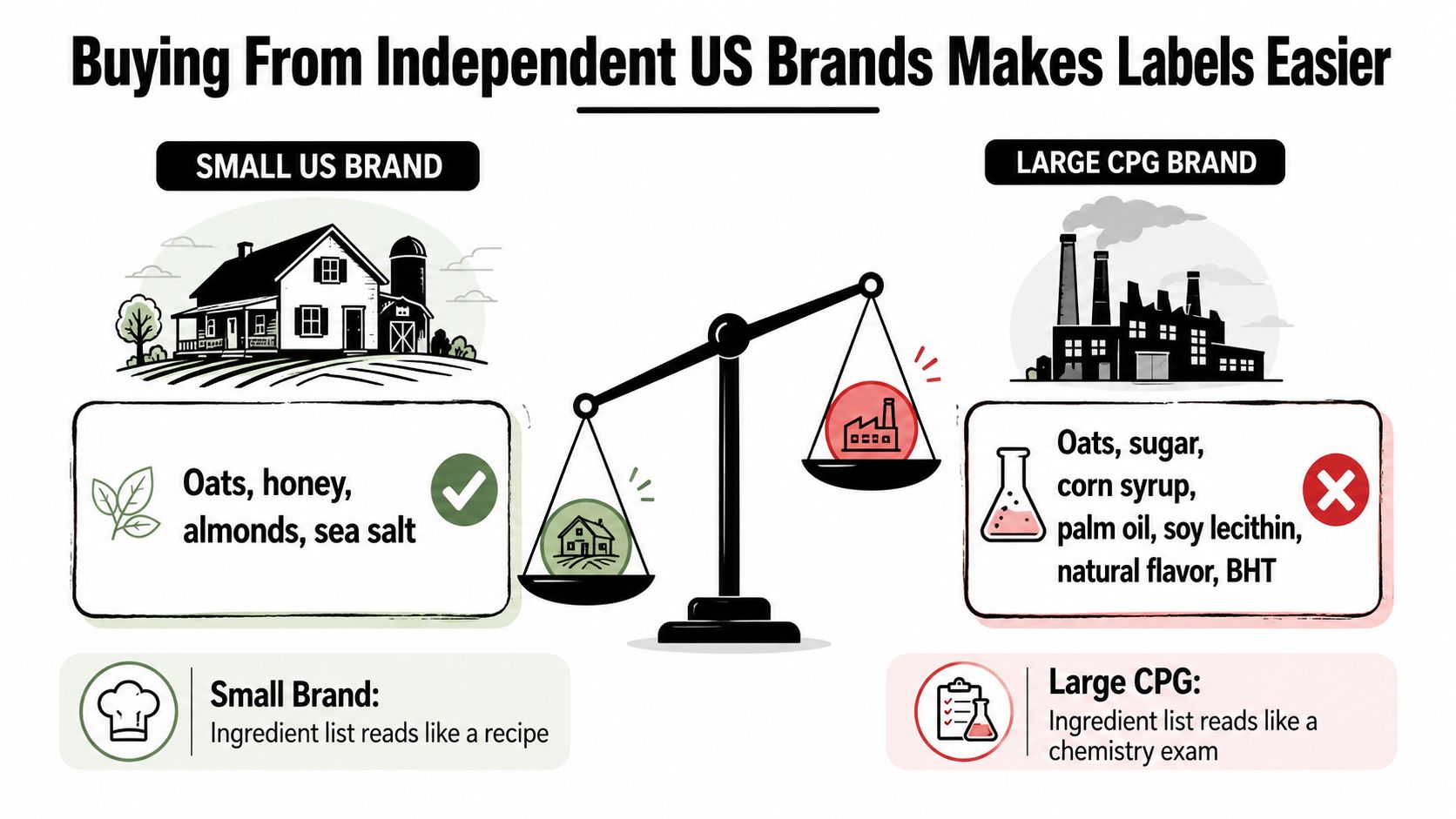
A clear label reduces the amount of detective work you have to do. Independent US brands and local makers often compete through product character, direct relationships, and specific formulas, so their ingredient lists can read more like recipes. That can make it easier to understand whether a coffee blend, balm, snack, supplement, or pet product matches your needs.
A mass-produced product may use a co-manufactured base or a broad term such as “natural flavors” or “spice blend.” Those terms can be legitimate label language, but they give you less detail. An independent maker may instead name the oil, identify the spice, describe the flavor source, and answer a question directly because you can buy directly from the maker with no middleman between the product creator and you.
Transparency becomes a quality upgrade
The advantage isn't charity. It's faster confidence. When the list is short, specific, and consistent with the product's stated purpose, you can make a decision without translating a wall of vague language.
Independent makers still need to meet applicable labeling requirements. For packaged foods, the FDA requires common or usual names and descending order by weight in its Food Labeling Guide. For sellers, clarity is both a compliance responsibility and a competitive edge. A complete list helps a shopper compare products, identify allergens, and understand what they're paying for.
Loyaltie is a marketplace where people discover and buy directly from the best independent brands in the US. You can use a marketplace such as Rose of Eden Home and Scents to explore direct-from-maker products while applying the same label-reading standards you'd use anywhere else.
Your Label-Reading Cheat Sheet and Quick Compliance Tips
At the grocery shelf, the front panel makes the promise. The ingredient list checks whether that promise holds up. Use this quick routine for food, supplements, pet products, and personal care.
- Check ingredient order first. Ingredients appear by weight, so read the first three before reacting to a front-panel claim. They reveal what the product is built around.
- Scan for sugar aliases. Look for names ending in “-ose,” along with syrup, nectar, and juice concentrate. Several forms can appear in one formula.
- Match the serving size to your habits. Read the stated serving, then multiply calories, sugar, sodium, and other nutrients by the number of servings you will consume.
- Find allergen language. Look for a dedicated “Contains” statement and read any “may contain” disclosure carefully. The two statements communicate different information.
- Question vague claims. Words such as “natural,” “clean,” and “simple” belong on your list of questions. Let the back panel explain what those words leave out.
Supplement labels use a different panel from conventional food labels. Check the Supplement Facts panel, serving size, amounts per serving, and the separate Other Ingredients list in the FDA supplement guidance. For a fuller explanation of Nutrition Facts panels, Gym Snack's nutrition label guide offers another practical reference.
A seller's clarity checklist
If you make or sell products, write for someone holding the package in an aisle:
- Use recognizable ingredient names instead of hiding a specific ingredient behind an umbrella term.
- Declare allergens in a dedicated statement where applicable rules require it.
- List sub-ingredients for compound ingredients.
- Keep the list focused where the formula allows, without omitting anything required for accurate disclosure.
- Explain unfamiliar terms briefly in product details or a dedicated ingredient section.
Clear labeling helps shoppers understand the formula, compare products fairly, and decide whether to buy again.
Loyaltie helps shoppers discover and buy directly from independent US brands across food, wellness, skincare, supplements, coffee, and pet products. Visit Loyaltie to compare products with clearer ingredient information and make fewer guesses.