
You've found the right coffee, face serum, or dog treats from an independent maker. You add it to your cart, reach checkout, and a shipping fee appears. The product still makes sense, but the total suddenly feels wrong. That extra charge can be enough to make you close the tab.
For sellers, the answer isn't to switch shipping to $0. Free shipping is a pricing decision, not a button. You need to know what each order can carry, which customers are likely to add more, and where delivery costs erode your margin. That's especially important for independent brands selling coffee, wellness products, skincare, food, supplements, and pet products directly to buyers across the US.
Table of Contents
Why Free Shipping Is Really a Pricing Decision
A shopper who abandons a cart over a shipping fee isn't necessarily rejecting your product. They're reacting to the final price. Recent retail research reports that 62% of consumers won't complete a purchase if shipping isn't free, while 74% are more likely to complete a purchase when delivery is free. The same free-shipping statistics research reports that 30% have abandoned an order because of shipping costs.
That changes the question. Don't ask, “Can I afford to offer free shipping?” Ask, “Which part of the order should fund delivery, and at what basket size?”
Many independent sellers show a product price, add shipping at checkout, and only think about the delivery cost after the order arrives. That approach makes shipping look separate to the customer but turns it into an invisible expense for the seller. You may collect the product margin you planned for, then give part of it back to the carrier.
Treat shipping like materials and labor
Your shipping cost belongs in the same planning conversation as ingredients, packaging, production time, payment fees, and overhead. If you make skincare, the product cost includes more than oils and containers. It includes the labor to fill and label each unit, the packaging that protects it, and the operational work required to get it out the door.
That's why a useful product pricing strategy accounts for the complete cost of making and selling the product. Free shipping can be built into the product price, recovered through a basket threshold, limited to selected products, or skipped when the numbers don't work.
Practical rule: Free shipping should have a break-even point before it has a marketing headline.
Choose the model after you know the floor
Your break-even point tells you what an order needs to contribute before free delivery becomes sustainable. Below that point, blanket free shipping may turn ordinary orders into margin leaks. Above it, a threshold can make the offer useful for both sides.
The strongest case for a threshold is simple. The shopper gets a clear reward for building a larger basket, while you recover some or all of the delivery cost through additional product margin. Loyaltie gives shoppers a place to discover and buy directly from independent brands in the US, so clear delivery rules matter. Buyers are comparing the complete checkout total, not just the product page price.
Calculating Your Break-Even Before You Turn It On
Start with three numbers in a spreadsheet:
- Average order value, or AOV, the typical revenue from one order.
- Gross margin, after product cost, labor, and relevant overhead.
- Average shipping cost per order, including the packaging and handling costs you pay.
The core calculation is:
Shipping cost ÷ gross margin = share of order revenue required to cover free shipping
Use the margin as a decimal in the spreadsheet. If your gross margin is 55%, enter 0.55. The calculation doesn't tell you what to charge customers. It tells you how much of the order's revenue free delivery consumes before you count the remaining profit.
A skincare example
Say a skincare brand has a $42 AOV, a 55% gross margin, and a $7 average shipping cost. The shipping burden is:
$7 ÷ 0.55 = $12.73 in required gross sales
That means roughly 30% of the order's revenue is needed to cover the shipping expense when delivery is free. The calculation uses the supplied operating assumptions, but the conclusion is practical: the brand can't treat $7 as a minor promotional cost. It needs either enough product margin, a larger basket, or a more selective offer.
For a broader explanation of how fixed and variable costs shape a break-even point, this break-even analysis guide is a useful reference. Keep your own sheet focused on the costs that change with each order.
Copy this template into your spreadsheet
| Input | Value | Calculation | Result |
|---|---|---|---|
| Average order value | $42 | Enter your actual AOV | $42 |
| Gross margin | 55% | Enter margin as a decimal | 0.55 |
| Average shipping cost | $7 | Include packaging-related delivery costs | $7 |
| Shipping burden | $7 | $7 ÷ 0.55 | $12.73 |
| Revenue share consumed | $12.73 ÷ $42 | Roughly 30% |
Use negotiated carrier rates whenever possible. Retail counter rates can make the offer look worse than it is, while dimensional-weight surcharges can make a compact-looking package unexpectedly expensive. Add packaging and pickup costs too. A free-shipping calculation that leaves those out isn't a break-even calculation.
The result is a floor, not a target. If free shipping breaks even at a certain basket size, you still need room for refunds, damaged parcels, payment costs, customer service, and ordinary variation in delivery rates.
Choosing Your Free Shipping Model
Free shipping is a pricing choice, not a checkout switch. Pick the model that protects your margin while giving shoppers a clear reason to buy more.
Blanket free shipping removes the fee from every eligible order. It is simple to explain, but low-value carts and distant delivery zones can erode profit. Use it for compact products with predictable postage and strong margins, especially when the product price already includes part of the fulfillment cost.
Threshold-based free shipping applies after the cart reaches a stated amount. I would start here for most independent brands. Shoppers often add a second product, larger pack, or useful companion item when the target feels reachable. The 2026 ecommerce optimization drivers provides more context on how delivery offers affect purchase decisions.
Hybrid shipping gives free delivery to selected products or qualifying baskets, while other orders use flat-rate or calculated shipping. Choose it when your catalog has sharply different shipping costs. A lightweight face oil and an oversized pet-food bundle should not automatically carry the same delivery subsidy.

A threshold can raise basket size, yet an unreachable cutoff can stop smaller purchases. One benchmark reports an average retailer threshold of about $64, while shoppers say they are willing to spend about $43 to qualify, leaving a gap of roughly $21. The same source reports that 80% of shoppers are willing to meet a minimum threshold. The practical lesson is clear: place the cutoff near a natural basket size, then check whether desktop and mobile shoppers respond differently. These figures appear in this free-shipping benchmark analysis.
Test blanket free shipping when:
- Your delivery cost is predictable: Orders use similar compact packaging and ship to comparable zones.
- Your margin has room: Product economics stay healthy after postage, packaging, and fulfillment.
- Your repeat buying pattern is strong: Frequent reorders can justify a lower margin on the first purchase.
For bulky furniture, made-to-order goods, or products with wide size variation, hybrid usually protects the business better. It keeps easy-to-ship items easy to buy without funding delivery on every order. Measure qualifying-order rate, actual basket value, and profit by device before making the model permanent.
Setting the Right Threshold for Your Brand
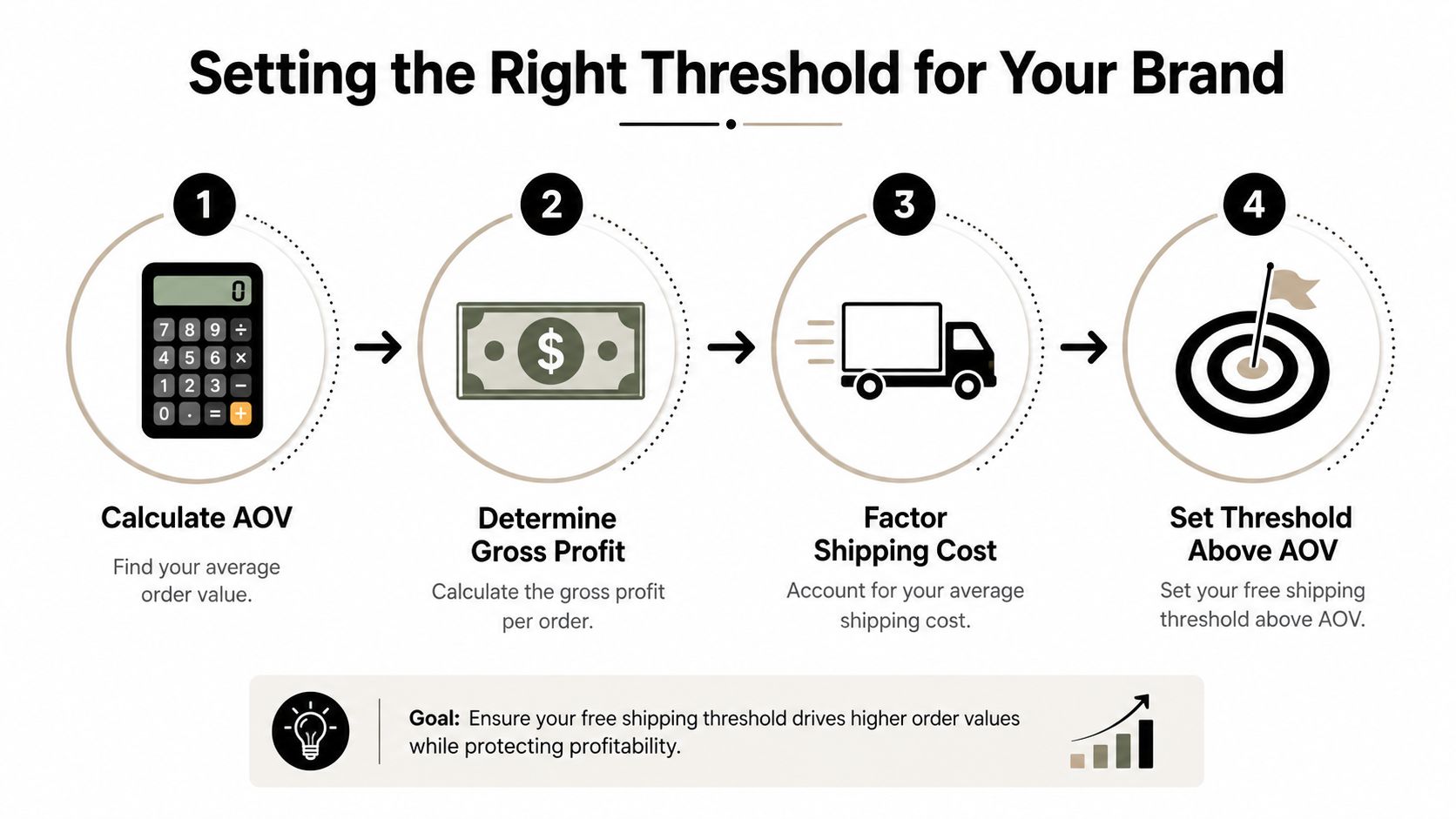
A threshold should follow your unit economics, not a competitor's checkout. Start with AOV, gross profit per order, average shipping cost, and the products customers naturally buy together. Set the first test 15% to 30% above current AOV, following this expert guide to free-shipping thresholds. Use that range as a testing window, then adjust for your product mix and actual basket behavior.
Consider a skincare brand with a $54 AOV, $7 average shipping cost, and a 60% gross margin. At a $65 threshold, the cutoff sits 20% above AOV. The additional $11 in revenue produces $6.60 before shipping, leaving the order nearly at break-even for delivery.
That result earns a test, not a permanent rollout. Compare $60, $65, and $70, then track conversion, AOV, qualifying-order share, and profit per visitor. Evaluate net margin alongside conversion. A higher qualifying rate can still lose money if shoppers add low-margin products or if shipping costs rise on the orders that qualify.
Make the next purchase obvious
A threshold changes behavior only when the cart shows a clear path to it. Add progress copy such as, “You're $12 away from free shipping.” Recommend products that fit the current order, such as a compatible refill or complementary accessory. Cheap filler products can raise order value while weakening profit.
Device behavior deserves its own readout. Mobile shoppers were more likely to increase the quantity of the same item, while desktop shoppers were more likely to add different products or choose higher-priced alternatives, according to this research on device-specific basket behavior. Build different recommendations or cart prompts when the data supports it, rather than applying one upsell pattern everywhere.
Exclude heavy, low-margin, gift, and final-sale products when they distort the calculation. Put exclusions beside the offer, not behind a policy-page link. Threshold language must state the cutoff and exceptions plainly. Research on threshold-free-shipping perceptions connects shoppers' response to the threshold, shipping cost, profit motive, and delivery speed. This research on threshold-free-shipping perceptions supports a direct policy: explain the rule before checkout and make customers' qualification status visible in the cart.
Shipping, Pickup, and Local Delivery Compared
Shipping, pickup, and local delivery aren't interchangeable conveniences. Each one creates a different margin equation, and your best mix depends on where your buyers live, what you sell, and how much control you have over fulfillment.
Parcel shipping works well for compact, repeatable orders. A coffee roaster can ship shelf-stable bundles nationwide, use a threshold for larger baskets, and offer paid faster delivery for customers who need it sooner. The seller controls the packing process, but carrier rates and destination changes still affect the result.
Local pickup removes postage, but it doesn't remove cost. Someone has to prepare the order, store it safely, communicate collection details, and manage customers who don't arrive when expected. Pickup can be a strong option for preorders and neighborhood demand, especially when the maker already operates from a storefront or production location.
Local delivery adds convenience but requires a real fee structure. Account for driver time, mileage, packaging, and the number of orders clustered in the same route. Free delivery usually makes more sense in nearby zones or above a larger order amount, where one trip serves a worthwhile basket.
| Method | Customer Cost | Seller Considerations | Best Fit |
|---|---|---|---|
| Parcel shipping | Free, flat-rate, or calculated | Carrier rates, packaging, destination, delivery speed | Compact products and repeatable nationwide orders |
| Local pickup | No postage, but collection is required | Handoff labor, storage, communication, missed pickups | Preorders, neighborhood buyers, storefront-based makers |
| Local delivery | Free in limited zones or paid by distance | Driver time, mileage, routing, order density | Fresh food and nearby customers needing convenience |
A neighborhood bakery might use nationwide shipping for shelf-stable bundles, pickup for preorder boxes, and free local delivery only above a higher basket threshold. Don't show every option to every shopper by default. Too many choices can slow checkout and make the offer harder to understand.
Test pickup and delivery separately. Pickup often reveals stronger local demand than a nationwide free-shipping promotion because it gives nearby buyers a practical way to buy directly from local makers without waiting for a parcel.
Platform Settings and the Right Messaging
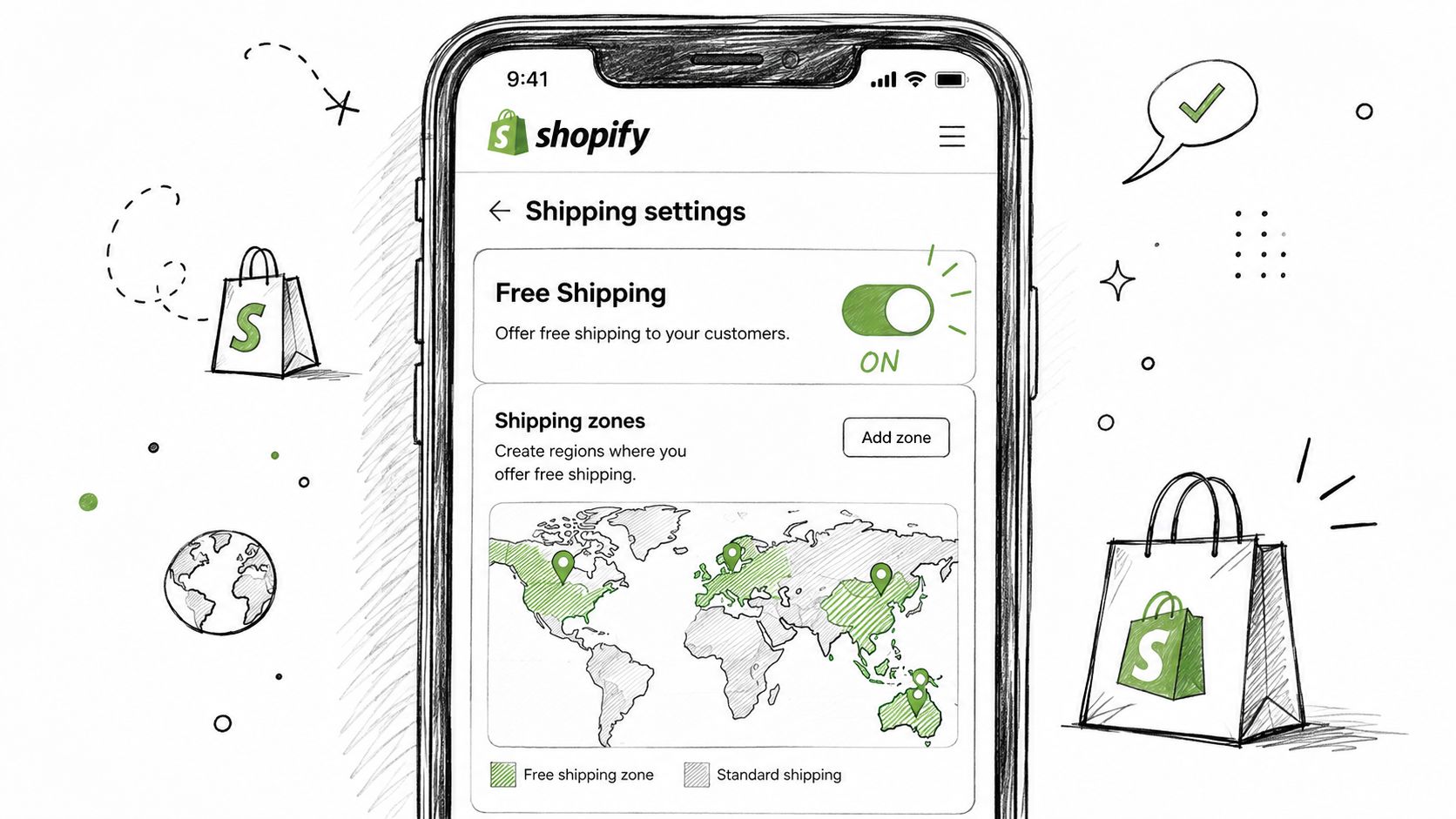
Set the rule where the shopper makes the decision, not only inside the checkout. On Shopify or a similar platform, create a free-shipping rate for the eligible shipping zones, then set the condition by order value, product group, or location. Shopify's shipping settings support free rates and conditional rates, while custom shipping profiles can limit the offer to selected products.
Your message should answer the shopper's next question immediately. “You're $12 away from free shipping” tells them what to do. “Shipping is on us” sounds pleasant but doesn't explain whether the offer applies to this cart.
Build the offer into the cart
Use a banner near the product price to introduce the rule early. Add a progress bar in the cart, then recommend relevant add-ons that help the shopper cross the cutoff. A coffee buyer might see another roast or a larger quantity suggestion. A skincare buyer might see a cleanser that complements the serum already in the cart.
On mobile, quantity suggestions can be more useful because shoppers are often building the basket with additional units of the same product. On desktop, cross-sells and trade-up options may fit the browsing behavior better. Don't force either path. Make the next useful purchase visible.
For pickup and local delivery, place those choices beside the shipping option. Show the fee, expected date, and service area in plain language. Keep exclusions visible, particularly for heavy items, buy-on-a-plan orders, and gift cards. A hidden exception can undo the trust created by the original offer.
Preview the whole flow on both mobile and desktop. Check the product page, cart, address step, shipping selection, and payment screen. If the threshold looks easy to reach on one device but impossible on another, your messaging or recommendations need work. Sellers who want to reach local buyers directly can also review the marketplace options available through Loyaltie for sellers.
Tracking ROI and Knowing When to Adjust
Revenue alone won't tell you whether free shipping is working. Track the offer every week across four measures, and separate mobile results from desktop results wherever your platform allows it.
| Metric | Why It Matters | Target Range | Action Trigger |
|---|---|---|---|
| Offer-page conversion rate | Shows whether delivery removes checkout hesitation | Compare against your own pre-launch baseline | Conversion falls on one device, investigate the message and cart experience |
| AOV before and after activation | Shows whether the threshold changes basket size | Compare against your own historical AOV | AOV stays flat while qualifying orders rise, review the cutoff |
| Shipping cost as a share of revenue | Shows whether delivery is consuming too much sales value | Keep a ceiling of 8% to 10% for most independent brands, based on the operating guidance in this brief | Move to exclusions, a higher threshold, or paid delivery when the share exceeds the ceiling |
| Incremental repeat purchase rate | Shows whether free shipping attracts buyers who reorder | Compare customers acquired under the offer with your normal repeat behavior | If repeat behavior doesn't improve, stop treating the first-order subsidy as growth |
The most important warning sign is a split result: conversion improves, but AOV holds flat or drops. That usually means the threshold is filtering out too many baskets, or blanket free shipping is encouraging smaller orders. Lower the threshold by 10% to 15% and retest for two weeks before deciding whether the change worked. Those test parameters come from the operating plan for this offer, not from a claim that every store will respond the same way.
Keep a simple change log. Record the threshold, eligible products, delivery zones, device results, and margin outcome. For additional operating resources on selling directly through a marketplace, visit Loyaltie's seller resources.
Loyaltie is a marketplace where people discover and buy directly from independent brands in the US, including local products with clear purchasing and delivery options. Visit Loyaltie to find better everyday alternatives from real makers, or explore how your brand can reach buyers without a middleman.