
You've got a product people love, whether it's a calming lavender soap bar, a carefully blended coffee, or food made with ingredients you can pronounce. You also know the brand does more than move units. It gives customers a better daily routine, keeps money closer to the people who make the product, and may create useful community or environmental benefits. The problem is explaining those outcomes without sounding like a corporation with a hundred-page ESG report.
You don't need one. How to measure social impact for an independent brand starts with a focused promise, a few useful signals, and the discipline to separate what you did from what changed. The result is a clearer brand story, better decisions, and proof that buying directly from the maker delivers more than a generic alternative.
Table of Contents
Why Tracking Real Outcomes Matters for Independent Brands
A maker usually notices impact in small, human moments. A customer sends a message saying the soap became part of a calmer evening routine. A local café tells a coffee producer that customers now ask where the beans came from. A pet-food buyer reorders because the ingredients feel more trustworthy than the mass-produced option on the shelf.
Those messages matter, but they're easy to leave scattered across email, social media, and customer-service notes. Without a simple record, your impact stays anecdotal. You know the product helps people, but you can't clearly explain how it helps, who experiences the change, and what evidence supports the claim.
A founder I know once described the brand as “good for the community.” That phrase sounded generous, but it said almost nothing. After asking customers a few direct questions, the team found a more useful story: buyers valued ingredient transparency, felt more connected to the person making the product, and changed part of their purchasing routine. The brand stopped leading with vague giving-back language and started showing the quality and care built into the product.
Track the change, not the activity
Selling a product is an activity. Shipping an order is an activity. Even reaching a new customer is an activity. An outcome is the difference those actions create, such as a customer replacing a less suitable product, adopting a more consistent wellness routine, or gaining a stronger connection to local production.
That distinction builds trust because customers can see the chain between the product and the result. It also protects you from inflated claims. If you sell a lavender soap made with rice bran oil and sweet almond oil, you can discuss a gentler-feeling cleansing routine based on customer feedback. You shouldn't claim the bar treats a medical condition.
Practical rule: If you can't explain the customer or community change in one plain sentence, the metric probably isn't ready.
The broader measurement movement became easier to organize through the UN framework of 17 Sustainable Development Goals, 169 targets, and 231 indicators, which created a shared language for outcomes. You can borrow that clarity without copying enterprise reporting. Your customers don't need corporate jargon. They need an honest account of why the product is better and what it changes.
Choosing the Right Goals for Your Local Mission
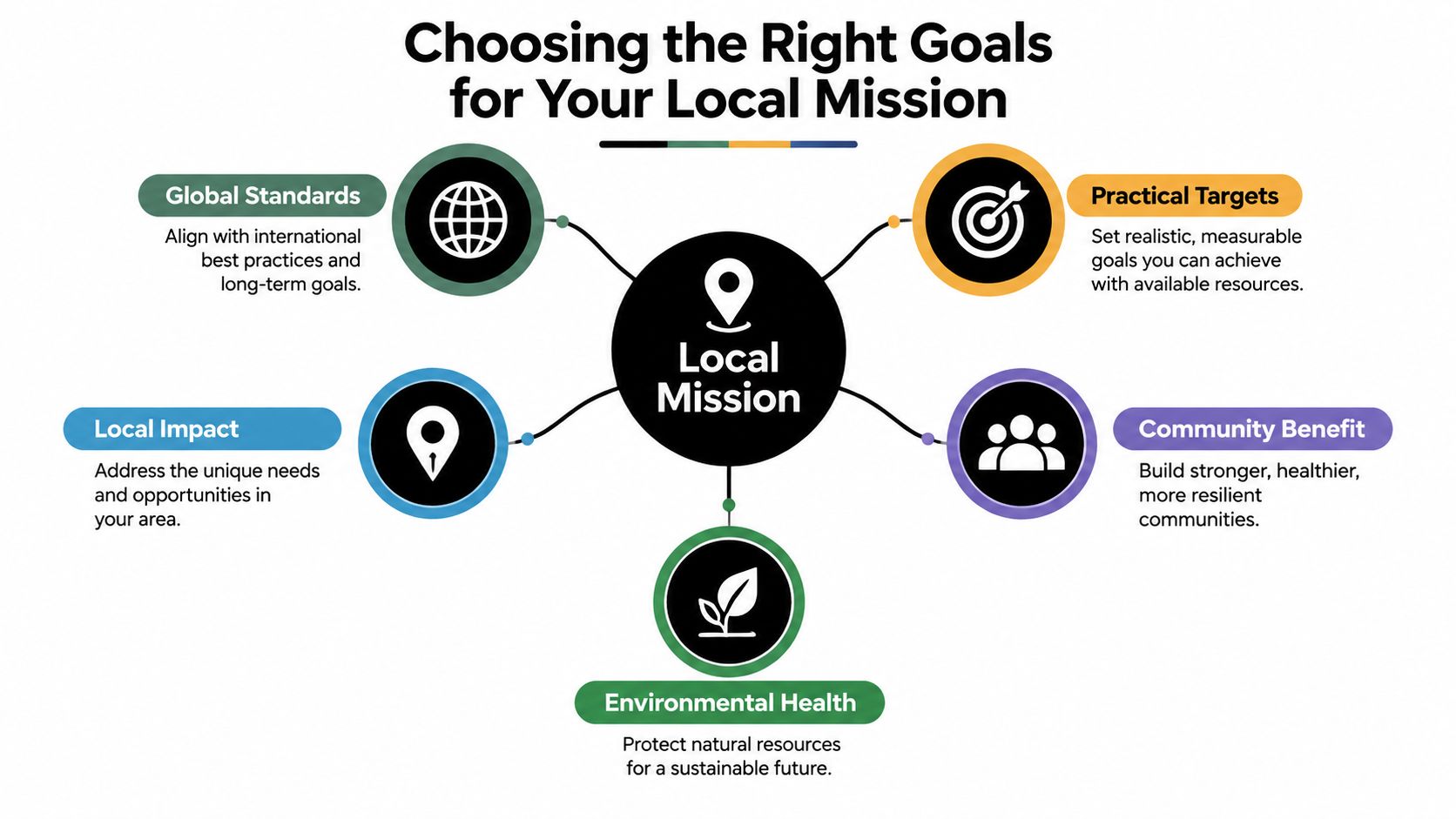
Start with your product, not a giant list of global problems. A coffee roaster might care about responsible sourcing and livelihoods. A wellness maker might focus on everyday wellbeing. A pet-product brand might care about animal health, ingredient transparency, or reducing unnecessary waste. Your mission should grow from what you already make and the people you already serve.
The UN Sustainable Development Goals give you a useful reference point. They create a common structure for defining outcomes, while the UNDP SDG Impact Standards organize impact work around four themes: strategy, management, transparency and accountability, and governance. That structure is practical because it connects measurement to decisions instead of treating it as a reporting exercise. Read the UNDP explanation of the SDG Impact Standards for the full framework.
Use a narrow goal filter
Choose one primary goal and, at most, one supporting goal. Then answer four questions:
- What do we make better? Name the change in customer or community language.
- Who experiences it? Identify the buyer, worker, supplier, neighborhood, or group affected.
- What do we control? Separate your product's direct contribution from outside influences.
- What would convince a skeptical customer? Pick evidence that demonstrates the change, not just your effort.
For example, “support local wellness” is too broad. “Help customers create a calmer evening shower routine through simple, clearly described ingredients” is specific enough to guide measurement. You might track whether buyers report using the product as part of that routine, then collect short comments about what changed.
Keep the goal visible in your weekly operations. A simple goal thermometer for tracking progress can help you see whether the mission is moving without adding a complicated dashboard. If you're building your direct sales process, your Loyaltie selling resources can sit alongside the same operating checklist.
Define success before collecting data
Write one sentence that describes success, one sentence that names the evidence, and one sentence that states what you won't claim. That last line is important. It keeps your marketing accurate when a positive customer story tempts you to overreach.
A strong local mission doesn't try to solve everything. It gives your product a sharper standard for quality, helps your team make better choices, and gives customers a reason to buy directly from the maker because they can understand the difference.
Building a Lightweight Data Collection Habit
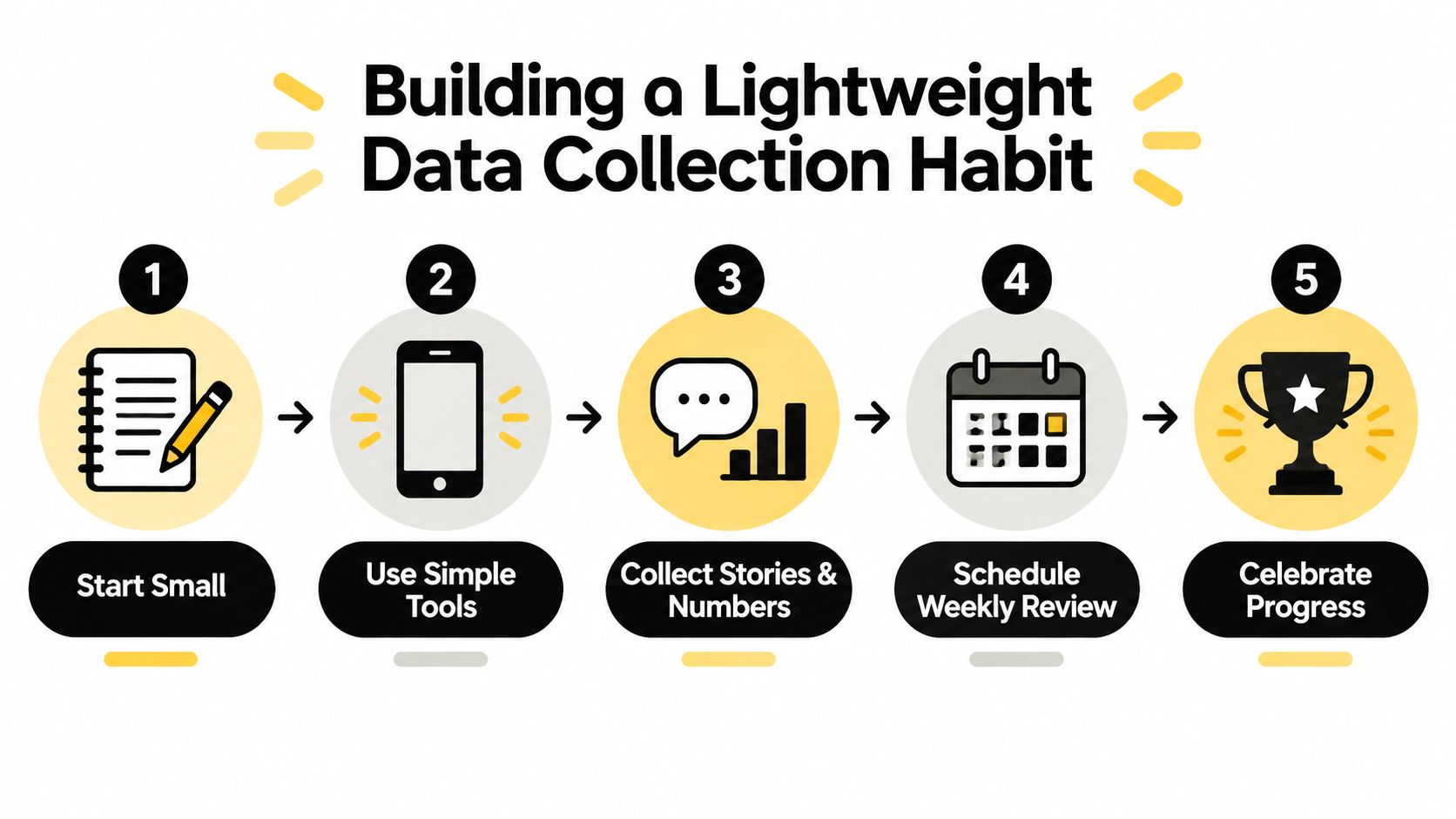
Data collection becomes painful when founders wait until the end to decide what matters. Set the baseline first, then use the same questions and definitions as the work develops. European social-economy guidance recommends collecting baseline information before launch, tracking progress during implementation, and repeating the same measures at follow-up with linked participant records. That approach reduces attribution error and is stronger than counting activities alone, as explained in this guidance on measuring social impact.
For an independent brand, a baseline can be simple. Before introducing a new product or initiative, ask customers what they currently use, how often they use it, and what problem they're trying to solve. Save the responses in the same customer record or spreadsheet. Later, ask the same questions rather than inventing a new survey every time.
Count outputs, then look for outcomes
Outputs tell you what happened inside the business. Outcomes tell you what changed for people or places.
| Output | Outcome |
|---|---|
| Orders shipped | Customers report changing part of their routine |
| Product units sold | Buyers replace an alternative with your product |
| Community event hosted | Participants gain useful access, knowledge, or support |
| Supplier relationship started | A sourcing practice changes in a way you can document |
You need outputs for operational control, but they shouldn't carry the whole impact story. A box of eco-conscious soap sold is not proof that a customer changed their habits. A customer response describing the switch is more relevant, especially when paired with a baseline question.
Use the tools already in your business. A post-purchase email can ask one outcome question. A reorder message can ask whether the product is still serving the original need. A customer-service tag can record recurring themes. A simple notepad, such as this weekly habit tracker, can help you make the review habit visible if a spreadsheet keeps getting ignored.
The video below offers another practical way to think about building a repeatable habit.
Make the burden match the decision
Only collect information you'll use. If a question won't change your sourcing, product design, customer education, or community work, remove it. Combine a small number of quantitative signals with qualitative evidence, such as customer comments, supplier feedback, and short interviews.
Review the information on a regular schedule. Look for repeated patterns, not isolated praise. A single message can inspire you, but a consistent response across customers gives you a stronger basis for a public claim.
Making Honest Claims Without Overcomplicating the Math
The hardest measurement question is simple: what changed because of your product, and what would have happened anyway? Attribution remains one of the least-served areas of social impact measurement, and many organizations still lack clear counterfactual or additionality methods, according to the JFI and IFSWF report on social impact integration.
That doesn't mean you need advanced statistics. It means you need to describe your contribution accurately.
Consider eucalyptus shower steamers. You can measure whether customers say the product helps them create a more enjoyable shower routine, how often they use it, and whether they reorder for that reason. You can't jump from those responses to a claim that the product cured allergies or produced a clinical health result.
Use a contribution statement
Write claims in three layers:
- What you did: You made and sold the product, changed an ingredient, partnered with a local supplier, or created access to a useful good.
- What customers reported: Buyers described a change in routine, confidence, convenience, or product choice.
- What you can reasonably claim: Your product contributed to that reported change.
That wording is stronger than pretending you caused every positive result. It also leaves room for other influences, including household habits, seasons, income, and competing products.
A useful evidence record includes the customer's starting point, the product they used, the change they described, and the date of the follow-up. Keep identifying information private and ask permission before publishing a story. If a community partner or supplier reviews your summary, note that plainly.
Don't turn easy metrics into fake proof
Likes, impressions, and units sold can show attention or demand. They don't automatically show social impact. The same warning applies to a polished score that combines unrelated activities into one impressive-looking number.
The OECD describes a progression from identifying potential impacts and counting beneficiaries to standardized metrics, evaluations, and monetary valuation. Choose the simplest method that answers your decision. SROI or other monetary approaches can be useful in the right setting, but they require baselines, verification, and explicit attribution rules. For most independent makers, a clear outcome log and transparent customer feedback are more credible than invented precision.
A modest claim with visible evidence will outlast a grand claim you can't defend.
Sharing Your Story to Build Deeper Customer Loyalty
Your impact story belongs where customers make decisions. Put the clearest version on the product page, then adapt it for post-purchase emails, regular delivery messages, packaging inserts, and social posts. Don't bury the evidence in a separate report that nobody reads.
Lead with the product benefit. A customer wants to know why the soap feels good on skin, why the coffee tastes better, or why the supplement fits their routine. Once that value is clear, show the care behind it and the outcome customers have reported.
A product page for Cottonwood Soap Company's Handmade Lavender Soap Bar can describe the 4.5 oz bar, its rice bran and sweet almond oils, and its calming shower use. If customers consistently report using it as part of a slower evening routine, share that as a measured customer outcome. Keep the language specific and avoid turning a personal routine into a medical promise.
Build a three-part story
A reliable format is:
- The product choice: Explain what you make and the quality decision behind it.
- The human result: Describe the change customers or partners report.
- The evidence and limit: Show how you track it and state what the data doesn't prove.
For example: “We make this bar with rice bran oil and sweet almond oil for a gentle-feeling cleanse. Customers tell us it has become part of a calmer evening shower routine, so we ask about that experience after purchase and at reorder. Those responses show a contribution to daily routines, not a medical outcome.”
This style gives customers a reason to trust you because it doesn't hide the boundary of the evidence. It also makes improvement easier. If buyers say the instructions are confusing or the packaging creates waste, you've found a product decision worth revisiting.
Give the story a place to grow
Independent brands often have a richer customer relationship than mass-produced alternatives because buyers can connect with a real maker and buy with no middleman. That relationship gives you more opportunities to ask useful questions, listen to feedback, and show changes over time.
A marketplace can extend that discovery without stripping away the maker's voice. Learn more about Loyaltie, a marketplace where people discover and buy directly from independent brands in the US, then decide whether its approach fits your route to local customers.
Keep the story current. Add a short update when you change an ingredient, improve packaging, deepen a local relationship, or learn that an intended outcome isn't happening yet. Customers don't need perfection. They need proof that you pay attention.
Avoiding Common Pitfalls and Keeping the Process Simple
Most independent brands don't fail at impact measurement because they lack good intentions. They fail because the system is too broad, too time-consuming, or too eager to produce impressive claims.
The first fix is to reduce the scope. Pick one mission area, one primary outcome, and a small set of questions. Record the baseline before a change, check progress during the work, and revisit the same questions later. Store customer comments with enough context that you can tell what changed and when.
Use this founder-friendly checklist
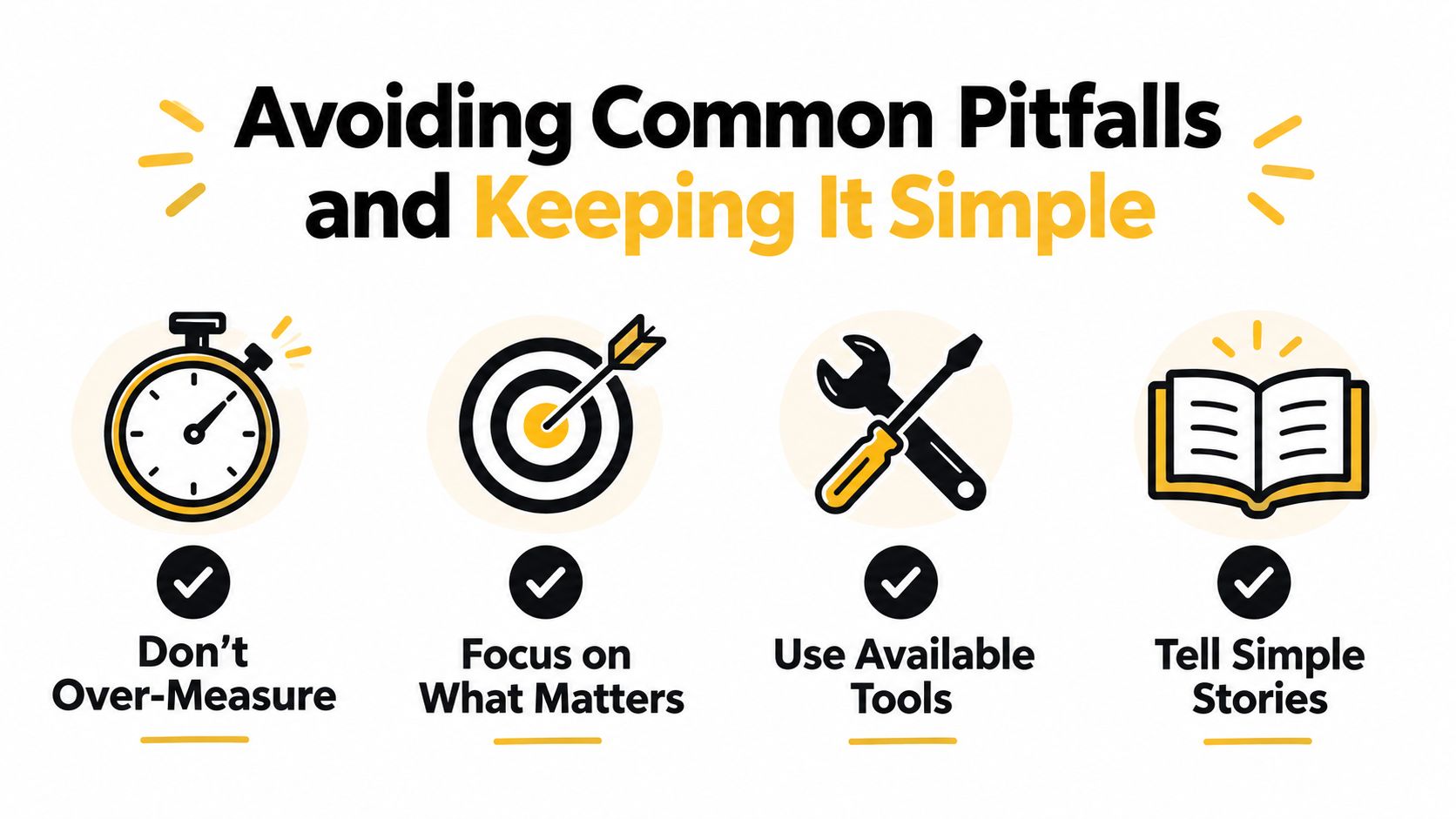
- Don't over-measure: Delete indicators that don't affect a product or operating decision.
- Focus on what matters: Track outcomes tied directly to your mission and customer promise.
- Use available tools: Start with order records, email forms, customer-service notes, and a basic spreadsheet.
- Tell simple stories: Pair one clear result with the evidence behind it and the limit of the claim.
- Review consistently: Choose a recurring review time so measurement becomes part of operations.
- Look for unintended effects: Ask what improved, what didn't, and whether the work created any negative result.
- Allow time for change: Deep community outcomes may take years to appear. Recent research warns that one- to two-year evaluation windows can be too short to capture deep social change, making early impact look smaller than it is. See the research on long-term impact measurement.
Your system should help you make better products, not imitate a corporate reporting department. Honest, consistent notes will give you more useful insight than a complicated framework you abandon after a busy season.
Loyaltie helps you discover and buy directly from independent brands and local makers across the US, including everyday products for coffee, wellness, skincare, food, supplements, and pets. Visit Loyaltie to find products with a real maker behind them and connect your purchases to the quality and community outcomes you care about.