
You land a great first order from a local maker, thank-you email goes out, and then the buyer disappears. The coffee was good, the skincare worked, or the pet treats arrived on time, but nothing gave that customer a clear reason to come back.
That's the loyalty problem for independent brands. You don't need a giant app, endless discount codes, or a complicated points economy. You need a product people want again, a buying experience that removes friction, and enough recognition to make the next purchase feel personal.
The economics are straightforward. Retaining customers costs far less than replacing them, and Bain's widely cited finding says a 5% improvement in retention can lift profits by 25% to 95% (Rivo's customer retention benchmarks). Loyalty is a margin lever hiding inside the post-purchase experience.
Table of Contents
- Why Your Buyers Disappear After One Order
- What Customer Loyalty Actually Means in 2026
- Make the first follow-up feel human
- Remove reorder friction
- Capture identity with permission
- Create discovery beyond paid ads
Why Your Buyers Disappear After One Order
A small-batch coffee roaster can dial in an excellent roast, pack the first order carefully, and deliver it locally. The customer finishes the bag, forgets the maker, and buys from whichever coffee brand appears next in their feed. A good product can still lose to a brand that stays useful and recognizable after checkout.
The leak usually sits in the weeks after delivery. No product-specific follow-up, no reminder tied to a realistic restock window, no saved reorder path, and no personal reason to remember the maker. Acquisition gets attention, while the moment that could create a buying habit gets treated as admin.
Replacing a customer can cost 5 to 25 times more than retaining one, while the estimated probability of selling to an existing customer is 60% to 70%, compared with 5% to 20% for a new prospect (Rivo's retention statistics). Category, margin, and fulfillment costs change the exact economics. The operating lesson stays the same: a repeat order can materially improve the contribution margin of a customer relationship.
For a local maker or DTC seller, loyalty starts with recognition. Remember the product they bought, help them use it well, and give them a reason to return before another brand fills the habit. Community trust often beats a points program because customers can see the person, taste the consistency, and feel remembered.
Practical rule: Don't launch rewards until you can explain why a customer should reorder, when they will need the product again, and how they can do it in seconds.
Send a useful usage tip, ask for feedback while the experience is fresh, and make the next order easy. If your follow-up needs better customer language, use stronger testimonials with Bragly by asking questions that reveal the result buyers value.
Nail the second order before you spend a dollar on rewards.
What Customer Loyalty Actually Means in 2026
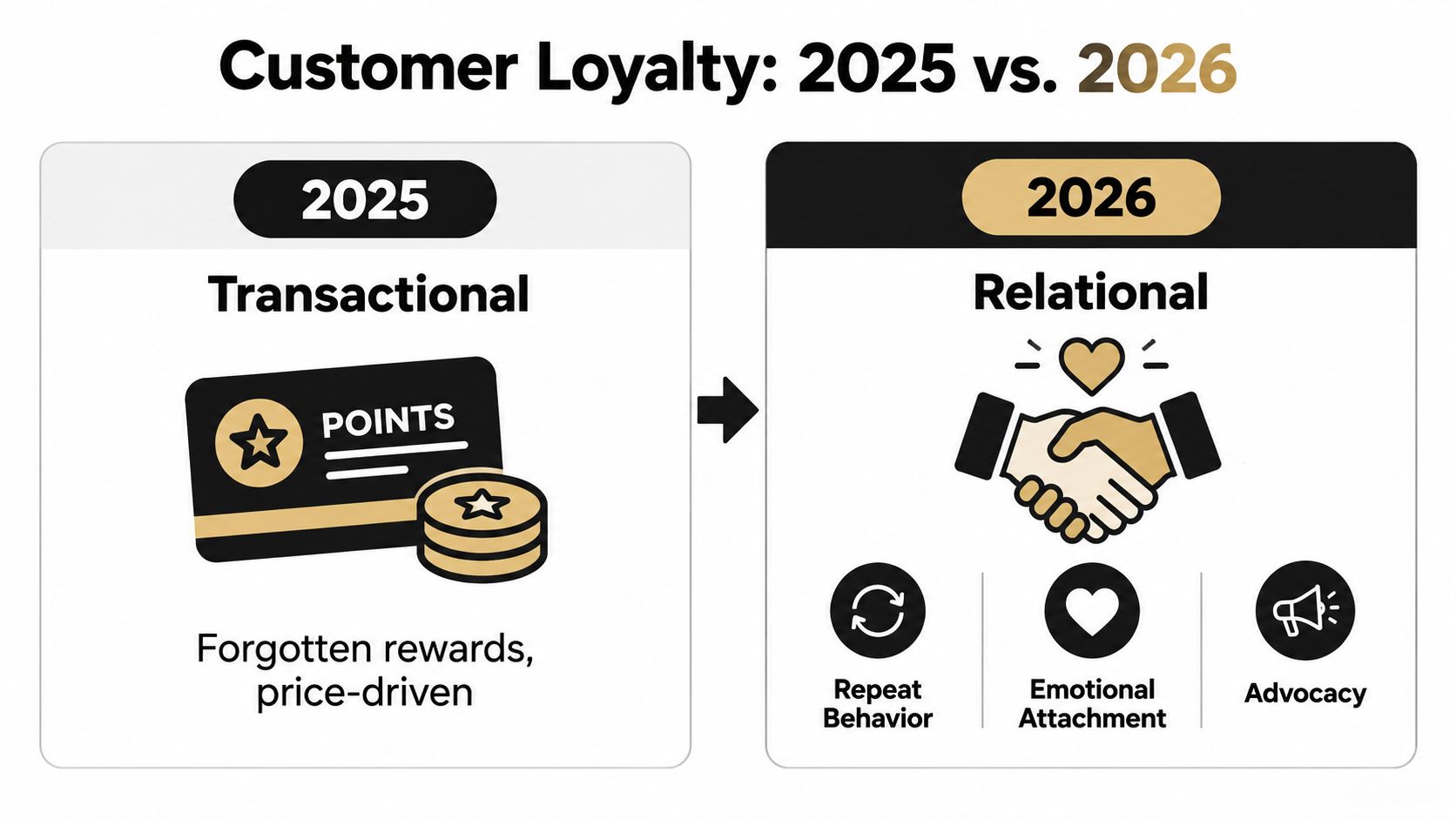
A customer who buys once has shown interest. A customer who returns, recommends you, and stays after a mistake has built a relationship. For an independent brand, customer loyalty combines repeat behavior, emotional attachment, and advocacy when something goes wrong.
Repeat behavior shows up in the reorder: the same coffee, face oil, supplements, or dog treats. Emotional attachment explains why the buyer chooses your product when alternatives look similar. Advocacy appears when they share your brand, defend it, or give you another chance after a poor experience.
The recognition gap separates functional satisfaction from real attachment. In 2026 research, 90% of consumers said their favorite brand delivers convenience, value, and ease, but only 61% said that brand makes them feel known, a 29-point recognition gap (Answerlab's consumer loyalty research). Separate global loyalty research reported that 82.6% of marketers believed customers feel valued, while only 56.2% of customers agreed.
Large retailers can fund mass personalization, broad product ranges, and app ecosystems. An independent maker should not try to beat Amazon on scale. Win through details larger companies struggle to make personal: remember a preference, answer with care, explain the product with care, and let customers see the person behind the decision.
That relational advantage grows through direct customer contact and relevant discovery, including Loyaltie's marketplace for independent US brands. A marketplace can help people find your products, but the loyalty is earned after the order through recognition, consistency, and trust.
Points can support a repeat purchase when they give customers a clear reason to return. They cannot repair an unremarkable product or impersonal communication. Build the habit loop instead: use the product, receive a useful reminder, feel recognized, reorder easily, and recommend the brand to someone who values the same quality.
The Foundation Every Local Brand Needs First
A loyalty program can't compensate for a broken customer journey. Before you add points, tiers, or rewards, make sure the four basics work.
Make the first follow-up feel human
Send something connected to the actual order. A coffee roaster can share a brewing adjustment for that roast. A skincare maker can explain how to introduce the product gradually. A wellness brand can send a simple usage reminder. A handwritten card works when it's sincere and operationally realistic, not when it becomes a burden you can't maintain.
The message should answer, “How do I get a better result from what I just bought?” That creates value before you ask for another sale.
Remove reorder friction
Give customers a clear path back to the same product. Use a one-click reorder where your commerce platform allows it, save preferences, and tell buyers when they'll likely need a restock. If you offer regular delivery, make pausing, changing, and skipping straightforward.
A customer shouldn't have to search their inbox, remember the exact product name, and rebuild an order from scratch. Every extra step creates an opportunity to postpone the purchase.
Capture identity with permission
Email is the minimum. SMS can be useful for restock reminders and time-sensitive updates, but collect it with explicit consent and respect the channel. Don't turn a helpful reminder into a noisy broadcast list.
Keep the data useful. Record what the customer bought, when they bought it, and any preference they intentionally shared. You don't need a sprawling customer profile to make the next message more relevant.
Create discovery beyond paid ads
Paid acquisition can introduce your brand, but it shouldn't be your only route to new buyers. Local customers actively look for better alternatives in coffee, wellness, beauty, food, supplements, and pet products. A marketplace can put your products in front of people already browsing for independent sellers.
Sellers can explore Loyaltie's resources as one discovery option, alongside local events, referrals, search content, and creator partnerships. The mistake is jumping straight into a points program while these foundations remain weak. Fix the path to the second order first.
Five Retention Levers That Work for Independent Brands
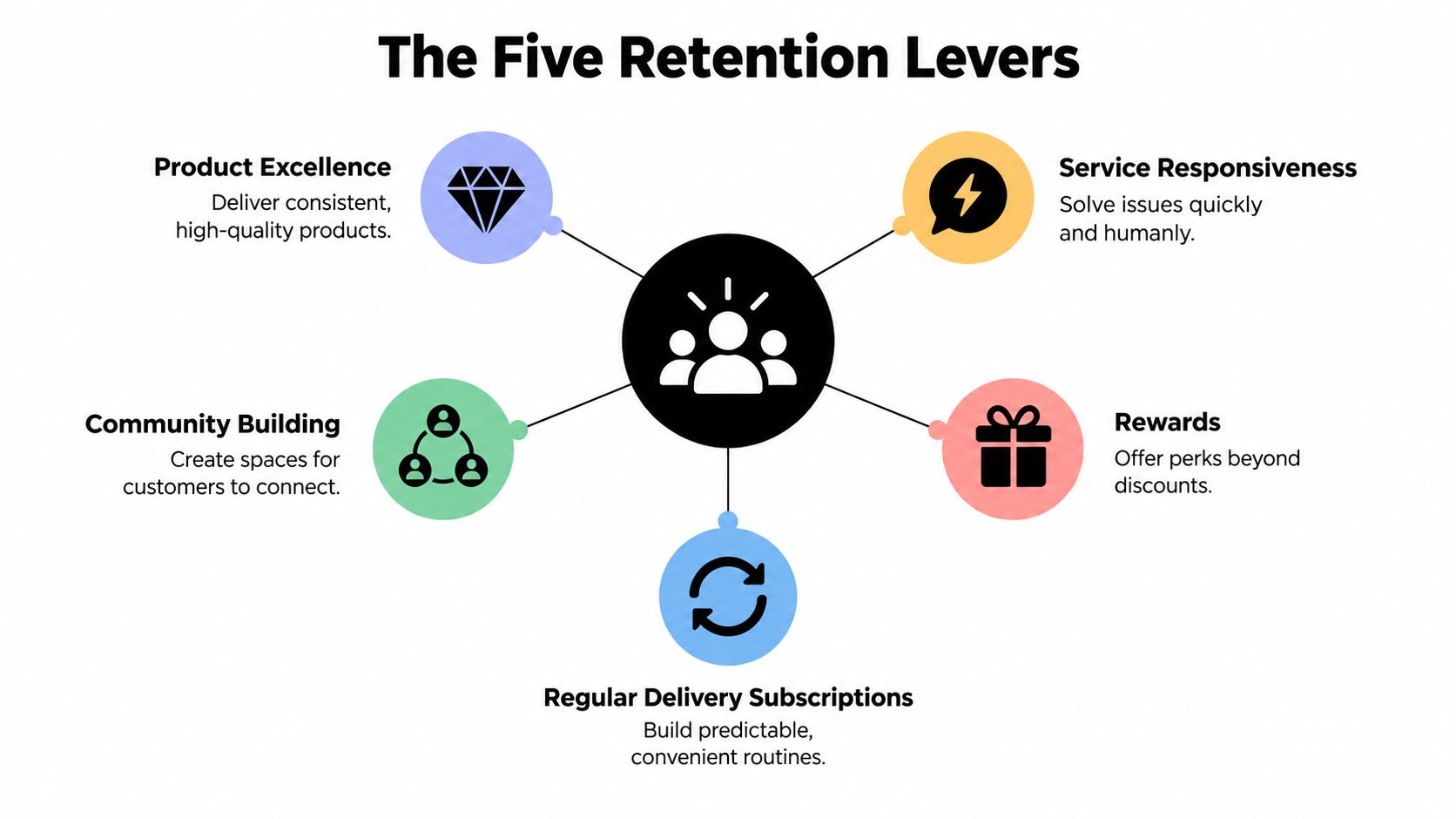
You have five practical levers. Don't pull all of them at once. Pick two that fit your category, margin, and relationship with the customer.
Product excellence
This is the strongest lever and the least glamorous to discuss. Make the coffee consistent, keep the skincare texture and performance reliable, and protect the product from disappointing substitutions.
A coffee roaster can include a brew guide matched to each roast. That costs little once the process exists, but it helps the buyer get the result they expected. Product excellence takes ongoing production discipline, quality checks, and honest inventory decisions. No points system can compensate for a product customers don't want to use again.
Service responsiveness
Fast, human problem-solving protects the relationship when fulfillment or product issues occur. A food producer can replace a damaged shipment and explain what happened without forcing the customer through a form maze.
The cost is mostly founder time and clear response rules. Set a service standard you can maintain, write reusable answers for common issues, and give yourself permission to make a fair correction without debating every request.
Community building
Community works when customers have a reason to participate beyond receiving promotions. A skincare maker might host a short routine clinic, while a wellness brand can create a practical space for customers to compare ways to use a product.
This lever requires consistent attention, not expensive production. If you can't moderate a community or publish useful material regularly, keep it smaller. A focused email series or local event can create more trust than an abandoned group.
Rewards
Rewards should reinforce behavior you already want, such as a second purchase, a referral, a review, or trying a complementary product. A pet product seller could offer a useful perk after repeat orders rather than discounting every first purchase.
Keep the structure easy to understand. If you're building the mechanics, this guide to boost retention with loyalty rewards offers a useful reference point. Rewards add software, explanation, and support work, so don't launch them until the underlying product and service are dependable.
Regular delivery
Predictable delivery fits replenishment categories such as coffee, food, supplements, and pet products. A buyer gets convenience, and you get a clearer reorder rhythm. Use “buy on a plan” or “regular delivery,” but make the customer's control obvious.
A useful starting point is a reorder option for one hero product, not a catalog-wide rollout. Test timing, pause behavior, and cancellation reasons before expanding. For a concrete coffee example, look at Guatemalan coffee with monthly delivery options.
Choose based on the job your brand already does. Product-led categories need consistency, replenishment categories benefit from convenience, and relationship-driven categories can win through service or community. Start with two levers and make them visible.
Measuring Loyalty Without Enterprise Software
You don't need a customer data platform to know whether buyers are coming back. Export orders from Shopify, Square, or WooCommerce, then build one spreadsheet that connects customer identity to purchase behavior.
Track four core measures:
- Repeat purchase rate: Customers with more than one order divided by total customers in the cohort.
- Purchase frequency: Total orders divided by total customers during the chosen period.
- Customer lifetime value: Revenue attributed to a customer over the period, adjusted for your preferred margin view.
- Active member share: Members who purchased or redeemed during the period divided by enrolled members.
Use a weekly sheet with customer email, first order date, latest order date, order count, total revenue, product category, referral source, and loyalty activity. Add cohort month and a simple status such as first-time, repeat, lapsed, or active regular. The CRR formula, [(E-N)/S] × 100, uses starting customers, ending customers, and new customers, and helps compare cohorts over time (CustomerGauge's loyalty measurement method).
| Metric | Calculation Source | Formula Example | Year-One Benchmark |
|---|---|---|---|
| Repeat purchase rate | Order export | Repeat customers ÷ total customers | Set a baseline, then improve it consistently |
| Purchase frequency | Order export | Total orders ÷ total customers | Compare by product category |
| Customer lifetime value | Customer revenue export | Total customer revenue ÷ customers | Track upward movement by cohort |
| Active member share | Loyalty export | Active members ÷ enrolled members | Prioritize activity over sign-ups |
Watch leading signals such as review velocity, email engagement, and referrals for early movement. Watch lifetime value and churn for confirmation. If you only have time for one weekly dashboard, choose repeat purchase rate by cohort, because it tells you whether the experience changed behavior rather than merely generating clicks.
Don't copy Amazon-scale targets. Set your year-one benchmark from your current baseline, category replenishment cycle, and gross margin. The right target is a measurable improvement you can explain.
Fixing the Recognition Gap in Your Program
A customer can place a second order and still feel like a stranger. Points sit in an account, the balance stays hidden, messages arrive too late, and expired value becomes a quiet reason to stop returning. In the 2026 global report cited earlier, 27% of points went unspent and 11% expired. For an independent brand, that recognition gap matters more than building a complicated points system.
Fix the customer-facing experience in one week:
- Show the balance everywhere: Add the reward balance to receipts, order confirmations, account pages, and loyalty emails. Customers should not have to search for what they earned.
- Trigger surprise rewards: Recognize a second order, a useful review, or a referral instead of rewarding spend alone. These actions strengthen the habit loop and support community trust.
- Offer early access: Let repeat buyers see a new coffee, seasonal food product, or skincare release before the general list. Access signals that you remember them.
- Personalize the message: Use purchase history to recommend the next relevant item. A product-specific suggestion beats the same promotion sent to everyone.
Points that expire silently don't create loyalty. They create the feeling that the brand designed the system for itself.
Tiered programs waste time when communication stops after setup. Customers need to know what each tier means, how they reach it, and why the benefit matters. A simple reward delivered at the right moment will outperform a structure customers cannot remember.
Recognition can be physical, too. The Gold Foil Greeting Card, Hey Sis Message, Blank Inside, A2 4.25x5.5, Envelope Included | Chika Paper Studio by Loyaltie features a gold-foil message, a blank interior for personal words, and an A2 format with an envelope. The card is only the vehicle. A handwritten note can make appreciation feel personal when a generic points notification feels cold.

Your 30-60-90 Day Loyalty Plan
A solo founder can start next Monday. Keep the first version deliberately narrow and assign every task a deliverable.
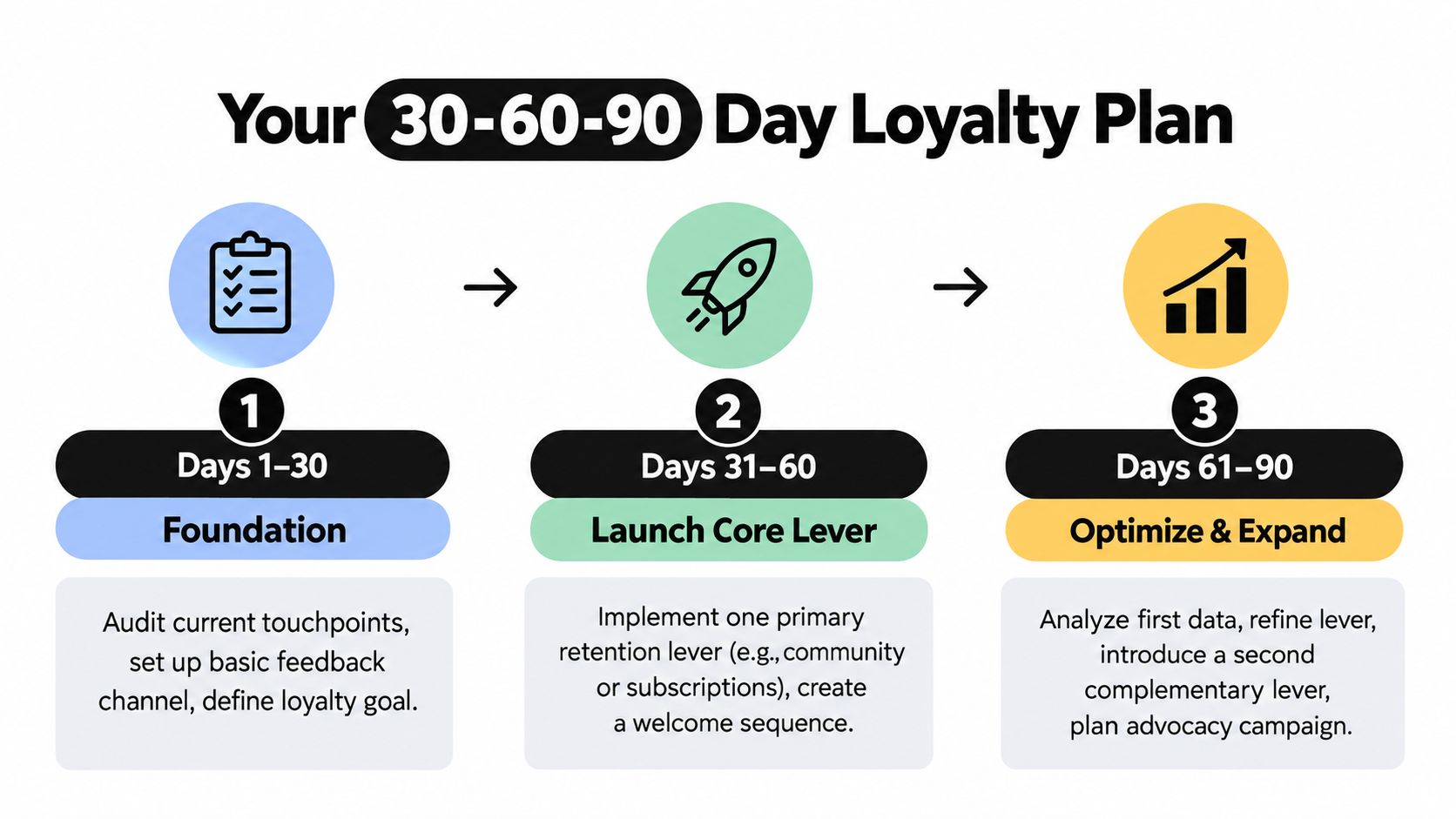
Days 1–30 build the foundation
- Tag repeat buyers: Export your customer list and label customers by order count, latest order date, and primary product.
- Map reorder friction: Place a test order, read the confirmation sequence, and list every step required to buy the same product again.
- Choose one primary lever: Pick product education, service, community, rewards, or regular delivery based on category fit and margin.
- Write the follow-up: Create one product-specific post-purchase email and schedule it for the realistic usage or restock moment.
- Publish the founder story: Post why you're improving the repeat experience and what customers can expect. Deliver this before day thirty.
Days 31–60 launch one core lever
Configure a simple points structure if rewards fit your business, publish an early-access list if recognition is stronger, or launch regular delivery for one replenishable product. Don't build a full ecosystem before you've observed customer behavior.
Send a first surprise reward to your top ten repeat buyers. Make the gesture relevant and record who received it, why they received it, and whether they purchased or referred afterward. Keep the welcome sequence short, useful, and tied to the product.
Days 61–90 measure and adjust
Calculate repeat purchase rate, average order frequency, and referral-driven revenue from your exports. Compare the new cohort with your baseline, then keep, change, or remove the lever based on what moved behavior.
Write next week's milestones on your calendar today: complete the reorder audit, send the first follow-up, choose the lever, and tag your repeat buyers. Then create your account through Loyaltie, where shoppers can discover and buy directly from independent brands in the US, and use that discovery channel as part of your repeat-purchase plan.