

For washed U.S. store-bought eggs, the safe limit is 2 hours unrefrigerated, or just 1 hour when the temperature is above 90°F (32°C). Unwashed eggs with their natural cuticle intact follow different rules, so farm, backyard, and imported eggs can't always be judged by the same clock.
You come home from the grocery store, set the carton on the counter, and start putting away the milk, vegetables, and bread. Then dinner happens, a phone call interrupts, or you begin baking and realize the eggs have been sitting beside the mixing bowl. The same thing happens after brunch, during a picnic, or when a delivery box arrives before you get home.
The answer is usually straightforward for refrigerated eggs sold in the United States. The clock starts when the eggs leave cold storage, and the safe window is short because washed commercial eggs are meant to remain refrigerated. But a carton from a local farm stand, a backyard flock, or a market abroad may have been handled under a different production system.
By the end, you'll know how to judge store-bought washed eggs, unwashed farm eggs, chilled eggs taken out for baking, cooked eggs, and eggs exposed to heat. You'll also have a practical way to decide whether to refrigerate, cook promptly, or discard them without relying on guesswork. If eggs are part of tonight's meal, or you're reaching for them to make grain-free protein burger buns, a calm time-and-temperature check is more useful than panic.
Table of Contents
- Introduction You Left Eggs Out Now What
- How Long Eggs Can Stay Out Safely
- Why Washed and Unwashed Eggs Follow Different Rules
- Everyday situations that change the decision
Introduction You Left Eggs Out Now What
Start with the carton, not the smell. If these are refrigerated U.S. supermarket eggs, treat them as refrigerated eggs even if the kitchen feels cool. You need to estimate how long they were out and whether the room was hotter than the normal indoor range.
A brief interruption, such as taking eggs out while you measure flour, usually calls for putting them back in the refrigerator or using them soon. A carton forgotten on the counter until the next morning is a different situation. Chilling it again doesn't erase the time it spent warm.
The confusing part is that eggs can look identical while coming from different systems. U.S. commercial eggs are generally washed, which removes the shell's natural cuticle, then kept in a controlled cold chain. Many European-style systems and some local producers sell eggs unwashed, leaving that protective coating in place. Those eggs may be kept at cool room temperature for weeks under suitable conditions, but that doesn't make every farm egg automatically safe on the counter.
The useful question isn't only “How long were the eggs out?” It's also “Were they washed, were they already refrigerated, and how warm did they get?”
This distinction matters for travelers, cross-border shoppers, people who buy directly from local makers, and anyone who keeps backyard hens. A farm carton may need different handling from a U.S. store carton, and the seller should be able to tell you whether the eggs were washed and how they were stored.
Don't use one universal rule for every egg. Identify the egg's origin and handling first, then apply the matching guidance.
How Long Eggs Can Stay Out Safely
For refrigerated eggs, use a simple clock:
- Start timing when the eggs leave cold storage.
- Use the 2-hour limit at room temperature.
- Use the 1-hour limit if the ambient temperature is above 90°F (32°C).
- Discard eggs that exceed the applicable limit.
The FDA gives the same two-hour rule for foods that require refrigeration, and Health Canada applies a two-hour maximum to eggs kept at room temperature. FDA consumer guidance on safe food storage explains why time matters: the range from 40°F to 140°F (4°C to 60°C) is the temperature zone where bacteria grow quickly.
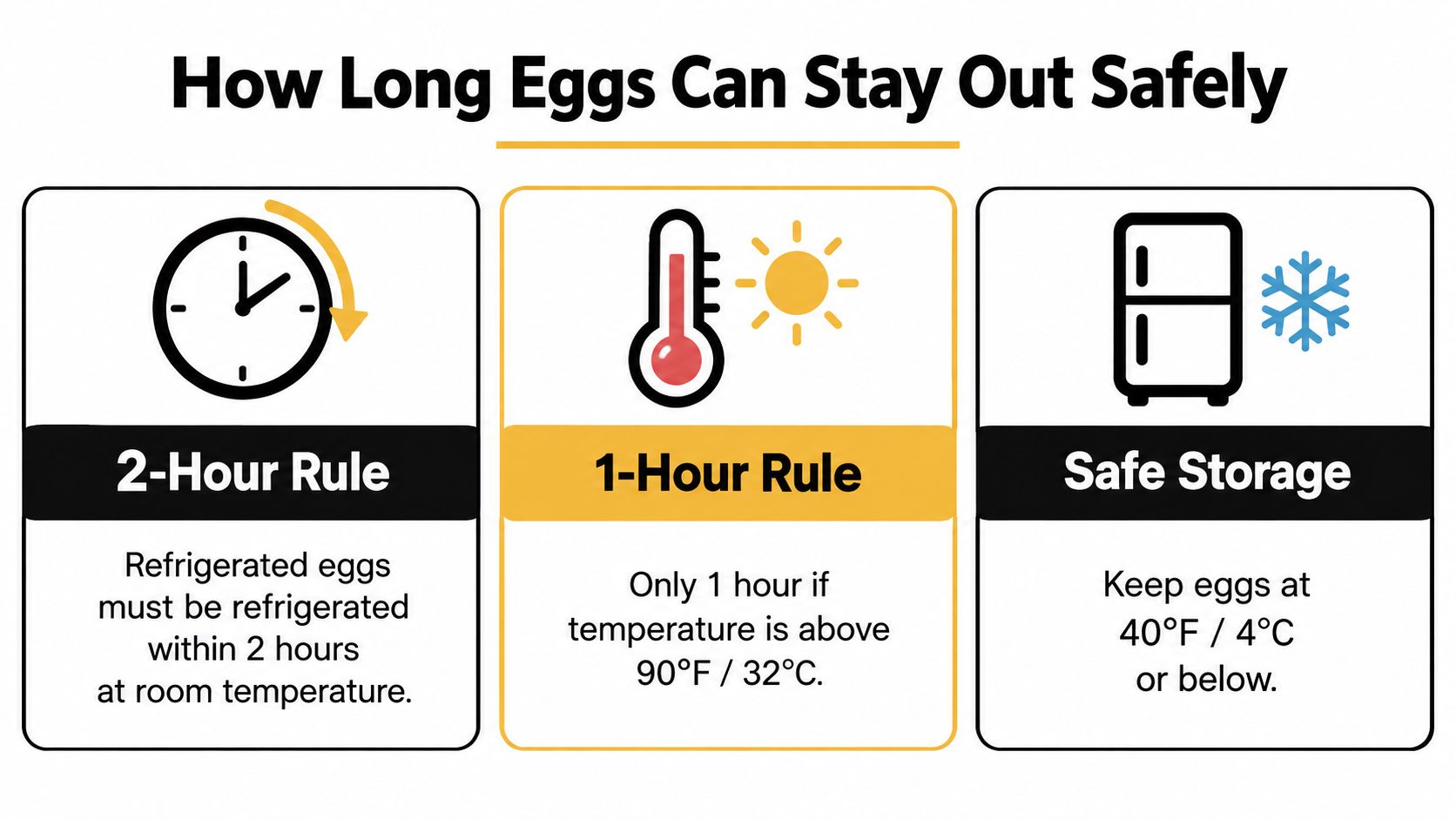
Think of the clock as a ticking timer that runs faster in heat. Two hours in a shaded, comfortable kitchen and one hour in a hot room aren't interchangeable safety decisions. If eggs sit in a sunny car, beside a warm oven, or outdoors on a hot day, use the shorter window rather than assuming the carton stayed cool.
For a broader explanation of why food safety guidance treats this range seriously, see the 40-140°F food safety rule. The important practical point is that returning eggs to the refrigerator doesn't reverse bacterial growth that may have occurred while they were warm.
Examples make the rule easier to use:
- Eggs taken out for a cake and returned promptly to the refrigerator are usually still within normal handling.
- Eggs left on the counter through an afternoon should be judged against the elapsed time, not their appearance.
- Eggs carried to an outdoor brunch on a hot day reach the shorter limit sooner.
- A carton found out overnight has passed the refrigerated-egg limit and should be discarded.
Cooked eggs don't get a separate exemption. Health Canada states that raw or cooked eggs shouldn't remain at room temperature beyond the same two-hour maximum, with heat requiring greater caution. Keep hard-boiled eggs and egg dishes chilled until serving.
Why Washed and Unwashed Eggs Follow Different Rules
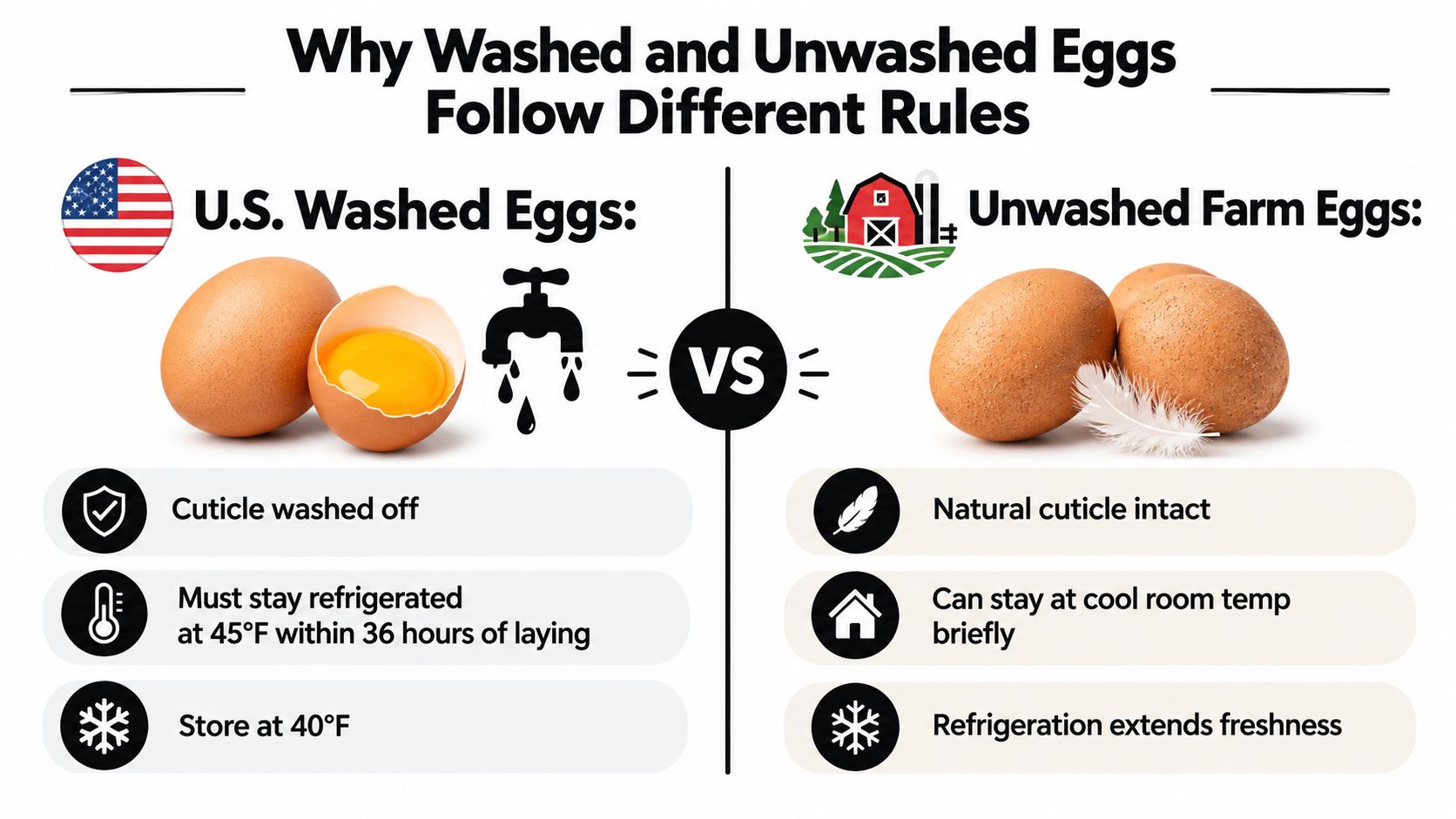
Washing changes the shell's surface. A freshly laid egg has a natural coating called the cuticle, sometimes called the bloom. It helps reduce moisture loss and slows the movement of microbes through the shell. When commercial washing removes that coating, refrigeration becomes an important part of the egg's protection.
In the United States, FDA rules require egg producers to keep eggs at 45°F (about 7°C) beginning 36 hours after laying, while USDA-linked guidance commonly recommends storage at 40°F (4.4°C) or below. You can review the production and storage distinction in the FDA's egg safety temperatures for food service and retail.
Unwashed eggs belong to a different handling system. Many European-style markets keep them at room temperature because the cuticle remains intact, and some guidance describes cool-room storage for about 3–4 weeks in suitable conditions. That practice shouldn't be transferred to washed U.S. supermarket eggs.
| Egg situation | What to check | Practical approach |
|---|---|---|
| U.S. supermarket carton | Usually washed and refrigerated | Keep refrigerated and use the refrigerated-egg time limit after removal |
| Farm or backyard eggs | Ask whether they were washed | Follow the producer's handling instructions |
| Eggs bought abroad | Check the local production system | Don't assume the U.S. rule or the local rule applies automatically |
| Any egg with a cracked shell | Shell protection is compromised | Discard rather than trying to clean or rescue it |
A local producer should tell you whether eggs were washed, whether they were chilled, and how they should be stored at home. If you buy directly from the maker, that handling information is often easier to clarify than it is with an anonymous carton.
The same attention to sourcing applies to other food choices. For example, Korean Samgyetang Ginseng Chicken Soup, Organic Pasture-Raised Chicken, Postpartum Recovery, Gluten-Free, 1 Meal is described as a warm, restorative soup made with organic, pasture-raised chicken, traditional ginseng, jujube dates, and herbs. Its product details don't change egg safety, but they illustrate why knowing how a food was made and handled helps you make better kitchen decisions.
What Makes Eggs Spoil Faster on the Counter
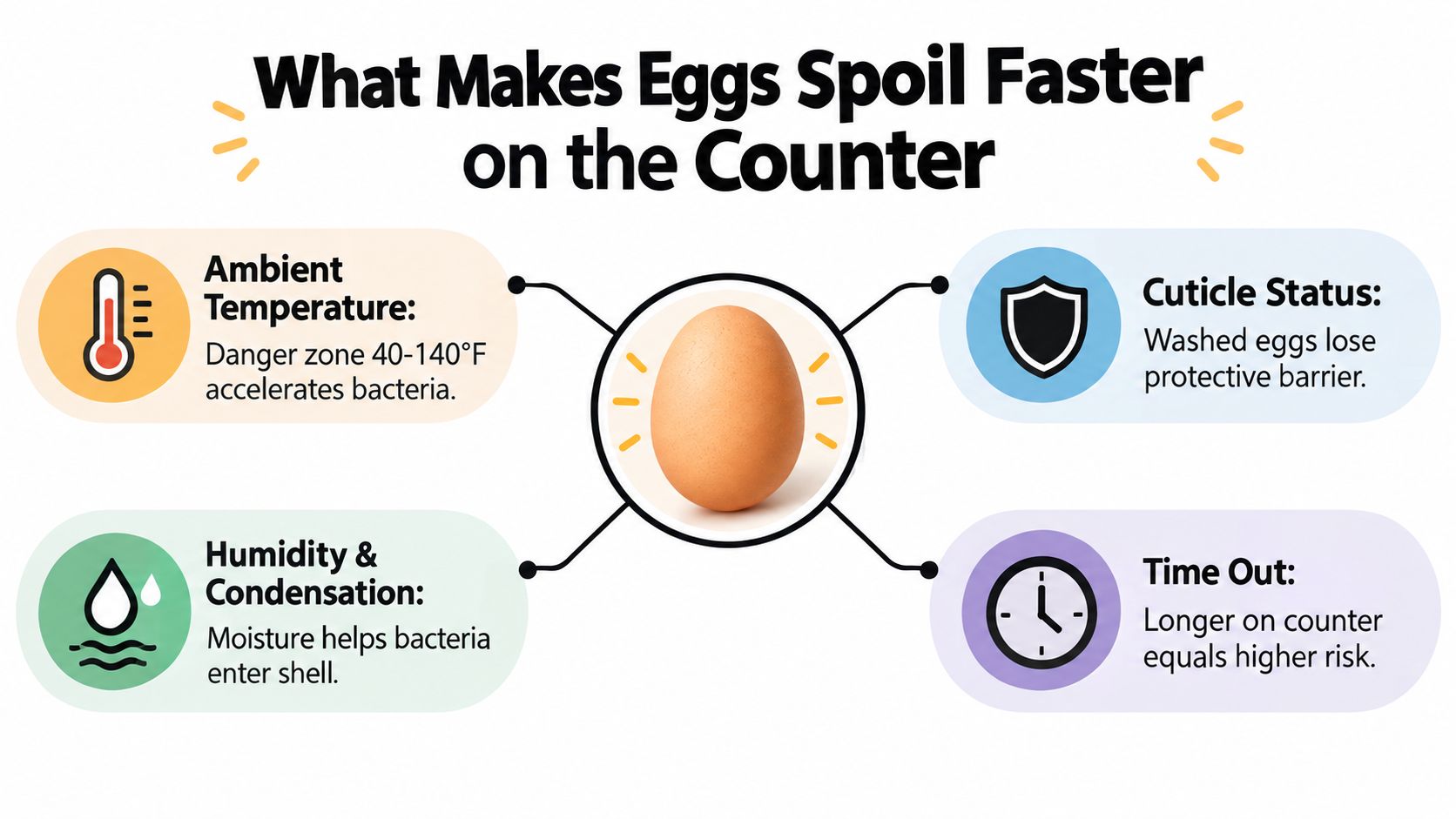
Temperature is only one part of the picture. The egg's shell condition, cuticle status, moisture, and history all affect how cautiously you should handle it.
Heat speeds the process. The FDA identifies 40°F to 140°F (4°C to 60°C) as the range where bacteria grow quickly. A carton in a cool kitchen isn't the same as a carton in a hot car or under direct sun, even if both began at the same refrigerator temperature.
Washing removes the natural barrier. Washed commercial eggs depend on refrigeration after processing. Unwashed eggs retain the cuticle, but that doesn't protect a cracked, dirty, or poorly handled shell.
Cracks create an opening. Don't use eggs with damaged shells. Dirt, liquid from a broken egg, or bacteria can reach the inside more easily when the shell is compromised.
Condensation adds moisture. Moving a cold egg into warm, humid air can create droplets on the shell. Moving it back into the refrigerator doesn't remove the exposure that already happened. Moisture can make it easier for bacteria on the outside to move through the shell.
Everyday situations that change the decision
Baking often involves a short period at room temperature, especially when you crack eggs one at a time and measure other ingredients. Picnics and outdoor markets are less forgiving because heat can build inside a bag or cooler. Delivery boxes also deserve attention. If chilled eggs arrive warm, wet, or with damaged shells, don't treat the refrigerator as a reset button.
A cold-to-warm-to-cold cycle matters because condensation and elapsed time both remain part of the egg's history.
The safest response to eggs that sat out too long is disposal, not rinsing, wiping, or rapid chilling. If you don't know when they left refrigeration, uncertainty itself is a reason to choose the safer option.
How to Tell If Eggs Are Still Good
Start by checking the shell. Cracks, leaks, unusual contamination, or contact with a broken egg are reasons to discard the egg. Don't wash a questionable shell and assume you've restored its safety. Washing can move bacteria through the porous shell.
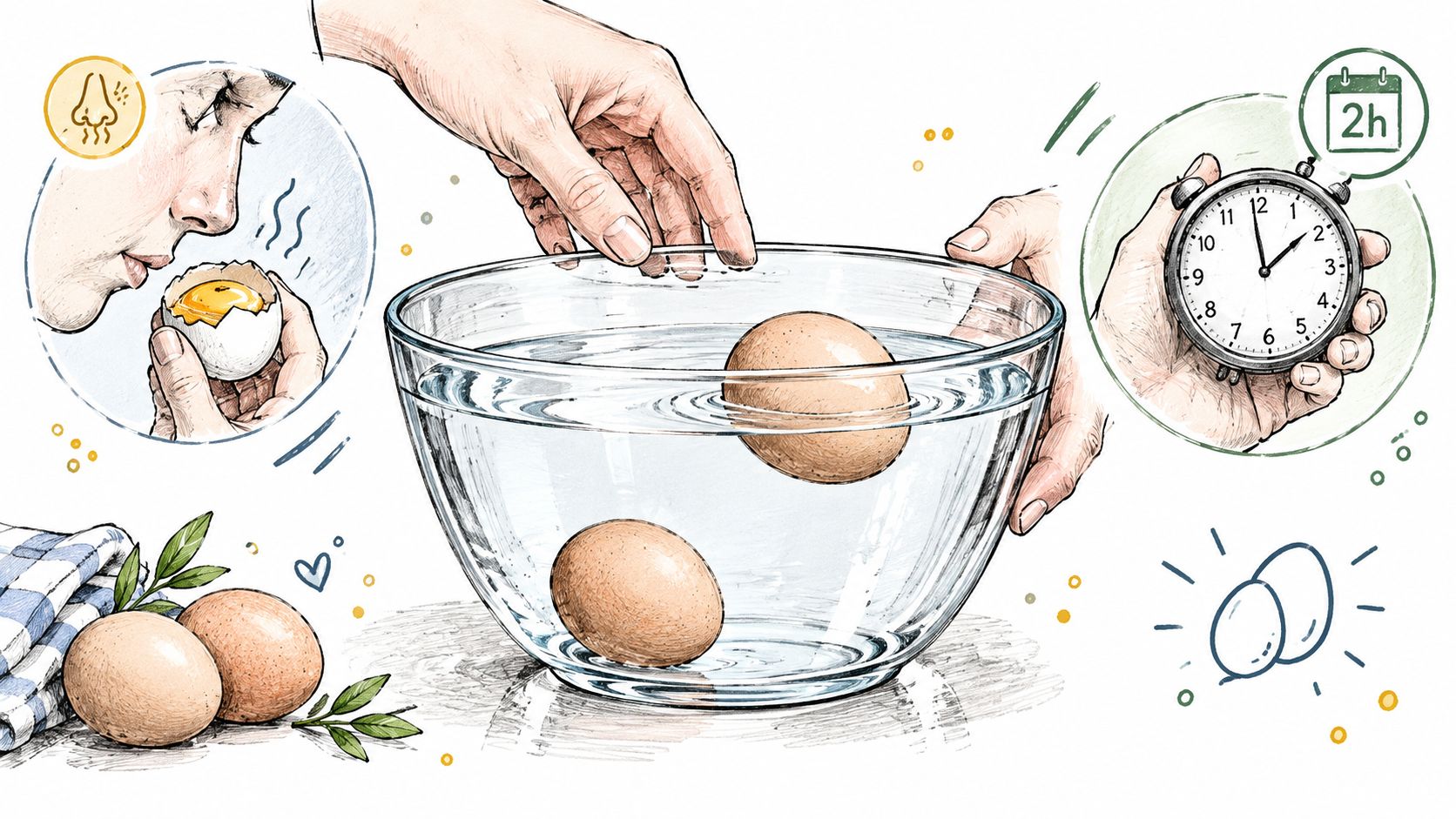
Crack an egg into a separate bowl rather than directly into your recipe. A strong sulfur smell, unusual discoloration, or an unmistakably abnormal texture means it belongs in the trash. A normal smell doesn't prove that an egg is safe, though, because harmful bacteria may not produce an obvious odor.
What the float test can and can't tell you
The float test can show that an egg is older because the air cell grows over time. It can't confirm that the egg is free from harmful bacteria. Use it as an age clue at most, never as permission to ignore the time, temperature, shell, or handling history.
A quick chill has the same limitation. Refrigeration slows further growth, but it doesn't undo excessive warm exposure. For cooked eggs, including hard-boiled eggs and egg dishes, use the same room-temperature limit described in Health Canada's egg safety guidance.
Your decision flow is simple:
- Known history and intact shell: Keep refrigerated or cook promptly.
- Brief preparation exposure: Return it to cold storage or finish the recipe.
- Unknown time, excessive heat, cracks, or suspicious appearance: Toss it.
- High concern or vulnerable household member: Choose thoroughly cooked eggs and follow local public-health advice.
Freshness also depends on how quickly food moves from maker to kitchen. A mix such as gluten-free banana cinnamon sugar cookie mix still requires safe egg handling when you add eggs and butter. Buying directly from the maker can also give you clearer information about product handling and transit than a long, opaque supply chain.
Smarter Ways to Store and Buy Fresh Eggs
Put refrigerated eggs into the carton as soon as you get home. The carton protects the shells, keeps the storage date visible, and reduces contact with other foods. A middle refrigerator shelf usually provides a steadier environment than the door, where frequent opening exposes food to temperature changes.
Keep eggs away from strong temperature swings. If you buy unwashed eggs from a local producer, don't wash them before storage. Wash your hands and the shells only when your food-safety guidance and the producer's instructions call for it, and avoid using any egg with a damaged shell.
Planning helps. Take out only the eggs you need for baking, keep the rest chilled, and use a kitchen timer when eggs will sit out during meal preparation. For picnics or outdoor serving, use an insulated cooler and avoid leaving egg dishes in warm surroundings.
Better sourcing starts with clearer information
Independent brands and local makers can be a quality upgrade because you can learn more about the people and process behind what you buy. Buying directly from the maker may give you more useful handling details, fresher context, and a clearer path to ask whether eggs were washed or chilled. That's different from choosing a product out of charity. You're choosing information and a product made with visible care.
Loyaltie is a marketplace where people discover and buy directly from independent brands in the United States, including everyday categories such as coffee, wellness, skincare, food, supplements, and pet products. You can also find practical pantry additions such as Everything Bagel Egg Seasoning Blend for meals made with eggs you store safely.
Quick Answers and Next Steps for Egg Safety
If you're deciding what to do right now, use this short checklist:
- Identify the egg: Was it a washed U.S. supermarket egg, or an unwashed egg from a local or overseas system?
- Check the history: Was it already refrigerated before it came out?
- Watch the clock: Refrigerated eggs have a two-hour room-temperature limit, shortened to one hour above 90°F (32°C), as summarized in FDA egg safety guidance.
- Inspect the shell: Toss cracked, leaking, dirty, or contaminated eggs.
- Don't reset the clock: Returning an egg to the refrigerator doesn't undo excessive warm exposure.
- When uncertain: Throw it out, especially if the egg will be served raw or lightly cooked.
For home cooks who sell baked goods, egg storage is only one part of the picture. Local requirements vary, so a practical overview of home bakery legal rules explained can help you identify questions to ask before selling from your kitchen.
Keep the carton cold after shopping, set a timer when eggs come out for prep, and ask local producers about washing and storage. Those small habits give you a clear answer instead of forcing you to guess from smell or the float test.
Loyaltie helps you discover and buy directly from independent brands and local makers across the US, including food, coffee, wellness, skincare, supplements, and pet products. Visit Loyaltie to find better everyday products with clearer maker information, then reorder on a plan or choose regular delivery when it fits your routine.