
You're standing in the pet aisle with a bag in one hand and your dog's regular stare in the other, and the choice feels annoyingly fake. Everything on the shelf looks polished, but most of it still feels anonymous, overprocessed, and impossible to compare without turning the bag over and squinting at the back panel.
That's why handmade pet treats have moved from curiosity to a real buying habit. You're not paying for sentimentality. You're paying for clearer ingredients, a person who can tell you what's in the bag, and a product that usually behaves more like food than factory fluff.
Table of Contents
Why Handmade Pet Treats Are Having a Moment
At a farmers market, the bad treat tables all look the same, a zip bag, a chalkboard sign, and a tired promise that says “natural.” The good tables look different fast. You can read the ingredients, ask who made them, and usually get a straight answer about whether the treats are baked, dehydrated, or soft.
That matters because the market is already large enough to reward better products. In the major U.S. pet treats market, spend reached USD 11.3 billion in 2022, after rising 20% in 2020, 18% in 2021, and 12% in 2022 during the pandemic surge, with forecasts expecting roughly 10% CAGR from 2021 to 2026 (Global Pet Industry). U.S. dog treats alone accounted for about 80% of U.S. pet treat sales in 2022 (Global Pet Industry). That's not a tiny curiosity category. That's a big, dog-heavy market where makers can carve out space if the product feels meaningfully better.
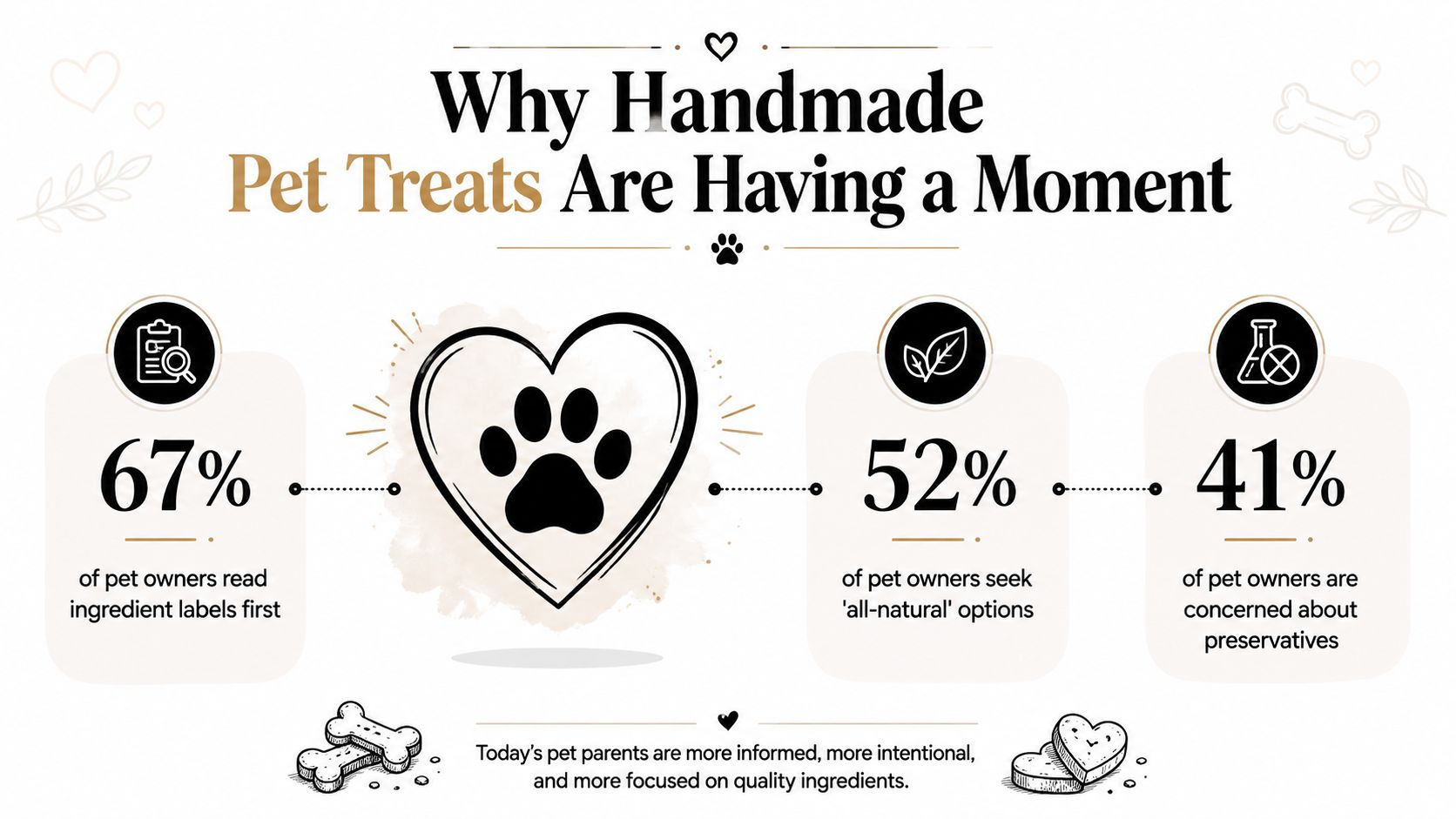
Why buyers keep reaching for the handmade bag
The appeal isn't mystery. It's control. Handmade treats usually mean shorter ingredient lists, identifiable sourcing, and a maker who can explain why they chose oats instead of a mystery starch or a single protein instead of a kitchen-sink formula.
Independent makers also fit the current market structure. Europe's pet treats market was estimated at USD 7.57 billion in 2022, is projected to reach USD 8.94 billion in 2025 and USD 13.3 billion by 2030, and is expected to grow at 8.26% CAGR from 2025 to 2030, while the top five companies held only 29.20% of the market (Research and Markets). North America was estimated to hold 40.2% of the global pet treats market in 2025 and to grow at a 7.6% CAGR through 2031 (Research and Markets). In plain English, there's scale and there's fragmentation. That's exactly the kind of market where local makers can win on clarity and trust.
Practical rule: if a treat brand can't tell you what it is, who made it, and why your dog should care, keep walking.
For readers who want to explore adjacent independent-brand ideas, Solo AI Website Creator's business ideas is a useful rabbit hole because it frames pet-related products as real businesses, not cute side projects.
What Handmade Pet Treats Actually Are
A handmade pet treat isn't just a treat in a paper bag. It's a product made in small batches, usually by one person or a tiny team, with ingredients you can name without looking like you need a chemistry degree. If the front of the bag is doing all the work and the back is vague, that's not the same thing.
The formats tell you a lot
Baked biscuits are the easiest place to start because they're familiar, forgiving, and usually the most shelf-stable. Dehydrated treats lean harder into single ingredients or simple blends, which makes them useful for dogs with picky stomachs or owners who want a cleaner formula. Soft chews and frozen treats can be great too, but they demand more attention to moisture, handling, and storage.
Commercial branding loves words like “natural,” but that doesn't automatically mean handmade. A treat can be mass-produced and still wear a friendly label. A handmade treat earns the label through process, not just packaging, and the process should be visible in the ingredients, the texture, and the maker's ability to explain what they're doing.
Why the format choice matters
Format is not just style, it's a business decision. A baker picks crunchy biscuits when shelf life matters. A dehydrator user picks jerky-style treats when they want concentrated flavor and less bulk. A maker choosing a soft chew is usually trading some storage simplicity for palatability or a more dog-friendly texture.
The right choice depends on what the treat is supposed to do. Training treats should be easy to break and easy to carry. A sensitive-stomach treat should stay simple. A senior-dog chew should be soft enough that your dog doesn't give up on it after one bite.
A good handmade treat has a point. If the maker can't tell you the point, the bag is mostly branding.
Ingredients, Safety, and How to Read a Treat Label
The front of the bag is advertising. The back is the truth. If you want to know whether a handmade treat is worth buying, ignore the cute wording and read the ingredient list like you're comparing two recipes, because that's exactly what you're doing.
What to look for on the ingredient list
Named proteins are the easiest trust signal. Chicken, beef, peanut butter, oats, pumpkin, and salmon tell you more than vague language ever will. Short ingredient lists are usually easier to evaluate, and they often tell you the maker cared more about the product than about stuffing the label with filler words.
That's also why a clean guaranteed analysis matters. Colorado's label structure for pet treats uses crude protein minimum, crude fat minimum, crude fiber maximum, and moisture maximum in that order (Colorado Department of Agriculture). Wisconsin requires the brand or product name, the species the product is formulated for, an ingredient statement using approved names, and a guaranteed analysis listing minimum crude protein and fat plus maximum crude fiber, moisture, and ash (Wisconsin DATCP). New York requires crude protein, crude fat, crude fiber, moisture, and ash with min/max values on pet food and treat labels (New York Department of Agriculture).
Moisture and fat are not background details
Moisture tells you a lot about shelf behavior. Industry technical guidance places baked treats at about 5 to 8 percent moisture, jerky-style treats at 12 to 18 percent moisture, and soft or chewy treats at 20 to 30 percent moisture with water activity at or below 0.85 for microbial stability; it also notes that higher moisture raises mold risk and shortens shelf life (PetreatsMachine). The same guidance says fat is often optimized around 5 to 10 percent because higher fat can speed up rancidity in storage, especially without good packaging (PetreatsMachine).
| Treat Format | Moisture | Fat | Shelf Stability Cue |
|---|---|---|---|
| Baked treat | About 5 to 8 percent | Often kept around 5 to 10 percent | Crisp texture, longer ambient storage |
| Jerky-style treat | About 12 to 18 percent | Often kept around 5 to 10 percent | Drier than soft chews, still needs careful packaging |
| Soft or chewy treat | About 20 to 30 percent | Often kept around 5 to 10 percent | More palatable, but shorter shelf life |
That's the difference between a bag that stays good on a shelf and a bag that turns into a mold project. If you want to buy smarter, compare the numbers, not the adjectives.
Simple Recipes and Production Basics That Actually Work
The best starter recipes are boring in the right way. They're predictable, easy to batch, and honest about what texture and shelf life you're building. Fancy recipes are where a lot of first-time makers go wrong because they chase novelty before they understand moisture.
Three formats worth starting with
A basic baked peanut butter oat biscuit is the cleanest starter because oats bring structure, peanut butter brings flavor, and baking does the shelf-life work. A dehydrated single-protein jerky makes sense when you want one recognizable ingredient and a chewy result. A no-bake soft chew is useful when you're making for dogs who need something gentler, but it also asks more of your storage discipline.
The trick is to think in terms of balance. More moisture means softer texture, but it also means more storage risk. More fat often improves taste, but it also raises rancidity risk if you're sloppy with packaging. Baking time, dehydrator time, and cooling time all matter because the product doesn't finish when it leaves the oven or machine, it finishes when it's dry, cooled, and packed.
For a quick visual walkthrough of the process, the video below is a useful reference point.
Kitchen habits that save you from bad batches
Batch tracking is not overkill. If one tray comes out crisp and another comes out soft, you want to know why. Cross-contamination matters too, especially if you're also making human food in the same kitchen and using allergens like peanut butter or dairy.

A small tool like the Mini Silicone Spatula, Food-Grade Silicone, Easy Bowl & Jar Scraper, 8.18 x 1.77 in, 1-Piece | ROSETTE'S by Loyaltie is useful because it gets every last bit of batter, frosting, and mix from bowls and jars. The compact 8.18 x 1.77 in size gives you better control for small-batch mixing and clean scraping.
If you're making for cats too, DIY cat treats your cat will eat is a good reminder that species matters just as much as recipe style.
Start with one recipe, one texture, and one dog. If your own dog won't consistently eat it, don't pretend strangers will.
Packaging, Labeling, and the Compliance Most Makers Skip
This is the part where a nice hobby turns into a real business. If you're selling handmade pet treats, packaging and labeling aren't side chores, they're the product's credibility layer. Buyers don't want a lecture, they want to know what they're feeding, how long it lasts, and whether the maker understands the rules.
What a serious label includes
Wisconsin's rule gives you a concrete checklist, the brand or product name, the species the treat is formulated for, an ingredient statement using approved names, and a guaranteed analysis with minimum crude protein and fat plus maximum crude fiber, moisture, and ash (Wisconsin DATCP). New York says pet food and treats need crude protein, crude fat, crude fiber, moisture, and ash on the label with min/max values (New York Department of Agriculture). Colorado's structure points in the same direction with the same guaranteed-analysis logic (Colorado Department of Agriculture).
That's not paperwork for the sake of paperwork. It's the difference between a maker who knows what's in the bag and one who hopes nobody asks. Buyers notice that quickly, even if they can't name the rule.
Packaging does more than look nice
The bag matters because oxygen and humidity matter. If you're making a low-moisture biscuit, decent packaging helps preserve crispness. If you're making a softer treat, packaging choice gets even more important because you're fighting moisture ingress and spoilage risk at the same time.
A lot of home-kitchen sellers also get tripped up by the legal category itself. In many states, pet treats are regulated as pet food rather than cottage food, which means you can't just assume a farmers market booth makes it legal. That's why a compliance-first approach is smarter than a “just get it out there” mindset, especially if you want to build trust instead of chasing refunds.
If you want a practical place to think about liability and risk for home bakers, product liability for home bakers is worth reading before you scale anything.

Compliance isn't a tax on good ideas. It's what keeps good ideas sellable.
Where to Sell Handmade Pet Treats Locally
The first mistake makers make is trying to sell everywhere at once. Don't do that. Start where your buyer already shops for pet products and where your label and packaging can stand up to questions. That usually means markets, local pet boutiques, and a couple of controlled online channels, not five platforms and a prayer.
The local channels that actually make sense
Farmers markets are great if your community already likes direct-from-maker food. You get immediate feedback, and you can watch which treats people pick up first, then put back down. Local pet boutiques and consignment in indie pet stores work when your packaging looks clean and your story is simple enough for staff to repeat without confusion.
Pop-ups are useful when you're still testing your positioning. Social commerce can move product if your audience already knows you, but it's usually weaker for discovery than people think. Direct online sales are where the repeat purchase habit starts to matter, because treats are a frequent buy, not a once-a-year novelty.
Treat demand is frequent enough to support that model. A market report cited in 2026 found 68% of U.S. pet owners buy treats at least once a week and 35% buy them daily, and it also said U.S. e-commerce sales of pet treats grew 21% in 2023 (Zipdo). Packaged Facts projected the U.S. pet treat category to reach about $15 billion in 2025, after nearly $10 billion in U.S. sales in 2021 (PetfoodIndustry). That's a strong signal for direct buying, not just shelf placement.
Why a marketplace can be the right middle ground
A good marketplace removes some friction without turning your brand into a faceless listing. Loyaltie is one option in that lane, a marketplace where shoppers can discover and buy directly from independent brands and local makers in the US, with orders backed for added peace of mind. If you're testing demand, that's cleaner than chasing every possible channel at once.
You'll also see this mindset in Pooche Couture on Loyaltie, which shows how a focused pet brand can live in a direct-buy environment without hiding behind generic retail language.
Start with one channel, one message, one size format. If the market likes it, then widen the net.
How Buyers Can Spot a Quality Handmade Treat
You don't need to become a label nerd. You just need a fast filter. If you can read a label, ask one question, and compare two bags without feeling lost, you'll dodge most of the junk.
The one-minute buyer checklist
- Read the ingredient list first. Look for named proteins and ingredients you recognize.
- Check for a guaranteed analysis. If the maker can't show crude protein, fat, fiber, moisture, and ash where required, that's a weak sign.
- Look for a clear species target. Dog treats should say dog, not pretend every pet is the same.
- Find a best-by date or batch code. Freshness should not be a guessing game.
- Ask what the treat is for. Training, sensitive stomachs, and senior dogs are different jobs.
That's the filter I'd use at a market stall. It keeps you from buying pretty packaging that doesn't answer the basic question, what is this for?
What fake handmade often looks like
Vague “natural” language is cheap. So is mystery sourcing. If a maker can't tell you whether the treat is baked or dehydrated, or if the guaranteed analysis looks copy-pasted from a mass-market formula, keep moving. Handmade should feel traceable, not theatrical.
A clean example is Roscoe & Stella's All Natural Cookies Treats, because the value is in the treat's actual presentation, not in empty flourishes. That's the standard to use: simple, readable, accountable.
Buy the treat that answers your question before you ask it. That's the one worth bringing home.
Bringing It All Together for Buyers and Makers
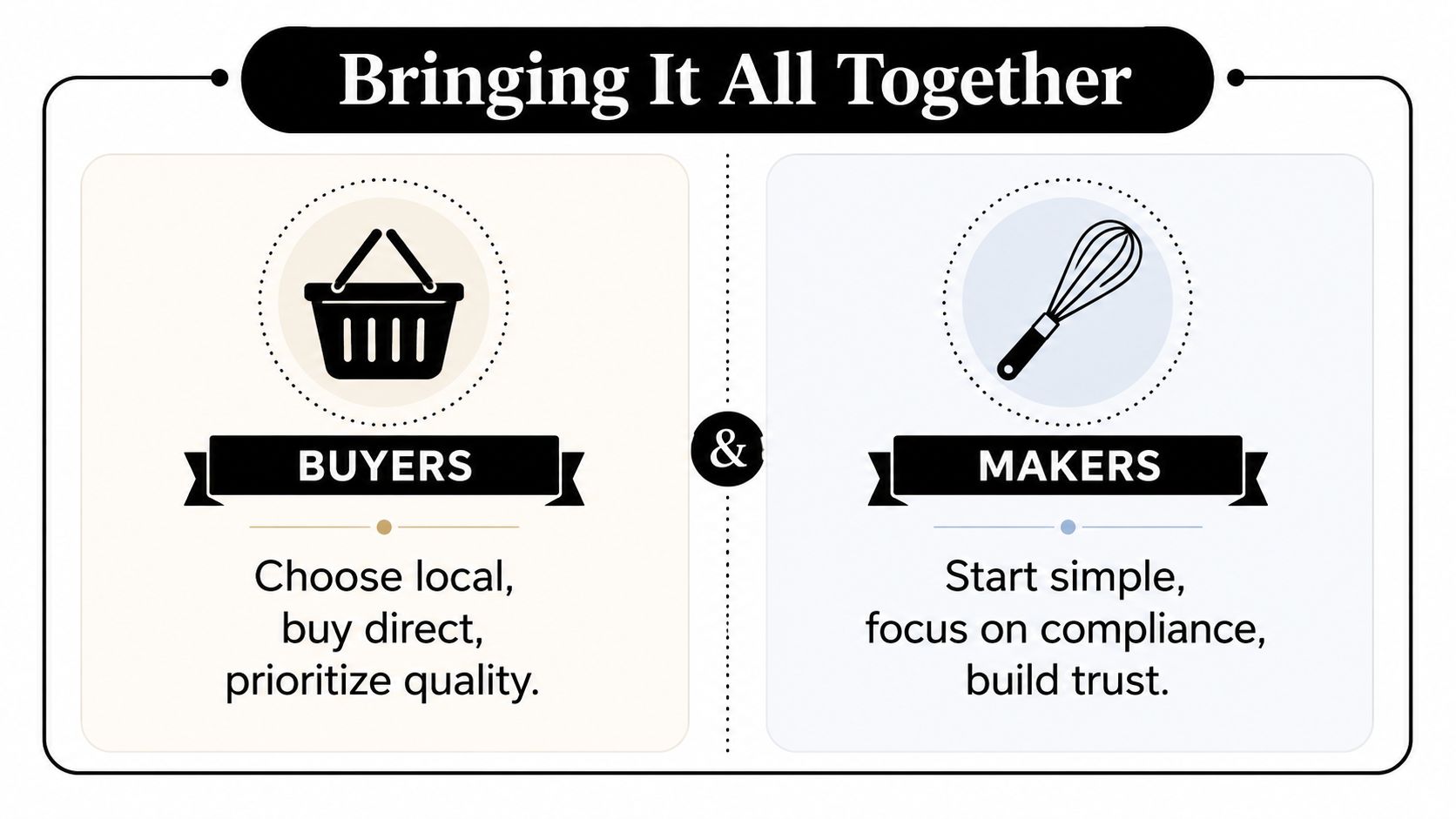
For buyers, the win is simple. Handmade pet treats are worth the swap when the maker gives you better ingredients, a clearer label, and a product that fits what your dog needs. Don't buy out of guilt, buy because the bag is more transparent and the treat does a better job.
For makers, the path is sharper than you might admit. Pick one clear use case, like single-ingredient, allergy-friendly, training-sized, or senior-dog soft, then price it for compliance, labor, and packaging, not just flour and peanut butter. If you skip the paperwork and the shelf-life basics, you're not building a brand, you're building a return problem.
The clean next move
Buyers, make your next bag count, buy directly from a maker who can explain the recipe and show the label. Makers, build your next batch around one format and one compliant label before you sell a single bag. That's how you get a product people trust.
If you want a place to discover and buy directly from independent brands in the US, visit Loyaltie. It's a straightforward way to connect real makers with buyers who care about what's in the bag and who made it.